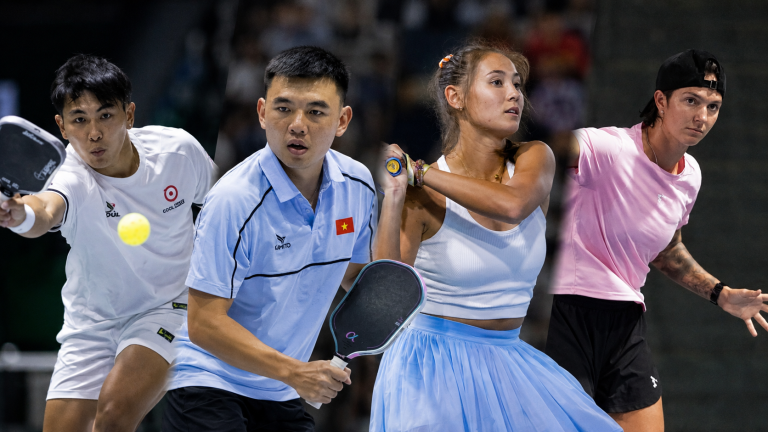
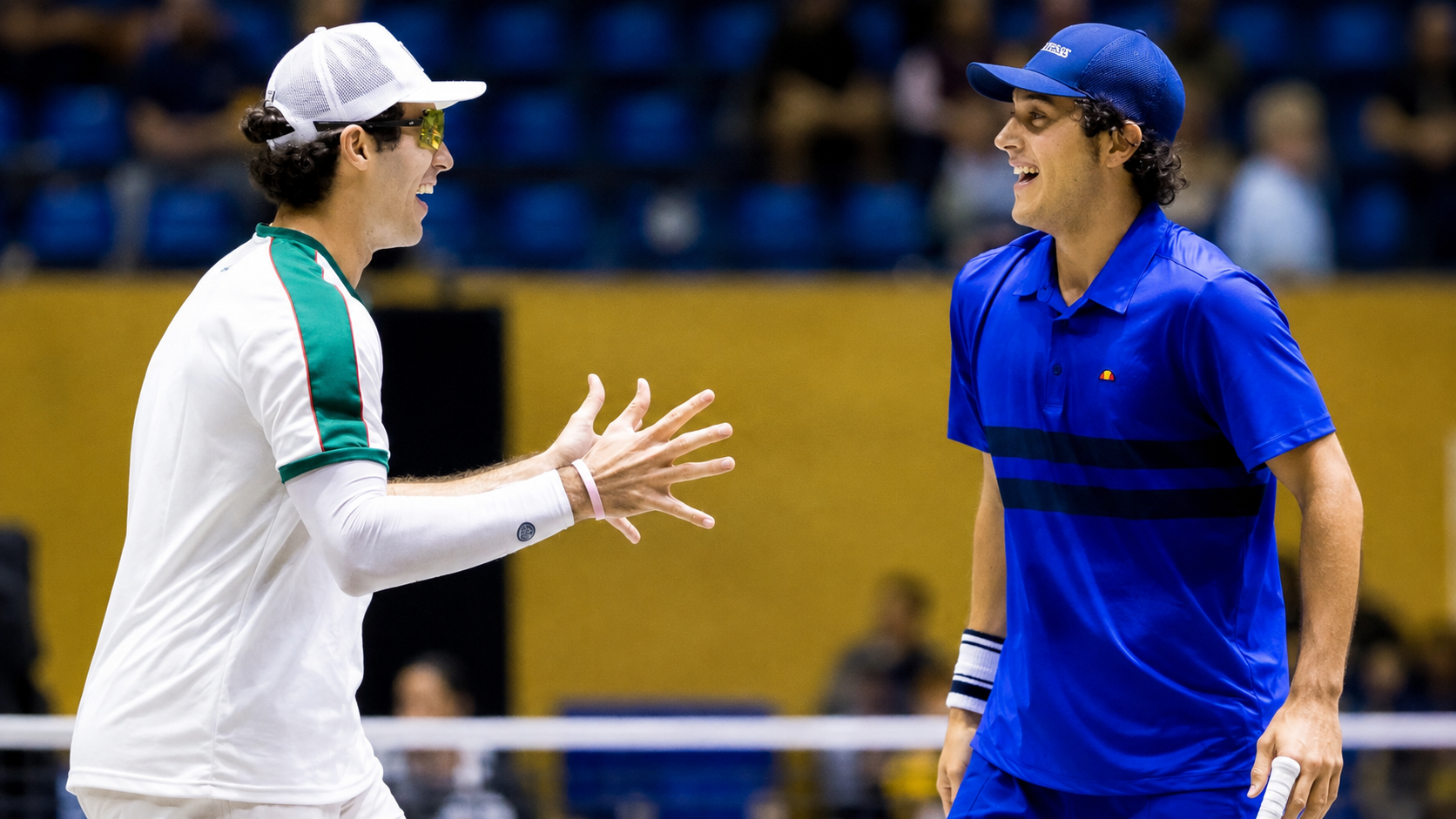
Lý Hoàng Nam and Nguyễn Ảnh Gia Huy have beaten established partnerships from Europe, Asia and the international professional game to reach the Pickleball World Cup men’s doubles final. Their reward is the partnership nobody has been able to solve.
Key Takeaways
- Lý Hoàng Nam and Nguyễn Ảnh Gia Huy beat Jay Devilliers and Émilien Burnel, Eunggwon Kim and Wong Hong Kit, then Quang Dương and Harsh Mehta to reach the men’s doubles final.
- Jack Munro and Richard Livornese Jr bring a five-tournament winning sequence into Sunday’s final, including four consecutive APP titles and the English Open.
- The women’s final will pit Selina Turulja and Nicola Schoeman against Domenika Turković and Katerina Stewart after both partnerships survived three-game semi-finals.
Lý Hoàng Nam and Nguyễn Ảnh Gia Huy did not take an easy route to the men’s doubles final at the Pickleball World Cup in Da Nang.
There probably wasn’t one available.
Jay Devilliers and Émilien Burnel were waiting in their section. Eunggwon Kim and Wong Hong Kit, one of the strongest established Asian combinations, came next. Then Quang Dương and Harsh Mehta stood between the Vietnamese pair and Sunday’s gold-medal match.
Hoàng Nam and Gia Huy came through all three.
Devilliers and Burnel went in straight games, 15-13, 15-12. Kim and Wong pushed them to three before the Vietnamese pair prevailed 17-15, 11-15, 15-8. Then Dương and Mehta took the opening game of their semi-final 15-11.
Hoàng Nam and Gia Huy answered 15-11, 15-12, a comeback also confirmed by Da Nang’s official city reporting.
The opponents changed. So did the problems. The Vietnamese pair kept finding the answer.
Now Jack Munro and Richard Livornese Jr are waiting.
They bring considerably more than another collection of impressive names to the other side of the net. Munro and Livornese are an established partnership with recent winning experience together, and they have spent this World Cup looking increasingly difficult to dislodge.
For Gordon Watson, watching courtside in Da Nang for World Pickleball Magazine, the broader impression from men’s doubles day was impossible to miss.
“The depth of talent happening in Vietnam is absolutely unbelievable,” he said. “There’s new pairings, there’s new names, and they’re all unbelievably high-level players.”
The World Cup is providing plenty of evidence for that argument.
Hoàng Nam and Gia Huy are doing something more useful than demonstrating depth, though.
They are beating people.
A draw that kept getting harder
The temptation with Vietnamese pickleball at the moment is to talk about potential.
There is plenty of it.
Quang Dương has already demonstrated how quickly a player with Vietnamese roots can establish himself among the elite. Hoàng Nam’s own transition carries particular interest because he arrived in pickleball after a professional tennis career that took him to No. 231 in the ATP singles rankings.
WPM examined the scale of Vietnam’s current competitive depth during the World Cup men’s singles draw, where three Vietnamese players reached the semi-finals.
Potential becomes less interesting once somebody starts beating established international players.
Devilliers and Burnel represented the first test.
A 15-13, 15-12 victory removed a pairing containing one of the most recognisable players in professional pickleball and sent Hoàng Nam and Gia Huy into a meeting with Kim and Wong.
That match asked something different of them.
Kim and Wong have built their reputation through the Asian game and offered the sort of doubles examination that cannot be reduced to individual firepower. The opening game stretched to 17-15 before the Vietnamese pair took it. Kim and Wong answered 15-11.
The deciding game went 15-8 to Hoàng Nam and Gia Huy.
Then came Dương and Mehta.
This time they had to chase the match.
Dương and Mehta won the opener 15-11. Hoàng Nam and Gia Huy reversed the score in the second and then closed the deciding game 15-12.
Tournament runs can occasionally be misleading. A favourable section of the draw, one opponent having a bad day or one unusually good performance can carry a pair surprisingly far.
Hoàng Nam and Gia Huy have not been afforded much of that.
Three rounds have presented three credible international pairings and three different matches to solve.
They are still there.
Munro and Livornese look like they belong there too
If the Vietnamese pair have become the story of the men’s draw, Munro and Livornese have looked rather more like the partnership everyone expected to see at the end.
Watson’s description of Livornese during their semi-final was considerably less measured.
“Richard Livornese played like Superman,” he said. “It was just off the charts.”
Munro, he added, “is no slouch”.
There is rather more evidence behind that assessment than one exceptional afternoon in Da Nang.
Munro and Livornese arrived in Vietnam with recent proof that their partnership works. As WPM reported last week, they have won four consecutive APP men’s doubles titles together, from Sacramento through Detroit, and added the English Open title during that sequence.
Their route through Da Nang has reinforced the point.
Zack Marceau and Ronan Camron took them to three games in the quarter-final. Munro and Livornese survived 15-12, 13-15, 15-12.
Brandon Lane and Ryler DeHeart could not take them that far in the semi-final, losing 15-12, 15-12.
That leaves an appealing contrast for the gold-medal match.
Munro and Livornese are an established international partnership behaving exactly as a strong established international partnership should.
Hoàng Nam and Gia Huy have spent the tournament knocking those sorts of players out.
The 17-year-old who made Watson stop watching the result
Not every important performance on doubles day ended with a place in a final.
One of the players Watson left the venue talking about was 17-year-old Vietnamese prospect Tống Nhật Minh, partnered with Robert Stirling.
They eventually ran into Marceau and Camron and lost in three games, but the result was almost secondary to what Watson saw from the teenager.
Minh came to pickleball through table tennis. He began playing that sport at the age of three, represented the T&T club system in Vietnam and won two bronze medals at the country’s National Youth Table Tennis Championships before his rapid switch towards pickleball.
What caught Watson’s attention was how little his age and relative inexperience appeared to matter once the match began.
“For him to convert across to pickleball and make such an impact so early in his career is quite spectacular,” Watson said.
One strong World Cup performance does not establish a 17-year-old as the next major Vietnamese professional. Pickleball has become rather too eager to turn every promising teenager into a prediction.
What it does provide is another name to remember.
That may prove more useful.
Vietnam’s depth is becoming harder to reduce to one obvious player. The interesting part of watching this World Cup from inside the venue is the number of other names Watson keeps encountering around him.
Minh was one of them.
Hoàng Nam and Gia Huy have made themselves rather more difficult to miss.
From opponents in Australia to partners in Da Nang
The women’s doubles competition provided a different version of the same World Cup test.
Success in international pickleball remains unusually fragmented. Players arrive from different tours, leagues and regions carrying results that are impressive in their own context but difficult to compare directly.
Then a tournament such as this puts them on the same courts.
Selina Turulja and Nicola Schoeman will play Domenika Turković and Katerina Stewart for the women’s gold medal.
For regular WPM readers, the first partnership requires a second look.
Only days ago, Turulja and Schoeman were opponents in Australia.
Schoeman’s Opals defeated Turulja’s Heat in the National Pickleball League finals, completing an extraordinary season in which Schoeman also edged Turulja in the MVP race. WPM covered the full championship run in Opals Sweep Heat as Nicola Schoeman Completes an MVP Season.
Now they are trying to win a World Cup together.
Their semi-final almost ended before that partnership reached the final hurdle.
Roos Van Reek and Vivian Glozman took the opening game 15-8 and pushed Turulja and Schoeman deep into the second. The Australian pair survived it 16-14, then won the decider 15-10.
Turković and Stewart needed a comeback of their own.
Bobbi Oshiro and Shelby Bates took an extraordinary opening game 16-14. Turković and Stewart responded emphatically, winning the second 15-5 before taking the deciding game 15-13.
Van Reek and Glozman later recovered to secure bronze with a 15-12 victory over Oshiro and Bates.
The result leaves four players in the women’s final whose recent form has been established in different competitions and against different opposition.
That is one of the reasons the World Cup has become interesting.
It gives those results somewhere to meet.
When form has to travel
Schoeman arrived in Vietnam having just completed a dominant NPL season in Australia.
Munro and Livornese brought their APP results.
Kim and Wong carried an established Asian partnership into the men’s draw.
Hoàng Nam and Gia Huy arrived with the advantage of playing at home, but without the same body of international doubles results together as several of the pairs standing between them and Sunday.
On Tuesday, none of those reputations earned anybody a free passage.
Kim and Wong went out.
Devilliers and Burnel went out.
Dương and Mehta went out.
On the women’s side, Van Reek and Glozman came within two points of taking the second game against Turulja and Schoeman and reaching the final themselves.
This is the useful part of bringing players from different pickleball systems into the same draw. Rankings and reputations can tell us where somebody has been. Eventually somebody still has to win the match in front of them.
That has been particularly revealing on the Vietnamese side of the men’s competition.
Watson arrived at the venue talking about the depth he could see around him. By the end of doubles day, that observation had acquired names and results.
Tống Nhật Minh had given him one to remember despite defeat.
Hoàng Nam and Gia Huy had supplied rather stronger evidence.
They beat Devilliers and Burnel in two games, survived Kim and Wong in three and recovered from a game down against Dương and Mehta.
Sunday gives them Munro and Livornese.
By now, nobody in Da Nang can call that a favourable draw.
Further Reading
- Latest pickleball news from around the world
- Tournament coverage and results
- Rankings and player profiles
- Regional pickleball coverage

Chris Beaumont
Founder and Editor-in-ChiefChris Beaumont is the founder and Editor-in-Chief of World Pickleball Magazine. Chris follows the global game closely, reporting on the latest news, developments, stories and tournaments from all five continents. He also hosts the World Pickleball Podcast, interviewing people at…
View All Articles →