
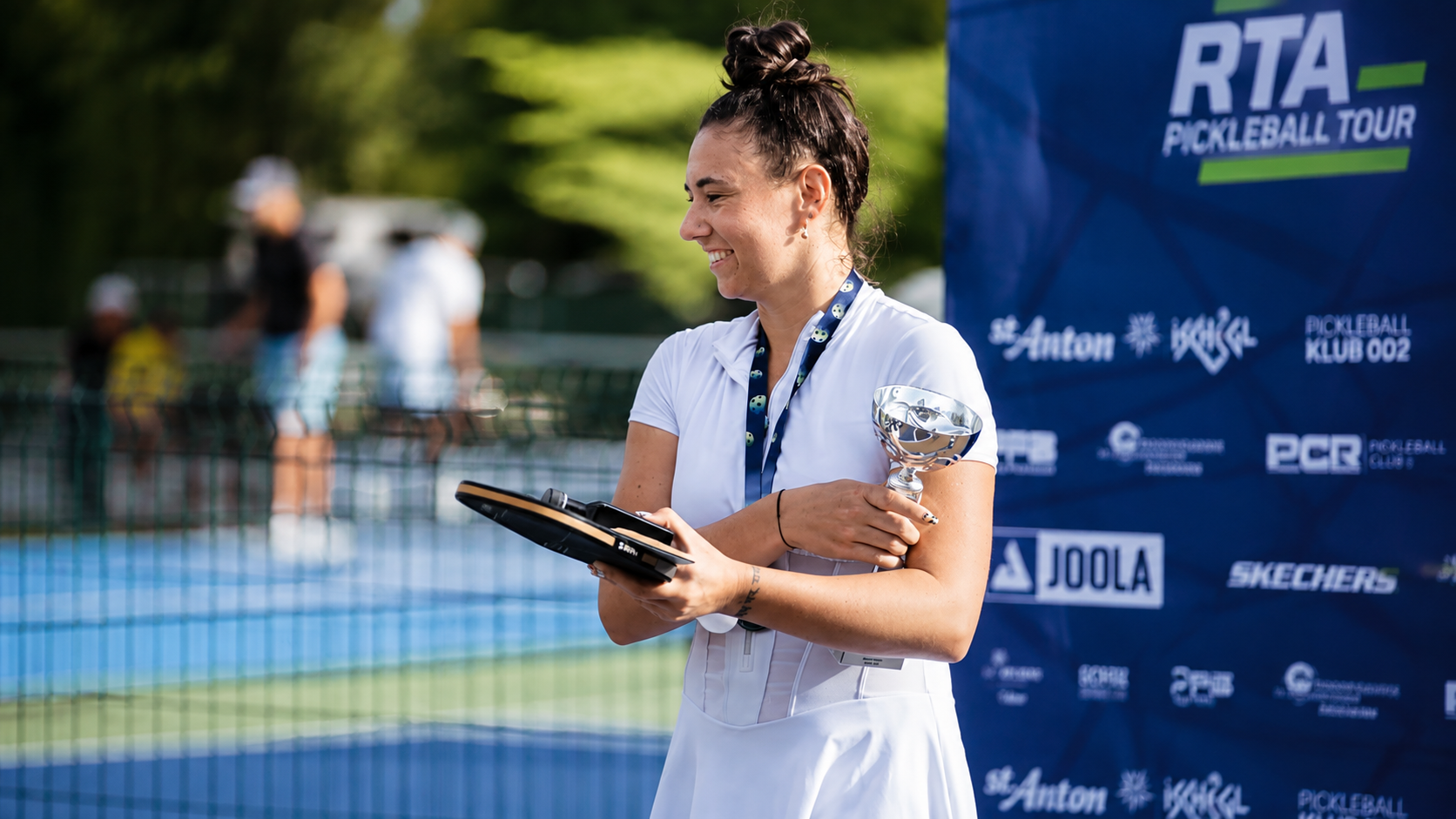
Domenika Turković won twice on home soil and Bálint Bakó returned to the top step at RTA2000 Split. On court, one of the RTA’s biggest weekends of 2026 delivered. Off it, the arrival of PPA Tour Europe has made what happens next considerably harder to predict.
Key Takeaways
- Domenika Turković claimed women’s singles and women’s doubles gold at RTA2000 Split, while Bálint Bakó beat James Chaudry in three games to win the men’s singles title.
- Split showed that the RTA can still assemble a strong European field, despite questions over the strength of its forthcoming events and the arrival of PPA Tour Europe.
- The bigger issue is player availability: Europe may have room for several tournament circuits, but not necessarily enough established elite players for all of them to consistently produce premier-level fields.
A few days before RTA2000 Split began, a provocative question appeared on European pickleball social media.
“Is this the last big RTA tournament?”
It was deliberately stark. Split had not even started, and there was no suggestion that the RTA itself was about to disappear. The argument was narrower: whether a European tour that has spent several seasons assembling increasingly strong international fields could keep doing so once PPA Tour Europe began signing some of the same players.
Then Split happened.
And the tournament itself made the pessimism look premature.
Domenika Turković won twice in Croatia. Bálint Bakó recovered from losing the opening game against James Chaudry to take the men’s singles final 9-11, 11-3, 11-4. Thaddea Lock and Arwid Dahlin won mixed doubles, while Myriam Enmer, recently announced among PPA Tour Europe’s first French recruits, reached the women’s singles podium.
This did not look like a circuit running out of relevance.
What it did look like was a very good tournament arriving just as the competitive conditions around the organisation staging it began to change.
Turković Brings Her Summer Home
There was something fitting about Turković becoming the central figure of the weekend.
The Croatian has spent much of the summer testing herself beyond the RTA circuit. In Chicago she reached the APP women’s singles final. Days later, she returned to Europe and won the English Open singles title in Birmingham, beating Roos Van Reek across three games and also reaching the mixed doubles final alongside Jae Centonze.
She then went back to the United States and reached the women’s singles quarter-finals at the APP Detroit Open.
Split brought her home and placed a different kind of pressure on her. She was no longer the European visitor trying to make ground in an American draw. She was the Croatian expected to win in Croatia.
She did.
Turković took women’s singles gold ahead of Pei Chuan Kao and Myriam Enmer, then partnered Brooke Revuelta to win women’s doubles. Maria Costantino and Claudia Caymel finished second, with Lock and Kao third.
The sequence across Chicago, Birmingham, Detroit and Split reinforces something already visible in WPM’s look at Europe’s leading players. The strongest Europeans are increasingly being judged across several competitive environments rather than one continental circuit.
That movement between tours is becoming central to what happens next.
Bakó Responds Again
Bakó’s summer has been less tidy.
He arrived at the English Open as one of the obvious contenders after winning in Portorož, only for Ignasi De Rueda to beat him 15-7 in the last 16.
His response since has been considerably more revealing than the defeat.
At the APP Detroit Open, Bakó entered a 37-player men’s singles draw as the No. 36 seed. He beat fourth seed Ryler DeHeart, Jack Davis and Drake Palm to reach the semi-finals, lost to eventual champion Ronan Camron and then defeated Andre Millet for bronze.
It was his first APP Tour medal.
In Split he had another problem to solve.
Chaudry took the opening game of the final 11-9. Bakó responded by taking control of the second 11-3 before closing the match 11-4 in the decider.
It was exactly the kind of result he needed.
Portorož had established his position. Birmingham interrupted it. Detroit and Split have restored the argument that Bakó remains one of Europe’s most significant men’s singles players.
He also left Croatia with men’s doubles gold alongside Arwid Dahlin, ahead of Spanish pair David Illescas and Jesus Garcia, with Jorge Rodriguez and Alvaro Regalado third.
One Podium Already Contained The Bigger Story
Myriam Enmer finished third in women’s singles.
That becomes more interesting when viewed beyond the medal table.
Enmer is also one of the French players recently announced as part of PPA Tour Europe’s new roster, alongside Cyril Peltier and Théo Platel.
Her presence in Split is therefore useful evidence of where European pickleball currently sits.
Players are still moving between competitive systems. Signing with PPA Europe did not prevent Enmer from appearing at this RTA2000.
That matters because it prevents an easy conclusion.
There is no evidence that every player signing with PPA Europe immediately becomes unavailable to the RTA. WPM’s previous investigation into PPA Europe and player exclusivity found that some agreements may contain restrictions on appearances in rival professional events, but the full contracts are not public and the terms may vary.
The distinction is important.
What we can say is that PPA is assembling a European player roster at the same time as the RTA needs those same leading players to maintain the strength of its own biggest tournaments.
Split Was The Strong Version Of The RTA Model
RTA2000 Split ran from August 28 to 30 at Pickleball Klub 002 in Stobreč.
As an RTA2000, it sat at the upper end of the tour’s competitive structure. The RTA has spent 2026 operating a hierarchy of RTA500, RTA1000 and RTA2000 tournaments, with ranking points intended to give players a recognisable European season rather than a collection of disconnected weekends.
Split showed what that can look like when the field comes together.
Turković and Brooke Revuelta won women’s doubles. Bakó and Dahlin won the men’s event. Lock and Dahlin took mixed gold ahead of Claudia Caymel and Bakó, with Maria Costantino and Jorge Rodriguez completing the podium.
The men’s singles final had Bakó and Chaudry. The women’s draw had Turković, Kao and Enmer.
There was enough quality for the results to carry weight beyond Croatia.
The pre-tournament Instagram discussion raised doubts about whether the events following Split would generate the same momentum, pointing particularly towards Vilnius and Farnham.
That claim needs treating carefully.
Both remain on the RTA calendar. Vilnius is an RTA1000, while Farnham is scheduled as another RTA2000. Public information currently available does not provide enough evidence to declare either field weak before it has been assembled.
The warning is worth watching.
It is not yet a verdict.
Europe Can Fit The Tournaments. Can It Fill Them?
The more substantial pressure comes from PPA Tour Europe.
The new circuit has announced 20 events across nine countries, €545,000 in total prize money and a season leading towards PPA Finals Europe in May 2027.
That joins an already crowded landscape containing RTA events, national Opens, federation competitions, APP-backed tournaments and independent promoters.
There are enough weekends to put all of them on a calendar.
The harder question is whether European professional pickleball currently has enough established elite players for several circuits to consistently produce fields that feel important.
Bakó matters to a European draw. Turković matters. Lock matters. Chaudry matters. Enmer matters. So do the strongest emerging players from Spain, France, Britain, Hungary, Croatia, the Netherlands and elsewhere.
The number of recognisable players at that level remains relatively small.
If they continue moving freely between competitions, several tours may be able to coexist. Different events can offer different ranking points, prize money, locations and competitive opportunities without requiring players to choose one identity.
If contractual restrictions increasingly separate those players, the calculation changes.
The same player pool gets divided.
For a mature sport with hundreds of established professionals, that might be manageable.
European pickleball is not there yet.
The RTA Has Something PPA Still Has To Build
It would be easy to look at the numbers and assume the outcome is already determined.
PPA Tour Europe arrives with substantial prize money, an established global professional brand and the ability to recruit players directly.
The RTA has something different.
It has already staged the tournaments.
European players have travelled its circuit, built rankings and repeatedly met one another in meaningful matches. Split was another weekend produced by that accumulated history.
PPA Tour Europe now has to turn a schedule into a functioning sporting competition. Twenty events only matter if enough good players enter them, if the strongest keep returning and if audiences learn why one stop connects to the next.
The RTA’s difficulty is that PPA does not need to reproduce years of European history before affecting it.
It only needs enough of the players.
So What Is The RTA For Now?
That may become the more important question than whether Split was the tour’s “last big tournament”.
The RTA could continue as an independent European professional circuit and compete directly for players.
It could become the more open alternative, offering meaningful competition to players who are outside contracted professional structures.
Its 500, 1000 and 2000-level tournaments could increasingly act as a development route beneath whatever emerges at the top of PPA Europe.
The two organisations could eventually find areas where cooperation makes more sense than direct competition.
Europe might simply support both.
There is not enough evidence yet to know.
Which is why the next RTA entry lists may tell us more than the next set of results.
Split Was Not A Farewell
After the weekend in Croatia, describing Split as the RTA’s final major tournament feels premature.
Split was big enough.
Turković added two titles to an exceptional run of form. Bakó recovered from losing the first game of the singles final and left with two golds of his own. Established European players occupied the podiums across all five professional divisions.
The uncertainty begins after that.
PPA Tour Europe has money, dates and players beginning to sign agreements. The RTA has an established competition structure and years of European history. Other tours and independent events want many of the same athletes.
Somewhere inside that increasingly crowded calendar, Europe’s best players will decide which tournaments deserve their time.
Split showed what the RTA can still assemble.
What matters now is whether it can keep assembling it.
Further Reading
- Latest pickleball news from around the world
- Tournament coverage and results
- Rankings and player profiles
- Regional pickleball coverage

Chris Beaumont
Founder and Editor-in-ChiefChris Beaumont is the founder and Editor-in-Chief of World Pickleball Magazine. Chris follows the global game closely, reporting on the latest news, developments, stories and tournaments from all five continents. He also hosts the World Pickleball Podcast, interviewing people at…
View All Articles →

