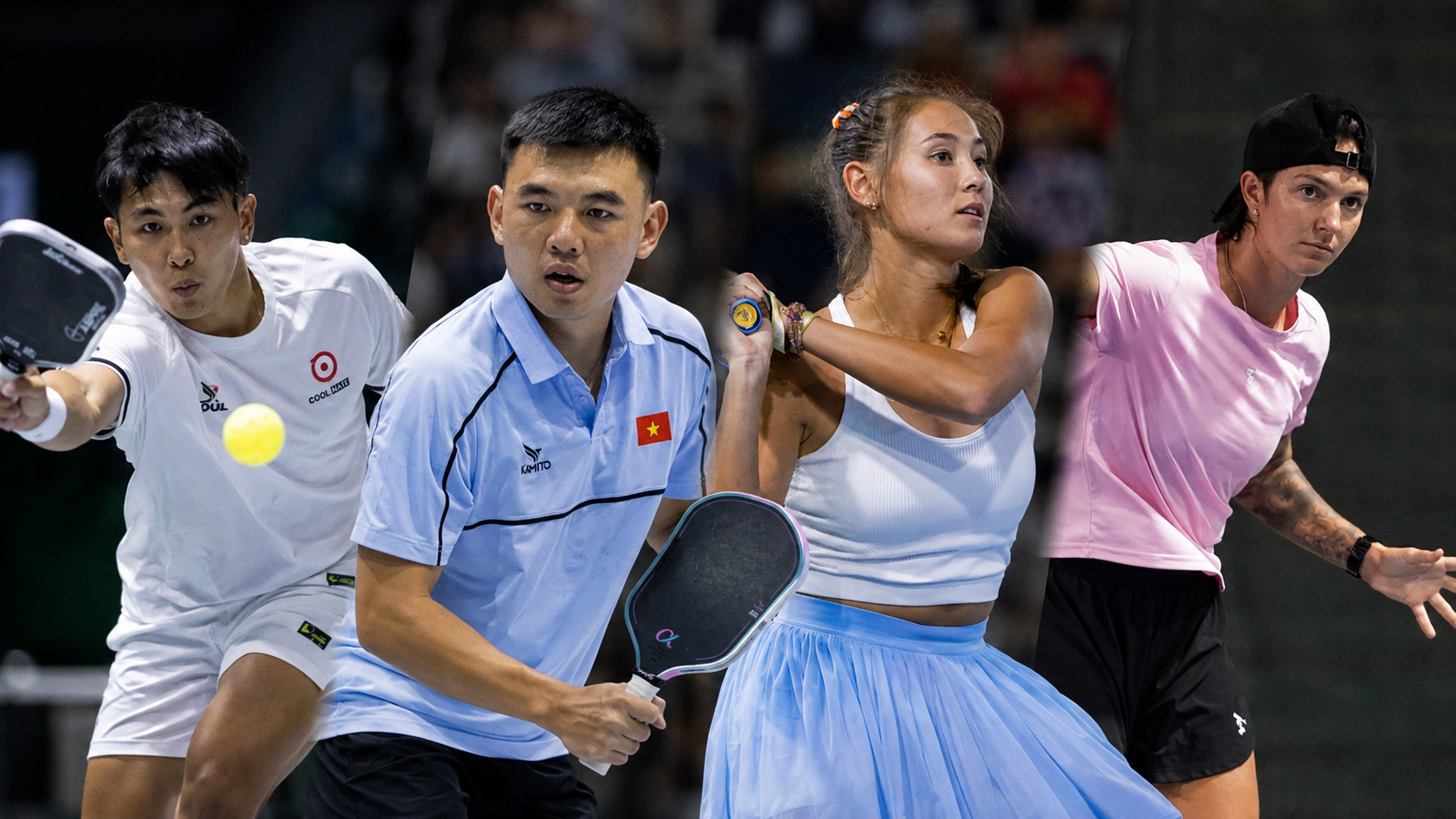
Three Vietnamese players reached the men’s singles semi-finals at the Pickleball World Cup, with Lý Hoàng Nam and Phúc Huỳnh advancing to an all-Vietnamese final on Sunday. Katerina Stewart and Roos Van Reek will contest the women’s title, underlining just how unusual Vietnam’s dominance of the men’s draw has been.
Key Takeaways
- Lý Hoàng Nam, Phúc Huỳnh and Quang Dương gave Vietnam three of the four places in the men’s pro singles semi-finals in Da Nang.
- Huỳnh and Hoàng Nam will meet for gold on Sunday, while Katerina Stewart faces Roos Van Reek in the women’s singles final.
- The women’s draw provides an important comparison: Vietnam produced competitive women, but nothing approaching the depth shown by its men.
By the middle of men’s singles day at the Pickleball World Cup, Gordon Watson – commentating at the event – had stopped looking for the Vietnamese threat at the top of the draw.
It was everywhere.
The courts in Da Nang had been loud from the start. Home players were producing ATPs, retrieving balls that appeared beyond them and attacking whenever an opponent left something short. Watson described it as a “carnival of fantastic singles pickleball”, but what struck him most was the number of Vietnamese players capable of sustaining the level.
By the semi-finals, the bracket made his point for him.
Lý Hoàng Nam. Phúc Huỳnh. Quang Dương.
Three Vietnamese men among the last four.
Only Bulgaria’s Martin Stanchev prevented the host nation from occupying every semi-final position, and he had earned his place by taking out Brandon Lane and APP singles champion Ronan Camron.
“Unbelievable depth in Vietnam at the moment,” Watson reported from Da Nang. “Especially in the men’s singles division.”
Vietnam was always expected to have contenders. Quang Dương is already known internationally. Hoàng Nam’s tennis career gives him a sporting pedigree stretching far beyond pickleball. Huỳnh has been building his reputation across Asia.
WPM had already identified Vietnam as one of the host nations capable of making the World Cup competitively meaningful. What the international field discovered was how little the level dropped once it moved beyond the most familiar name.
On Sunday, Hoàng Nam and Huỳnh will play for gold.
Vietnam had already made the more revealing statement by placing three players in the final four.
Phúc Huỳnh Had To Solve Stanchev
Huỳnh’s route to Sunday was anything but ceremonial.
He began by beating Zachary Grabovic before Drake Palm pushed him to three sets. Nguyễn Việt Hoàng followed, setting up a semi-final against the player responsible for most of the damage to the expected order.
Martin Stanchev had arrived without the profile of several players around him. He left singles day as its outstanding outsider.
Brandon Lane went first. Then came Ronan Camron, whose APP season had already established him among the stronger singles players in the field.
Stanchev beat them both.
Watson called the Bulgarian “the surprise of the day”, and by the semi-finals he had become the only obstacle between Vietnam and complete control of the men’s draw.
Huỳnh eventually found his way through.
His speed is obvious, but speed alone does not explain why he is so difficult to contain in singles. Plenty of players at this level can retrieve one more ball. The problem is what Huỳnh can do once he gets there.
He can defend beyond the sideline without automatically surrendering the next shot, find enough paddle behind the ball to alter the exchange and recover quickly enough that opponents are often forced to win the same rally twice. Leave the attack slightly short and he can reverse the point.
That ability has been visible throughout 2026. WPM has already tracked Huỳnh’s recent victories over Vietnam’s strongest domestic opposition, including Quang Dương.
Stanchev had spent the day beating players with enough professional experience to expose weaknesses.
Huỳnh survived the test.
Hoàng Nam Uses The Court Differently
Lý Hoàng Nam reached the same destination with a different game.
His tennis background remains impossible to miss.
Hoàng Nam won the Wimbledon boys’ doubles title alongside Sumit Nagal in 2015 and later reached No. 231 in the ATP singles rankings. Years spent playing professional tennis show in the details rather than simply the size of his groundstrokes.
His first movement is usually efficient. He stays balanced through contact and understands what depth does to an opponent.
Hoàng Nam does not need to chase a clean winner from every attacking position. A deep ball that forces another step backwards can create the shorter reply he wants next.
That economy matters in pickleball singles, where players capable of covering the court can tempt opponents into trying to finish points too early.
His Da Nang route included victories over Đỗ La Việt Nhật, Ryler DeHeart and Emilien Burnel before the semi-final brought the match the Vietnamese crowd wanted.
Hoàng Nam against Quang Dương.
Their backgrounds made the contrast fascinating. One came through elite tennis and has adapted those habits to a smaller court. The other developed into one of pickleball’s most exciting young singles players and has already experienced the pace and pressure of the American professional game.
The match never had the chance to answer those tactical questions.
According to the official Da Nang tournament report, Quang Dương suffered a wrist injury and was forced to stop, sending Hoàng Nam into Sunday’s final.
For Watson, the disappointment was obvious. Dương had been one of the crowd’s central attractions throughout the day, an aggressive shot-maker capable of turning points into spectacle without losing their competitive edge.
His injury changed the semi-final.
It did not change what Vietnam had done to reach it.
Three Semi-Finalists Cannot Be Explained By The Crowd
Home advantage was real in Da Nang.
The Vietnamese players had noise behind them. Every extended rally involving a home favourite pulled another reaction from the stands, and Watson could feel the atmosphere building as more of them survived the draw.
That helps, but it cannot account for three of the last four.
The Vietnamese semi-finalists arrived through very different routes into the sport and played singles in noticeably different ways.
Hoàng Nam brought the spatial understanding of a former top-250 tennis professional. Quang Dương brought experience from the American professional pickleball system. Huỳnh brought the speed and transition ability that have made him increasingly difficult to contain across Asia.
There was another layer immediately beneath them. Nguyễn Việt Hoàng reached Huỳnh’s section, while other Vietnamese players populated a draw in which the home challenge never depended upon one athlete carrying the week.
That builds on a pattern WPM has followed throughout the year, from Vietnam’s increasingly strong domestic competitive core to major PPA Asia results involving the same group of players.
Watson had expected good Vietnamese singles players.
What surprised him was how many there were.
Stanchev Made The Result Mean More
Some of the strongest evidence for Vietnam’s level came from the player who prevented an all-Vietnamese semi-final line-up.
Stanchev’s run mattered.
If three home players had reached the last four through a depleted international field, the result would require qualification.
That was not what happened.
Stanchev removed Lane and Camron before Huỳnh eventually stopped him. DeHeart took a set from Hoàng Nam. The wider draw contained established professionals and players arriving with significant results from other circuits.
Vietnam’s finalists had to negotiate a genuine international test.
Stanchev, in particular, gave the World Cup the sort of run that exposes whether a favourite can adjust when the expected order disappears.
Huỳnh could.
The Women’s Draw Is An Important Contrast
If crowd support and familiar conditions were enough to explain the men’s result, the women’s draw should have produced something similar.
It did not.
Vietnam had competitive players in the field and produced meaningful wins, but Sunday’s final will be between two international players: Katerina Stewart of the United States and Roos Van Reek of the Netherlands.
Trang Huynh made the strongest home run among the prominent Vietnamese players, beating Ellie Tomkinson 15-7, 15-4 before coming through a much tighter contest with Virvienica Isearis Reyes Bejosano, 15-13, 15-11.
Bobbi Oshiro stopped her in the quarter-finals, 15-12, 15-12, and then came within a game of reaching Sunday herself.
Oshiro took a fiercely contested opening game from Stewart 18-16 in their semi-final.
Stewart responded.
She levelled the match 15-6 and maintained control through the decider, winning 15-8 to complete the comeback and secure her place in the final.
Van Reek’s semi-final was considerably cleaner.
The Dutchwoman faced the Philippines’ Kelsey Laurente and controlled the match in straight games, winning 15-6, 15-10.
It sets up a compelling final in its own right.
Stewart had to absorb Oshiro’s resistance and solve a match that had already moved against her. Van Reek arrives having conceded only 16 points across two semi-final games and without being dragged into a decider.
Van Reek’s form should not surprise WPM readers. Only two weeks ago she left the English Open with two gold medals and a singles silver.
Their meeting also sharpens what happened in the men’s draw.
Vietnam’s women won matches against international opposition and put Trang Huynh into the quarter-finals. Its men took three of four semi-final places and guaranteed themselves both gold and silver.
Same tournament. Same home crowd. Very different competitive outcome.
That makes it considerably harder to dismiss what happened in the men’s draw as home advantage.
The Finals Will Wait Until Sunday
The four singles finalists now face an unusual rhythm.
They know their opponents but will not play them for several days.
The World Pickleball Federation confirms that the Da Nang event runs from August 30 to September 6, with the professional title matches held on the closing Sunday.
Stewart and Van Reek will contest the women’s singles final before Hoàng Nam and Huỳnh meet for the men’s title.
That is different from a conventional professional stop, where quarter-final, semi-final and final usually follow one another across a compressed schedule.
The rest of the World Cup continues around them.
For players appearing across disciplines, physical management becomes part of the week, as does moving between singles and doubles patterns that ask different questions of positioning, movement and shot selection.
Huỳnh and Hoàng Nam, in particular, now have to preserve the movement and open-court sharpness that brought them through singles while competing elsewhere in the programme.
How they arrive on Sunday will become part of the final.
Da Nang Is A Serious International Test
The scale of the World Cup gives the singles results additional weight.
The event is the first Pickleball World Cup staged in Asia and has been formally recognised by the World Pickleball Federation. Organisers have reported representatives from 81 countries and nearly 5,000 athletes in Da Nang.
Approximately 930 matches were played on August 31 alone, part of more than 8,500 scheduled across the tournament.
This is not a small regional field dressed up with international branding.
Da Nang gives Vietnamese players a chance to measure themselves against athletes arriving from very different pickleball environments.
The names appearing elsewhere in the week reinforce that. Jay Devilliers, Jack Munro, Vivian Glozman, Nicola Schoeman, Bobbi Oshiro and others are among the international players listed by the organisers.
Vietnam will not dominate every division.
The women’s singles competition has already made that clear.
The men’s singles draw showed something else.
Sunday Decides The Champions
Stewart against Van Reek gives the women’s competition a final between two players arriving there in different ways.
Stewart has already been forced to recover from losing an 18-16 opening game against Oshiro. Van Reek reached Sunday without needing a third game in her semi-final.
Then Vietnam takes over the court.
Hoàng Nam will try to use his balance, depth and experience to stop Huỳnh turning the men’s final into a running contest. Huỳnh will want to stretch exchanges, force Hoàng Nam to defend repeatedly and find the moments when his own defence can become attack.
It is a legitimate tactical contrast between two players who represent different strands of Vietnam’s rise.
Sunday will decide which one becomes World Cup champion.
What happened before it has already shown that Vietnamese men’s singles runs considerably deeper than one or two familiar names.
An international field found Hoàng Nam. It found Huỳnh. It found Quang Dương. Stanchev had to produce one of the runs of the tournament merely to prevent Vietnam taking all four semi-final places.
Watson’s reaction from courtside remains the right one.
The surprise was never that Vietnam produced a finalist.
It was the depth required to guarantee two of them.
Further Reading
- Latest pickleball news from around the world
- Tournament coverage and results
- Rankings and player profiles
- Regional pickleball coverage

Chris Beaumont
Founder and Editor-in-ChiefChris Beaumont is the founder and Editor-in-Chief of World Pickleball Magazine. Chris follows the global game closely, reporting on the latest news, developments, stories and tournaments from all five continents. He also hosts the World Pickleball Podcast, interviewing people at…
View All Articles →