Jack Munro and Richard Livornese Jr have won four consecutive APP men’s doubles titles and added the English Open in between. Detroit showed they can be pushed. The problem for everybody else is that nobody has yet pushed them far enough.
Key Takeaways
- Jack Munro and Richard Livornese Jr have won four consecutive APP men’s doubles titles together, from Sacramento through Detroit.
- The pair also won the 2026 English Open in Birmingham during the run, giving them five titles across the sequence.
- Four different partnerships have opposed them in the APP finals, but none has yet developed into a consistent challenger.
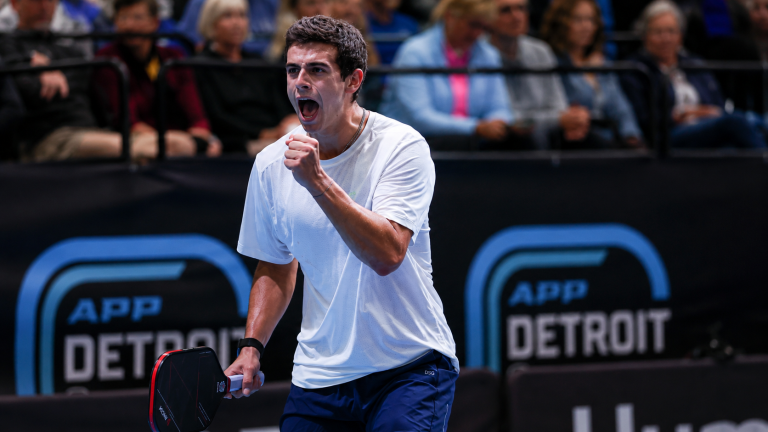
At 10-6 in Detroit, Jack Munro and Richard Livornese Jr were finally in trouble.
Etienne Blaszkewycz and Callan Dawson had reached game point first in the opening game of the men’s doubles final. Munro and Livornese had won the previous three APP tournaments together, but the fourth was beginning to look considerably less inevitable.
They found a way out.
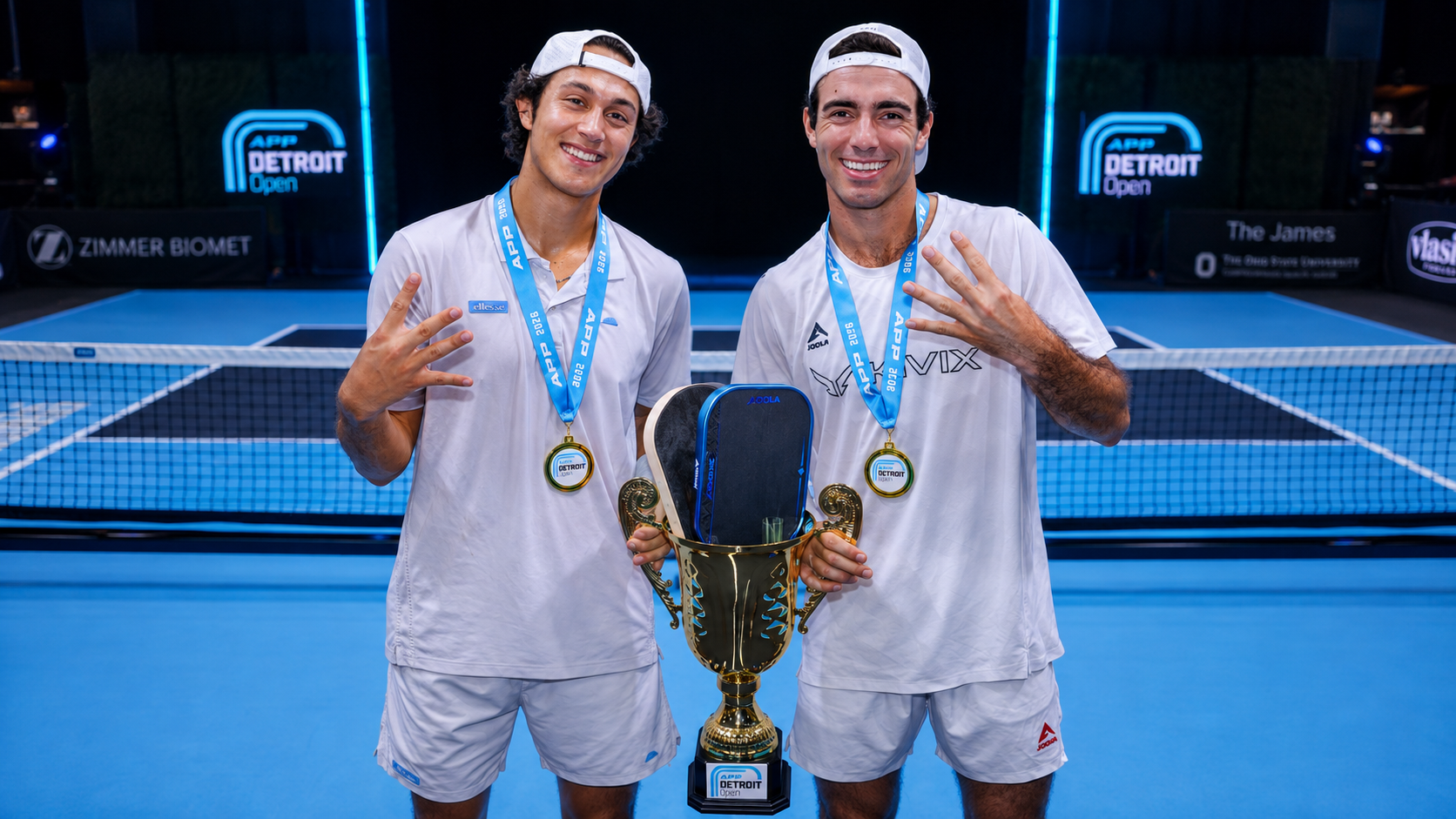
Six consecutive points turned 6-10 into 12-10. The second game finished 11-7 and, with it, Munro and Livornese had their fourth consecutive APP men’s doubles title.
The APP streak now stretches from Sacramento through Cincinnati and Chicago to Detroit. Four tournaments, four different finalist pairings, four gold medals.
And even that understates the run.
Munro and Livornese also travelled to Birmingham and won the men’s doubles title at the English Open, extending their sequence beyond the APP Tour. Across the five tournaments in this run, the outcome has been the same.
The opposition has changed. The country changed. The winners did not.
That has made Munro and Livornese the clearest competitive reference point in APP men’s doubles. The question is no longer whether the partnership is in form.
It is who can beat them.
Sacramento: The Beginning of the Run
The first title of the sequence did not arrive with much room to spare.
Munro and Livornese reached the Sacramento final as the top seeds and beat Robert Slutsky and Zack Taylor 11-8, 11-9. Across the tournament they had given opponents little encouragement, but the final provided an early indication of something that would become important over the following months.
They could win tight games without needing to dominate them.
An 11-9 game leaves very little separation. A couple of poor decisions, one loose return or a missed opportunity at the kitchen can change the outcome. Munro and Livornese did enough.
At that stage it was another title for two of the APP’s strongest doubles players.
Cincinnati changed the scale of it.
Cincinnati: No Contest
Ronan Camron and Drake Palm reached their first final together at the Vlasic Classic in Cincinnati.
Munro and Livornese gave them almost nothing.
The final lasted two games and produced scores of 11-4, 11-3.
It remains the most straightforward championship match of the four-title APP run, and perhaps the most useful counterpoint to what happened later. There was no late escape required and no third game to negotiate. Munro and Livornese established control and kept it.
Munro left Cincinnati with two gold medals after also winning mixed doubles alongside Jill Braverman.
Two APP men’s doubles tournaments had now produced two different finalist pairings.
Neither had found an answer.
Chicago: Duong and Kawka Change the Match
If Cincinnati showed what Munro and Livornese look like in control, Chicago showed what happens when control disappears.
Quang Duong and Patrick Kawka took the opening game of the final 11-9.
For the first time during the APP title sequence, Munro and Livornese had lost a game in a championship match and needed to recover rather than protect a lead.
The response was emphatic.
They took the second 11-2 and the third 11-6.
Duong and Kawka had changed the terms of the final and proved that the leading partnership could be knocked out of its rhythm. They simply could not keep them there.
Munro and Livornese did not scrape through the remainder of the match. After dropping the opener, they outscored their opponents 22-8.
By then the run was becoming difficult to dismiss as a particularly good few weeks.
Then came Birmingham.
Birmingham: The Run Leaves America
The English Open matters to this story precisely because it was not another APP Tour stop.
Munro and Livornese left the familiar rhythm of the American circuit, travelled to Birmingham and entered a different tournament against a different field.
They still left with the men’s doubles title.
There is no need to pretend that winning the English Open is identical to winning an APP event. The fields are different and the competitive context is different.
That is also why it belongs in the story.
The English Open provided a direct comparison between leading American and European doubles. Munro and Livornese beat Ben Cawston and Théo Platel 11-0, 11-0 in the semi-final before going on to take gold, with Tristan Dussault and Ronan Camron finishing second.
A partnership develops routines around competition. Travel, preparation, court conditions, tournament schedules and familiar opponents all form part of that environment. Birmingham changed some of those surroundings without changing the result.
For Munro and Livornese, it became another week of playing together and another tournament in which nobody managed to separate them from the title.
Then they returned to the APP Tour.
Detroit provided their closest warning yet.
Detroit: The Door Was Open
Blaszkewycz and Dawson did not need to be told what had happened before they reached the Detroit final.
By the fourth APP tournament of the sequence, Munro and Livornese were no longer simply another top-seeded partnership. There was a streak to stop.
For most of the opening game, Detroit looked capable of being the place where it happened.
At 10-6, Blaszkewycz and Dawson were one point from taking the opener and putting the champions in exactly the position Duong and Kawka had managed in Chicago.
They never got it.
Munro and Livornese scored six unanswered points to win 12-10, then took the second 11-7. The APP’s official Detroit recap confirmed their fourth consecutive men’s doubles gold.
The distinction from Chicago is important. This time the recovery happened before a game had been surrendered. Blaszkewycz and Dawson created the opportunity but were never allowed to turn it into control of the match.
Munro later explained that the finalists had presented a strategy the pair had not really encountered before, forcing them to adapt as the match developed. That matters because it gives Detroit a little more significance than another comeback scoreline. The champions were being asked a different question and had to work out the answer while the final was already moving against them.
It showed how narrow the gap can become without actually closing.
Four APP Finals, Four Different Problems
Put the four championship matches beside one another and the streak becomes more interesting.
Slutsky and Taylor kept both games relatively close in Sacramento.
Camron and Palm were overwhelmed in Cincinnati.
Duong and Kawka became the first pair in the run to take a game from Munro and Livornese, then received a 22-8 response.
Blaszkewycz and Dawson reached 10-6 in Detroit and watched the opening game disappear.
There is no single matchup to explain away.
Munro and Livornese have not won four APP titles because one particular rival cannot handle them. They have beaten four different finalist pairings and have done so from different match positions.
That presents the rest of the field with a frustrating problem.
The evidence says Munro and Livornese can be pushed. Sacramento contained tight games. Chicago contained a lost one. Detroit contained a four-point deficit with their opponents sitting on 10.
What nobody has managed is to sustain that pressure for long enough.
What Five Tournaments Say About the Partnership
It is tempting to search for one technical explanation for a run like this.
There probably is not one.
Munro brings obvious attacking threat and a capacity to change the shape of points quickly. Livornese gives the partnership a different profile, with the patience to stay inside neutral exchanges rather than treating every available ball as an invitation to accelerate.
Reducing them to attacker and stabiliser would still be too simple. Both can perform either role, often within the same rally.
The more persuasive evidence is what this run has allowed them to accumulate.
Repetition.
While the identity of the APP finalists has changed at every stop, Munro and Livornese have kept playing matches together. Even leaving the tour for Birmingham did not interrupt the sequence.
Men’s doubles is full of decisions made too quickly to look like decisions. Who protects the middle when one player is dragged wide? Who gives ground when a speed-up comes back harder than expected? Which ball belongs to whom when both paddles can reach it?
Those answers become less complicated when the player alongside you has reacted the same way hundreds of times before.
The results cannot prove that continuity is the reason for the five titles in this run.
They do show what opponents have been facing: not simply two strong players, but an increasingly established partnership.
Detroit Did Not Produce a Blueprint
It would be easy to describe Detroit as the moment Blaszkewycz and Dawson showed everybody how Munro and Livornese can be beaten.
The evidence does not support going that far.
The scoreboard and Munro’s post-match comments tell us that they presented the champions with an unfamiliar problem and put them under serious pressure. They do not establish a repeatable weakness.
Chicago had already supplied another warning. Duong and Kawka actually took a game.
The more interesting evidence comes from what followed those moments.
After losing 11-9 in Chicago, Munro and Livornese won the next game 11-2.
After falling 10-6 behind in Detroit, they did not concede another point in the opener.
Getting ahead has not been enough.
The next pair has to stay there.
Plenty of Challengers, but No Challenger
There is an important distinction between depth and hierarchy.
Four different partnerships reaching four consecutive APP finals suggests the men’s doubles field has depth. There are enough good players and combinations to prevent the same two teams simply trading championships every month.
What it has not produced is a second partnership capable of repeatedly confronting Munro and Livornese.
Slutsky and Taylor had their opportunity.
Camron and Palm had theirs.
Duong and Kawka got closer.
Blaszkewycz and Dawson got close differently.
Nobody has returned for a second attempt during the APP streak.
That leaves Munro and Livornese in an unusual position. They have become the established partnership in a field where the identity of their principal challenger is still changing from tournament to tournament.
Perhaps that challenger is already somewhere in those four finals. Perhaps Duong and Kawka build on Chicago, or Blaszkewycz and Dawson take something from Detroit. Perhaps an entirely different combination emerges at the next stop.
That uncertainty does not make APP men’s doubles predictable.
It makes the next stage more interesting.
Someone has to turn themselves from another finalist into a rival.
Five Golds Change the Question
Munro and Livornese will lose eventually. Detroit made the possibility visible enough.
But the tournaments behind them have changed what happens when they next enter an APP draw.
In Sacramento, they were a leading partnership trying to win another tournament.
By Detroit, they were the partnership everybody else was trying to stop.
Between those two points came Cincinnati, Chicago and a flight to Birmingham that produced another championship.
The field has accumulated evidence along the way. Sacramento showed they could be kept close. Chicago showed they could lose a game. Detroit showed they could trail 10-6 with another title under threat.
Yet the sequence remains intact.
Four consecutive APP tournaments have produced four different finalists across the net. The English Open added another country, another field and another gold.
Five tournaments in the run.
Five titles.
The APP men’s doubles field does not need proof that Jack Munro and Richard Livornese Jr can be pushed.
It has plenty.
What it needs now is somebody who can push them all the way.
Further Reading
- The English Open Grew Up at the NEC. Now Comes the Hard Part
- Speed, Systems and a Sacramento Sweep: The Week That Redefined the APP Tour
- Tournament coverage and results
- Rankings and player profiles

Noah Burns-Green
Founder and Editor-in-ChiefNoah Burns-Green is an APP Correspondent for World Pickleball Magazine and a member of the WPM Academy. Aged 21, he has recently completed his first year studying at Solent University and is developing his skills in sports journalism through regular…
View All Articles →