Tournament organisers spend heavily finding courts, hiring venues and extending playing days. Raqt founder Jens Larsson believes a cheaper source of capacity is hiding in the minutes tournaments already waste.
Key Takeaways
- Raqt says its new scheduling engine produced 6% higher court utilisation and 10–15% more sign-ups when tested against real tournament data.
- For tournament organisers, better scheduling can turn existing court hours into additional capacity without adding courts or extending an event.
- The bigger question is whether efficiencies demonstrated in simulations can survive the unpredictability of live pickleball tournaments at different levels.
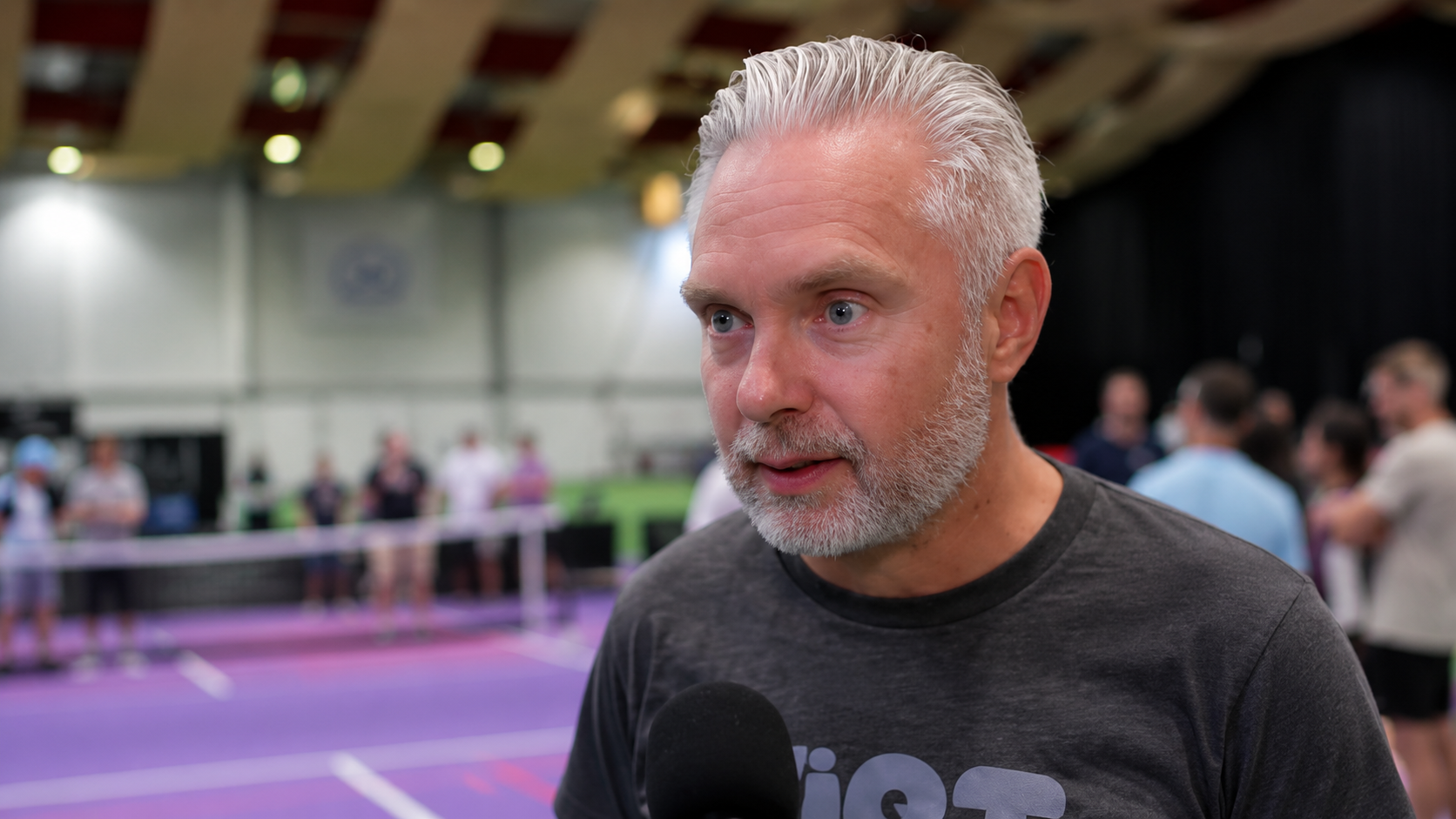
Jens Larsson has developed an occupational hazard when he goes to pickleball tournaments.
He notices the empty courts.
Not every empty court, obviously. Players need rest, matches run long, brackets collide and tournament directors cannot control every moving part across several days of competition. Larsson understands all of that. What bothers him are the other gaps: the court sitting unused because the next players have not been called, the match delayed by a problem elsewhere in the draw, the minutes disappearing between one group leaving and another arriving.
“Sometimes I get really stressed out because I see there’s so much inefficiency in how they run tournaments,” he says.
Most spectators would barely notice. Larsson sees inventory going to waste.
He is the co-founder and chief executive of Raqt, the Swedish tournament platform he says is now operating across 38 countries, and increasingly his company is trying to answer a question that becomes more valuable as pickleball tournaments get bigger.
What is a court hour actually worth?
It sounds like an administrative question until you follow the money. A tournament organiser can attract more players, sell more entries and build a larger event, but eventually everything runs into the same physical constraint. There are only so many courts and only so many hours in which to use them.
Building another court, hiring another venue or adding another tournament day can all increase capacity. They also cost money.
Raqt’s proposition is that there is another place to look first: the minutes already being lost.
Finding the six per cent
Larsson has numbers.
They are Raqt’s numbers, generated from the company’s own simulations and tournament work rather than independently audited industry benchmarks, but they are significant enough to make the underlying question difficult to dismiss.
In a recent public description of its new scheduling engine, Raqt said it had run simulations against real tournament data involving events of up to 6,500 matches across five days. The company reported 6% higher court utilisation, 10–15% more sign-ups and approximately one hour less playing time per day.
Each figure requires context. A 200-player weekend competition in a local sports hall is not a multi-thousand-match international event, and tournament formats, venues, staffing structures and player behaviour vary enormously.
But six per cent is worth examining.
An organiser with 20 courts available for ten hours begins with 200 court-hours to schedule, sell and protect. Once those hours are gone, demand does not matter. Another player can enter only if the organiser finds another court, extends the playing day or creates room somewhere inside the existing schedule.
If software genuinely allows more competition to pass through those same 200 hours, it has effectively created tournament inventory without pouring concrete.
That changes the value of the schedule.
A problem created by success
Large pickleball tournaments are particularly awkward things to organise because the schedule is not really one schedule.
A player may enter singles, gender doubles and mixed doubles. Their partner may be alive in another bracket. Matches have unpredictable lengths. Rest periods matter. Courts become available at different times. Referees have to be positioned. One unexpectedly long quarter-final can eventually interfere with matches that appear to have nothing to do with it.
Moving one match solves very little if the decision creates three problems an hour later.
That is the problem Larsson has become interested in.
Raqt’s scheduling module repeatedly runs tournament information through different scenarios, looking not simply for the next available court but for the consequences of putting a particular match there. At the larger end of the company’s testing, that means coordinating thousands of matches across dozens of courts while accounting for the people moving between them.
The aim is not faster pickleball. It is reducing the dead time between matches.
For years, much of the infrastructure conversation around the sport has understandably concentrated on adding courts. Participation rises, existing facilities fill up and somebody eventually asks where everybody is going to play. WPM examined a similar capacity problem when English Open registrations began disappearing within hours.
Larsson is asking a slightly different question.
Before building more capacity, how efficiently is the existing capacity being used?
When Sweden needed paddles
There is something fitting about Raqt ending up here because Larsson’s involvement in pickleball began with a much simpler shortage.
Sweden needed equipment.
When he became involved around 2017, pickleball was sufficiently obscure in the country that the small group attempting to establish the sport could not simply walk into a specialist retailer and buy what they needed. Nets, paddles and balls had to be imported.
Larsson was part of Sweden’s early organised pickleball movement. The practical solution to the equipment problem was to start selling the equipment themselves, creating one of Europe’s early specialist pickleball retail operations.
Larsson says his professional background spans around three decades in product development, including medical and military technology. Moving physical products around Europe soon interested him rather less than the digital problems appearing around a young sport.
Raqt began developing its software operation, initially through the web before moving into native mobile applications. The current Raqt app was released in 2022.
Then Larsson and his team made the sort of decision that tends to sound more sensible several years afterwards than it probably did at the time.
They decided to launch the new applications at the Swedish Nationals and Spanish Open on the same weekend.
According to Larsson, the iOS version received approval from Apple on the morning competition began.
There was no gentle introduction at a small club tournament, no protected test environment and very little opportunity to hide when something went wrong. Real players were trying to use the product at real tournaments while the team discovered which assumptions survived contact with an event.
Not all of them did.
Larsson believes that was precisely why the exercise worked. The weekend exposed problems immediately and, in his view, compressed months of incremental testing into a much shorter period.
More importantly, it helped Raqt understand that tournament technology becomes considerably more interesting once you look behind the registration screen.
What the player never sees
Players interact with the obvious parts of tournament software.
They find an event, enter a division, locate a partner, check their draw and eventually look for the court on which they are supposed to play.
The tournament director sees something else entirely.
Why is Court 14 behind? Are the players required on Court 22 actually available? Has a delayed men’s doubles match trapped somebody needed in mixed doubles? If one match is moved, what happens to the bracket it moves into?
At a large event, the answers change continuously.
Raqt is developing what Larsson describes as a Control Tower to give tournament directors a live view of that movement, highlighting delays, player flow and pressure developing around different courts and brackets. A separate referee module is intended to digitise another process that, at some tournaments, still involves paper scoresheets travelling around a venue.
None of it will sell many tickets.
It could determine whether the people who have bought them are still watching finals at a sensible hour.
This is also where Larsson’s claim about staffing becomes more interesting. He is not arguing that people should simply be stripped out of tournament operations. His frustration is with human beings being used to compensate for processes that software could handle.
“I can promise you that in some tournaments, if we were running them, we could easily remove 20 per cent of the administrative staff,” he says.
Twenty per cent is too broad a number to apply across the sport. Some events depend heavily on volunteers. Others use professional teams. A small venue with a straightforward draw has little in common with a multi-day international tournament.
The principle is harder to argue with.
If an organiser is paying people to spend their day fixing avoidable scheduling problems, inefficiency has acquired a wage.
Raqt’s international experiment
Larsson says Raqt is now active in 38 countries, with another eight national markets expected to open over the next three months. Spain and England are among its strongest territories, while France is developing quickly.
The United States is different. It remains the world’s largest established pickleball market, but it is also crowded with tournament platforms and existing systems, leaving Larsson content to wait for the right route in rather than spend heavily trying to force one.
Elsewhere, tournament participation can develop before the infrastructure around it has fully matured. India, for example, is currently building physical and digital pickleball systems almost simultaneously, something WPM recently examined through the DUPR and Courtly partnership.
That creates opportunities for companies such as Raqt, but it also gives Larsson a useful vantage point from which to compare how tournaments are being built.
Large pickleball events are effectively moving networks. Hundreds, sometimes thousands, of people have to pass through a limited number of courts while competing in different combinations and different events. The value of a court therefore depends not only on whether somebody is playing on it, but whether the right people are ready to use it at the right moment.
A five-minute gap does not sound important.
Multiply it across 40 courts, several sessions and thousands of matches, and it starts to become an operating model.
The 10–15 per cent question
Of all Raqt’s figures, one has the clearest consequence for tournament organisers.
Ten to 15 per cent more registrations.
If an event that previously accommodated 1,000 paid entries could accept another 100 or 150 without adding courts or another day, the financial calculation changes quickly. The venue has not become larger. The organiser has simply found a way to sell more competition through it.
There are limits.
More registrations mean more people using the car park, toilets, changing facilities, practice areas and food outlets. A tournament can become technically efficient while becoming miserable to attend. Players need rest, and nobody wants to feel as though they are being fed through a production line because an algorithm has identified another available seven minutes.
Efficiency only has value if the event remains good.
That is why Raqt’s numbers ultimately matter less than whether tournament directors can reproduce them in the messy conditions of live competition.
Late arrivals will still happen. Matches will still run unexpectedly long. Players will withdraw. Somebody will be standing beside the wrong court when their name is called. Software cannot turn sport into a perfectly controlled process, and probably should not try.
What it can potentially do is expose the difference between disruption and waste.
Pickleball technology is increasingly attempting to solve problems that occur away from the visible action. At the English Open, for example, WPM watched Stupa Sports test data and officiating technology inside a 60-court tournament. The common thread is that technology eventually has to survive live competition rather than a demonstration.
Scheduling software deserves the same test.
The minutes between the matches
Larsson still watches the pickleball when he goes to tournaments.
He just cannot stop watching everything around it.
The empty court. The delayed changeover. The administrator solving a problem that might not have needed to exist. The tournament that reaches the end of another long day with matches still waiting to be played.
For a player, five lost minutes may mean nothing more than another conversation beside the court. For an organiser, those minutes accumulate into venue time, staffing costs and registrations that cannot be accepted.
Raqt has not proved that 6% better utilisation or 10–15% more registrations can become universal expectations across pickleball. Different tournaments will produce different answers, and the larger the claim, the more real-world evidence it will require.
But Larsson’s underlying question survives whether those eventual numbers are six per cent, three per cent or something else entirely.
Pickleball spends a great deal of time discussing where its next courts will come from.
Perhaps tournament directors should also be asking how much of the courts they already have is disappearing between matches.
Further Reading
- Latest pickleball news from around the world
- Tournament coverage and results
- Rankings and player profiles
- Regional pickleball coverage

Chris Beaumont
Founder and Editor-in-ChiefChris Beaumont is the founder and Editor-in-Chief of World Pickleball Magazine. Chris follows the global game closely, reporting on the latest news, developments, stories and tournaments from all five continents. He also hosts the World Pickleball Podcast, interviewing people at…
View All Articles →