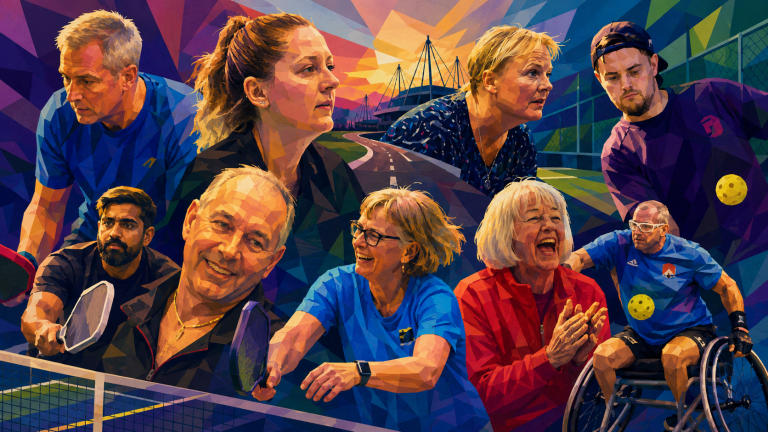

For 11 weeks, the Road to the English Open has followed a group of ordinary pickleball players towards Birmingham. What began as a project about preparation became something much messier: a story about work, family, injury, responsibility, friendship and the limits of what any training plan can control.
- The project began with 12 players preparing for the 2026 English Open. The full group did not remain intact, and almost every original plan changed somewhere along the way.
- Across 11 weeks, the players have become fitter, more competitive and more self-aware, while also dealing with injuries, changing partners, family responsibilities and circumstances far beyond pickleball.
- The next time we hear from the group will be after the English Open. For now, preparation is over. Birmingham is here.
There are moments when sport knows its place.
For 11 weeks, the Road to the English Open has followed a group of ordinary pickleball players towards Birmingham. We have talked about serves and drops, partners and drills, injuries and fitness, confidence, competition and the peculiar anxiety that comes from putting a date in the diary months ahead and deciding that, somehow, you are going to be better when it arrives.
For Kath Knowles, none of that matters now.
On Thursday evening, August 6, at 8.17pm, the man she had loved for 25 years and seven months died after being diagnosed with pancreatic cancer that had spread to his liver.
It was four weeks and four days since they had been told.
Kath had already stepped away from the English Open as his illness took over everything else. This week she sent us the news none of us wanted to receive.
“After a valiant battle by the most beautiful, talented, patient man that ever walked this earth, the cancer in his pancreas and liver finally consumed my man,” she wrote.
Their last holiday together had been in Kos. There had been a few small twinges which disappeared after three days. Weeks later, their world had changed.
Kath asked us to help raise awareness of pancreatic cancer. Mostly, though, there was simply grief.
“I’ve got so many wonderful memories of the true love we shared for 25 years and seven months.”
Then:
“No need for words. I know you’ll be shocked to the core.”
We were.
There is nothing useful we can add to that.
Twelve people and one date in the diary
When this project began, there were 12 of them.
The idea seemed simple enough. Take a dozen recreational pickleball players entering the English Open and follow their final months of preparation. Ask what they wanted to improve, how they intended to do it and whether deliberately preparing for one major tournament would change anything by the time they walked into the NEC.
They were never supposed to be representative of every pickleball player. They were simply 12 people with different ages, abilities, sporting backgrounds, personalities and expectations, heading towards the same place.
Some were fiercely competitive. Some were less interested in results. Some had clear training plans. Others were still trying to work out what preparing properly might involve.
We started asking about drills, coaching, fitness, partners, weaknesses and goals.
Then life began interfering with the questions.
The original 12 did not all make it through the entire project. People disappeared for periods. Circumstances changed. Partners changed. Injuries arrived. Work got busy. Families needed attention. Training plans survived for a while and then met the diary.
There were medals along the way, coaching sessions, new paddles, troublesome serves, sore hamstrings, a tight Achilles and endless conversations about what everybody ought to be practising.
There were also weeks when somebody simply had more important things to do.
That, more than any training plan, became the reality of the Road to the English Open. By Week 7, life was already refusing to wait for Birmingham. A week later, the tournament itself had barely changed, but the people preparing for it clearly had.
Professional athletes organise their lives around competition. These people organise competition around their lives.
For 11 weeks we have watched what happens when the two refuse to fit together neatly.
Now the date in the diary has arrived. The 2026 English Open runs from August 11–16 at the NEC in Birmingham, across 60 courts. The destination that has sat at the end of this project since May is no longer theoretical.
“I’m actually here”
Hari expects to stop for a moment when he first walks into the NEC.
“I think there’ll be excitement, nerves and probably a moment where I stop and think, ‘I’m actually here.’”
Then he plans to remind himself that the dimensions of a pickleball court have not changed simply because the building around it is bigger.
“Once the first point starts, it becomes just another pickleball match.”
The Hari who arrives in Birmingham, however, is not quite the player who started this project.
Early on, he assumed that becoming better at pickleball largely meant playing more pickleball. Over the following weeks he began running consistently, strength training, working on his mobility and thinking about the physical requirements of becoming a better player.
Eventually his language changed too. He wanted to become a better athlete, not simply a better pickleball player.
His first 5K took a little over 38 minutes.
This week, he ran one in under 33.
“Would I have eventually started taking fitness more seriously? Maybe,” he says. “But I genuinely believe this project gave me the accountability to start sooner and stick with it.”
The scoreboard matters differently now as well. Hari increasingly judges a session by his decisions and understanding of the game rather than simply whether he won.
That does not mean he is heading to Birmingham without a plan.
His first five points with 14-year-old Jack are already mapped out. Trust the drops. Reach the kitchen. Communicate. Make the opponents earn everything.
More importantly, Hari knows what he wants Jack to see when he looks across the court.
Calmness.
“If momentum swings, I want him to know that nothing changes. We’ll stick to our game and trust each other.”
Zoe Ashbridge was asked the same question about her first five points.
Her response was rather different.
“That’s really got me thinking. Maybe I should have more of a plan.”
Eleven weeks of preparation, and there are still things nobody thought to prepare for.
The plans that survived, and the ones that didn’t
Zoe has barely practised pickleball for the last 10 days.
She thought she would. She probably could have carved out the time if she had insisted upon it.
Instead, she has been fostering two young children.
“It’s been amazing,” she says. “I just didn’t prioritise it because I was doing so much more.”
The decision was straightforward. Her feelings about it are less so.
If she does not play well in Birmingham, Zoe worries that she will feel she has let her partners down. Not because she expects to win the English Open, but because she wants to walk away believing she produced her best pickleball.
She knows why she might not.
“I have got to give myself some grace.”
The wellbeing of the children she is looking after came first. She made that choice knowingly and would make it again.
The strange thing about tournament preparation is that understanding something logically does not necessarily stop you feeling guilty about it.
Zoe will deal with the nerves in ways she has learned work for her. Sometimes she writes a letter to herself before a tournament. Sometimes she writes down the shape of the day in advance, from getting into the car to playing the first match. She uses breathing exercises. When she plays with Mart, they tap paddles and remind each other to have fun.
She spends a surprising amount of effort convincing herself that something she cares deeply about does not matter very much.
“It’s just a game.”
Laura Yeomans has spent much of the same journey trying to make peace with a different part of herself.
Her problem has never been caring too little.
“The last 12 weeks have been a complete rollercoaster in terms of trying to re-find my love of the game,” she says.
Laura puts enormous pressure on herself to perform. Through this project she has talked repeatedly about mindset, confidence and the uncomfortable relationship between wanting to improve and making yourself miserable because improvement is never happening quickly enough.
Now she can say something that did not come naturally at the beginning.
“I’m finally learning that perfection doesn’t exist.”
She remains ambitious. Laura wants to compete more often at 4.5 and believes that is where she needs to test herself. She has made a late decision to enter singles at the English Open, partly to get the first experience of the venue and competition out of her system before the doubles events she cares about most.
Her women’s partnership already has its rhythms. Keep things simple. Work through the middle. Get a feel for how the opponents play.
Yet her definition of success for the entire weekend has become remarkably uncomplicated.
Enjoy all three days.
For somebody who has spent 12 weeks trying to rediscover why she enjoys pickleball, that is not lowering expectations. It is the point.
The body gets a vote
Not everything can be resolved by changing your mindset.
A couple of weeks ago, David “Thomo” Thompson had what he describes as a slightly sore back. With the English Open approaching, he decided to have acupuncture.
Thomo says that since then he has suffered badly with sciatica. He is taking strong painkillers. Getting out of bed can be difficult and it takes hours before his body begins to loosen.
The irony is miserable.
When this project started, Birmingham was basically another tournament to Thomo. As the weeks passed, he became more excited about it.
Now that he desperately wants to play, he may not be able to.
“I’m desperate not to miss this.”
He is stretching, seeing an osteopath, using heat and ice and trying whatever he can. Singles has become expendable if withdrawing gives him a better chance of playing doubles.
The worry underneath everything is familiar.
He does not want to let his partners down.
If he gets onto court, at least he knows the first problem he wants to solve. Thomo has an irritating habit of going 5-0 or 6-0 down in opening games before beginning the fightback. Birmingham would be a convenient place to stop doing that.
For now, he would probably be delighted to have the opportunity.
Sarah Reading reaches Birmingham with her own uncertainty.
Several weeks ago, she admitted that much of the preparation she imagined at the beginning of the project simply had not happened. She had not really sorted the diet. The fitness work had not gone as planned. There had not been enough drilling.
Her son graduated and moved. Work continued. Her Achilles tightened up. Her mum kept warning her that she was trying to do too much.
Then Brenda, her women’s doubles partner, became unavailable.
Sarah considered dropping the event before Erin, a player from Bermuda whom she had never met, got in touch. They decided to play together.
At the NEC, they will have to accelerate everything normally built through weeks of playing alongside somebody.
Sarah at least has recent evidence that this can work.
At a warm-up event in Abingdon, she partnered Jo Moore, somebody she had previously played against but never with. They won silver in the over-50 4.0 competition.
But the medal came with a scare.
Sarah says she experienced an episode of tachycardia during the later stages, felt sick and had very little energy. She continued because she did not want to let Jo down, a decision she now acknowledges was probably the wrong one.
An ECG the following Monday was, she says, thankfully OK. She was waiting for blood-test results when she sent us her final update.
The English Open is next.
Preparation can improve your chances.
It cannot guarantee your body will cooperate.
The other person on the court
Something has appeared repeatedly in these final conversations that we did not set out to investigate.
Partners.
More specifically, the fear of disappointing them.
Zoe worries that her reduced preparation could let hers down. Thomo is desperate for his back to allow him to fulfil his commitment. Sarah carried on at Abingdon because Jo was standing beside her.
Hari wants Jack to look across the court and see calmness.
Julie Vickerman puts it most plainly.
“My partners being proud of me is what would make me proud of myself.”
Julie is one of the people who has visibly changed during the project. At the beginning, so much of her pickleball life revolved around other people. Her club. Its players. Making opportunities happen.
She still thinks that way.
But she wants to win a little more now.
“I do want to win more than perhaps I did at the beginning.”
She and her women’s partner recently took silver at a North East competition. Her troublesome serve has received plenty of attention and she has developed a routine around it. At Birmingham, she wants to find a spare court, understand the surface and hit enough serves to reassure herself that the ball is going where it should.
Her first few points have a plan too. Serve deep. Return deep. Try to establish a lead because she knows she plays more freely from ahead.
We asked what she wanted her partner to see immediately.
Someone completely focused on the match.
Someone who, for once, was not thinking about anything else.
“Like, ‘Have I booked the meal tonight for everybody?’”
Of course Julie is organising the meal.
Eleven weeks have made her more competitive without removing the instinct to look after everybody around her.
Her proudest contribution to this English Open may have happened before she hits a ball. Several people from her club are travelling to Birmingham to compete, including players who had never imagined entering something on this scale.
Julie was one of the people who persuaded them they could.
There comes a point when another drill won’t help
By the final week, some of the answers have become noticeably shorter.
That feels appropriate.
Karen Farnhill has spent the project thinking about her game and arrived at Birmingham with one word.
CONSISTENCY.
She has turned it into her own mnemonic.
C: calmly make shit.
O: one more dink.
N: no panicking.
S: slip step.
I: into space.
S: slacken grip.
T: time approach.
E: energy.
N: never give up.
C: communicate.
Y: you can do it.
Then:
“Let’s go.”
Simon has a mnemonic too, although his has been around considerably longer.
Proper Preparation Prevents Piss Poor Performance.
The six Ps.
Simon is 71 on the weekend of the English Open and has no intention of pretending that results suddenly cease to matter once you acquire perspective.
He expects nerves and considers them useful. He wants to enjoy Birmingham.
He also enjoys winning considerably more than losing.
“I am still the same competitor that I was 55 years ago when I was crowned European Champion,” he says. “If I was playing tiddlywinks I would still want to win.”
His preparation with Andy is finished. The match play has been done. Simon believes his game has improved, and he is equally clear that improvement has required money, time and emotional investment.
There is no breakthrough left to chase this weekend.
“The hard groundwork has been done.”
Control the controllable.
Bring it on.
What did the road actually change?
We did not know what this series would become when we started it.
There were 12 people at the beginning. The full dozen did not remain intact. Others disappeared for weeks and returned. The group approaching the NEC is not quite the group whose plans we first heard at the start of the summer.
Neither are the individuals within it.
Some changes can be measured.
Hari has taken nearly six minutes off his 5K and completely reconsidered what physical preparation means.
Some are harder to quantify.
Laura is trying to enjoy the game without demanding perfection from herself.
Julie has discovered a stronger competitive streak while bringing other people from her club along for the ride.
Zoe’s preparation was overtaken by something she considered more important, and she is learning not to punish herself for making that choice.
Thomo discovered quite how badly he wanted to play when playing was suddenly no longer guaranteed.
Sarah’s carefully imagined preparation met the ordinary chaos of work, family, changing partners and a body that has given her reasons to be cautious.
Karen has CONSISTENCY.
Simon remains wonderfully, unapologetically Simon.
And Kath will not be there.
There is no honest way to turn what has happened to her into a sporting lesson.
So we won’t.
Friends now
Simon used two words in his final message that we did not expect when this began.
He thanked us for allowing him to be part of this “fascinating insight into people’s (friends now) journey”.
Friends now.
Eleven weeks ago, they were names on a project plan.
They did not choose each other. They had different ratings, ambitions and reasons for entering the English Open. Some knew one another, many did not.
Then they started sharing the journey.
Injuries. Doubts. Medals. Bad sessions. Good sessions. Partners. Coaching. Family upheaval. Training ideas. The occasional disappearance when life became too busy to send an update.
They read about one another.
They encouraged one another.
Somewhere in there, a collection of individuals became a group.
We never put that on the list of things the Road to the English Open was supposed to measure.
Perhaps we should have.
On Tuesday, the road ends.
The series does not. We will return after the English Open and find out what actually happened when 11 weeks of plans, compromises, improvements and setbacks finally met competition.
But there is nothing meaningful left to add now.
No weakness will be transformed over the weekend. No last-minute drill is going to produce a different player. The serves will land or they won’t. The drops will work or sit up. Some draws will be kind and others horrible. Somebody will play beautifully and lose. Somebody else will have an awful game and somehow survive it.
There will be nerves.
There will be mistakes.
There will almost certainly be moments when somebody forgets everything they spent 11 weeks learning.
Then they will play the next point.
When we started, we thought the interesting question was whether deliberately preparing for the English Open would make these players better by the time they reached Birmingham.
It has.
Hari is fitter. Julie is more competitive. Laura understands herself a little better. Zoe knows what matters to her. Karen has her reminders. Simon has his six Ps.
But preparation was never going to control everything that happened between Week One and the NEC.
That may be the most useful thing this project has shown us.
These are not professional athletes living inside a training programme. They are people trying to fit a tournament around jobs, children, clubs, partners, injuries, responsibilities and lives capable of changing without warning.
They prepared anyway.
Now, finally, they get to play.
Open the doors.
Let them in.
Further Reading
- The English Open Is Still Weeks Away. Their Lives Have Already Started to Change
- Life Refuses to Wait for Birmingham
- The Tournament Hasn’t Changed. The People Have.
- Two Weeks To Go: The Moment Every Player Stopped Chasing Perfection
- Read the complete Road to the English Open series

Chris Beaumont
Founder and Editor-in-ChiefChris Beaumont is the founder and Editor-in-Chief of World Pickleball Magazine. Chris follows the global game closely, reporting on the latest news, developments, stories and tournaments from all five continents. He also hosts the World Pickleball Podcast, interviewing people at…
View All Articles →