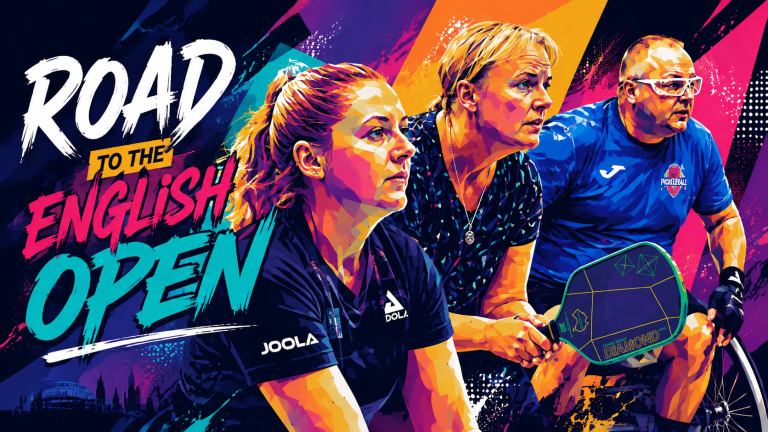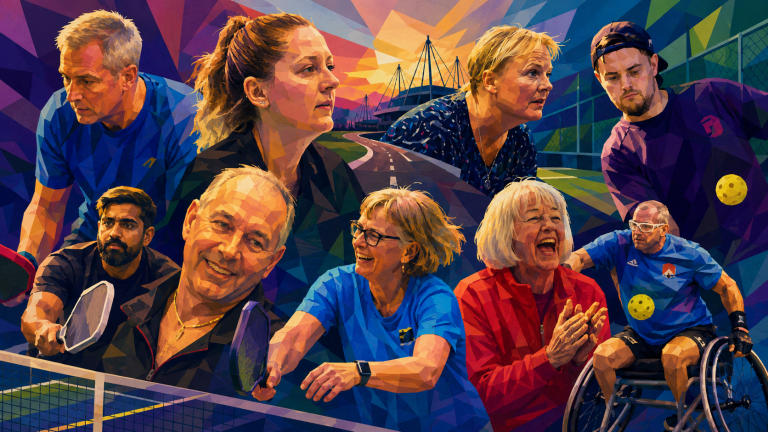
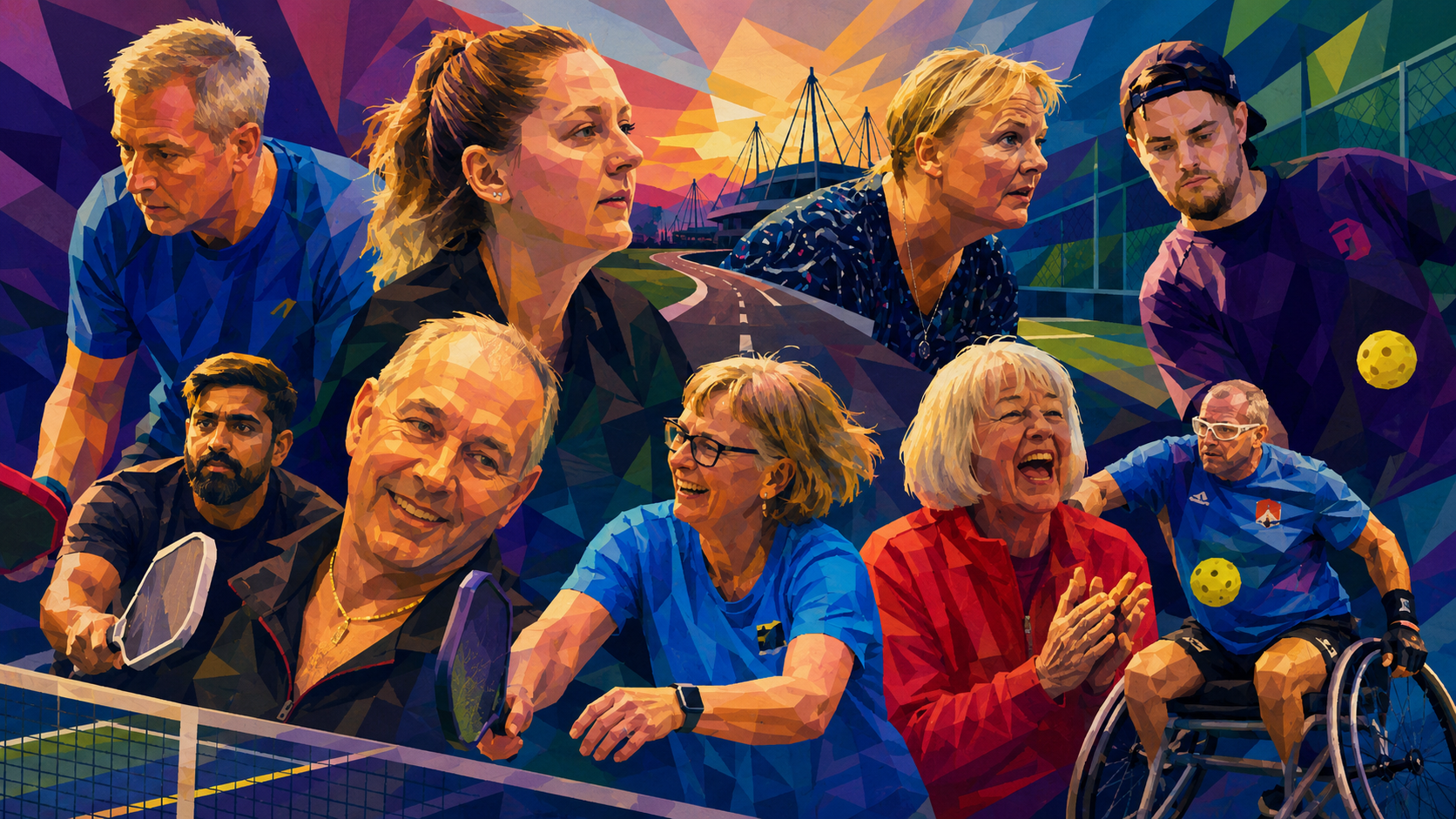
Road to the English Open, Week 8: As Birmingham gets closer, the twelve players are preparing with more purpose, more perspective and a clearer sense of where pickleball fits within the rest of their lives.
Key Takeaways
- Week 8 brought a clear shift from simply preparing more to preparing better.
- Sarah, Emily, Karen, Kath and Laura showed how life outside pickleball is now shaping the road to Birmingham.
- The English Open still matters, but the players are beginning to understand that it cannot be the whole story.
Sarah Reading had barely arrived at the airport when her phone vibrated.
Only minutes earlier she had been thinking about missed training sessions, the drills she had not managed while on holiday and the familiar feeling that the English Open was creeping ever closer.
Then everything shifted.
A close friend, Dean, had died.
“The build-up to the Open has been quite hard,” she reflected later, “but it kind of put things into perspective.”
Eight weeks ago, almost every conversation in this project revolved around Birmingham. This week, Birmingham was still there. Life simply kept getting in the way.
Nobody is taking the 2026 English Open less seriously.
They are simply beginning to understand where it fits within the rest of their lives.
The Invisible Work
One of the quiet stories of Week 8 is that preparation has become less visible.
Earlier in the project, progress often meant another tournament, another social session or another medal. This week, it looked very different.
Simon Heaps spent another session working with his professional coach, much of it devoted not to spectacular winners but to the mechanics of moving a wheelchair more efficiently around the court. Sweat arrived long before the ball did. Progress, for Simon, is increasingly measured in inches rather than points.
Stephen Humphries has become almost consumed by the way he grips his paddle. He has watched videos of professionals, filmed himself, stood against a wall repeating the same movements over and over, trying to remove a habit that has quietly shaped his game for years.
To anyone else it looks insignificant.
To Stephen, it might be the difference between arriving in Birmingham frustrated or confident.
Hari has reached a similar place through a different route. Earlier in the series he simply wanted more court time. Now every session has a purpose. Third-shot drops. Serves. Patience. One more ball before trying to finish the point.
His own description was better than any technical explanation.
“My Road to the English Open,” he said, “feels like I’m beginning to understand the game rather than simply play it.”
Julie Vickerman found herself analysing matches from a hotel room in Rome.
“Videos don’t lie,” she said.
Without ever discussing it together, almost everyone in the project has arrived at the same conclusion.
Improvement is no longer about doing more.
It is about doing better.
The Lives Waiting Outside The Court
Yet the strongest moments this week happened nowhere near a pickleball court.
Emily Williams finally received the news she had spent weeks waiting for.
She had secured the nursing job she wanted.
For weeks, Emily has embodied organised chaos. University deadlines, placements, motherhood and pickleball have all competed for space in the same diary. Last week she admitted everything felt overwhelming.
This week she simply said, “I feel like I can breathe again.”
The moment that stayed with her most, though, came during a 24-hour Relay for Life with her cricket club. Walking through sunshine, wind and rain alongside teammates raising money for causes that mattered deeply, she found herself thinking less about Birmingham and more about perspective.
“There might not be medals coming home,” she reflected, “but for some of us, just being there is going to be the achievement.”
Without knowing it, she had echoed Sarah.
Not because their weeks had been the same.
But because both had arrived at almost the same place.
Karen Farnhill has spent another week balancing her own preparation with caring for both her husband, who is recovering from fractured vertebrae, and her mother. Somewhere between hospital visits, household jobs and trying to protect her own back from failing again, she found herself becoming impatient.
Then came one of the lines of the week.
“I can’t be all things to all people.”
It is difficult to imagine a more honest description of amateur sport.
Everyone in this project is trying to improve. None of them have stopped being husbands, wives, parents, carers, employees or friends. The courts never exist in isolation.
Kath Knowles knows that as well as anyone.
Only a week ago she still spoke confidently about returning to the court. This week, for the first time, she admitted she is having to accept the possibility that Birmingham may come too soon.
More revealing still was what followed.
“The hardest moment for me this week,” she admitted, “is dealing with my head.”
For months the injury had been physical.
Now it has become emotional.
Returning On Different Terms
Nobody illustrates that changing relationship with pickleball better than Laura Yeomans.
Last week she was not sure she wanted to come back.
Burnout had drained almost all enjoyment from the sport. She had stepped away deliberately, hoping that time rather than more training would provide the answer.
This week she quietly returned.
There was no tournament. No fanfare. No attempt to force a dramatic comeback.
Just Laura, a ball machine, an empty court and hundreds of repetitions on one of the hottest afternoons of the year.
The biggest surprise was not that she played.
It was that she enjoyed it.
Her expectations have changed too. She accepts she probably will not become the player she once hoped to be before Birmingham arrives. Rather than chasing lost time, she talks about quality over quantity, giving herself permission to cancel sessions if she cannot fully commit to them.
The pressure has eased.
Perhaps because she finally stopped trying to force the game to love her back.
The Players They Are Becoming
If Laura’s confidence has returned quietly, Thomo’s has come back with unmistakable energy.
A week spent coaching at Hurlands, introducing young children to the game and accidentally picking up the old paddle he thought he had retired has reignited something that had been fading.
He laughed as he realised he had played some of his best pickleball for months with the wrong paddle.
But beneath the humour sits something more important.
He has remembered why he enjoys playing.
Stephen’s confidence has taken a different shape.
Being drafted into the Yorkshire Thunder Northern League squad gave him validation he never expected. Yet success has brought fresh pressure. He now admits frustration lingers after mistakes in a way it never used to.
His chosen image of the week?
“An angry little man.”
Self-deprecating, honest and surprisingly revealing.
Simon, meanwhile, remains focused on the smallest details. Julie still wants to reward the faith her partners have placed in her. Hari no longer wonders whether he belongs against stronger opponents. Instead, he wonders whether he can stay patient enough to beat them.
The confidence across the group has not grown louder.
It has become quieter.
More settled.
More earned.
More Than Birmingham
Eight weeks ago, the English Open felt like the destination.
Now it feels more like a meeting point.
A place where twelve very different lives will briefly intersect before heading off in their own directions again.
Some will arrive carrying confidence built through careful preparation.
Some will arrive carrying injuries that never fully healed.
Some will arrive carrying grief.
Some will arrive carrying exhaustion.
A few will simply carry relief that they made it at all.
The medals will still be there.
The draws will still be made.
The courts will still look exactly the same.
The people stepping onto them will not.
The tournament has not changed.
The people have.
Further Reading
- Latest pickleball news from around the world
- Tournament coverage and results
- Rankings and player profiles
- Regional pickleball coverage

Chris Beaumont
Founder and Editor-in-ChiefChris Beaumont is the founder and Editor-in-Chief of World Pickleball Magazine. Chris follows the global game closely, reporting on the latest news, developments, stories and tournaments from all five continents. He also hosts the World Pickleball Podcast, interviewing people at…
View All Articles →