
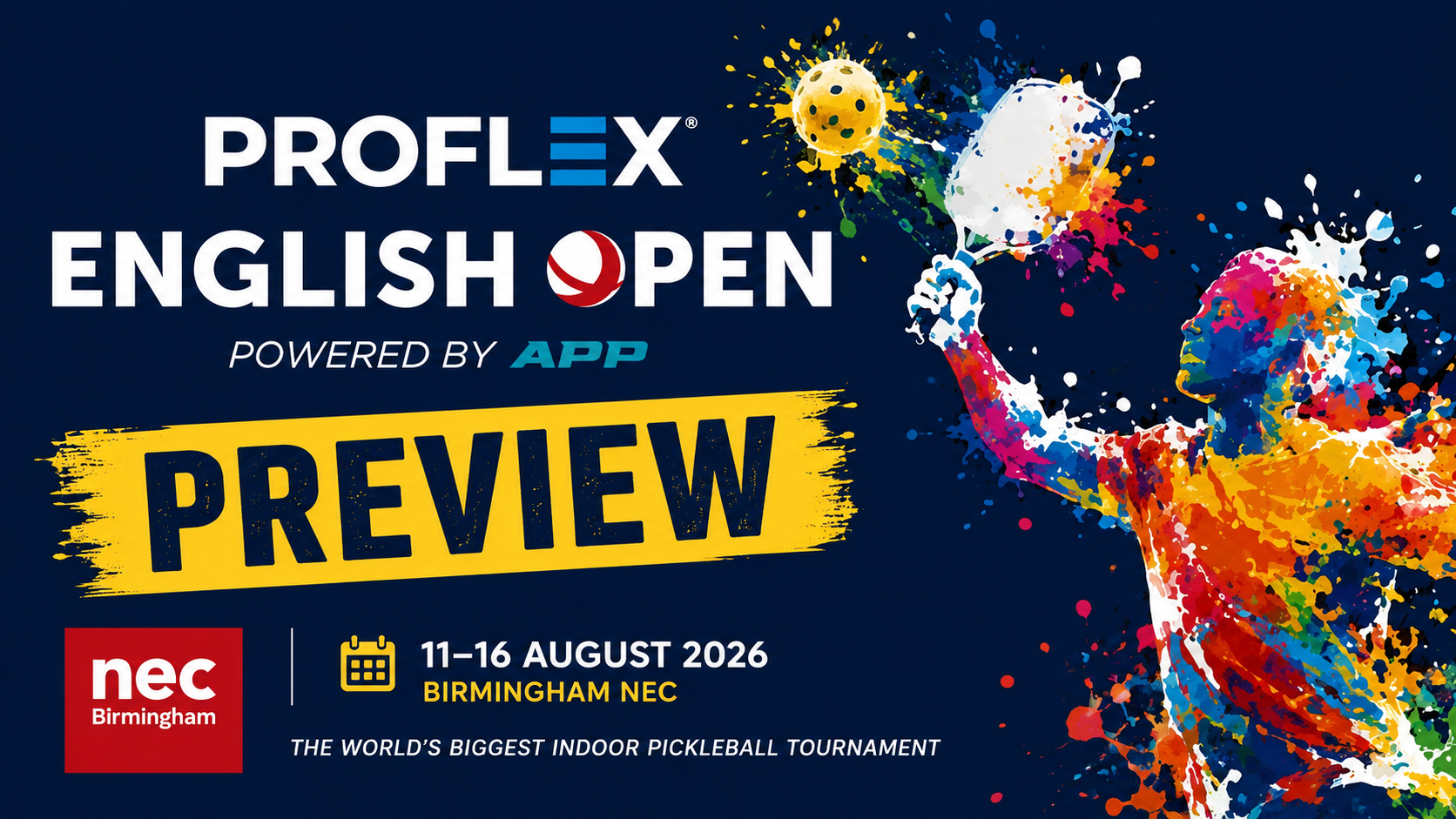
Thousands of players, 60 courts and six days of competition await at Birmingham’s NEC. Chris Beaumont and Nick Hobbis examine the contenders, the draws and the significance of an English Open that has outgrown everything that came before it.
Key Takeaways
- The 2026 English Open runs from 11 to 16 August at Birmingham’s NEC, with competition spread across 60 courts.
- Marcelo Jardim, Lee Whitwell, Megan Fudge and several of Europe’s leading players feature in a deep international field.
- Chris Beaumont and Nick Hobbis preview the medal contenders, dark horses, venue and demands of commentating across the six-day event.
Next week, thousands of players will walk through the doors of Birmingham’s NEC carrying paddles, hopes and varying degrees of expectation.
Some will arrive with realistic ambitions of winning a medal. Others will be hoping to escape a difficult group, defeat a higher-rated opponent or simply produce the version of their game they know exists somewhere beneath the nerves. For many, success will be measured by a single match or moment rather than a podium.
Others will spend the week discovering what it feels like to play in an arena that bears little resemblance to the sports hall where they first picked up a paddle.
That may be the real story of the 2026 English Open.
The Tournament Has Stopped Asking Whether It Belongs
The numbers are impressive enough. The English Open will occupy three halls at the NEC, with 60 courts prepared for six days of competition from Tuesday, 11 August to Sunday, 16 August.
Pickleball England describes it as the largest indoor pickleball tournament in the world. The event has grown from 305 players and 694 event registrations when it launched in 2019 to 2,350 players and 4,321 registrations in 2025. This year’s move to Birmingham gives it considerably more room, both physically and in terms of what the tournament may eventually become.
Every major event reaches a point where it stops proving that it belongs and starts behaving as though it already does.
This English Open feels like one of those moments.
Moving from Telford to the NEC is more than a logistical upgrade. It says something about where Pickleball England believes its flagship event now sits within the international game. The NEC has spent decades hosting major exhibitions, concerts and sporting occasions. Pickleball is no longer borrowing a leisure centre for the weekend. It is taking over three halls at one of Britain’s best-known event venues.
The scale will be obvious from the moment players walk inside. Two championship courts, ProFlex playing surfaces, an expanded vendor village, seminars, inclusive competition and matches running across dozens of divisions will make this feel less like one large tournament and more like a temporary pickleball city.
The Definitive English Open Preview
That changing scale became the starting point for the latest edition of the World Pickleball Podcast on Spotify, where Chris Beaumont is joined by fellow commentator Nick Hobbis for a detailed preview before the opening serve is struck.
The pair work through the senior and Open draws, examining the defending champions, new partnerships, international contenders and players capable of upsetting the expected order.
Can anyone prevent Marcelo Jardim from dominating the senior divisions again? Jardim claimed the men’s doubles, mixed doubles and singles titles in 2025, and returns alongside Richard Love in the men’s competition before reuniting with Lee Whitwell in mixed doubles.
Whitwell begins the week as one of the strongest favourites anywhere in the tournament. Her partnership with Teresa Tarn will take some dislodging in the women’s senior doubles, while the singles draw could provide one of the more competitive tests of her week.
Megan Fudge returns to defend her place at the top of the women’s Open field, although the tournament’s strongest divisions contain enough depth to punish anyone who begins slowly. Dominika Turkovic, Roos Van Reek, Kat Stewart, Shelby Bates, Molly O’Donaghue, Bobby Oshiro and several leading European and Australian players give both the singles and doubles events a genuinely international complexion.
You can also follow the show through The World Pickleball Podcast on Apple Podcasts.
The Draws That Could Define The Week
The men’s Open singles draw may be the most difficult competition of the week to predict. Defending champion Ronan Camron and 2025 finalist Balint Bako return, but the field beneath them is deep.
Louis Laville, Josh Roberts, Jack Edwards, Harry Feast, James Ling, Alexander Minogue Stone, Theo Platel, Ben Cawston, Ignasi De Rueda, Pep Canyadell, Brandon Lane, James Chaudry and a long list of credible challengers leave little room for an easy route into the latter stages.
The podcast does not pretend that every prediction will survive contact with the draw. That uncertainty is part of the attraction. A tournament of this size always produces unfamiliar names, unexpected partnerships and players who arrive as outsiders before leaving as part of the wider conversation.
The same applies to the Open doubles. Jack Munro and Richard Livornese return as defending men’s champions, but Cawston and Platel arrive as one of Europe’s most established partnerships, while De Rueda and Canyadell offer another credible challenge.
Sunday’s mixed doubles provides a particularly intriguing change. The leading partnerships from 2025 have been rearranged, with Megan Fudge now alongside Richard Livornese and Rose Van Reek partnering Jack Munro. Familiar players will enter with different dynamics, while a deep group of European, American and Australian pairings waits behind them.
The podcast also looks beyond the obvious names. Hobbis and Beaumont identify players whose progress over the past year deserves attention, from developing British talent to overseas competitors who may be unfamiliar to much of the home audience.
More Than The Open Divisions
The English Open has never been defined solely by its show courts.
Competition runs from junior age groups through to divisions for players aged over 80. Wheelchair and para events sit alongside elite Open draws, while Thursday’s Unity Cup deliberately mixes ages and levels in a format built around participation rather than traditional tournament hierarchy.
That breadth is part of what the tournament is trying to represent. The leading players give the English Open status, but the thousands competing away from the championship courts give it scale, atmosphere and identity.
A player entering their first major event may share the building with established professionals, international champions and athletes who have spent decades competing at the highest level. They are not having the same tournament, but they are part of the same occasion.
The Road to the English Open has followed that more personal side of the event throughout the summer, documenting the ambition, injuries, partnerships and uncertainty experienced by players preparing for Birmingham.
Life Behind The Microphone
The final section of the episode offers something listeners rarely hear: a detailed conversation about the work required to commentate on a tournament of this size.
Beaumont and Hobbis will spend six days calling matches from the first balls on Tuesday morning until the final medal contests on Sunday. The working day may begin at 8am and continue well into the evening, with long periods of concentration interrupted by moments that require immediate accuracy, energy and judgement.
They discuss research, voice care, hydration and the difficulty of remaining alert when a routine group match suddenly produces the point of the day. The comparison they reach is with goalkeeping. A commentator may spend long periods allowing the match to breathe, but when the decisive moment arrives, there is no opportunity to ask for it again.
Knowing when to stop speaking matters too. Good commentary is not measured by how many words can be forced into a rally. Sometimes the atmosphere, players and pictures should carry the moment themselves.
Beaumont faces an additional problem. He is competing as well as commentating, entering the 35-plus 4.5 singles before attempting to return to the broadcast position with enough physical and mental energy left for the remainder of the weekend.
Birmingham Is Ready
By this time next week, many of the predictions made in the episode will already be obsolete.
Some favourites will have fallen early. New names will have emerged. Partnerships that looked convincing on paper may have discovered that tournament play is less accommodating. Somebody will leave Birmingham with a medal capable of changing how the rest of Europe sees them.
That uncertainty is why the preview matters and why the tournament itself has become such an important week in the calendar.
The English Open is no longer simply a large British event with international visitors. It has become a meeting point for European pickleball and, increasingly, for players from well beyond Europe who understand the value of being there.
For six days, the NEC will offer a glimpse of where the game currently stands, from the people trying tournament pickleball for the first time to the professionals attempting to establish themselves at its highest level.
The predictions will soon be forgotten. The scale of what Pickleball England has built will be harder to overlook.
Listen to the full English Open preview
Hear Chris Beaumont and Nick Hobbis break down the draws, medal favourites, dark horses and stories to follow across all six days at Birmingham’s NEC.
Further Reading
- Meet the players on the Road to the English Open
- Listen to more World Pickleball Podcast episodes
- Tournament coverage and results
- Latest pickleball news from around the world

Chris Beaumont
Founder and Editor-in-ChiefChris Beaumont is the founder and Editor-in-Chief of World Pickleball Magazine. Chris follows the global game closely, reporting on the latest news, developments, stories and tournaments from all five continents. He also hosts the World Pickleball Podcast, interviewing people at…
View All Articles →

