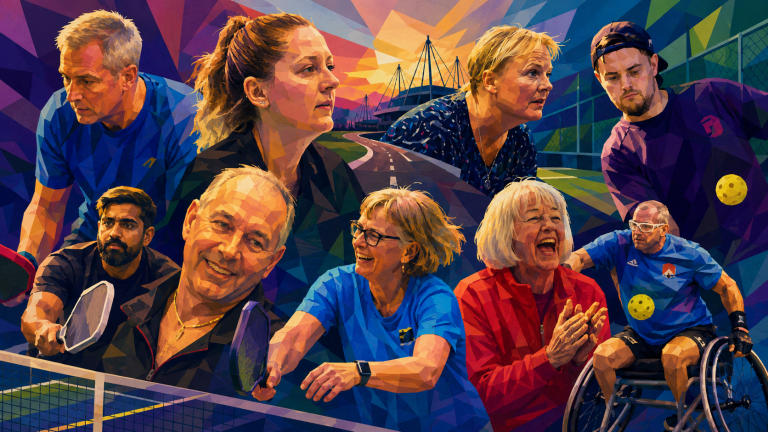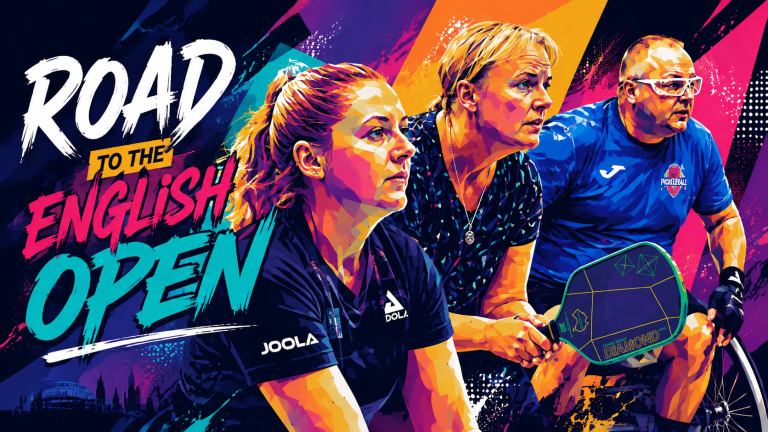

Twelve players. One summer. One road to the English Open. From wheelchair champions to 7am drill sessions, World Pickleball Magazine begins following the stories behind Europe’s biggest tournament.
The sport that took over their lives
The lights inside the sports hall in Hull do not flicker on until late evening, but by then Stephen Hargreaves has already been awake for hours.
He has finished another night shift at Amazon. Somewhere between family life, organising his own club in Doncaster and chasing the elusive jump to 4.0 level pickleball, he has squeezed in another 100-mile round trip for training.
On Thursdays, that journey takes him to the We Do Pickleball centre in Hull. On Wednesdays, it might be Grantham. Most evenings end the same way. Watching PPA Tour matches deep into the night, studying patterns, rewinding rallies, trying to understand why the best players in the world make the decisions they do.
“I want to play it every minute of every day.”
Across the country, alarm clocks are going off before sunrise for reasons that have nothing to do with work.
At 7am, Zoe Ashbridge is already on court drilling backhand dinks before the working day begins. Last year she walked into the English Open unsure whether she even deserved to be there. She lost every match she played. This week, she won a gold at a tournament and spoke with the quiet confidence of somebody beginning to realise she belongs.
In North Wales, Emily Williams is trying to balance nursing placements, GCSE revision sessions with her son, committee work at Anglesey Pickleball Club and preparation for the biggest tournament of her year.
“I’m stretched, but I’m determined.”
Meanwhile, Simon Heaps is spending part of his week hitting 200 serves from a wheelchair, sharpening movements and refining chair adjustments ahead of the English Open. At 70 years old, the former England and Great Britain table tennis international has already conquered one sport. Now he wants another title in another arena.
“Proper Preparation Prevents Piss Poor Performance,” he says, still carrying the mindset of an elite athlete decades after first competing internationally.
And in Wales, Kath Knowles is temporarily off court altogether.
The woman who helped establish pickleball communities across Anglesey and played a major role in the growth of Pickleball Wales is currently battling a hamstring injury. Physio exercises have replaced tournaments for now. The fear is not simply missing matches. It is the thought of losing something much bigger.
“I’ve realised how empty and different my life would be without pickleball.”
This is the reality behind the English Open.
Not just medals and livestreams and packed halls at the NEC in Birmingham. Not just rankings, draws and podium photographs.
For the players World Pickleball Magazine is following on the Road to the English Open, the tournament has already started to reshape daily life.
Sleep schedules are changing. Holidays are being planned around tournaments. Bodies are being pushed. Confidence is rising and collapsing again within the same week. New friendships are forming. Old sporting identities are returning.
Some are chasing medals.
Some are chasing proof.
Some are simply trying to hold on to the feeling the sport has given them.
And somewhere between the early morning drills, the motorway miles, the injury rehab and the late-night match study, pickleball has quietly stopped being just a hobby.
Pickleball has taken over
For some players, the road to the English Open looks carefully planned and balanced.
For others, it has started to consume almost every spare hour available.
Stephen Hargreaves laughs when he describes his pickleball life as “hectic”, but there is an intensity underneath the joke that many players inside the sport will recognise immediately. Two years ago, he decided it was time to put down the gaming controller and direct his competitiveness elsewhere. Now his weeks are built around league matches, high-level sessions, tournaments, drilling and long drives across the country searching for stronger opposition.
There are weekly sessions in Hull with 4.0+ players preparing for the English Open. There are trips to Grantham to work with his doubles partner. There is league play with Grid Pickleball in North Yorkshire, where his team opened the season with twelve wins from twelve matches. Then there is the constant background noise of improvement. Watching PPA Tour matches. Studying patterns. Trying to close the gap between where he is and where he believes he can reach.
The danger, he admits openly, is burnout.
A recent knee problem, caused by a Baker’s cyst, has forced him to think more carefully about how much training his body can absorb. Yet even while talking about the injury, the excitement still spills through. He talks about singles losses that suddenly became encouraging instead of disappointing. About realising how far he has come. About finally feeling like he belongs in stronger company.
That same obsession with improvement exists in a very different form for Zoe Ashbridge.
Her route into pickleball began at the English Open itself in 2024. She attended because a client was exhibiting there. At the time, she barely knew what pickleball was. Now she plans her entire working week around it.
Because she is self-employed, she has built a life where pickleball sessions fit around work rather than the other way around. Some days involve two separate sessions. Others start before sunrise.
This week, she described meeting fellow player Lauren Brown at 7am specifically to work on backhand dinks before the working day started. They are part of a women’s development squad coached by Gemma Southall, with sessions built around repeating and refining specific shots rather than simply playing games.
A ball machine has become part of the routine too.
“Who couldn’t resist going on a ball machine when you’ve got the whole court to yourselves?” she laughed.
Twelve months ago, the emotional tone around the tournament was completely different. Zoe arrived at the English Open wondering whether she deserved to be there at all. She lost every match. Instead of retreating from the experience, she doubled down on it.
Now there is less fear and more curiosity.
“This year feels different,” she admitted.
Hari Bollineni’s story is still at an earlier stage, but the pull of the sport already sounds familiar.
He started pickleball last year with no racket sports background and now finds himself trying to balance full-time work with social sessions, drilling, tournaments and helping grow the game around Worksop. What has struck him most is how quickly the sport humbles players who think they have figured it out.
“Some days I feel like I’m improving quickly,” he said. “Other days the game humbles you very fast.”
That tension between confidence and frustration appears again and again in these stories.
The obsession is not really about winning medals yet.
It is about the feeling that another level exists somewhere just ahead, if only enough hours can be poured into finding it.
Second chances
Long before he ever picked up a pickleball paddle, Simon Heaps had already lived several sporting lives.
At 17, he toured the United States with the Harlem Globetrotters, performing table tennis exhibitions during half-time shows. He represented England and Great Britain as an able-bodied player. Later, after losing his first leg, he transitioned into para table tennis and returned to international competition within six months, eventually winning medals across the world and becoming a European and world champion.
Most athletes would have accepted that as enough.
Instead, at 70 years old and after losing both legs within the last six years, Simon is preparing for another major tournament in another sport entirely.
His weeks now revolve around pickleball sessions, advanced doubles games, wheelchair movement work and repeated service practice. Thursdays are reserved specifically for 200 serves, partly to sharpen his wheelchair game, partly because elite habits never really disappear.
“I am only in a wheelchair when I play sport,” he explained this week, discussing the challenge of adapting to movement patterns that lifelong wheelchair athletes naturally possess.
What stands out most listening to Simon speak is not resilience. It is competitiveness.
He is not travelling to Birmingham simply to participate in the largest indoor pickleball tournament the sport has ever staged. He is travelling there expecting to contend.
“Focused, determined and positive,” was how he described his mindset heading towards August.
Elsewhere in Wales, Kath Knowles is fighting a very different battle.
For the first time in years, pickleball has temporarily been taken away from her.
A hamstring injury has halted her preparation and forced her into physio exercises instead of tournaments, a frustrating pause for somebody who has spent much of the last decade helping build parts of the sport’s grassroots structure in Wales. Kath has played in every English Open and Nationals since their beginnings. She helped establish pickleball communities across Anglesey after discovering the sport in Bolton in 2017. During Covid, she pushed relentlessly to keep the game alive outdoors and later played a role in the creation of Pickleball Wales itself.
The stories inside her story seem endless.
Breast cancer. Two heart attacks. Mental health struggles. Community projects for over-60s players across the island. Leading Wales into the European Championships in Rome. An upcoming visit to Buckingham Palace for the King’s Garden Party.
Yet despite everything she has already experienced in sport and life, her biggest fear right now is painfully simple.
Not being able to compete again.
“My worries right now are that my injury, along with my ageing joints, won’t allow me to play at my optimum,” she admitted. “Or worse still, not repair well enough to play competitively again.”
There is no self-pity in her words. Only sadness at the possibility of losing something that has become woven into daily life.
For Kath, the English Open is no longer just a tournament. It is a reunion point for years of friendships, travel and shared experiences built through pickleball. This summer she plans to compete alongside Frank Arico, President of the European Pickleball Federation, a partnership she still sounds slightly amazed by.
“I’ve had so much out of the game of pickleball,” she said. “Thank goodness for pickleball… changing lives and the mindset of players far and wide.”
That line could easily sit underneath almost every story in this project.
Because beneath the training schedules and DUPR ratings, many of these players are talking about something far deeper than competition.
They are talking about finding another version of themselves.
The people building the sport
Not everybody on the Road to the English Open measures progress through medals or ratings.
For some, the most important work happens long before anybody walks onto a tournament court.
A few years ago, Julie Vickerman visited her daughter in Vancouver and saw pickleball for the first time. She returned home convinced not only that she wanted to play it herself, but that the sport could genuinely improve people’s lives if the right community existed around it.
Now that community stretches across Richmond and Wellfield Pickleball Club, where Julie helps oversee around 90 members, five weekly sessions, coaching structures, drills, league teams, friendlies and a growing network of players preparing for tournaments around the country.
Her own pickleball life is almost impossible to separate from the club itself.
“There’s always something to do with pickleball going off,” she laughed this week.
The details reveal just how much unseen work sits behind grassroots growth. Notices before sessions. Organising drills. Introducing new members. Scheduling games. Managing finances. Running coaching structures. Bringing in guest coaches. Supporting beginners while still trying to improve her own game.
Recently, England coach Rob Williams visited the club for an intensive coaching day. One of the biggest lessons he gave Julie was not technical.
She needs to spend more time on herself as a player.
At the moment, she spends so much energy making sure everybody else is progressing that her own development often comes second.
Yet when Julie talks about the upcoming English Open, her first instinct is still to discuss the players travelling with her rather than herself.
“Their success is my success.”
That same balancing act between personal ambition and community responsibility appears again and again throughout the group.
Emily is currently juggling nursing placements, committee work with Anglesey Pickleball Club, social media responsibilities, coaching ideas, league matches and family life, all while trying to prepare for the biggest tournament she has entered.
Laura Yeomans is balancing full-time NHS work with helping run Pickleball Complete Academy, league competition and preparation for both women’s doubles and mixed doubles events at the Open. Last year’s gold medal success has added another layer of pressure.
“There’s always a little part of my mind that worries about letting others down,” she admitted.
Sarah Reading describes something similar from a different perspective.
The first time she attended the English Open, she only knew four people. Now she walks into tournaments surrounded by familiar faces, support networks and friendships built through the sport.
“I just love that community spirit,” she said. “When I played tennis, I never had these kinds of opportunities.”
Even routine life now seems to orbit around pickleball for many of them.
Schedules are organised around league fixtures. Holidays include tournaments. WhatsApp groups buzz constantly with partner searches, tactical discussions and court bookings. Players who once considered themselves casual participants are suddenly discussing nutrition plans, recovery strategies and tactical drilling sessions.
What emerges from all these stories is a picture of a sport growing not through advertising campaigns or celebrity endorsements, but through ordinary people quietly reorganising their lives around it.
The players heading to Birmingham this summer are not simply entering a tournament anymore.
Many of them are carrying entire communities with them.
The NEC is coming
For now, the English Open still exists mostly in fragments.
A date in the calendar.
A hotel booking.
A doubles partnership slowly taking shape.
A growing collection of WhatsApp messages, drills, league matches and nervous thoughts.
But the closer August gets, the more real it becomes.
Karen Farnhill can already picture the courts inside the NEC.
“I’m bursting to play there,” she said this week. “I can’t wait to see the whole lot of the courts set out there.”
For players who remember the sport’s smaller early years in Britain, the scale of what is coming still feels slightly surreal. Karen has followed pickleball’s growth in this country since 2018 and now finds herself preparing to compete inside one of the UK’s biggest sporting venues while balancing swimming sessions, daily walks and the constant management of injuries and fatigue.
Others are thinking less about the venue and more about what the tournament represents personally.
For some, Birmingham is a genuine medal opportunity.
Simon Heaps is travelling there expecting to compete for gold. Laura Yeomans is carrying the pressure of previous success into stronger categories. Stephen Hargreaves believes the recent progress in his game has finally put him in a position to test himself properly against high-level opposition.
But for others, success looks very different.
Emily wants proof that she can survive the chaos of balancing nursing placements, family life and competition while still improving as a player. Zoe wants confirmation that she belongs at this level after losing every match a year ago. Hari wants to discover where his ceiling really is after entering the sport with no racket background at all.
And beneath all of it sits the anxiety that every athlete understands, regardless of level.
The fear of letting partners down.
Julie still battles nerves despite already winning national titles. Sarah worries about not producing her best level on the day. Laura admits the mental side of competition remains one of her biggest challenges. Kath fears her body might not recover in time to let her compete freely again.
Nobody hides from those doubts for very long in pickleball.
The sport is too social. Too exposed. Too emotionally immediate.
There are no giant entourages here. No layers separating competitors from each other. Players warm up beside the people they will face later that day. Rivals become practice partners a week later. Medal winners sit together after matches discussing missed volleys and bad line calls over coffee or drinks.
That is part of what makes the English Open feel bigger than a normal tournament to so many involved.
It is not only about competition anymore.
It is about identity.
About belonging.
About discovering whether the version of yourself that exists in training sessions, league matches and quiet moments of confidence can survive under brighter lights and bigger pressure.
The English Open is still weeks away.
But already, lives are being reorganised around it.
The journey has already started
Over the next thirteen weeks, some of these players will arrive in Birmingham carrying confidence.
Others will arrive carrying injuries, doubts or exhaustion.
Some partnerships will click. Others will not. DUPR ratings will rise and fall. There will be breakthrough performances, brutal losses, surprise runs and difficult drives home. There will almost certainly be moments where players question whether all the hours, motorway miles and nerves were worth it.
And then there will be moments that remind them exactly why they started.
A packed court at the NEC.
A medal match.
A comeback win.
A new friendship.
A message from somebody inspired to try the sport for the first time.
For now, though, the Road to the English Open exists in quieter places.
In early morning drill sessions before work.
In wheelchairs loaded into cars before league matches.
In physio exercises done while hoping a body holds together for one more tournament.
In nursing placements, family schedules, motorway services and WhatsApp groups full of tactical conversations.
This is not the polished side of professional sport.
It is something far more recognisable.
People trying to become something more than they were a year ago.
People trying to belong.
People trying to prove something to themselves before time, injury or life gets in the way.
The tournament itself has not started yet.
But for these twelve players, the journey already has.

Chris Beaumont
Founder and Editor-in-ChiefChris Beaumont is the founder and Editor-in-Chief of World Pickleball Magazine. Chris follows the global game closely, reporting on the latest news, developments, stories and tournaments from all five continents. He also hosts the World Pickleball Podcast, interviewing people at…
View All Articles →