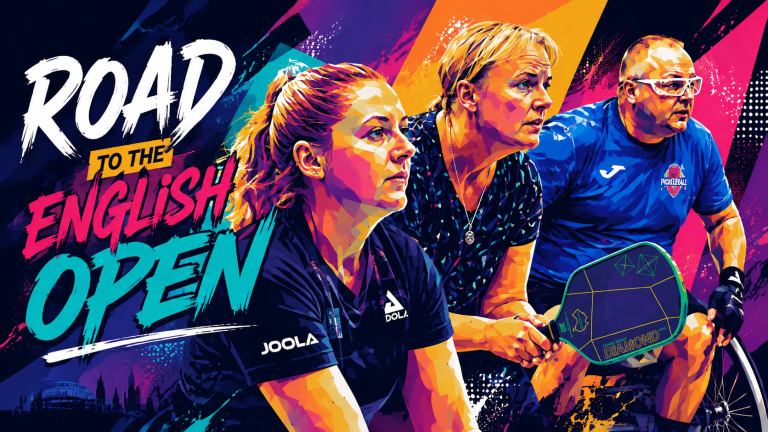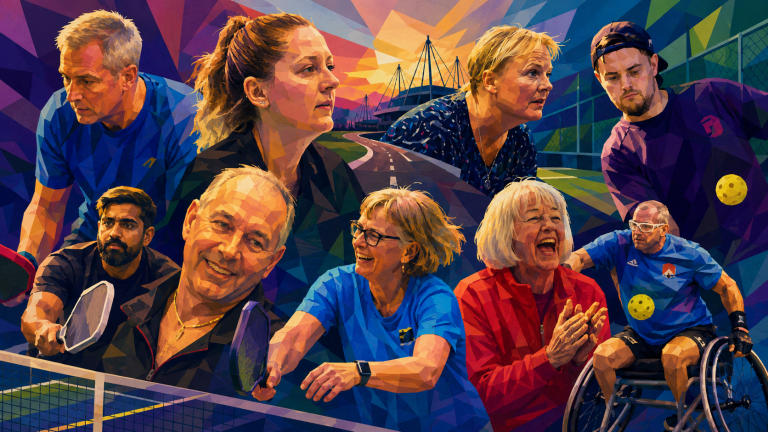

Road to the English Open, Week 7: As the English Open moves closer, the twelve players are learning that preparation rarely happens in ideal conditions.
On Wednesday morning, Karen Farnhill’s husband was admitted to hospital with two fractured vertebrae.
The English Open did not move.
It remained exactly where it had always been, sitting in late August, waiting patiently at the end of a summer that suddenly looked rather different from the one Karen thought she would have.
There were hospital visits to make. A mother who still needed care. A house that would not stop generating jobs simply because a pickleball tournament was approaching. There was also a question hanging quietly in the background. How much energy was realistically left for preparation when everything else seemed to demand attention first?
A few days later, Karen found herself driving to Leeds to compete anyway.
Not because circumstances had improved. They hadn’t. The hospital was still there. The responsibilities were still there. The worries had not disappeared.
She simply went.
That decision, repeated in different forms across twelve lives, feels like the story of Week Seven.
Seven weeks ago, Road to the English Open was largely a story about preparation. Players talked about ratings, partnerships, draws and ambitions. Birmingham felt distant enough to be imagined in ideal terms. There would be more drilling. More court time. Better fitness. Greater confidence. Improvement would arrive steadily and predictably, accumulating week after week until the tournament eventually arrived.
The closer Birmingham gets, the less convincing that version of events appears.
Life rarely provides a clear runway.
Instead it interrupts.
Illness arrives. Jobs need applying for. Parents need caring for. Children have proms. Bodies break down. Motivation disappears. Hospital appointments appear without warning. Summer plans change.
The tournament remains where it always was.
Everything else moves around it.
Hari spent much of the week alone with a bucket of balls.
No tournament. No medal. No audience.
Just serves, dinks and third-shot drops repeated until they became a little more reliable than they had been a week earlier.
A few months ago he might have viewed a week like that as uneventful. Now he sees it differently. Improvement, he realised, is not about spending more time on court. It is about spending better time on court.
Many amateur players spend years believing effort and progress are the same thing.
Week Seven suggests several members of this group are beginning to understand otherwise.
David “Thomo” Thompson reached a similar conclusion from a different direction. For years he has relied on instinct, experience and competitive stubbornness. This week he attended two drilling sessions, a fact he repeated several times, partly because he found it amusing and partly because it represented a genuine shift in behaviour.
Two drilling sessions will not transform a player overnight. They do, however, suggest a growing recognition that Birmingham cannot simply be approached in the same way as every previous tournament.
The player who arrives there may need to be slightly different from the one who started this journey.
Sarah Reading’s development feels less technical and more psychological.
Earlier in the project she often worried about whether she was doing enough. More training. More tournaments. More preparation. More everything. This week she sounded calmer. Not complacent. Just calmer.
She is learning not to force points. Learning not to rush. Learning that patience can be as valuable as aggression.
On the surface she is talking about shot selection.
Underneath, she is talking about herself.
The most revealing line in her submission was not about pickleball at all. She admitted she sometimes looks at what others are doing and wonders whether she is doing enough.
Most amateur athletes know that feeling.
The difference now is that Sarah seems less willing to let it control her.
Julie Vickerman returned from Sunderland with a silver medal and a question.
Why did her serve behave so differently under pressure?
In practice it felt reliable. In competition, particularly when matches became close, it became far less predictable.
The medal mattered. The question mattered more.
Julie plans to spend the coming week analysing match footage, looking for patterns she may have missed while standing in the middle of it all. It is a very different response from the one she might have given earlier in the project.
What has changed is not simply her game.
It is her ambition.
For much of this series, Julie has spoken about community, friendships and helping others succeed. Those things remain central to who she is. Yet seven weeks spent alongside ambitious, driven competitors appears to have shifted something.
She still wants everyone around her to do well.
She has simply started allowing herself to want that too.
For all the differences between their stories, there is a common thread running through them.
Buckets of balls.
Serving practice.
Video analysis.
Wall drills.
Tiny adjustments that rarely appear in photographs but often determine what happens when competition finally arrives.
The invisible work continues.
Yet for many participants, pickleball occupied only part of the week.
The larger story sat elsewhere.
Emily Williams barely mentioned the sport.
That in itself felt revealing.
There was work. More work. Time with her son Kaelo before his school prom. Preparations for a trip to Africa. The emotional uncertainty of waiting to discover whether years of study would lead to a first nursing position at a time when newly qualified nurses are finding opportunities increasingly difficult to secure.
Seven weeks ago Emily often sounded like somebody trying to fit everything into the same day.
This week sounded more like somebody accepting that not everything can fit.
Pickleball remained important.
It simply wasn’t the loudest thing happening in her life.
The same could be said of Simon Heaps, although in a very different way.
Shingles have imposed an unwelcome pause on a summer that was supposed to be building towards Birmingham. Instead of competing, Simon found himself watching. Football. Golf. Tennis. Table tennis. Pickleball. Hours spent observing the sports he normally participates in rather than playing them himself.
The image carries a quiet sadness.
Not because Simon is feeling sorry for himself. He rarely does.
Rather because watching reminded him how much he misses being involved.
His withdrawal from the WPC Global tournament in Leeds cost him valuable court time alongside other wheelchair players. It also deprived him of an opportunity he had been looking forward to for months.
The frustration is obvious.
So is the guilt.
One of the most striking themes of Week Seven is how many participants seem reluctant to extend compassion to themselves. Laura feels guilty for stepping away. Simon feels guilty for being ill. Karen wonders whether she is giving enough. Sarah worries she could always do more.
Nobody appears disappointed in themselves anymore.
But many still seem uncomfortable with the realities of their circumstances.
Simon’s submission contained one line that cut through everything else.
Hope is all I need.
A table tennis pupil may have identified a route towards a new wheelchair before Birmingham. Nothing is certain. No guarantees have been made. No outcome is promised.
But the possibility exists.
And for Simon, at least for now, that is enough.
Kath Knowles would probably understand that feeling.
While most participants spent the week thinking about drills, partnerships or tournaments, Kath’s ambition remains much simpler.
She wants to hold a paddle again.
Injured for much of the project, she has reached the stage where recovery itself has become the focus. Exercises are no longer something to complete vaguely. Repetitions matter. Technique matters. Patience matters.
The objective is not Birmingham.
Not yet.
The objective is returning.
There was another image from Kath’s week that lingered long after reading her submission. Standing with her husband outside a wedding venue, arms around one another, watching the sun disappear over the Irish Sea.
A few months ago she might have described a perfect pickleball session.
This week she described a sunset.
That shift feels important.
Not because competition matters less.
Because perspective has widened.
The most powerful moment in her update arrived unexpectedly. Asked what she tells herself when things become difficult, Kath spoke about Abigail, her stepdaughter, who died two years ago after spending eight weeks in hospice care.
When nerves arrive, when frustration builds, when circumstances feel overwhelming, Kath thinks about Abigail’s strength.
Then she carries on.
Some stories do not need explaining.
Laura Yeomans spent much of the week wrestling with a different challenge.
For several weeks she has been circling a difficult truth. This week she finally said it plainly.
Her heart was not in it.
After stepping away from pickleball for a period, she attempted to return, only to discover the enthusiasm she expected to find simply wasn’t there. The experience unsettled her, partly because she is deeply competitive and partly because she is accustomed to pushing through difficult periods rather than retreating from them.
Yet the longer she spoke, the clearer it became that this temporary withdrawal might represent progress of a different kind.
Most sports have an off-season, she observed.
Football has one.
Cricket has one.
Rugby has one.
Why should pickleball be any different?
It is a deceptively simple question.
Amateur sport often encourages constant participation. There is always another tournament. Another league fixture. Another opportunity to compete. Rest can begin to feel like failure.
Laura is challenging that assumption.
Instead of forcing herself back onto court, she has spent the week running. Long runs in the sunshine. More miles than she has managed for years. Most importantly, more miles without pain.
For somebody whose sporting history has been shaped by hip problems and surgery, that matters.
The irony is difficult to ignore. While stepping away from pickleball, she may have rediscovered something that first drew her towards sport in the first place.
Freedom of movement.
The ability to exercise simply because it feels good.
If Laura’s story is about permission, Zoe Ashbridge’s is about belonging.
There was a time earlier in the project when Zoe often sounded as though she was trying to earn her place. Every tournament result, every new skill and every improvement seemed to carry a hint of validation with it.
Week Seven felt different.
Not because she won.
Although she did.
Not because she remained unbeaten alongside her doubles partner Marta.
Although she did that too.
The change was subtler.
She sounds like somebody who genuinely believes she deserves to be there.
The most revealing moment arrived after the medals had been handed out. One of her opponents, Robyn, sent her a message. Not to congratulate her on winning, but to describe her as dominant, determined and focused.
The words landed harder than the result itself.
Partly because Zoe respects Robyn.
Mostly because those were exactly the qualities Zoe herself had admired across the net.
The message meant so much she took a screenshot and sent it to her mother.
That detail says more than any medal count could.
What many of the participants seem to be discovering is that improvement rarely arrives in the form they expect. Sometimes it appears as a technical breakthrough. Sometimes it appears as a result. Sometimes it arrives through another person recognising a version of you that you are only just beginning to recognise yourself.
That influence runs throughout the group.
Sarah spoke warmly about a young player she met earlier this year who has transformed his confidence through the sport. Simon found hope through a table tennis pupil. Julie talked about the determination of others rubbing off on her own ambitions. Karen described the infectious enthusiasm of her younger partner Lucy Bamber. Even Laura, while stepping away from competition, found reassurance in a doubles partner who placed no pressure on her return.
The further this project progresses, the harder it becomes to separate individual journeys from collective ones.
Nobody is travelling alone anymore.
Perhaps that is why the thought of missing Birmingham provokes such strong reactions.
Again and again, answers drifted away from medals and results and towards people.
Partners.
Friends.
Team-mates.
The group itself.
Somewhere over the last seven weeks, the destination has become shared.
Which brings us back to Karen.
Asked to describe how the Road to the English Open currently feels, she offered perhaps the defining image of Week Seven.
A diversionary route on a minor road.
Satnav would keep telling her to make a U-turn.
It is funny because it is true.
Nobody is travelling the route they expected.
Hari has discovered that improvement is quieter than he imagined.
Thomo is drilling rather than relying on instinct.
Sarah is learning patience.
Julie is becoming more analytical.
Zoe is beginning to trust herself.
Kath is rebuilding.
Simon is waiting.
Laura is resting.
Emily is juggling a life that barely leaves room for pickleball at all.
Karen is balancing hospital visits, caring responsibilities and competition.
The direct road disappeared some time ago.
And yet nobody has abandoned the journey.
Seven weeks ago many of these players believed Birmingham would become the dominant story of their summer.
Instead, life kept interrupting.
A husband went into hospital.
A nursing career hovered in uncertainty.
Shingles arrived.
A player stopped enjoying the sport entirely.
A mother still needed care.
A body still needed healing.
Yet Birmingham remained, quietly waiting at the end of it all.

Chris Beaumont
Founder and Editor-in-ChiefChris Beaumont is the founder and Editor-in-Chief of World Pickleball Magazine. Chris follows the global game closely, reporting on the latest news, developments, stories and tournaments from all five continents. He also hosts the World Pickleball Podcast, interviewing people at…
View All Articles →