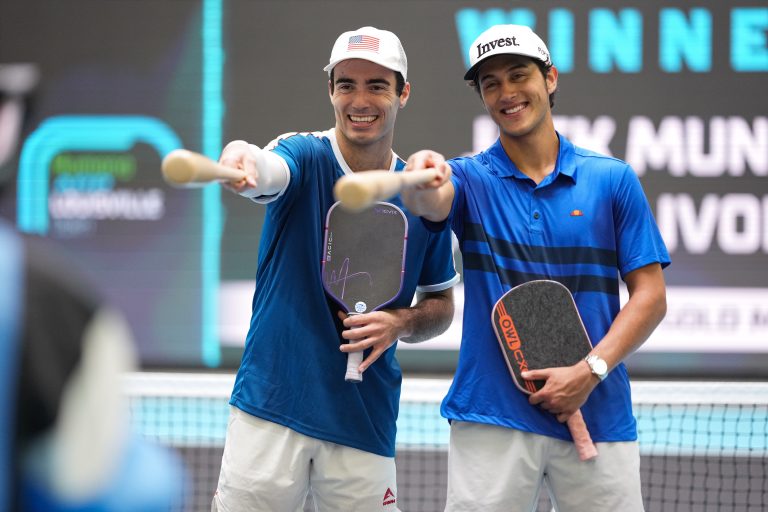

The March 2026 issue of World Pickleball Magazine is now live, featuring global league developments, tournament analysis, exclusive interviews, and stories from across the international pickleball community.
Follow @worldpickleballmagazine on Facebook and Instagram for daily pickleball news, and listen to the World Pickleball Podcast on Spotify, iTunes, and other major podcast platforms.
The 2026 schedule for the Cerveza Victoria Pickle Pro Tour has officially been confirmed, setting a definitive seven-stop itinerary for Spain’s premier national pickleball circuit. Following a successful inaugural campaign in 2025, the tour has now formalised its geographical footprint for the coming year, outlining a pathway that stretches from the Canary Islands to the northern coast before culminating in a high-stakes December finale in the capital. The announcement signals a clear intention to move beyond the foundational stage of the sport and establish a permanent, professional rhythm for competitors.
The current state of Spanish pickleball
Spain currently occupies a highly strategic and increasingly influential position within the European pickleball landscape. The country boasts a deeply ingrained racket sport culture, with tennis and padel already dominating the recreational and professional sporting psyche. Consequently, the adoption of pickleball has not required a complete education of the sporting public; rather, it has found fertile ground among an audience already fluent in court positioning, paddle control, and net play.
However, while the sport has experienced rapid growth across various Spanish municipalities, the immediate challenge has been to unite these distinct pockets of activity into a cohesive national structure. The initial launch of the tour in 2025 served as a vital proof of concept. It demonstrated that there was an appetite not just for playing, but for a structured competitive tier. Now, the confirmation of the 2026 dates indicates that the national governing bodies and commercial partners are heavily invested in transitioning the sport from a purely recreational pastime into a credible professional pursuit. It provides local talent with regular, high-stakes environments in which to compete and develop against the country’s best.
Mapping the 2026 circuit
The confirmed 2026 calendar reveals a highly considered geographical spread, designed specifically to maximise exposure across major hubs while maintaining a logical travel and training schedule for the athletes. The season commences off the mainland, with the Gran Canaria Open serving as the opening act from the 17th to the 19th of April, immediately positioning the tour as a truly national enterprise rather than a mainland-only concern. Competition then transitions back to the southern coast for the Málaga Spanish Open in early May, followed by a mid-summer stop in the capital for the Madrid Open in late June.
As the temperatures rise, the tour heads north to the Galician region for the A Coruña Open in July. Following a brief late-summer pause, allowing players a necessary window for recovery and tactical adjustments, the circuit returns to the south for the Mijas – Costa del Sol Open in September. The crucial penultimate stage takes place at the Barcelona Open in mid-October. This sets the stage for the season to reach its ultimate climax with the Madrid Master Final, scheduled for the 11th to the 13th of December. This balanced approach, weaving between coastal hubs, repeat host markets, and major inland cities, is entirely deliberate, building continuity and sustained audience engagement throughout the year.
Significance in the global landscape
Zooming out, the confirmation of a structured, multi-city calendar in Spain holds significant weight for the wider European project. In the broader context of global pickleball expansion, establishing a robust domestic circuit is the essential bridge between grassroots enthusiasm and international relevance. At present, much of the European landscape is defined by standalone events or scattered weekend festivals. While these are excellent for introductory exposure, they do not build the necessary competitive depth required to challenge established international powerhouses.
Spain is distinguishing itself by creating something the sport still desperately lacks in many international regions: rhythm. Nations that successfully implement regular touring schedules invariably accelerate the tactical maturity of their player pools, as consistent competition forces rapid technical evolution. The Cerveza Victoria Pickle Pro Tour demonstrates that Spain is actively building a sustainable professional ecosystem rather than simply importing a trend. This level of organisational stability provides a clear pathway for emerging players and creates a reliable commercial product that can attract enduring sponsorship and broadcast interest.
Looking ahead to the season
The successful execution of this seven-stop schedule will likely serve as a crucial blueprint for neighbouring European federations watching closely from across the borders. As the Spanish circuit matures and builds its audience from Gran Canaria to Barcelona, it will naturally elevate the competitive standard of its domestic roster. Ultimately, by dictating the pace of play across a full calendar year, Spain is laying the necessary groundwork to produce the next generation of players capable of holding their own on the world stage, ensuring the nation remains at the vanguard of European pickleball development.
Stay ahead of the global game by signing up for the World Pickleball Report newsletter.
Further Reading

Chris Beaumont
Founder and Editor-in-ChiefChris Beaumont is the founder and Editor-in-Chief of World Pickleball Magazine. Chris follows the global game closely, reporting on the latest news, developments, stories and tournaments from all five continents. He also hosts the World Pickleball Podcast, interviewing people at…
View All Articles →