
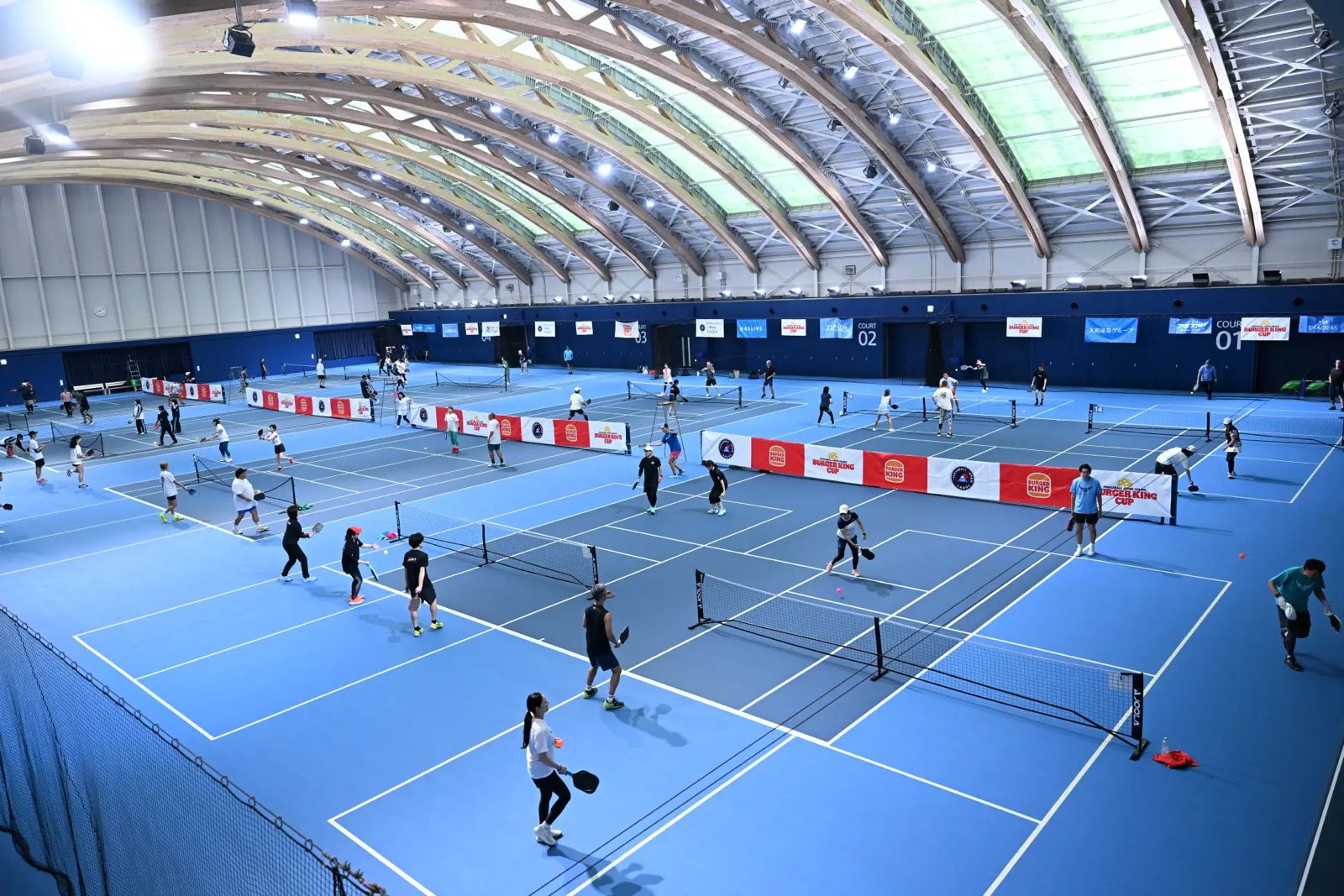
More than 800 players, 24 courts and more than ¥10 million in cash and prizes. Japan’s next major pickleball event is impressive on numbers alone, but the deeper story is how companies are becoming part of the machinery through which the sport is being built.
- The second PJL BURGER KING® CUP will bring more than 800 players to Tokyo across General, Corporate and Professional divisions.
- Sansan’s new PX League puts companies directly inside professional competition as team owners rather than conventional sponsors.
- Japan’s emerging model links player development, corporate networks, facilities and a newly recognised national federation in a way that may differ sharply from the US pathway.
More than 800 players, 24 courts and more than ¥10 million in cash and prizes. When the second PJL BURGER KING® CUP takes place at Tokyo’s Ariake Tennis Forest Indoor Courts from October 11–14, those figures will naturally attract attention.
It will be one of the biggest pickleball events ever staged in Japan, reflecting how quickly the country’s competitive calendar is changing as the sport moves from a small but enthusiastic community into a more organised national movement.
Yet the most interesting story may not be found in the size of the tournament itself.
Beyond the participation numbers, professional players and prize money, something more unusual is beginning to take shape: companies are becoming part of the machinery through which Japanese pickleball is being built.
The Burger King Cup will feature three broad categories of competition: a General Division covering beginner through advanced players, a Corporate Division and a Professional Division. The professional category will connect with the new PX League and bring together some of Japan’s leading players alongside international competition.
But the Corporate Division may be the element that reveals the most about the direction Japanese pickleball is taking.
At almost exactly the same time, the Pickleball Japan Federation announced Sansan, Mitsui Fudosan and Kenedix as the first members of its new Grand Slam Partner programme. These relationships are intended to support the longer-term development of the sport rather than function simply as sponsorship agreements attached to a single tournament.
Taken separately, each announcement could be viewed as another sign of an emerging pickleball market attracting more players, more money and more commercial interest. Put together with the other developments taking place in Japan, however, they suggest a broader question: what if companies are not simply supporting pickleball, but becoming part of the infrastructure through which the sport grows?
Corporate involvement in sport is hardly unusual in Japan. For decades, companies have played a major role in supporting sporting activities, from corporate baseball teams to employee participation programmes and community initiatives.
Pickleball may now be entering a similar environment, where businesses are not only providing financial support but helping to create teams, develop players and build communities around the sport.
The Corporate Division of the Burger King Cup is therefore more than a marketing feature. It reflects a wider trend already visible through Sansan’s Pickleball X project.
The Tokyo-based technology company has supported Pickleball X since January 2025, with the goal of developing Japanese players capable of competing internationally. The first two editions focused heavily on training camps, access to high-level coaching and creating opportunities for promising players to improve.
That investment is already beginning to show results.
Nasa Hatakeyama and Kyo Sawaki, both supported through the programme, signed professional contracts with the Professional Pickleball Association (PPA) in June 2026 after progressing through Pickleball X.
For the third edition, Sansan is taking the concept further. Rather than another series of training camps alone, Pickleball X is launching the PX League in October, a seven-month, six-team mixed professional competition that will run until April 2027.
The defining feature of the league is its corporate structure. The teams belong to companies.
ASICS will operate the ASICS Sevens, Globelide will have the GLOBERIDE TEALS, TBS Television will run the TBS Lucky Cats, Transcosmos will field transcosmos NEXUS, and Sansan itself will participate with Sansan Passions. Mercari has also announced that it will participate through its own Mercari Pickleball club.
Players will be recruited publicly between August 10 and 23 before a September 12 draft. Each team will consist of three men and three women, with league matches featuring men’s and women’s doubles, singles and mixed doubles.
What makes the PX League significant is not simply that companies are attaching their names to teams. They are becoming directly involved in creating the competitive structure itself.
Instead of paying only for visibility around an existing sport, they are helping to build the environment in which players develop and competitions take place.
From player development to professional competition
There is another reason the PX League matters to this wider story.
Sansan’s ambition with Pickleball X was never simply to increase the number of people playing pickleball in Japan. The company identified a different challenge: developing players who could compete internationally.
Across the first two editions of the programme, approximately 300 applications were received, showing the level of interest among Japanese players who wanted to improve and potentially pursue the sport at a higher level.
The initial response was to create an environment for development through coaching, training and access to experienced professionals. Former US pickleball champion Daniel Moore and Rika Fujiwara, who represented Japan in tennis for 11 years before moving into pickleball, have been involved as coaches in the programme, helping players bridge the gap between recreational participation and professional competition.
The launch of the PX League represents the next stage of that process.
A training programme alone cannot create a professional sporting pathway. Players also need regular competition, pressure situations and the opportunity to measure themselves against strong opponents over time.
By creating a seven-month league, Pickleball X is attempting to provide something that has often been missing in emerging sports markets: a consistent competitive environment.
The pathway is still in its early stages. Two players signing PPA contracts does not mean Japan has suddenly created a complete national development system, and a single league season will not establish the country as a global pickleball powerhouse.
But the mechanism itself is beginning to appear.
Companies provide support and own teams, players enter through a draft process, coaches develop talent, and a domestic competition gives athletes the experience needed before testing themselves internationally. That developing pathway sits alongside a Japanese competitive scene that has already produced significant results, including Yuta Funemizu’s historic men’s doubles victory at the Sansan Tokyo Open.
The relationship between the Burger King Cup and the PX League is also significant. On October 14, the professional category of the Burger King Cup is scheduled to collaborate directly with the PX League, bringing together Japan’s flagship tournament and its emerging corporate-backed professional structure.
The two developments are not happening separately. They are beginning to connect.
Beyond professionals: connecting pickleball with society
Focusing only on the professional side of the sport, however, risks missing another important part of the Japanese model.
The future of pickleball may not be built only through elite players and professional leagues. It may also depend on how the sport reaches ordinary employees, communities and existing business networks.
Mitsui Fudosan provides an interesting example of how a company from outside the traditional sporting industry could contribute to that development.
One of Japan’s largest real estate companies, Mitsui Fudosan already operates within a huge network of businesses and workplaces. Through Mitsui Offices, approximately 3,000 corporate tenants use its office facilities, while its WORKSTYLING shared-office network has expanded to around 580 locations across Japan.
The company has increasingly focused on creating spaces where people do more than simply work. Mitsui Fudosan describes its workplaces as environments where people can gather and spend time both during and outside working hours, and it already operates a range of fitness, wellbeing and community programmes connected to those spaces.
Pickleball has begun to appear within that wider environment.
This year, Mitsui Fudosan announced ten new pickleball courts at NEMU Resort in Mie Prefecture as part of the resort’s redevelopment.
It would be easy to overstate what this means. There is no evidence that hundreds of Mitsui office buildings will suddenly be transformed into pickleball facilities, and corporate involvement alone does not guarantee widespread participation.
But the significance lies in the type of partner Mitsui Fudosan represents.
A property company can contribute something very different from a paddle manufacturer or a sportswear brand. A company with workplace communities and physical spaces has a different relationship with potential players from a professional tour organiser.
The important question is therefore not simply how much corporate money enters Japanese pickleball, but what those companies can connect the sport to.
That may ultimately be the defining feature of Japan’s development model. The sport’s growth is not happening in isolation. It is being linked to existing corporate networks, workplaces, communities and commercial infrastructure that already play an important role in Japanese society.
That emphasis on local structures is also visible elsewhere in Tokyo. Fabrizio Lavezzari recently examined how Shusaku Kumakura is trying to build pickleball in the heart of the city, where space, business realities and the habits of urban life demand a distinctly Japanese solution.
Japan’s own model of growth
All of this is happening against a changing institutional backdrop.
On June 24, the Pickleball Japan Federation was officially recognised by the Japan Sport Association, giving the sport a more established position within Japan’s broader sporting structure. The Burger King Cup will be the federation’s flagship event since receiving that recognition.
Recognition alone does not create a successful sport. It does not automatically produce players, spectators, facilities or sustainable competitions.
But it does provide a foundation on which other developments can build.
Japan now has a recognised national federation alongside a developing professional league, a player-development programme, corporate-backed teams, a major tournament capable of hosting more than 800 competitors and companies willing to establish longer-term relationships with the governing body.
The institutional change itself has happened quickly. Earlier this year, WPM examined the first major competitive test for Japan’s newly unified governing structure, following the merger that brought the country’s two principal pickleball bodies together.
The sequence matters.
Each individual announcement is interesting, but the wider picture only becomes visible when those pieces are viewed together. Japan is not simply adding more tournaments or attracting more recreational players. It is beginning to create a structure around the sport.
There is a natural tendency when discussing the international development of pickleball to compare every country with the United States, where the modern game developed from a huge recreational base before evolving into a professional industry.
The American model has produced enormous participation, dedicated facilities, professional tours, sponsorship opportunities and a rapidly expanding commercial landscape.
But there is no reason every country must follow exactly the same path.
Emerging sports develop within the environments where they arrive. They interact with existing sporting traditions, business structures and cultural habits. Some countries will develop around dedicated commercial facilities. Others may rely on existing tennis infrastructure. Some may be driven by celebrity investment, professional franchises or private clubs.
Japan’s version may increasingly involve the company.
That could mean businesses owning professional teams, as seen with the PX League. It could mean employees encountering pickleball through workplace activities. It could mean property companies creating places where people can play. It could mean established corporations supporting player development because the sport provides value beyond competition itself, whether through employee engagement, networking opportunities, brand association or community building.
It is a theme I have been tracking for some time. My earlier feature on Kazuhiro Nomura and Burger King Japan showed how corporate involvement was beginning to form while the sport was still at an early stage of adoption.
Sansan has been particularly open about this wider vision.
In explaining the PX League, the company has presented corporate team ownership not only as a way to support athletes, but also as a means of encouraging employee participation, creating connections between businesses and potentially developing new commercial relationships.
That is a very different proposition from traditional sponsorship. A company is not simply purchasing advertising space around a sport. It becomes part of the sport as a team owner, community builder and supporter of athletes.
Whether this model will succeed in the long term remains to be seen.
Corporate enthusiasm can change. New leagues face challenges. Participation programmes do not automatically create spectators, and producing a small number of internationally competitive players does not by itself establish Japan as a global pickleball power.
There is still a great deal to prove, but that uncertainty is precisely what makes this stage of Japanese pickleball development interesting. The sport is still young enough that different models are being tested, and Japan is experimenting with a structure that reflects its own existing strengths rather than simply copying another country’s approach.
When the Burger King Cup begins at Ariake on October 11, the easiest image of Japanese pickleball will be the obvious one: 24 courts filled with more than 800 players, competing across four days in one of the country’s largest tournaments.
That image will certainly demonstrate the scale the sport is beginning to achieve.
But the more revealing picture may require looking beyond the courts themselves.
Some participants will be recreational players discovering the sport. Some will represent companies in the Corporate Division. Some will be professional athletes competing at the highest level. Some will come from overseas.
PX League players will compete within a tournament organised by a recently recognised national federation whose partners include companies involved in technology, real estate, sporting goods and professional development.
Those relationships do not yet represent a finished Japanese pickleball system. The foundations are still being built, and many questions remain about sustainability, commercial viability and long-term participation.
But the connections are beginning to form.
Japan is not simply finding more people to play pickleball. It is experimenting with who helps build the game around them, and that may ultimately be the most interesting story of all.
Further Reading
- Kazuhiro Nomura and Burger King Japan: Pickleball as Early-Stage Adoption in Japan
- The Man Building Pickleball in the Heart of Tokyo
- Yuta Funemizu Had to Deliver in Tokyo. Then He Made Japanese Pickleball History
- More pickleball news and features from across Asia

Fabrizio Lavezzari
Founder and Editor-in-ChiefFabrizio Lavezzari is a contributor to World Pickleball Magazine.
View All Articles →
