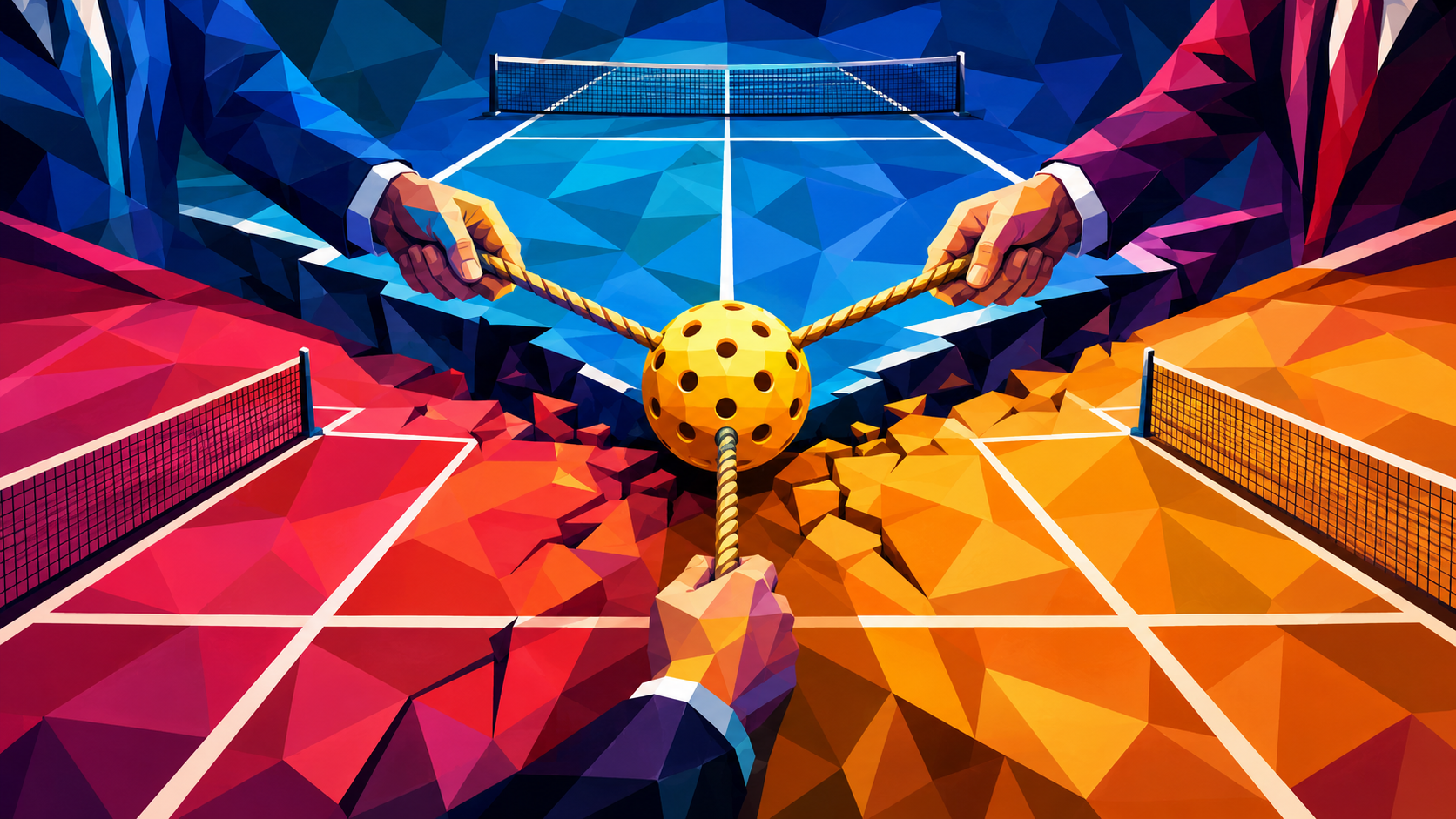
The European Pickleball Federation thought it had found a reasonable place to stand.
It would maintain relationships with both international federations. By joining the World Pickleball Federation and applying to the Global Pickleball Federation, the EPF hoped to avoid adding another hard border to a sport already divided by them.
Europe did not need to settle the argument over who should eventually govern world pickleball. Not yet. Its national federations had different histories, affiliations and views. The continental body could work with both sides while leaving open some possibility of conversation between them.
Then the GPF declined its application.
The decision was constitutionally defensible. Membership organisations are entitled to decide who may join and under what conditions. The GPF could reasonably conclude that admitting a continental federation already affiliated with another international body did not fit its structure.
The effect reached much further than one application.
Europe’s attempt at neutrality had failed. National federations which had not created the split now had to consider which relationships mattered, which championships carried authority and who would represent their interests internationally. A disagreement that could once be left to the WPF and GPF had entered the European room.
This is where governance stops being an administrative subject. A choice made at international level becomes a problem for somebody running a national federation after work. Recognition becomes access. Affiliation becomes allegiance. The wording of a constitution begins to shape who can sit at a table, enter an event or claim to speak for a country.
Pickleball has reached that point in several places at once.
The WPF and GPF are pursuing rival claims to international legitimacy. Reports of a possible third international federation suggest that the territory between them may attract another claimant. In the professional game, the PPA and APP are building different systems for organising players, prize money and opportunity.
These disputes belong to different organisations, but they concern the same question.
Who gets to decide what everybody else must join?
Recognition and the Road Towards It
International pickleball has never lacked organisations willing to govern it. The difficulty has been persuading them to govern together.
The World Pickleball Federation and Global Pickleball Federation have accumulated members, created boards and adopted the language expected of bodies seeking authority over an international sport. Both speak about unity, development, representation and the long route towards recognition by the International Olympic Committee.
There has been genuine progress. The WPF entered 2026 after unifying with the International Federation of Pickleball. The GPF completed its first member-led board election, adding ten elected directors to a structure which also includes continental representatives.
Those developments made each organisation more credible. They also made the division more permanent.
A board is not a temporary decoration. Neither is a constitution, a sanctioning system or a network of national members. They create positions, obligations and loyalties. People invest years in building them. Every step taken separately makes a later unification more complicated, even when both organisations continue to support unity in principle.
For a time, the sport appeared to have a route through. The WPF and GPF held discussions. A joint task force was established and a roadmap considered. Pickleball could imagine emerging from the process with one international authority.
That did not happen.
Public information about the talks became scarce while the two organisations continued to expand. The question slowly changed. It was no longer when unification would be completed, but whether anybody involved still expected it to happen.
Pickleball carried on. Courts opened, national bodies formed and tournaments drew entries. The game’s apparent health made it possible to dismiss the international dispute as a pastime for administrators who preferred meetings to matches.
Fragmentation is easy to tolerate while little depends upon the answer. It becomes harder when recognition, championship access, officiating standards, coaching systems and national representation begin passing through rival structures.
The EPF discovered the limit. Its relationship with both sides could survive only while both sides accepted it.
Recognition sits at the centre of this because it promises something pickleball badly wants. It can strengthen relationships with national sporting institutions and governments. It may create access to established multi-sport systems. Any serious Olympic ambition requires the game to look like one internationally governed sport rather than several organisations presenting overlapping claims.
Yet recognition answers only which organisation has been accepted. It does not settle whether the people beneath it feel represented.
A governing body can follow its constitution and still leave important constituencies outside the room. It can create a balanced-looking board while national federations question whether their region has a meaningful voice. A process can be valid without producing trust.
That distinction is central to the European dispute. If the EPF cannot join the GPF, how are shared European interests meant to reach the organisation’s decisions?
Individual national federations may already possess their own routes of influence. The GPF could argue that it is built upon direct national membership and therefore has no need to admit a continental organisation in the form the EPF proposed. That may satisfy the constitutional question. It does not necessarily provide the collective European voice the EPF believed it could offer.
Europe is no longer a minor part of this argument. The continent has more substantial tournaments, greater commercial investment and a growing group of players attempting to build something resembling professional careers. Its national organisations differ greatly in size and resources, but their collective choices will matter to any body claiming to govern the international game.
Counting their flags is not the same as hearing them.
The EPF decision therefore exposed more than an unsuccessful application. It showed the limits of a recognition strategy which concentrates upon reaching the correct institutional destination. The route matters, especially when federations are asked to give up existing relationships along the way.
The Space Left Open
WPM has heard consistent but unconfirmed reports that a third international federation may be preparing to emerge.
There has been no announcement sufficient to treat its creation as fact. Nor is there enough public information to assign motives to people who have not declared them. Any new organisation might have sincere reasons for believing it can offer something the existing bodies do not.
The significance of the rumour is that it sounds plausible.
A third federation would not need to create the division in world pickleball. It would need only to persuade a number of dissatisfied or unattached organisations that neither current option represents them adequately.
Its organisers might believe certain regions lack influence. They might object to the distribution of voting rights, doubt an existing recognition strategy or regard both present structures as too established to reform. Starting again could appear easier than entering somebody else’s system and trying to change it from within.
That temptation has accompanied many divided sports. A new body presents itself as the route to unity, provided everybody accepts its leadership, constitution and plan.
Should a third federation appear, it will probably be accused of muddying already difficult waters. The accusation may be justified. It would also be convenient for two organisations which had years to clear them.
Neither the WPF nor GPF can be ordered into a merger because outsiders find duplication untidy. Genuine unification would require decisions about leadership, membership, voting rights, assets and authority. Those are not minor details. People who have spent years building institutions will not abandon them merely because one organisation would look neater on an Olympic application.
Delay still carries a cost.
Political space does not remain empty when federations believe their interests are being missed. Someone eventually offers another home. By the time the WPF and GPF agree that a third organisation would damage the sport, the decision to create one may no longer belong to them.
The EPF’s failed neutrality is an early sign of that cost moving down the structure.
Imagine the problem from the position of a volunteer national president. The immediate work may involve finding courts, establishing coaching programmes, answering member complaints and persuading sporting authorities that pickleball deserves support. International affiliation can feel distant until it begins affecting the legitimacy of a championship, access to development programmes or the status of players representing the country.
The president must then choose among structures they did not design, using information which may be incomplete, while knowing that another part of the sport may interpret the decision as disloyalty.
A third federation would add another application form, another set of assurances and another claim to the same future. It might also attract countries which believe the first two never offered them a proper place.
That is why the rumour cannot be treated simply as news of another prospective organisation. It is a measure of the space the existing organisations have left unresolved.
The Other Kind of Authority
International federations are not the only bodies setting pickleball’s boundaries.
Professional tours do not need constitutions full of national members to exercise power. Their rules are written into player agreements, rankings, prize structures and calendars. A federation may decide which organisation speaks for a country. A tour can help determine where an athlete is allowed to earn a living.
PPA Tour Europe has brought that question into sharper focus.
The circuit promises 20 events across nine countries, €545,000 in prize money and a season ending with the PPA Finals Europe in May 2027. For leading European players, many of whom continue to combine competition with full-time work, it is the strongest attempt yet to create a substantial professional season on the continent.
That investment matters. Europe has produced increasingly capable players without offering them enough regular high-level competition close to home. Anyone trying to build a season has had to travel to North America or piece together tournaments which vary considerably in prize money, field strength and presentation.
If you're following how the global game is shifting week by week, the World Pickleball Report breaks this down every day in our morning briefing.
PPA Tour Europe can provide repetition and order: recognisable stops, stronger fields, meaningful rankings and a final towards which the season can build. It can give sponsors and audiences a group of players to follow from one event to the next.
The terms attached to that opportunity matter just as much.
WPM understands that some PPA Europe agreements may restrict players from entering rival professional events. The full contracts are not public, and the details may vary. It would therefore be wrong to claim that every player faces the same conditions or that the effect upon every independent tournament is already known.
The broader issue is clear enough. Exclusivity is part of the PPA model. An organisation investing in players, broadcasts and promotion wants some assurance that the talent around which it builds will appear. Concentrating leading players can improve competitive quality and make the tour easier to understand. A supposedly premier circuit has limited value if its best-known names regularly disappear to play elsewhere.
Europe, however, is still building the levels below its leading professional game.
Its top players appear at national Opens, independent tournaments and regional events. They strengthen draws, attract attention and give emerging competitors access to opponents above their usual standard. Promoters can use their presence when approaching sponsors, selling entries or persuading spectators that a final is worth watching.
If enough of those players become unavailable, the central tour grows stronger while parts of the surrounding calendar become weaker.
That may be a price worth paying for a coherent professional product. It is still a price, and it will be paid partly by organisers who were not involved in setting the terms.
For a player, the calculation is personal. A contract may provide the clearest opportunity yet to pursue pickleball seriously. It may also affect appearances at a home championship, an event run by friends or a tournament which supported that player before a European professional tour existed.
There is no single correct decision. The value of security depends upon what is being surrendered to receive it.
The APP is making a different pitch. Its 2027 plans include doubling professional prize money to US$3 million, adding two events to its American schedule and livestreaming all four days of each tournament. It is also extending its international relationships, including its work with the European Pickleball Federation.
The announcement emphasises a wider pool of opportunity and more routes into professional competition. That does not establish that every APP player is free of contractual restrictions, nor should it be used to turn the APP into the benevolent opposite of the PPA. The available evidence supports a contrast in emphasis, not a simple division between freedom and control.
An open competitive structure has its own weaknesses. It can provide more entry points without guaranteeing that the strongest players meet often enough. Talent and attention may spread across too many events. The audience is then left trying to decide which results matter and where the best competition actually sits.
The PPA’s model is built around concentration. The APP is placing greater value on breadth. One can create a more recognisable elite product. The other can leave more ways into the professional game.
Both are deciding how opportunity should be distributed.
This is governance carried out through commercial choices rather than federation votes. Its authority grows through contracts, partnerships and control of attractive events. It can alter a national calendar without passing a by-law.
The lines are becoming less distinct as tours form relationships with national and continental bodies. Federations need operators capable of delivering competitions, broadcasts, rankings and sponsor value. Tours benefit from the local legitimacy, membership networks and representative status that federations provide.
Such partnerships can solve practical problems. They can also give private commercial preferences institutional weight. If a federation depends upon one tour to stage its most important events, that tour’s calendar and player rules begin influencing the wider system. If contracts determine whether leading players can appear in national championships, private agreements shape public representation.
Authority accumulates quietly. One event at a time is usually enough.
The Choice Left to Everyone Else
Governance stories arrive wrapped in initials: WPF, GPF, EPF, PPA, APP.
The shorthand is useful. It also removes the people who have to make the choices.
Behind a national federation may be a volunteer answering emails late at night. Behind an independent Open may be an organiser who has placed personal money at risk. Behind a professional ranking is a player trying to decide whether the sport can become a career or must remain something fitted around work.
The national president may want recognition without joining a political camp. The promoter may welcome investment in European professional pickleball while fearing the loss of players from their own event. The athlete may want the security of a tour contract and still care about representing a country or supporting the tournament where their career began.
None of these positions is contradictory. They are what an unfinished system looks like from inside it.
The problem comes when organisations ask for loyalty before the structure beneath that loyalty is secure. International bodies want national federations to choose. Professional tours want players to commit. In return, those federations and players need reasons to believe the promises will survive changes of leadership, commercial priorities and strategy.
Pickleball’s institutions are trying to establish authority while asking people to submit to it. They do not possess generations of history or trust upon which to draw. Every closed route therefore attracts more attention than it might in an older sport.
The EPF applied to the GPF because it believed Europe could maintain relationships on both sides of the international divide. The GPF declined because it believed that arrangement did not belong within its structure. Both positions can be understood.
The door still closed.
National federations are left to decide what the decision means for them. The WPF and GPF continue along separate roads. Somewhere beyond the confirmed announcements, another group may be considering whether the gap between them is large enough to enter.
At the same time, European players are being offered the best-funded professional structure the continent has seen. Some may have to decide which other events they are prepared to lose in order to enter it.
Pickleball’s organisations are no longer competing only to build. They are competing for the right to determine where other people may belong.
That is the choice now travelling down from meeting rooms and contracts to the people who did not create it. One door has closed. Nobody yet knows how many more will follow.
For a clearer view of where the sport is heading each week, you can join the World Pickleball Report here.

Chris Beaumont
Founder and Editor-in-ChiefChris Beaumont is the founder and Editor-in-Chief of World Pickleball Magazine. Chris follows the global game closely, reporting on the latest news, developments, stories and tournaments from all five continents. He also hosts the World Pickleball Podcast, interviewing people at…
View All Articles →