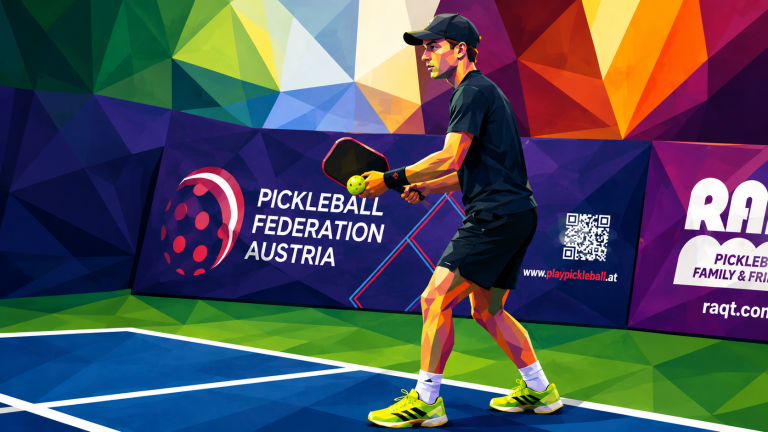

Europe has spent years wondering how to build pickleball the American way. Austria may have just demonstrated that it does not have to.
Key Takeaways
- Europe’s shortage of dedicated pickleball courts cannot necessarily be solved by copying the large, permanent venue model used in the United States.
- A modular court system demonstrated at the Austrian Open could allow clubs to introduce pickleball over clay, grass and uneven surfaces without permanent construction.
- Europe’s existing tennis clubs, civic spaces and multi-sport facilities may offer a more realistic infrastructure pathway than hundreds of new standalone venues.
For much of the past decade, the global pickleball conversation has been shaped by an American assumption.
Build more courts.
Build bigger venues.
Build permanent facilities.
That formula made sense in the United States, where sprawling outdoor complexes became physical proof of the sport’s extraordinary rise. If Europe wanted to become a serious pickleball continent, conventional wisdom suggested it would eventually have to follow the same path.
But what if Europe has been trying to answer the wrong question?
The issue facing European pickleball has never simply been a shortage of courts. It is that Europe was never built for American-style expansion in the first place.
That distinction matters because it changes the challenge entirely. Rather than asking how Europe can recreate America’s infrastructure, perhaps it should be asking how to build a distinctly European model instead.
If the Austrian Open offered one lesson beyond the medal winners, it was that Europe’s greatest weakness may yet become its greatest advantage.
Europe Doesn’t Lack Interest. It Lacks Space.
Few would argue that enthusiasm for pickleball is the problem.
Participation continues to spread across the continent. National federations are becoming more organised. Professional opportunities are expanding. More clubs want to introduce the sport and more players want regular competition.
Demand exists.
Infrastructure has struggled to keep pace.
Across much of Europe, players still spend their weekends competing on temporary courts inside multi-purpose sports halls. Leisure centres designed for badminton or basketball are routinely adapted for pickleball, often producing inconsistent playing conditions and surfaces that many players describe as slippery or unforgiving.
Dedicated outdoor facilities remain the exception rather than the rule, although developments such as Madrid’s new pickleball hub inside the Spanish tennis system show that some markets are beginning to invest more heavily.
The obvious conclusion has always been that Europe simply needs to build more facilities of its own.
That sounds logical.
It also assumes Europe can develop like America.
The American Blueprint Doesn’t Easily Translate
The United States benefited from circumstances Europe simply does not share.
Land was available.
New sports complexes could be planned around rapidly expanding suburbs.
Municipal recreation budgets often supported purpose-built developments.
Europe presents a very different landscape.
Cities are older. Space is tighter. Planning regulations are more restrictive. Tennis clubs often occupy valuable land and, particularly in countries where clay courts remain part of the sporting identity, permanent conversion is rarely a straightforward decision.
These are not temporary growing pains.
They are structural realities.
Other parts of the world are confronting the same question in different ways. The Philippines is pursuing a major purpose-built development containing 16 dedicated pickleball courts alongside tennis and athlete facilities. That model may suit a large new sporting complex, but it is not easily repeated inside densely developed European cities or long-established tennis clubs.
Expecting Europe to solve its infrastructure challenge by copying America may therefore become an increasingly expensive exercise in solving the wrong problem.
Austria Asked A Better Question
The most significant story surrounding the BaseX Pickleball Austrian Open was not confined to the competition itself.
More than 160 entries were recorded across 13 divisions, with 180 matches completed and players representing more than ten nations. Yet the most consequential development may have appeared away from the medal ceremonies.
BaseX demonstrated a prototype court foundation described by the official Austrian Open report as suitable for installation on different surfaces.
The wider concept is a modular foundation capable of being placed over clay courts, grass and uneven ground without the excavation, concrete base or permanent structural changes normally associated with hardcourt construction.
On the surface, it looks like an interesting piece of engineering.
Look a little deeper and it becomes something much more important.
Instead of asking where Europe can afford to build entirely new pickleball venues, it asks a different question altogether.
Where can pickleball fit today?
That subtle shift has enormous implications.
If clubs no longer need to commit to expensive redevelopment projects, lengthy planning applications or irreversible construction work, introducing pickleball becomes a significantly lower-risk decision.
The conversation moves from replacement to addition.
From demolition to adaptation.
Europe’s Opportunity May Already Exist
Across the continent sit thousands of tennis clubs facing familiar pressures.
Many are looking for new members, additional revenue streams and better use of existing facilities. Until now, pickleball has often been presented as a choice between one sport and another.
That framing almost guarantees resistance.
A removable court changes the discussion.
Clay courts no longer need to disappear.
Grass does not need to be excavated.
Existing facilities can host more activity without sacrificing their original purpose.
Instead of competing with tennis, pickleball begins to complement it.
That is a very different proposition for club committees making investment decisions. The process is already beginning in places such as the Netherlands, where tennis clubs are adding pickleball while retaining their wider racket-sport role.
Europe may not need 500 entirely new pickleball venues.
It may simply need 5,000 existing sports clubs willing to say yes.
The Rathausplatz Offered Another Clue
Austria had already hinted at this philosophy before the tournament even began.
Weeks earlier, transportable courts appeared in Vienna’s Rathausplatz during the Sport Austria Finals, inviting thousands of people to try pickleball in one of the country’s most recognisable public spaces.
Again, the lesson reached beyond Austria.
Europe is filled with historic squares, civic spaces, exhibition centres and community festivals where temporary courts can introduce the sport without waiting for permanent facilities to appear.
Similar thinking is emerging in crowded Asian cities. Singapore has considered whether underused car-park levels could become pickleball spaces, another example of the sport adapting to limited urban land rather than waiting for ideal conditions.
America built destination venues.
Europe may build destination moments.
Neither approach is inherently better.
They simply reflect different environments.
Building Differently, Not Catching Up
International pickleball has often measured progress against American benchmarks.
How many dedicated courts?
How many purpose-built venues?
How closely does another country resemble the United States?
Those comparisons may become less useful over time.
History repeatedly shows that late adopters rarely succeed by becoming copies of the pioneers. They succeed by recognising different constraints and finding smarter solutions.
European pickleball may now be approaching that point.
Its greatest obstacle has never been a lack of players.
It has been a landscape that refuses to accommodate American assumptions.
Ironically, that same landscape may force the sport to become more flexible, more integrated and ultimately more sustainable.
For years, Europe has measured itself against America.
It may eventually discover that the better question was never how to catch up.
It was how to build differently.
If Austria’s approach proves scalable, Europe’s most important contribution to global pickleball will not be another tournament or another champion.
It will be proving that sometimes the smartest way to build a sport is not by pouring more concrete, but by finding better ways to use the ground already beneath your feet.
Further Reading
- Latest pickleball news from around the world
- Tournament coverage and results
- Rankings and player profiles
- Regional pickleball coverage

Chris Beaumont
Founder and Editor-in-ChiefChris Beaumont is the founder and Editor-in-Chief of World Pickleball Magazine. Chris follows the global game closely, reporting on the latest news, developments, stories and tournaments from all five continents. He also hosts the World Pickleball Podcast, interviewing people at…
View All Articles →