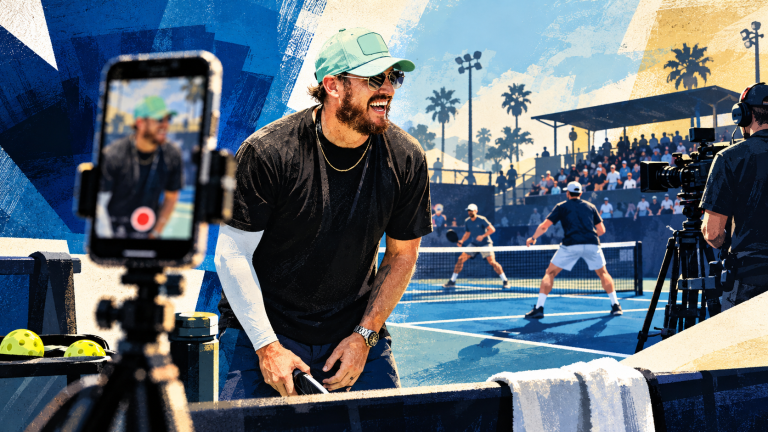

What happens when you try to build a professional sport before the traditions, rivalries and habits around it have had time to develop? NPL Australia CEO Ron Shell joins the World Pickleball Podcast to talk culture, competition and why professional pickleball may still be searching for what it wants to become.
- Ron Shell explains why the NPL has always been about more than simply running a professional pickleball league.
- The conversation explores audiences, rivalries and the challenge of creating sporting culture without trying to manufacture it.
- Shell also questions whether professional pickleball has yet discovered the format that will ultimately work best as entertainment.
There is a problem with trying to build a professional pickleball league that has very little to do with the quality of the pickleball.
Football clubs inherit generations of allegiance. Cricket has its grounds, rituals and arguments. Tennis comes with more than a century of recognisable sporting culture.
Pickleball has players, teams, tournaments and increasingly serious competition. What it does not yet have, at least in most of the world, is decades of accumulated history.
Someone has to build that bit.
That was the conversation we wanted to have when National Pickleball League CEO Ron Shell joined the World Pickleball Podcast.
Not simply who is winning in Australia or where the NPL expands next. We wanted to understand what Shell believes he is actually building.
His answer takes the conversation somewhere much more interesting.
For Shell, the professional league has always been a vehicle for something larger: getting more people to discover the sport in the first place.
Listen to the full conversation
Ron Shell joins Chris Beaumont on the World Pickleball Podcast to discuss NPL Australia, sporting culture, rivalries, new audiences and what professional pickleball might eventually become.
Stop selling pickleball to pickleball people
One of Shell’s strongest arguments is that professional pickleball cannot limit itself to people who already love pickleball.
The existing community matters enormously. But if the ambition is to create a genuine spectator sport, eventually you have to persuade somebody else to care.
That influences how Shell thinks about NPL venues, events and the atmosphere surrounding the matches. He wants something people want to attend and, importantly, somewhere they want to bring somebody who has never watched pickleball before.
It also creates one of the central tensions in our conversation: how much should a young professional sport serve the culture it already has, and how much should it deliberately try to create a new one?
You cannot manufacture a rivalry
Then there are the personalities.
Professional sport needs people to support and, occasionally, people to dislike.
Shell talks about the competitive edge beginning to emerge between NPL teams and about players becoming more comfortable showing personality on court. Those storylines are becoming increasingly visible as the league matures. WPM’s recent look at how NPL Round 7 changed the Australian championship picture found rivalries already carrying their own history into the upcoming Melbourne Finals.
That matters because sporting culture cannot simply be ordered into existence.
You can invent a team name tomorrow. You cannot invent 20 years of history between two teams.
But history has to start somewhere.
The same players meet. Something happens. Somebody remembers it. The next match means slightly more.
NPL is young enough that we are watching those first layers being created.
What if pickleball has not found its final form?
Perhaps the most intriguing part of the podcast comes when we ask a larger question.
What should professional pickleball actually look like as entertainment?
Shell is refreshingly uncertain.
The sport has naturally borrowed plenty from tennis and other racket sports. But that does not necessarily mean the version of pickleball being streamed today is the version audiences will be watching a decade from now.
Maybe teams become more important. Maybe formats change. Maybe broadcasts change. Maybe the spectator product develops in directions nobody has properly considered yet.
Shell does not claim to have solved it.
He thinks the question is still open.
That view makes particular sense when looking at an organisation that now operates a professional tour, a Division 2 pathway across Australia and New Zealand and a growing venue network. The National Pickleball League is effectively testing several parts of the sporting model simultaneously.
And that may be the most interesting thing about professional pickleball right now.
The structures, rivalries, personalities and conventions that older sports inherited are being created in real time. NPL Australia is one of the places where that experiment is happening.
Our conversation with Ron Shell goes considerably further, from New Zealand’s emergence and NPL’s early mistakes to the challenge of attracting new audiences and his own philosophy for building the league.
But ultimately it comes back to one question.
How do you build the culture of a sport while the sport itself is still figuring out what it wants to be?
Hear the complete interview
Listen to Ron Shell on the World Pickleball Podcast.
Follow and listen on Spotify
|
Follow and listen on Apple Podcasts
Further Reading
- The NPL Finals Are Set. But Round 7 Changed the Championship Picture
- Inside the August 2026 edition of WPM
- More from the World Pickleball Podcast
- Pickleball stories from around the world

Chris Beaumont
Founder and Editor-in-ChiefChris Beaumont is the founder and Editor-in-Chief of World Pickleball Magazine. Chris follows the global game closely, reporting on the latest news, developments, stories and tournaments from all five continents. He also hosts the World Pickleball Podcast, interviewing people at…
View All Articles →