
Europe’s governing body has recognised the 2026 Pickleball World Cup in Vietnam—but only after drawing one of the clearest governance boundaries yet seen in international pickleball. The decision allows European athletes to compete while refusing to endorse any competing claim to global authority.
Key Takeaways
- The European Pickleball Federation has formally recognised the 2026 Pickleball World Cup in Da Nang, Vietnam.
- The federation made clear that recognition of the tournament does not amount to recognition of any international governing body or official world championship status.
- The decision offers a potential blueprint for regional federations trying to support players while remaining neutral in pickleball’s ongoing governance dispute.
The European Pickleball Federation has attempted something few organisations in international pickleball have managed.
It has backed one of the sport’s biggest events without choosing a side in the battle over who governs the game.
In a carefully worded statement issued from its headquarters in Luxembourg, the EPF confirmed that it recognises the 2026 Pickleball World Cup in Da Nang, Vietnam, and supports the participation of eligible European players.
The federation also made something equally clear.
Its decision should not be interpreted as recognition of any competing international federation, nor as confirmation that the tournament represents an officially sanctioned world championship.
Those two positions sit alongside each other throughout the statement.
Support the players.
Remain neutral on the politics.
That balance is what makes the announcement significant.
A Statement Written With Precision
The EPF’s language leaves little room for interpretation.
The federation explains that its recognition applies specifically to the organisation of the tournament and the opportunity it provides European athletes to compete internationally.
At the same time, it explicitly distances that recognition from the wider governance dispute that continues to divide international pickleball.
In other words, the federation is recognising an event, not endorsing an organisation.
That distinction may appear subtle.
In the current political landscape of global pickleball, it is anything but.
The Most Important Sentence
Buried within the statement is arguably its most significant passage.
The EPF reiterates its belief that pickleball ultimately requires “a single, independent, democratic and properly constituted international federation” before events such as the World Cup can carry universally recognised official status.
That sentence explains almost everything.
It acknowledges that the current governance landscape remains unresolved.
It avoids declaring a winner.
And it establishes the principle the EPF believes should underpin the sport’s future.
Rather than backing one claimant over another, Europe is effectively saying the final answer has not yet arrived.
This is the same unresolved structural problem examined in WPM’s recent analysis of why pickleball can produce two Team USAs without one accepted authority. Different organisations can create credible international projects because the sport still lacks a universally accepted system capable of settling competing claims.
Why Europe Matters
The EPF is not simply another federation issuing another statement.
It represents one of pickleball’s busiest developing competitive regions, with national federations across Europe building tournaments, player pathways and international competition.
Its position therefore carries influence beyond the continent itself.
Other regional federations wrestling with the same governance questions will inevitably examine how Europe has handled the issue.
The EPF’s approach offers a possible middle ground.
Players are not denied opportunities to compete.
Nor is the federation drawn into recognising an international structure it believes remains incomplete.
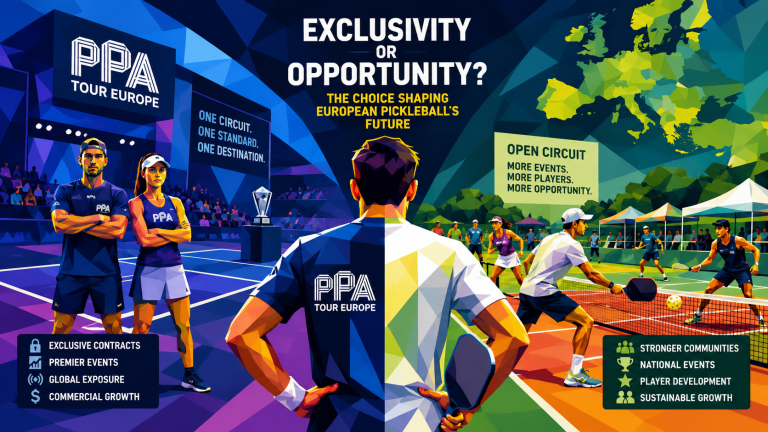
That approach also fits a broader European strategy in which the federation has strengthened its sporting calendar through projects such as its partnership with the APP around the European Pickleball Open, while retaining control over how it positions itself within international governance.
A Diplomatic Solution To A Sporting Problem
Refusing to recognise the World Cup would have risked preventing European athletes from participating in one of the calendar’s most ambitious international competitions.
Offering unconditional backing, however, could easily have been interpreted as taking a political position within an unresolved governance dispute.
Instead, the EPF has chosen a narrower path.
Support the competition.
Support the athletes.
Avoid deciding a question that, in its own view, has yet to be settled.
It is an approach that reflects diplomacy as much as administration.
More Than A Vietnam Story
On the surface, this is an announcement about a tournament in Da Nang.
In reality, it reveals something much bigger.
As pickleball expands internationally, federations are increasingly being asked to make practical decisions before the sport has reached agreement on who ultimately governs it.
The EPF has shown that those decisions do not have to be binary.
It is possible to create opportunities for athletes without endorsing a political position.
The federation cannot resolve pickleball’s governance debate on its own.
What it has done is demonstrate a framework others may choose to follow.
Until the sport speaks with one recognised global voice, that may prove to be one of the most important governance decisions made outside the courtroom or the boardroom.
Further Reading
- Latest pickleball news from around the world
- Tournament coverage and results
- Rankings and player profiles
- Regional pickleball coverage

Chris Beaumont
Founder and Editor-in-ChiefChris Beaumont is the founder and Editor-in-Chief of World Pickleball Magazine. Chris follows the global game closely, reporting on the latest news, developments, stories and tournaments from all five continents. He also hosts the World Pickleball Podcast, interviewing people at…
View All Articles →