
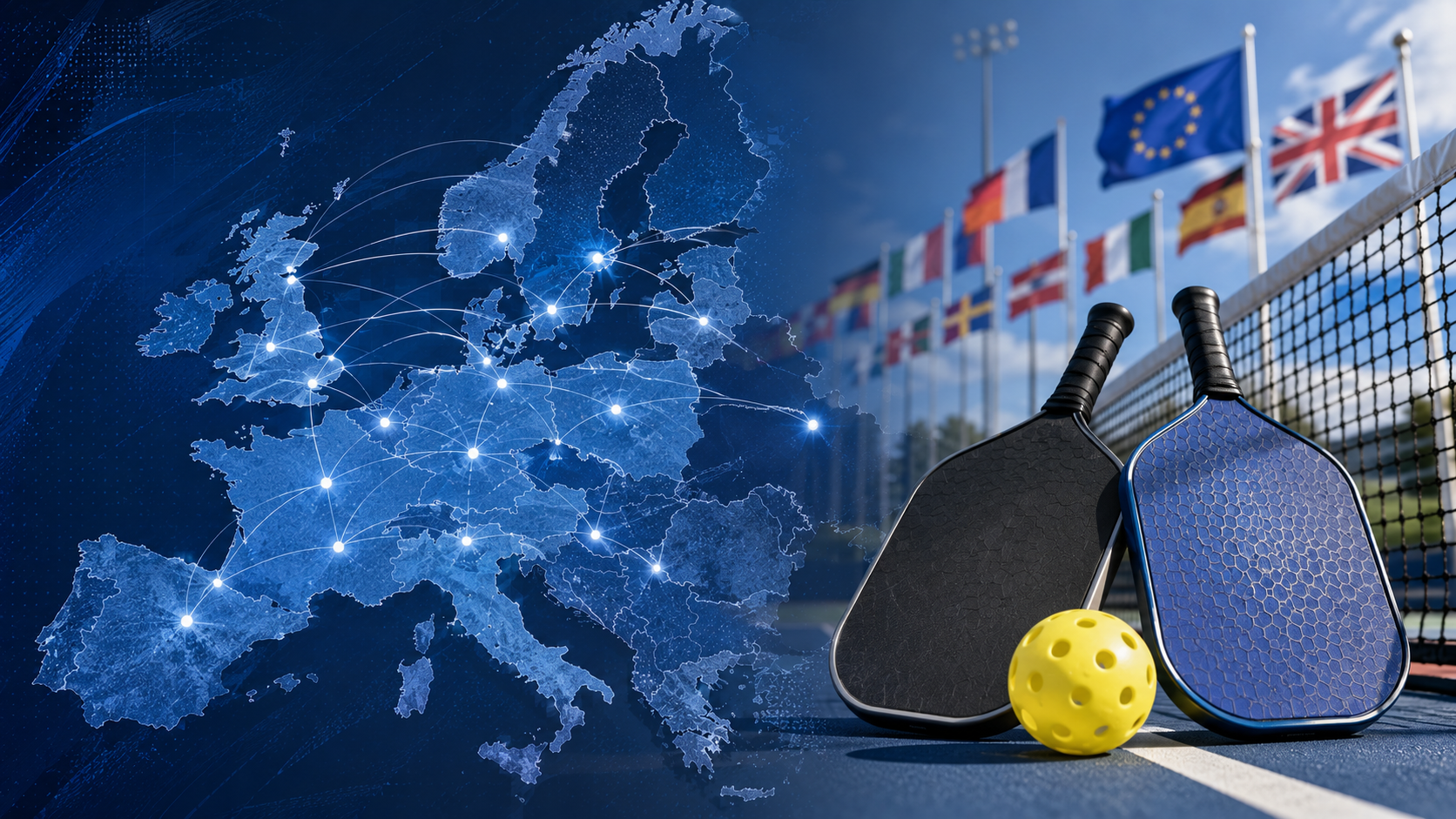
The Association of Pickleball Players’ expanded partnership with the European Pickleball Federation is ostensibly about a tournament in Türkiye. In reality, it may offer a glimpse into a much larger contest over who gets to provide the structure, rankings and pathways that international pickleball still lacks.
Key Takeaways
- The APP and European Pickleball Federation will jointly stage the 2026 European Pickleball Open in Antalya.
- Europe remains one of pickleball’s busiest but most fragmented regions, with overlapping tours, federations and ranking systems.
- The APP increasingly appears to be pursuing influence by positioning itself as an organiser and connector of emerging markets.
Plenty of Activity, Little Alignment
European pickleball has rarely looked healthier.
National federations continue to emerge. The English Open has grown into one of the world’s largest participation events. International tournaments are appearing across Spain, France, Italy and Scandinavia, while countries previously considered peripheral markets are beginning to host competitions of their own.
Yet beneath that activity sits a persistent problem.
For players attempting to navigate the international landscape, the pathways can still feel confusing.
Different tours award different rankings. Federations align themselves with different international bodies. Independent events sit alongside tour-affiliated tournaments.
Some competitions prioritise amateur participation. Others are designed around professional aspirations. Several attempt to accommodate both.
Europe has momentum.
It does not necessarily have coherence.
The APP’s announcement of an expanded partnership with the European Pickleball Federation may therefore say less about one tournament and more about an attempt to address that broader issue.
Antalya Is the Vehicle, Not the Destination
The centrepiece of the agreement is the 2026 European Pickleball Open Powered by The APP, scheduled for 3-8 November at the Ali Bey Club in Antalya.
The venue is already familiar within racket sports circles and organisers expect competitors from more than 37 countries. Singles, doubles and mixed doubles competitions will span amateur divisions, age-group categories and professional brackets.
On its own, that would constitute a respectable addition to the international calendar.
The significance arguably lies elsewhere.
Established in Luxembourg in 2023, the European Pickleball Federation now represents more than 35 national federations and emerged partly from efforts within the Global Pickleball Alliance to provide greater coordination between European member organisations.
Bringing an organisation with that reach into a closer relationship with the APP gives the American tour access to something increasingly valuable in pickleball.
Institutional legitimacy.
At the same time, the EPF gains a partner capable of delivering tournament operations, media production, commercial activation and a recognisable international framework.
Both sides benefit.
Players may benefit most.
For an athlete trying to understand where they can compete internationally, how rankings interact and what opportunities might exist beyond their domestic scene, simplicity has value.
APP’s Strategy Looks Different
Sports organisations tend to expand internationally in one of three ways.
Some simply export existing events into new territories.
Others focus almost exclusively on attracting elite professionals.
Increasingly, the APP appears to be exploring a third approach.
Its launch of the APP Asia Tour hinted at a desire to establish regional ecosystems rather than isolated tournaments. Strengthening ties with the English Open suggested something similar. The EPF agreement reinforces the impression that APP executives see value in becoming not merely another tour, but an organisation capable of connecting federations, tournament organisers and emerging markets into something more coherent.
That distinction matters.
Many sports do not operate beneath a single universally accepted governing structure. Athletes and organisers often gravitate towards whichever framework provides the clearest routes to participation, rankings and progression.
Pickleball may ultimately follow a similar path.
Europe Matters Because It Is Still Available
Europe may be the ideal testing ground.
The continent already possesses substantial tennis infrastructure. Travel between countries is comparatively straightforward. Participation continues to increase. National federations are active and increasingly ambitious.
Yet Europe remains surprisingly open.
No organisation currently dominates the calendar.
No ranking system commands universal acceptance.
No pathway enjoys overwhelming loyalty.
That creates opportunity.
It also creates competition.
Not everyone within pickleball necessarily wants a commercial tour to become the sport’s default organiser.
Some federations may ultimately prefer a more neutral international framework. Others may believe governance responsibilities should sit with an independent world body rather than an event operator. There are also practical questions about balancing elite competition with participation events, particularly in markets where grassroots development remains fragile.
Those debates are unlikely to disappear.
Indeed, they may intensify as pickleball becomes more internationally connected.
The Question Beneath the Announcement
The APP-EPF partnership may eventually prove transformative.
It may also become one of several competing ecosystems that coexist for years.
At this stage, nobody knows.
But the announcement does raise an increasingly important question.
If pickleball never develops one universally accepted governing structure, will players simply align themselves with whichever organisation offers the easiest way to understand where they can play, how they can progress and what their next step should be?
That may be the real contest beginning to unfold.
And Europe could become the first place where we discover the answer.
Further Reading
- Latest pickleball news from around the world
- Tournament coverage and results
- Rankings and player profiles
- Regional pickleball coverage

Chris Beaumont
Founder and Editor-in-ChiefChris Beaumont is the founder and Editor-in-Chief of World Pickleball Magazine. Chris follows the global game closely, reporting on the latest news, developments, stories and tournaments from all five continents. He also hosts the World Pickleball Podcast, interviewing people at…
View All Articles →

