
Canada’s withdrawal from the 2026 Pickleball World Cup junior competition is not simply a story about funding. It has become a public reckoning over elite development, national leadership and whether one of pickleball’s traditional powers is being overtaken while arguing over how to support the athletes it already has.
Key Takeaways
- Team Canada Pickleball has withdrawn its junior team from the 2026 Pickleball World Cup after failing to secure financial support to send all three national squads to Vietnam.
- Yui See Loud has publicly criticised Canada’s elite pathway, questioning how a governing body representing more than 90,000 members continues to rely heavily on athletes to fund their own international opportunities.
- The dispute comes at a time when countries across Asia and Europe are investing aggressively in high-performance programmes, raising fresh questions about Canada’s place in world pickleball.
- Pickleball Canada had not publicly responded to the criticisms at the time of writing.
Five years ago, Canada was widely regarded as the world’s second-strongest pickleball nation.
Today, one of its national teams is staying at home.
That contrast is why Team Canada Pickleball’s decision to withdraw its junior squad from the 2026 Pickleball World Cup should be viewed as far more than an unfortunate funding story.
It has exposed a deeper debate about how Canadian pickleball develops elite players, allocates resources and defines success.
The immediate facts are straightforward.
Team Canada Pickleball announced it would not send a junior team to Da Nang after months of unsuccessful attempts to secure financial support. The organisation had intended to send Open, Senior and Junior squads but concluded it could no longer afford all three.
The juniors were the ones left behind.
That matters because they had earned the opportunity.
Canada’s junior team finished fourth at last year’s World Cup, missing the podium by a single place.
According to Team Canada Pickleball, funding—not talent, commitment or performance—is the reason they will not compete this year.
The Human Cost Comes Before The Politics
The organisation’s statement carried little anger.
Mostly, it carried disappointment.
It described repeated approaches to Canada’s national governing body seeking assistance before concluding that, as a self-funded non-profit organisation, it simply did not possess the financial resources to send every team.
Its closing message was directed not at administrators but at the athletes.
“We know how much this opportunity meant to you, and we’re heartbroken that we couldn’t make it happen this year.”
Those words matter.
Behind every governance dispute are young players who trained, qualified and expected to represent their country on the world’s biggest stage.
Instead, they received an apology.
Then The Conversation Changed
Had the story ended there, this would have been another example of a developing sport wrestling with limited resources.
Instead, Team Canada manager Yui See Loud transformed it into something much bigger.
Loud is not simply an observer.
He manages Team Canada Pickleball while also playing influential roles across the Canadian National Pickleball League, Epic Championships and APP Asia.
When someone operating at the centre of the sport publicly questions the national system, people listen.
His opening question was deliberately provocative.
Where do the fees paid by more than 90,000 Pickleball Canada members actually go?
The scale of that membership is not disputed. Pickleball Canada announced in November 2025 that it had surpassed 90,000 members, while its 2025 annual report described it as the world’s largest paid pickleball membership.
From there, Loud’s criticism became increasingly direct.
He described national championships that, in previous years, offered no prize money, no live stream and limited professional presentation. He criticised a national selection process requiring athletes to pay around $500 before accounting for flights and accommodation simply to compete for a place representing Canada.
Their conclusion was striking.
The system, he argued, risks selecting from “a pool of privilege rather than a pool of talent”.
Whether readers agree entirely with that assessment or not, it captures the concern at the heart of this debate.
Elite pathways are supposed to identify the country’s best players.
The more expensive those pathways become, the more financial circumstances inevitably influence who can access them.
National Representation Should Not Feel Like A Purchase
Loud’s criticism extended beyond selection events.
He claimed athletes have been expected to purchase their own kits before arranging to have Team Canada branding added themselves.
That observation resonates because it speaks to something larger than uniforms.
Representing a country should feel like recognition.
Not another invoice.
Some self-funding is inevitable in emerging sports.
Few would dispute that.
The more difficult question is whether those financial expectations are reducing over time as participation grows—or simply becoming accepted as permanent features of the system.
Canada’s pickleball community has expanded dramatically.
Many players will reasonably ask why the elite pathway appears to have become no easier to navigate.
This is not the first time those questions have surfaced. WPM previously examined Canada’s competing national-team pathways and the wider dispute over who gets to represent the country internationally.
The Rest Of The World Is Accelerating
This debate also arrives at an awkward moment internationally.
Only days ago, the Pickleball World Cup announced a landmark strategic partnership with Pickleball Inc., a deal designed to strengthen commercial investment while ensuring many of the world’s leading professionals can compete for their countries from 2027.
International pickleball is becoming stronger.
At precisely the same moment, one of its traditional powers cannot send a qualified junior team.
That contrast should concern everyone involved in Canadian pickleball.
Across Asia, national federations, private investors and commercial organisations continue building increasingly sophisticated player pathways.
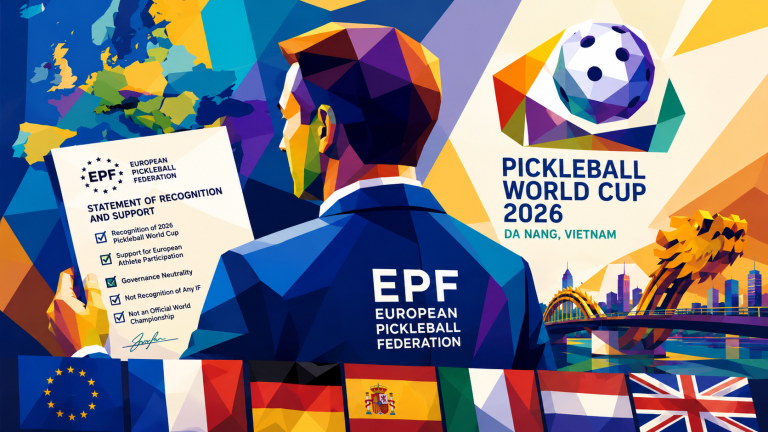
European nations are strengthening their own international programmes, even while the broader argument over governance remains unresolved—as shown by the European Pickleball Federation’s carefully limited recognition of the World Cup.
Countries once considered emerging pickleball markets now routinely fund international delegations, uniforms, accommodation and daily allowances.
Loud even suggested Canada’s leading professionals would now struggle to reach the main draws of many Asian tournaments.
That may be a deliberately provocative assessment.
Whether it proves entirely accurate or not, the broader trend is difficult to dismiss.
Asia’s competitive depth has increased dramatically over the past three years.
Canada’s elite pathway has instead become the subject of increasingly public criticism.
Pickleball Canada Now Faces Important Questions
Public criticism deserves scrutiny.
So does public administration.
The concerns raised by Team Canada Pickleball and Loud are serious.
Equally, Pickleball Canada deserves the opportunity to explain its own position, its funding priorities and the level of support it believes national teams should receive.
At the time of writing, it had not publicly responded to the criticisms.
Those answers now matter.
How are membership revenues allocated?
What responsibility does the governing body believe it has towards international teams operating outside its direct control?
How should elite pathways be funded as the sport grows?
These are governance questions, not social media arguments.
Ignoring them will not make them disappear.
The same issue sits beneath WPM’s wider examination of who owns the top of Canadian pickleball: the country has several organisations capable of creating meaningful competition, but no settled agreement over how their responsibilities should connect.
A Country At A Crossroads
Canada still produces outstanding players.
It still possesses one of the world’s largest pickleball memberships.
It still has a thriving domestic professional league through the CNPL and experienced organisers delivering major events.
None of those strengths automatically create a successful national programme.
Somewhere between recreational participation and international representation, the system appears to be breaking down.
That is why this story matters far beyond one junior team missing one tournament.
It asks whether Canadian pickleball has become better at growing participation than developing champions.
That is a far more important question.
The tragedy is not simply that Canada will arrive in Vietnam without its junior team.
It is that a nation which once helped define international pickleball is now publicly debating whether it can properly support the next generation of players capable of keeping it there.
Until those questions are answered, this withdrawal may be remembered not as an isolated disappointment, but as the moment the fractures within Canada’s high-performance pathway became impossible to ignore.
Further Reading
- Canada’s Pickleball Divide Heads Overseas
- Who Owns The Top Of Canadian Pickleball?
- Why Pickleball Has Two Team USAs And No Clear Authority
- EPF Backs World Cup Without Choosing A Governance Side

Chris Beaumont
Founder and Editor-in-ChiefChris Beaumont is the founder and Editor-in-Chief of World Pickleball Magazine. Chris follows the global game closely, reporting on the latest news, developments, stories and tournaments from all five continents. He also hosts the World Pickleball Podcast, interviewing people at…
View All Articles →