
The traditional pickleball nations still dominate the conversation. But across Europe, Poland is building something increasingly difficult to ignore: a growing player base, international results and a generation beginning to believe it belongs among the sport’s best.
Key Takeaways
- Polish players have produced a sustained run of results at the Polish Pickleball Cup, WPC England and the WPC Italian Open.
- Bartosz Karbownik has emerged as one of the country’s leading players, collecting three gold medals and one silver across his two most recent international events.
- Poland’s challenge is now to turn a player base of around 100 semi-professional and professional competitors into sustainable international careers.
Poland is not one of pickleball’s traditional powers.
It does not have the depth of the United States, the established reputation of some Western European markets or the rapidly expanding commercial ecosystems emerging across Asia.
Yet over the past month, Polish players have started appearing everywhere that matters.
At WPC England.
At the WPC Italian Open.
And most recently, at the Polish Pickleball Cup.
The pattern is becoming harder to dismiss.
Polish players are not simply participating.
They are competing.
Which raises a bigger question.
Is Poland becoming one of pickleball’s next European forces?
The Home Nation Takes Centre Stage
The Polish Pickleball Cup provided the clearest example of the country’s growing strength.
The later stages of the tournament had one thing in common.
You did not have to look far to find a Polish player.
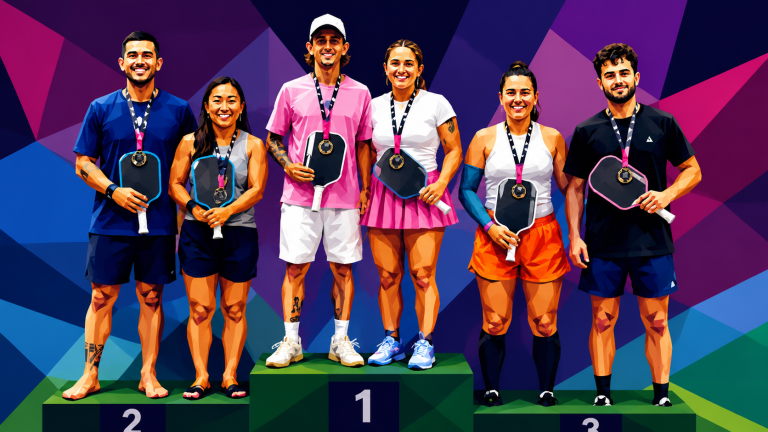
In mixed doubles, three Polish athletes reached the semi-finals: Mikolaj Biedermann, Bartosz Karbownik and Karolina Owczarek.
Owczarek and Biedermann narrowly missed out on a medal after losing both their semi-final and bronze medal match.
Karbownik, partnering American Dora Kurdi, progressed to the final, where they were defeated by Marina Alcaide of Spain and Bako Balint Gergo of Hungary.
The silver medal was only the beginning.
Biedermann later secured bronze in men’s singles, while Klaudia Suchocka narrowly missed out after losing her bronze medal match to Kurdi.
By the final day, Owczarek, the Suchocka sisters, Biedermann and Karbownik were all among the medal winners.
For a host nation, success at home is not unusual.
The more important question is whether those performances travel.
Poland’s players are increasingly proving that they do.
This Is Bigger Than One Tournament
The danger with any successful home event is assuming it tells the whole story.
Poland’s recent results suggest something more significant is happening.
The WPC rankings are increasingly populated by Polish players. Some are already established competitors. Others are only beginning their journeys in the sport.
The country now has approximately 100 semi-professional and professional players spread across major cities including Warsaw, Krakow, Poznan and Katowice.
That figure remains modest compared with the world’s largest pickleball markets.
But elite sporting nations are rarely built overnight.
They develop when enough players emerge at the same time to create internal competition, stronger training environments and a pathway for the next generation.
As WPM reported earlier this year, Polish players were already making an impression abroad. The latest European results suggest that progress is gathering pace.
Poland appears to be entering that phase.
Why Poland’s Timing Matters
The wider European pickleball landscape is changing quickly.
The sport is moving beyond its first wave of adopters.
Early growth was driven by established markets and enthusiastic recreational players. The next stage will be decided by countries capable of turning participation into competitive depth.
That requires more than courts.
It requires players who can test themselves internationally.
It requires tournaments that provide meaningful competition.
It requires athletes who believe professional ambitions are realistic.
Poland’s recent results suggest those ingredients are beginning to appear.
The country may not yet have the scale of the sport’s biggest nations.
But it has something every emerging sporting power needs.
Momentum.
Karbownik Leads The Charge
At the centre of Poland’s recent success has been Bartosz Karbownik.
The 24-year-old has enjoyed an outstanding run, winning three WPC gold medals and one silver medal across the Italian Open and Polish Pickleball Cup.
His performances have come against players from countries with longer sporting traditions and larger pickleball communities, including Italy, Spain, Germany, France and the United States.
For Karbownik, those results represent more than medals.
They represent confirmation.
“I’m very pleased with how the last month has gone. Winning medals at both the Italian Open and the Polish Cup has given me a lot of confidence and confirmed that the work I’ve been putting in is paying off,” Karbownik said.
Playing in Poland made the achievements even more meaningful.
“The atmosphere was fantastic, and sharing those results with them is something I’ll remember for a long time.”
But his ambitions extend beyond Europe.
Karbownik wants to compete in Asia and the United States, where many of the sport’s biggest tournaments are held.
The challenge is familiar for players outside established markets.
Opportunity is growing faster than funding.
International travel remains expensive, and finding sponsors or partners can determine whether promising players are able to continue competing at the highest level.
For Karbownik, however, the ambition remains clear.
“I’m proud of what I’ve achieved so far, but I also feel like this is just the beginning.”
The Next European Pickleball Test
The biggest challenge for Poland is no longer proving that it can produce talented players.
It has done that.
The next challenge is building the structures that allow those players to continue improving.
Can Poland create enough competitive opportunities?
Can it support its best athletes internationally?
Can one successful generation inspire the next?
Those questions will determine whether this becomes a brief moment of success or the beginning of something much bigger.
The history of sport is full of countries that emerged quietly before becoming impossible to ignore.
They did not announce themselves with one major victory.
They built.
They developed.
They kept producing athletes until the rest of the world had no choice but to pay attention.
Poland may not yet be a pickleball powerhouse.
But the evidence suggests it is no longer an outsider either.
For a clearer view of where the sport is heading each week, you can join the World Pickleball Report here.
Further Reading
- Latest pickleball news from around the world
- Tournament coverage and results
- Rankings and player profiles
- Regional pickleball coverage

Will Russell
EditorWill Russell is a journalism student at the University of Central Lancashire (UCLan) and a contributor to the World Pickleball Magazine Academy. He is particularly interested in player development, emerging talent and the stories shaping pickleball's growth around the world.
View All Articles →