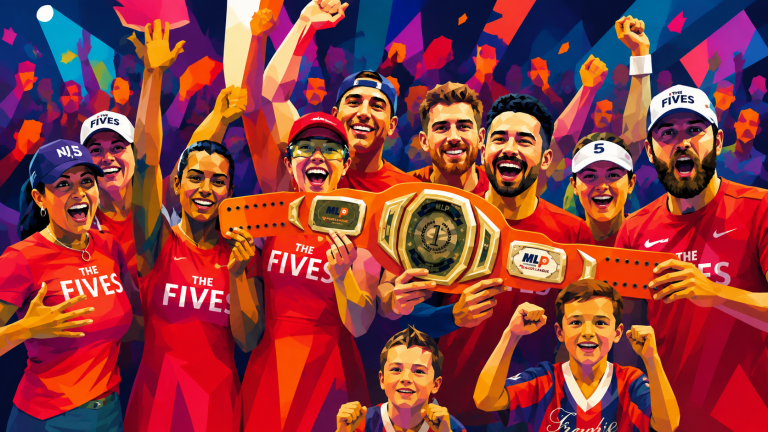

Major League Pickleball arrives in Chicago with the regular season entering its final stretch, but the weekend’s most significant story may not be the race for the playoffs. Instead, it is whether the league can prove that elite pickleball careers — and the audiences that follow them — do not end when players reach 50.
Key Takeaways
- MLP Chicago is the penultimate regular-season event before the 2026 playoffs, with key positions still to be decided.
- The weekend marks the competitive debut of the MLP Champions Series, integrating elite 40+, 50+ and 60+ competition into an MLP event for the first time.
- Chicago will test whether senior professional pickleball can become a permanent commercial and broadcast product rather than a standalone niche.
Major League Pickleball knows how to stage a successful professional event.
Chicago asks a much bigger question.
Can elite pickleball become a sport where professional relevance lasts decades rather than years?
That is the experiment unfolding across four days at Life Time North Shore and The Picklr Mount Prospect. Alongside the Premier and Challenger divisions, the newly branded MLP Champions Series makes its competitive debut under the MLP umbrella, creating one of the most intriguing commercial and sporting experiments the league has attempted.
The standings will matter.
The long-term implications could matter considerably more.
MLP Is Selling A Longer Career
Professional sport is normally built around youth.
Athletes peak, retire and eventually return as coaches, commentators or honoured guests.
MLP is proposing something different.
Rather than celebrating former professionals from a distance, it wants them to remain part of the live product.
The Champions Series, formerly the National Pickleball League, now sits alongside the main tour after the partnership between the two organisations. It is an acknowledgement that pickleball’s competitive landscape is fundamentally different from many other sports. Players often remain capable of performing at an elite level well into their fifties and beyond, while many fans are in exactly the same demographic.
That creates an opportunity few professional leagues possess.
Instead of treating senior competition as a separate market, MLP is attempting to weave it directly into its flagship product.
If it succeeds, it changes what a professional pickleball career can look like.
Broadcast Is Voting With Its Schedule
The clearest indication that this is more than a side event comes from television rather than tournament operations.
Pickleballtv will broadcast one featured Champions Series TeamBattle during every playing session across the weekend, creating 20 televised contests before October’s championship finals in Dallas.
That scheduling decision deserves attention.
Launching another competition is relatively straightforward.
Giving it valuable broadcast time is not.
Television schedules are shaped by one underlying belief: that people will watch.
MLP is not simply asking whether players over 50 can still produce elite pickleball.
It is asking whether audiences want to keep following them.
Chicago will provide the first meaningful evidence.
The Main League Still Has Business To Settle
None of that reduces the importance of the main competition.
Dallas Flash arrive carrying momentum after reclaiming the championship belt in San Diego, strengthening their position ahead of the closing weeks of the regular season.
Brooklyn, meanwhile, continues to manage uncertainty after Christian Alshon, Rachel Rohrabacher and Riley Newman all missed Grand Rapids through illness, leaving questions over whether one of the league’s strongest rosters can rediscover its rhythm before the playoffs.
The weekend also provides the first sustained look at two of the season’s headline trades.
Federico Staksrud begins building his future with the New Jersey 5s, while Connor Garnett starts life with the Mad Drops.
Neither transfer will be judged on one event.
But every new partnership has to begin somewhere.
More Than Extra Matches
The Champions Series is not simply adding fixtures to the schedule.
It is increasing the value of the entire weekend.
Supporters receive more meaningful competition. Sponsors gain exposure to a broader audience. Broadcasters have additional live programming. Former elite players remain visible rather than disappearing from the professional conversation.
Each of those elements strengthens the business case for integrating senior competition into MLP’s wider product.
Most sports create separate legends tours after careers have effectively ended.
MLP is attempting something more ambitious.
It is trying to make longevity part of the same professional story.
A Weekend That Could Change More Than The Standings
The playoff picture will become clearer by Sunday evening.
That is expected.
The more revealing outcome may be whether the Champions Series feels like an essential part of the weekend rather than an interesting addition.
If players perform, crowds engage and television audiences respond, MLP will have demonstrated that elite pickleball does not have one professional market.
It has two.
Chicago is not simply introducing another competition.
It is testing whether professional pickleball can redefine what a sporting career looks like — and whether fans are ready to follow that journey for much longer than anyone previously imagined.
Further Reading
- Latest pickleball news from around the world
- Tournament coverage and results
- Rankings and player profiles
- Regional pickleball coverage

Chris Beaumont
Founder and Editor-in-ChiefChris Beaumont is the founder and Editor-in-Chief of World Pickleball Magazine. Chris follows the global game closely, reporting on the latest news, developments, stories and tournaments from all five continents. He also hosts the World Pickleball Podcast, interviewing people at…
View All Articles →