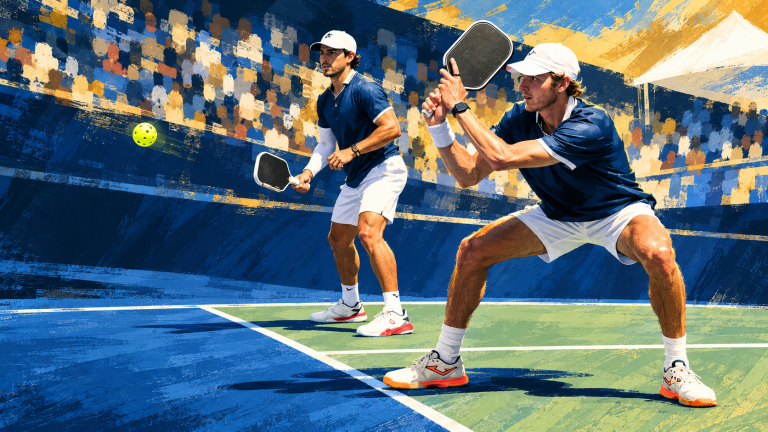

Canada will be represented internationally this year by two very different squads, operating under two very different realities. One sits inside Pickleball Canada’s official high-performance pathway. The other is trying to reach the Pickleball World Cup in Vietnam through a largely self-driven campaign.
Key Takeaways
- Pickleball Canada has launched its first national high-performance pathway, with an initial Team Canada squad selected through a Steve Deakin Pickleball MLP combine.
- A separate Canadian group is preparing for the 2026 Pickleball World Cup in Da Nang, Vietnam, with its own selection and support campaign.
- The split points to a wider question for international pickleball: who decides what national representation actually means?
Two Teams, Two Realities
National teams are supposed to answer a simple question.
Who are the best players available, and how do they represent their country?
In pickleball, that question is becoming harder to answer.
Canada’s preparations for a busy international year have exposed an unusual situation. One representative pathway now sits inside Pickleball Canada’s new high-performance programme, which was announced in April and described by the national body as the first step towards forming an official Team Canada.
Another Canadian squad is preparing for the Pickleball World Cup in Da Nang, Vietnam, where organisers are expecting national teams to compete across multiple divisions.
Both groups speak to Canada’s growing depth. They also reveal the administrative strain now appearing around international pickleball.
The Official Pathway
Pickleball Canada’s high-performance programme begins with a National Player Development Pool, including a minimum of ten women and ten men, plus a junior group split equally by gender. The first selection event was the Steve Deakin Pickleball Major League Pickleball combine in Calgary from 15 to 17 May 2026.
That combine was designed to select six players, three women and three men, for an initial Team Canada group to compete at an MLP event scheduled for 8 to 12 July in Grand Rapids, Michigan.
Further selections are due to take place at the 2026 National Championships and through the Provincial Team Competition, with Pickleball Canada stating that its first official international participation is being targeted from 2027 onwards.
On paper, this is a logical step. A national governing body needs a formal pathway, transparent criteria and a development structure that reaches beyond whoever happens to be visible in the professional game at a given moment.
But pickleball is not developing on a neat administrative timetable.
The World Cup Question
The complication comes from the other side of the calendar.
A separate Canadian World Cup campaign is already taking shape for Vietnam, with the Da Nang event scheduled to bring international teams to Asia later this year. The group behind the Canadian campaign says it is selecting players across junior, open and senior divisions, with six players per team.
That leaves a difficult question hanging over the process.
If Pickleball Canada’s official pathway is still building towards 2027, who represents Canada at major international events taking place before then?
The answer, for now, appears unsettled. Canada has elite players, established domestic competition through the Canadian National Pickleball League, and enough international credibility to be taken seriously at events outside North America. What it does not yet appear to have is a single, universally accepted route through which those players are selected, backed and promoted for every major overseas competition.
This Is About More Than Funding
It would be easy to frame this as a dispute over travel costs. That would miss the bigger point.
Funding matters, especially in a sport where many players are still paying for large parts of their own competitive careers. Flights, hotels, entry costs, coaching, medical support and lost work time all carry real weight. For athletes asked to compete under a national banner, those costs are not merely personal expenses. They become part of the meaning of representation itself.
But legitimacy may be the deeper issue.
Who decides which team counts? Which competitions deserve official recognition? Should national bodies control representation only when they are ready to fund and organise it properly? Or should strong players, professional leagues and independent selection groups be able to fill the gap when the official structure is still catching up?
Those are not small questions. They sit at the centre of pickleball’s attempt to move from a fast-growing participation sport into a more serious international competition system.
Why Canada Matters
Canada is an especially interesting case because its governing body has not been idle. Pickleball Canada is recognised as the national governing body for the sport in the country and has been granted funding-eligible status by Sport Canada. It is also a member of the Global Pickleball Federation, according to the GPF.
That gives the organisation greater standing, but also greater responsibility.
When a national body starts building a formal high-performance structure, it has to balance fairness, geography, player development and long-term credibility. Yet the professional game keeps moving. Players do not want to wait years for administrative systems to mature while international opportunities appear now.
This is where pickleball differs from older sports. In tennis, football or athletics, the idea of national representation is usually tied to long-established selection systems. In pickleball, those systems are being built while the international calendar is already expanding around them.
What This Means
Canada’s situation is unlikely to be unique for long.
As more countries send teams to World Cups, continental events, league showcases and invitational competitions, national governing bodies will face the same pressure. Some will have the money, staff and authority to manage it cleanly. Others will find themselves chasing a calendar that has already moved ahead.
Players, meanwhile, will ask a more direct question.
If representing your country means paying your own way, raising your own support and explaining your own legitimacy to the public, at what point does national representation start to feel self-employed?
That is the uncomfortable issue beneath Canada’s current divide. The country does not lack players. It does not lack ambition. What remains unclear is whether its competitive structures can line up quickly enough to give those players one clear national pathway.
For now, Canada’s pickleball identity is being shaped through more than one route. Whether those routes eventually converge may tell us a great deal about how national teams across the sport are built in the years ahead.
Further Reading
- Latest pickleball news from around the world
- Tournament coverage and results
- Rankings and player profiles
- Regional pickleball coverage

Chris Beaumont
Founder and Editor-in-ChiefChris Beaumont is the founder and Editor-in-Chief of World Pickleball Magazine. Chris follows the global game closely, reporting on the latest news, developments, stories and tournaments from all five continents. He also hosts the World Pickleball Podcast, interviewing people at…
View All Articles →