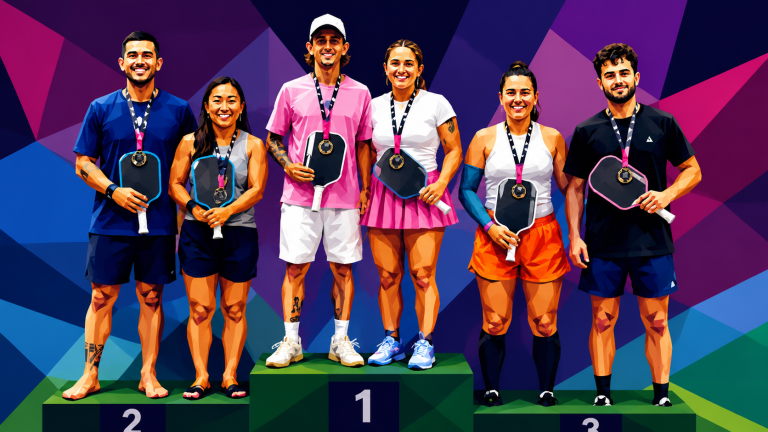

England’s 2026 Pickleball World Cup squad represents a different stage of the country’s development. This is not simply a collection of domestic standouts. It is a group of professionals who have taken different routes into the international game, from the established global circuit to Asia’s emerging markets, now brought together to answer a bigger question: can England turn individual talent into a genuine team?
- England’s World Cup squad combines established professionals, experienced international representatives and a younger generation looking to establish itself.
- Megan Fudge gives England a proven global performer, while players including Ben Cawston, Matt Finnerty and Ellie Tomkinson represent the changing pathways into elite pickleball.
- Under manager Dan Osben, England’s challenge is no longer simply producing talented players. It is creating the environment where those players can succeed together.
England has spent years proving that it can produce talented pickleball players.
The 2026 Pickleball World Cup presents a different challenge.
Can those players become a team?
That question sits at the heart of England’s latest international campaign. The squad heading to Da Nang is not built around one pathway or one generation. It is a combination of established professionals, experienced international representatives and emerging players looking to establish themselves on the biggest stage.
There is no single route into elite pickleball anymore.
Some players have built their reputations through the professional circuit. Others have arrived through different racket sports. Others are developing through the increasingly global tournament landscape.
That variety is what makes this England squad interesting.
The country is no longer simply introducing itself to international pickleball. It is sending players who have already been testing themselves against the wider game.
The 2026 squad features:
Women
Megan Fudge
Thaddea Lock
Katie Morris
Ellie Tomkinson
Evie Kenna
Men
Mikar Fisher
Freddie Powell
Nicholas Wade
Ben Cawston
Matt Finnerty
The team will be managed by Dan Osben, founder of Picklebros UK and Friday Pickleball, as England attempts to bring together a group of players whose careers have developed across different parts of the sport.
The Builder Becomes The Manager
Dan Osben’s appointment reflects an interesting moment for English pickleball.
His background has been built around developing the sport’s identity as much as its competition. Through Picklebros UK, he has helped tell the story of British pickleball, while Friday Pickleball has taken him further into the commercial side of the game.
The World Cup requires a different challenge.
A national team cannot simply collect talented individuals and expect success to follow. Players who spend much of the year competing against each other must suddenly share a purpose, prepare together and understand their roles within a larger group.
Osben’s task is therefore about more than selection.
It is about creating a team identity.
Megan Fudge Gives England A Global Reference Point
Every ambitious national team needs a player who changes the conversation around it.
For England, that player is Megan Fudge.
Fudge does not arrive as a developing talent searching for international recognition. She arrives as an established professional with extensive experience across the major competitive circuits.
Her career has been built through repeated exposure to elite competition, giving England something every national team wants: a player who understands what the highest level looks like.
That matters because international events create a different kind of pressure.
Individual players spend most of their careers chasing personal results. A World Cup adds another responsibility. Every performance carries the weight of a country behind it.
England’s advantage is that Fudge already knows how to operate in that environment.
Thaddea Lock: The Player Who Understands The Mission
If Fudge represents international experience, Thaddea Lock represents England’s development story.
Lock has become one of the central figures in English pickleball, combining playing, coaching and leadership responsibilities.
She has previously represented England internationally and taken on leadership roles within the national programme.
Her value comes from understanding the bigger picture.
A World Cup team needs players who can perform, but it also needs players who understand where the programme is heading.
Lock has seen English pickleball move through different stages. She understands both the foundations that were built and the expectations that now exist.
She is not simply part of the team. She represents the journey that brought England here.
The Players Who Built Their Own Routes
One of the strongest themes within England’s squad is the variety of journeys that brought these players together.
The modern pickleball pathway is no longer straightforward.
Ben Cawston: The Racket Athlete Who Found A New Arena
Ben Cawston represents one of the clearest examples of pickleball’s changing athlete profile.
Players from other racket sports are increasingly recognising that pickleball offers a serious competitive pathway, not simply a recreational opportunity.
Cawston arrived with experience from another racket discipline before establishing himself within England’s international set-up.
The challenge is not just technical adaptation.
Pickleball rewards different qualities. Timing matters. Patience matters. Decision-making under pressure matters.
Cawston’s journey reflects a wider shift in the sport: athletes are no longer discovering pickleball by accident. They are choosing it deliberately.
Ellie Tomkinson: The Next Generation
Ellie Tomkinson represents the next stage of England’s development.
A former tennis player, Tomkinson has transferred her competitive background into pickleball and established herself among England’s leading female players.
Her selection matters because successful national teams cannot rely only on established names.
They need the next group already moving towards the international level.
England’s challenge is not only competing at this World Cup. It is building the players who can compete at the next one.
Matt Finnerty And England’s Asian Route
Matt Finnerty provides one of the most interesting examples of the modern professional route.
While many English players have developed through domestic and European competition, Finnerty has tested himself in Asia’s emerging professional environment.
His bronze medal at the 2026 PPA Tour Asia Macao Open demonstrated his ability to compete internationally.
That pathway matters.
The future of professional pickleball will not be built in one country. Players will increasingly move between continents, following the strongest competition and the biggest opportunities.
Finnerty represents that new reality.
Strength and depth
The rest of England’s squad represents the depth behind the headline names.
Mikar Fisher represents one of the country’s emerging players, with his selection reflecting England’s desire to develop talent that can contribute now while becoming part of the national team’s future.
Freddie Powell brings something every successful team needs: personality. Powell has become one of England’s most recognisable players, combining competitive ability with an entertaining style that has helped make him a popular figure within the sport.
Katie Morris provides international experience and familiarity with the demands of national competition, while Nicholas Wade and Evie Kenna add further depth to the group.
The Real World Cup Test
The World Cup will not reveal whether England has talented pickleball players.
That question has already been answered.
The harder question is whether those players can combine into something greater than their individual careers.
The United States remains the deepest talent pool in the sport. Other nations are developing their own pathways and building systems designed to produce international competitors.
The next phase of pickleball will not belong only to countries with the most players.
It will belong to countries that create the strongest environments around those players.
England has reached the point where participation is no longer the ambition.
Competition is.
Further Reading
- Latest pickleball news from around the world
- Tournament coverage and results
- Rankings and player profiles
- Regional pickleball coverage

Chris Beaumont
Founder and Editor-in-ChiefChris Beaumont is the founder and Editor-in-Chief of World Pickleball Magazine. Chris follows the global game closely, reporting on the latest news, developments, stories and tournaments from all five continents. He also hosts the World Pickleball Podcast, interviewing people at…
View All Articles →