Pickleball players analyse every detail of their paddles, but what happens when sweat compromises the hand holding one? Sahara Dry CEO Rob McEvoy joins the World Pickleball Podcast to explain the science, the unlikely sporting journey behind the product and why grip may deserve more attention.
Key Takeaways
- Sahara Dry approaches sweaty hands differently from traditional chalk-based products, using modified silica designed to repel rather than simply absorb moisture.
- CEO Rob McEvoy’s route to pickleball runs from Rossendale to Thailand and through sports as varied as pole, gymnastics, shooting and golf.
- The full World Pickleball Podcast explores whether grip is an overlooked part of performance and puts some of Sahara Dry’s claims to the test.
Pickleball players can become spectacularly particular about equipment.
Paddle weight. Swing weight. Twist weight. Core thickness. Surface. Handle length. Grip circumference.
Then there is the hand actually holding the thing.
That tends to receive rather less analysis.
Until it is hot. Until the hand starts sweating. Until the paddle shifts slightly during a drive or suddenly feels less secure when the player needs a relaxed hand and reliable control.
After six days around the courts at the English Open, Chris Beaumont had experienced the problem himself. Even indoors at Birmingham’s NEC, conditions were hot enough for sweat to become part of the contest.
There were plenty of reasons for the occasional mishit.
For once, lack of talent did not have to accept all the blame.
It was also a useful starting point for the latest World Pickleball Podcast with Rob McEvoy, CEO of Thailand-based sports technology company Sahara Dry.
Because sweaty hands sound like one of sport’s more trivial problems.
Until you start thinking about what they actually do.
The weakest link?
Pickleball’s equipment conversation has become increasingly sophisticated.
Players now discuss paddle construction in considerable detail. Manufacturers sell around core technology, surface materials, dwell time, power, control and increasingly elaborate measurements of how a paddle behaves.
WPM has explored the same principle elsewhere, including the question of whether pickleball performance is paying enough attention to what happens beneath the player.
Grip raises a similar question.
All of that paddle engineering ultimately has to be controlled through a few inches of handle sitting inside a human hand.
If that connection becomes unreliable, the rest starts to matter rather less.
A player who feels the paddle moving can squeeze harder. Change grip pressure and you can change the stroke. Lose confidence in the connection between hand and paddle and a small physical problem starts interfering with technique.
McEvoy has spent several years thinking about precisely that problem.
His answer began with an unusual piece of material and an important distinction.
Should you absorb sweat?
Or repel it?
A different way of dealing with sweat
Most familiar grip products deal with moisture in the obvious way.
They absorb it.
McEvoy points to chalk and magnesium-based products as examples. Moisture enters the material, which means there is necessarily a limit to how much it can absorb before the product needs to be reapplied.
Sahara Dry takes a different approach.
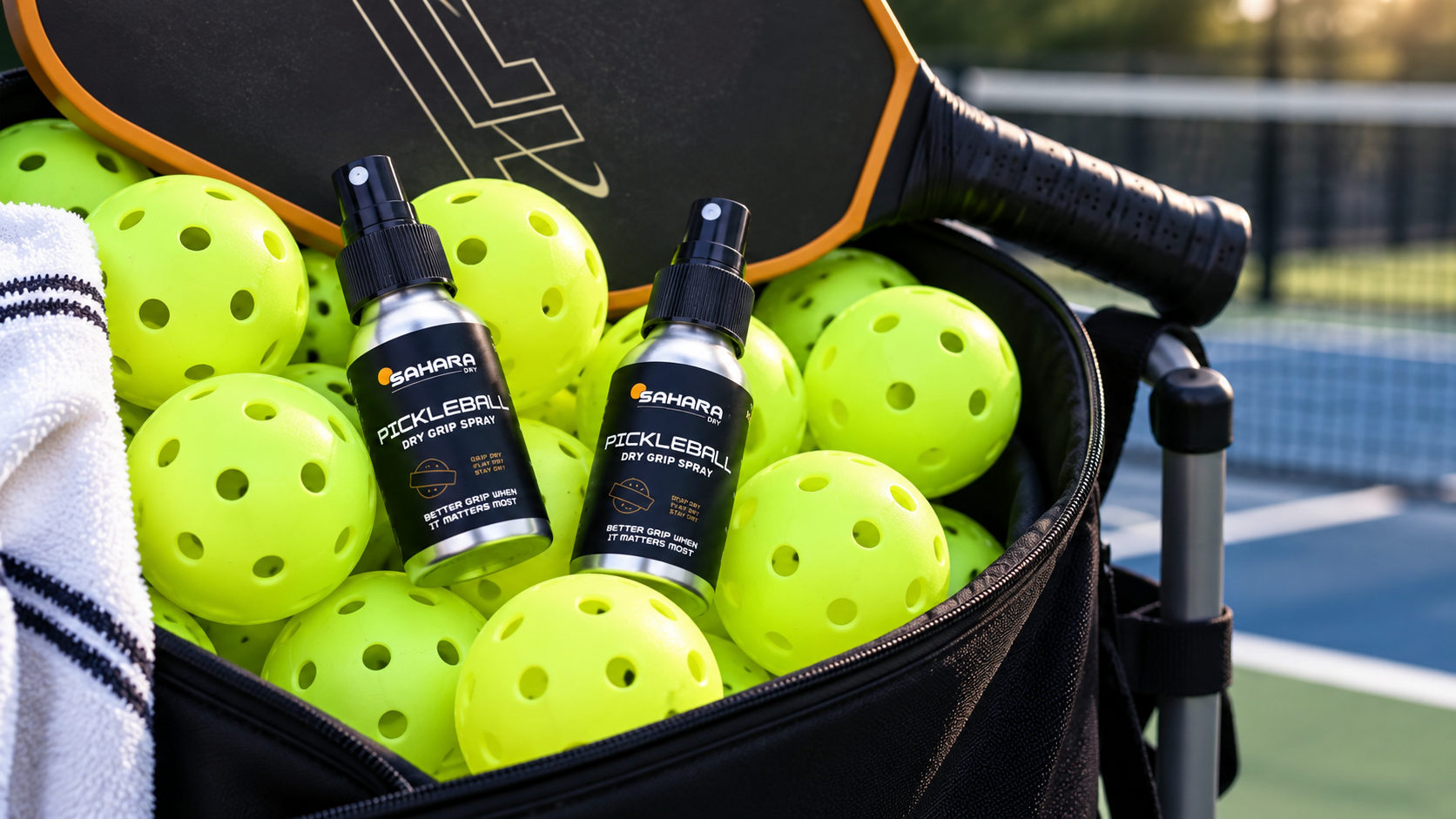
McEvoy says the company’s modified silica powder settles into the tiny wrinkles of the skin and repels moisture rather than absorbing it.
His preferred comparison is water landing on a lotus or banana leaf. Instead of spreading across the surface, it beads.
Importantly, the player still sweats.
Sahara Dry is not designed to prevent perspiration. McEvoy says the idea is to change what happens when that moisture reaches the treated skin, reducing the amount sitting between hand and grip.
For a pickleball player, the proposed benefit is straightforward.
A more consistent connection with the paddle.
Whether that works as advertised is an obvious question, and Beaumont puts the sceptical case to McEvoy during the podcast.
How long does it actually last? What happens when somebody sweats heavily? How does it compare with traditional products? What evidence sits behind the claims?
The answers lead somewhere rather unexpected.
Listen to the full conversation: The World Pickleball Podcast is available on Spotify and Apple Podcasts.
Pickleball was not where this started
McEvoy comes from Rossendale in North West England and spent part of his career around professional rugby, including Sale Sharks, Cornish Pirates and London Welsh.
Then he went to Thailand.
The original plan was to stay for a year.
He never really came back.
While working at a university there, McEvoy was approached by a scientist who, he says, had spent more than a decade working with the material that would eventually become Sahara Dry.
The scientist understood the material.
McEvoy had previously developed and sold a golf training product.
Together, they began trying to work out what they actually had.
Golf might seem the obvious starting point.
It wasn’t.
The early sporting journey took Sahara Dry through racquet sports and esports before one community became particularly important to the young company.
Pole dancing.
What pole sport can teach pickleball
There are easier places to test whether a grip product works.
There are probably few better ones.
For a pole athlete, grip is fundamental. Losing it does not mean pushing a third-shot drop long. The athlete may be supporting much of their body weight through the contact they are trying to maintain.
McEvoy says the pole community was willing to experiment with the product and, crucially for a young company, willing to buy it.
That helped fund Sahara Dry’s development into other sports.
Gymnastics followed. Shooting. Golf. Basketball. Cheerleading. Racquet sports.
Eventually, pickleball.
There is a much bigger story here about how a scientist in Thailand, a former rugby executive from Rossendale and athletes from very different sports ended up producing something aimed at recreational pickleball players.
We will tell that story properly in the September edition of World Pickleball Magazine.
For now, the sporting question is simpler.
How much does your grip really matter?
Nobody is suggesting a grip product will suddenly produce a better backhand.
Sadly, pickleball remains more difficult than that.
But consider the amount players will spend to make relatively small improvements elsewhere.
A different paddle because it feels marginally more stable.
Another pair of shoes because the movement feels better.
An overgrip because the handle does not quite sit correctly.
Hours spent working on touch and learning to relax the hand at the kitchen.
Then add sweat.
McEvoy believes pickleball presents a particularly interesting problem because so much of the sport is recreational, often played outdoors and increasingly played in hot climates.
Thailand provides him with a fairly unforgiving testing ground.
The much larger opportunity lies elsewhere.
America has a huge recreational pickleball market, much of it playing in warm conditions, and McEvoy believes the challenge is less about explaining the chemistry than getting players to put the product on their hands and feel the difference for themselves.
That is part of what makes the conversation interesting.
Sahara Dry is a product, certainly.
But the podcast keeps returning to something broader: the strange way sports technology develops.
An idea starts in a laboratory. Another sport discovers it. Athletes expose weaknesses. The product changes. Somebody from an entirely different sport notices they have essentially the same problem.
Eventually it reaches pickleball.
And suddenly you find yourself asking a question that seemed almost too mundane to bother with.
You chose your paddle carefully.
How much thought did you give the hand holding it?
Rob McEvoy joins Chris Beaumont on the latest World Pickleball Podcast to discuss the science of sweat and grip, the sceptical questions around Sahara Dry, building a sports technology company in Thailand, what pole athletes taught him about grip and why he believes pickleball could become one of the company’s most important markets.
Listen now on Spotify or Apple Podcasts.
Further Reading
- Latest pickleball news from around the world
- Tournament coverage and results
- Rankings and player profiles
- Regional pickleball coverage

Chris Beaumont
Founder and Editor-in-ChiefChris Beaumont is the founder and Editor-in-Chief of World Pickleball Magazine. Chris follows the global game closely, reporting on the latest news, developments, stories and tournaments from all five continents. He also hosts the World Pickleball Podcast, interviewing people at…
View All Articles →