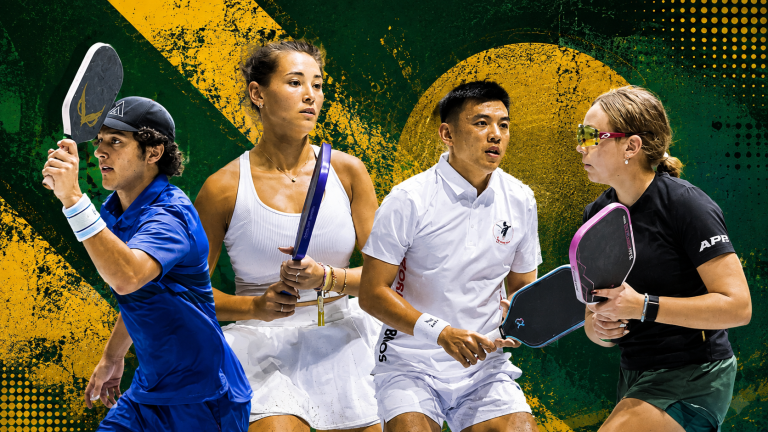

Vietnam dominated the opening team stage in Da Nang, but the knockout rounds ask a different question: which countries have enough depth across six disciplines to survive when the match-up keeps changing?
Key Takeaways
- Vietnam won all three of their Open group ties 6-0 and now enter the knockout stage as one of the clearest favourites alongside the United States.
- The national-team format rewards depth across women’s doubles, men’s doubles, two mixed doubles matches and both singles disciplines, making roster balance as important as individual star power.
- Australia’s balance, South Korea’s women and India’s 17-1 pool record give the bracket several credible challengers beyond the obvious Vietnam-USA storyline.
For three days in Da Nang, Vietnam have been difficult to escape.
They have won across the individual programme, filled podiums and repeatedly demonstrated the depth that has made Vietnamese pickleball one of the most interesting competitive stories of the week.
Now comes the part that asks a different question.
The flags are on the court.
The Pickleball World Cup has moved into its Open national-team competition, where each tie runs through women’s doubles, men’s doubles, two mixed doubles matches, women’s singles and men’s singles.
That changes the competitive problem completely. Individual brilliance still matters, but a country has to keep finding answers as the discipline, partnership and role change around it.
And after watching Vietnam at close quarters throughout the week, WPM’s Gordon Watson has reached a fairly straightforward conclusion.
They are one of the teams everybody else has to beat.
“Vietnam yesterday were absolutely supreme,” Watson said from Da Nang. “They absolutely controlled it.”
The home nation then supplied the numbers to support the impression, winning all three of its Open pool ties 6-0 against Chile, the Cayman Islands and Colombia before advancing to Friday’s knockout programme.
The individual events showed what Vietnam’s best players can do.
The team competition may be better suited to showing how difficult it is to find a weak point.
Vietnam’s strength is becoming harder to isolate
The temptation with a host nation is to allow the crowd, the scale of the event and an accumulation of medals to inflate what is happening competitively.
Vietnam do not need that help.
Their case has been made on court.
The Open roster includes established names such as Ly Hoang Nam, Quang Duong, Phuc Huynh, Do Minh Quan, Truong Vinh Hien, Trinh Linh Giang, Ken Tam, Sophia Huynh Tran, Trang Huynh and Si Boi Ngoc, giving the hosts multiple options rather than one obvious route through a tie.
That matters because the national format does not allow a country to solve one problem and keep solving it. A singles player who dominates one match may not influence the next. A strong gender-doubles pairing can be followed immediately by mixed combinations that ask different questions of positioning, pace and partnership.
A country with one exceptional player can therefore be attacked elsewhere. A powerful men’s group can still lose ground through the women’s matches. Strong doubles combinations are less useful if the singles portion of the tie becomes an obvious target.
Vietnam’s week suggests fewer easy places to look.
Watson has watched that depth reveal itself across several days, which is why he places the hosts alongside the United States among the tournament favourites rather than treating their individual success as something that resets when the team event begins.
There is also the home court. The crowd in Da Nang has spent the week watching Vietnamese players win, and those performances now feed a national result rather than separate draws.
Vietnam are no longer collecting medals independently.
They have to keep solving different versions of the same tie.
The USA still have the cleaner route
If Vietnam carry the emotional weight of the tournament, the United States carry the expectation.
Watson’s reading of their side of the bracket was uncomplicated. He expects the Americans to reach the latter stages without requiring anything extraordinary.
That does not mean their first knockout assignment against Thailand should be dismissed. South East Asian pickleball has shown enough this week for the old assumption that an American side should simply walk through a regional opponent to be treated carefully.
The USA remain the benchmark because the format should reward exactly what a mature pickleball nation can provide: answers across several disciplines rather than dependence on one match-up.
An American run into the latter stages would confirm an established hierarchy. The identity of the teams capable of travelling with them would tell us something newer.
That uncertainty sits further down their side of the draw, where France, Germany, Belgium, Bulgaria, Spain, Colombia, Hong Kong, China and Costa Rica all appear in Friday’s first knockout round on the official Sporttora order of play.
South Korea are the team Watson keeps coming back to
Vietnam are the favourites on their side.
Australia have arrived with depth.
Japan remain dangerous.
Yet when Watson starts looking for a country capable of disturbing that route, he keeps returning to South Korea.
The reason is not abstract.
He has already watched the Korean women.
“If Min Young Kim and Mi-hye are performing,” Watson said, “we know how devastating they’ve been.”
That matters because strength on the women’s side changes the whole arithmetic of a tie. South Korea’s men do not need to overwhelm every opponent if the women are consistently creating wins elsewhere, and the mixed matches then become opportunities rather than rescue missions.
The format also rewards players who can move between singles and doubles without becoming significantly less dangerous. Singles exposes movement, court coverage and the ability to create offence without a partner. Doubles compresses reaction time and places greater value on hands, positioning and partnership. Mixed introduces another tactical layer around space, pressure and targeting.
A national side has to survive all of it.
South Korea have shown Watson enough in those different areas to make him wary of treating their place in the bracket as merely another step towards Vietnam.
A deep Korean run would not need a grand conclusion attached to it.
It would simply confirm that the individual quality seen earlier in the week travels into team competition.
Australia may have been selected for exactly this problem
Australia are perhaps the clearest reason not to reduce the World Cup to Vietnam versus USA.
Their Open roster contains Harrison Brown, Robert Stirling and Zac Grabovic alongside Sarah Burr, Nicola Schoeman and Selina Turulja. Pickleball Australia confirmed the six-player selection in July, and Thursday’s pool stage gave a useful demonstration of how those pieces can be rearranged.
Against Belgium, Schoeman and Turulja won women’s doubles 21-10, Brown and Stirling took men’s doubles 21-13, Stirling and Turulja were edged 22-20 in the first mixed match, Brown and Schoeman restored the advantage 21-15, Burr lost a competitive women’s singles 21-18 and Grabovic closed the tie 21-7 in men’s singles.
Australia won the tie 4-2.
That scoreline explains the format better than any theory could. Nobody had to dominate every discipline. Two losses did not expose the whole team because other combinations were strong enough to compensate.
A World Cup roster is partly a selection puzzle. The strongest individual names do not automatically create the strongest team if the combinations leave obvious holes when the disciplines change.
Australia look as though they have thought about that problem.
They finished their pool unbeaten after beating Nepal 6-0 and Belgium 4-2, alongside a forfeit victory over Kenya, and advanced to face Singapore in Friday’s first knockout round.
Schoeman’s presence is particularly useful because her week has already established her as one of Australia’s strongest performers, while Brown gives the men’s side a player accustomed to carrying significant responsibility.
Neither needs to win everything.
That may be the point.
India have made themselves impossible to ignore
One country deserves more attention than Watson had time to give it while watching events unfold elsewhere in Da Nang.
India.
Three pool ties. Three victories.
Antigua and Barbuda were beaten 6-0.
Israel were beaten 6-0.
The Czech Republic managed one win in a 5-1 Indian victory.
Seventeen matches won from 18.
At some point, “dark horse” becomes an unnecessarily cautious description.
More importantly, India’s record tells us something that an isolated singles run cannot. One excellent player can emerge almost anywhere. Winning 17 of 18 matches across women’s doubles, men’s doubles, two mixed doubles contests and both singles disciplines requires a much wider base.
The Indian Pickleball Association’s post-pool reporting listed a pro squad including Harsh Mehta, Arjun Singh, Anish Froilan, Aman Patel, Pearl Amalsadiwala, Naomi Amalsadiwala, Aaliya Ebrahim and Mihika Yadav, and the first day gave opponents repeated opportunities to find a weak match-up. They found very little.
The current Sporttora order of play lists China as India’s first knockout opponent.
There is no need to pretend three pool victories have suddenly placed India alongside the USA or Vietnam.
But 17-1 has earned them something more useful than hype.
Attention.
Now the bracket starts testing depth rather than reputation
The Open team competition gives the World Cup its cleanest sporting test yet because reputation can only take a country so far once the tie starts moving through six different disciplines.
Vietnam have to turn a superb individual week and a 6-0, 6-0, 6-0 pool stage into a knockout run.
The United States have to justify being the benchmark when opponents can attack several different combinations rather than one player.
South Korea have to discover whether the quality Watson has seen from their women can become the foundation of an entire tie.
Australia have to prove that balance is as valuable in competition as it appeared against Belgium.
India have to show that 17 wins from 18 pool matches were the beginning of something rather than the ceiling.
Japan are still waiting.
And somewhere else in Friday’s first knockout round is a country with an opportunity to emerge from Da Nang with considerably more international credibility than it arrived with.
This is where the format becomes useful.
National-team pickleball should not simply ask which country possesses the most recognisable names. It should expose weaknesses, force selection decisions and reward teams capable of surviving when the match changes shape.
For most of the week in Da Nang, the World Cup has shown us excellent pickleball players wearing national colours.
Vietnam have looked better than most of them.
Now comes the harder question.
Whether they can remain the best team when every tie starts looking different.
Further Reading
- Latest pickleball news from around the world
- Tournament coverage and results
- Rankings and player profiles
- Regional pickleball coverage

Chris Beaumont
Founder and Editor-in-ChiefChris Beaumont is the founder and Editor-in-Chief of World Pickleball Magazine. Chris follows the global game closely, reporting on the latest news, developments, stories and tournaments from all five continents. He also hosts the World Pickleball Podcast, interviewing people at…
View All Articles →