
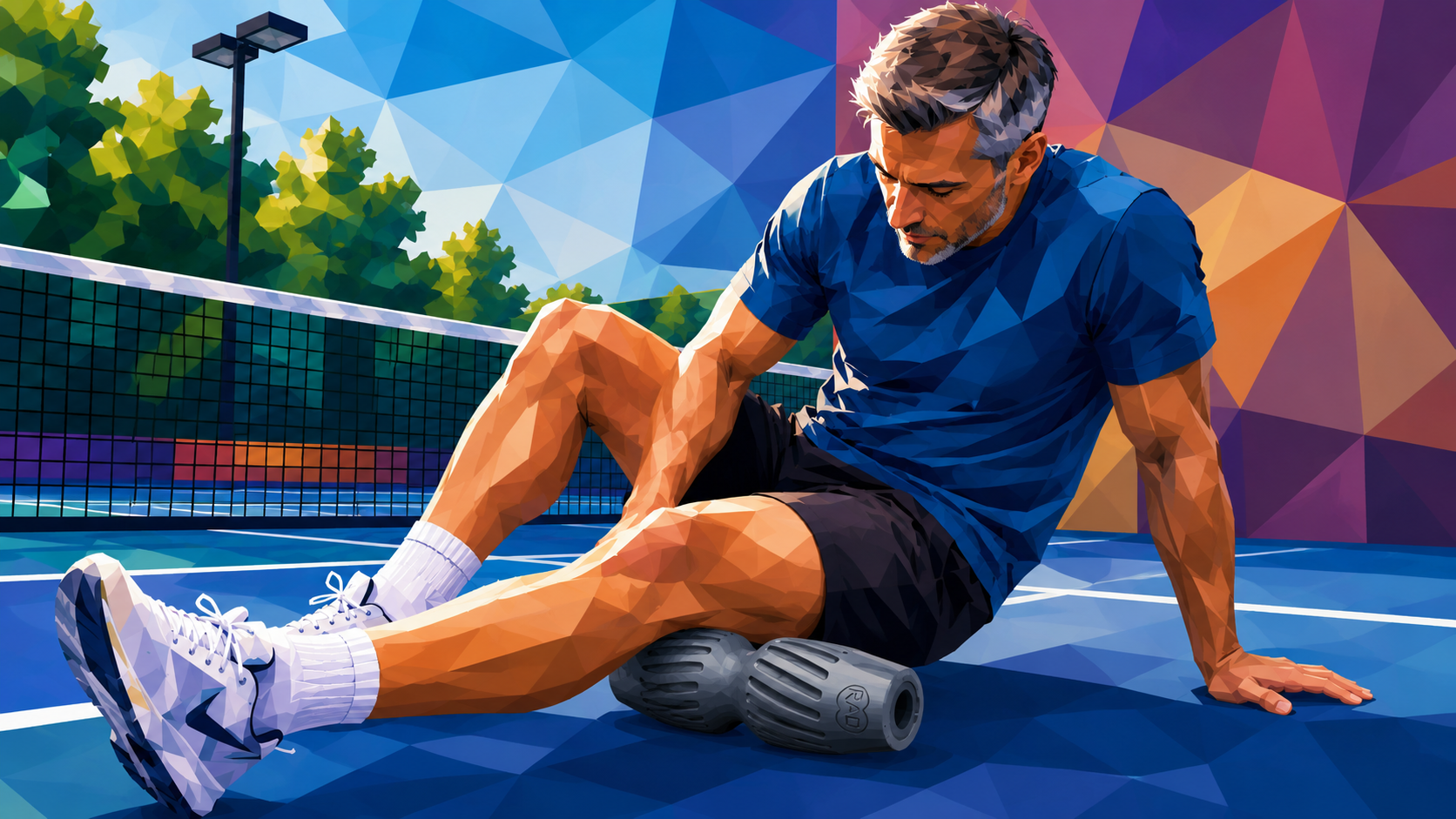
RAD Roller founder Michael Mallory believes many players are approaching recovery with the wrong objective. Instead of crushing sore muscles, enduring painful foam-rolling sessions and waiting until their bodies break down, he argues that a few deliberate minutes each day could help players move better, recover faster and remain on court for longer.
Key Takeaways
- Pain is not reliable evidence that mobility or recovery work is effective.
- Excessive pressure can cause the nervous system to guard rather than relax.
- Five to ten minutes of daily recovery work may be more valuable than occasional intensive sessions.
- Pre-match mobility and post-match recovery serve different purposes.
- Restricted movement elsewhere in the body can contribute to common pickleball shoulder, elbow and knee problems.
Pickleball players are very good at finding more time to play pickleball.
They add another social session.
Accept one more invitation.
Enter another tournament.
Stay on court for an extra game because four more players have just arrived.
What they are far less effective at doing is protecting the body that makes all of that possible.
The familiar pattern is easy to recognise.
A player walks into the sports hall, takes a paddle from the bag and begins hitting almost immediately.
When the session ends, the paddle goes away and the player heads home.
There may be no meaningful warm-up.
No recovery.
No attempt to restore movement or understand why the shoulder, knee, calf or elbow has begun to complain.
Until eventually, a niggle becomes an injury.
On the latest episode of the World Pickleball Podcast, RAD Roller founder Michael Mallory argues that this cycle is not inevitable.
But changing it requires players to abandon one of the most persistent myths in amateur sport.
Recovery does not need to hurt to work.
When Harder Is Not Better
Anyone who has spent time around a foam roller will recognise the performance.
A player drops their entire bodyweight onto a painful area.
Their face tightens.
Their breathing changes.
They grit their teeth and continue rolling because they believe the discomfort proves something useful is happening.
Mallory believes that response may indicate the opposite.
When pressure becomes so intense that a person holds their breath or begins guarding the area, the nervous system may simply refuse to release it.
The body has decided that the threat is too great.
Continuing to apply pressure does not necessarily produce a better outcome.
It may only create a bigger fight.
“Go all the way up to that point where you start to feel yourself guard, and then back off 20%.”
Mallory’s advice is straightforward: approach the point where the body begins to resist, then reduce the pressure.
The objective is not to survive the experience.
It is to create enough relaxation and movement for the body to respond.
There are circumstances where more forceful manual therapy may be appropriate, particularly during tightly controlled rehabilitation after surgery.
But for the ordinary player managing daily stiffness or trying to recover between sessions, Mallory says lighter work can still improve movement, shift fluid and influence the nervous system without creating unnecessary resistance.
The Body Does Not Work In Isolated Parts
Pickleball injuries are often named according to the location where pain appears.
Tennis elbow.
Rotator-cuff trouble.
Patellar-tendon irritation.
A tight calf.
A sore lower back.
Yet the place that hurts is not always the place where the original problem began.
Mallory uses the shoulder as an example.
For the arm to move freely, the shoulder blade and upper spine must also contribute. When the upper body becomes rounded and stiff, the shoulder may be forced to generate movement it was never designed to produce alone.
The joint begins compensating.
Over time, that compensation can become irritation or injury.
The same principle applies throughout the body.
A joint that cannot share load effectively with the surrounding structures is likely to absorb more stress than it should.
This matters particularly in pickleball, where repeated reaching, rotation, stopping and accelerating place demands on players who may also spend much of the working day sitting still.
The answer is not always to strengthen the painful joint harder.
Sometimes the first task is restoring movement around it.
Prehab And Recovery Are Not The Same
One of the most useful distinctions in the conversation is the difference between preparing to play and recovering afterwards.
Before stepping on court, the player is trying to create usable movement.
That may mean improving range around the shoulders, hips, spine or ankles so the body can rotate, reach and change direction without forcing one area to do all the work.
After playing, the objective changes.
The focus moves towards circulation, reducing stiffness and helping the body recover from the stress it has just absorbed.
Mallory describes this as moving fluid through the system.
That does not require an aggressive attack on sore tissue.
Fast, lighter movements may be more appropriate when the aim is recovery rather than trying to address a specific restriction.
The distinction sounds simple.
Yet many amateur players use the same tool, pressure and technique for every purpose.
A hard foam-rolling session becomes the answer to stiffness, warm-up, soreness, mobility and injury alike.
It is the recovery equivalent of trying to play every pickleball shot with the same swing.
Stretching Is More Complicated Than It Looks
Stretching remains one of the most familiar recommendations in sport.
It is also, Mallory suggests, one of the most misunderstood.
Passive stretching may feel pleasant and can help a player begin moving, but increased range is not automatically useful if the body lacks the strength, joint movement or control to support it.
Muscles sometimes tighten for a reason.
They may be protecting a joint.
Compensating for weakness.
Or preventing the body from entering a position it does not yet feel capable of controlling.
That is why Mallory encourages players with significant restrictions or persistent pain to seek professional guidance rather than assuming that pulling harder on the tight area will solve the underlying problem.
The body is not simply a collection of short muscles waiting to be stretched.
It is a connected system constantly making decisions about safety.
Five Minutes Is Enough To Begin
The most practical recommendation from the episode is also the least dramatic.
Five minutes.
Not an hour-long recovery routine.
Not a complete lifestyle overhaul.
Just five deliberate minutes each day.
Mallory compares it to brushing your teeth.
People do not wait until they develop severe dental pain before deciding oral hygiene might be useful. The habit is maintained precisely because it helps prevent the larger problem.
Recovery should be approached in the same way.
“Your body needs a little bit of help on a daily basis. It needs to relax, it needs to recover and it needs normal joint ranges of motion.”
A few minutes spent noticing where the body feels restricted, encouraging movement through stiff areas or helping tired muscles settle after play may appear insignificant.
Repeated every day, it becomes something much more powerful.
Awareness.
Players begin identifying tightness before it becomes pain.
They begin recognising how their bodies respond to different workloads.
They arrive on court better prepared and make more intelligent decisions about when to push and when to back off.
That awareness may be particularly valuable in pickleball, where enthusiasm frequently outruns physical preparation.
A player who once competed twice each week may suddenly begin playing five or six times because the sport is social, accessible and difficult to resist.
The heart wants another game.
The body may need something else.
The Recovery Habit Pickleball Has Ignored
Professional athletes receive regular treatment because recovery is considered part of the job.
Amateur players often treat it as an optional extra.
That distinction becomes increasingly important as players age, play more frequently or return to sport after years of reduced activity.
The body still adapts.
It still improves.
But it requires attention.
Mallory’s message is not that every player needs expensive equipment or an elaborate recovery system.
It is that doing something consistently is far more valuable than doing something extreme occasionally.
Start lightly.
Pay attention.
Move with purpose.
Stop using pain as the measure of effectiveness.
And give the body five minutes of the same enthusiasm you give the game.
If all this makes sense to you, you have to check out RAD Roller’s range of recovery tools – genuinely, they could change your pickleball game.
Listen To The Podcast
Hear the full conversation with Michael Mallory on the latest episode of the World Pickleball Podcast.

Chris Beaumont
Founder and Editor-in-ChiefChris Beaumont is the founder and Editor-in-Chief of World Pickleball Magazine. Chris follows the global game closely, reporting on the latest news, developments, stories and tournaments from all five continents. He also hosts the World Pickleball Podcast, interviewing people at…
View All Articles →

