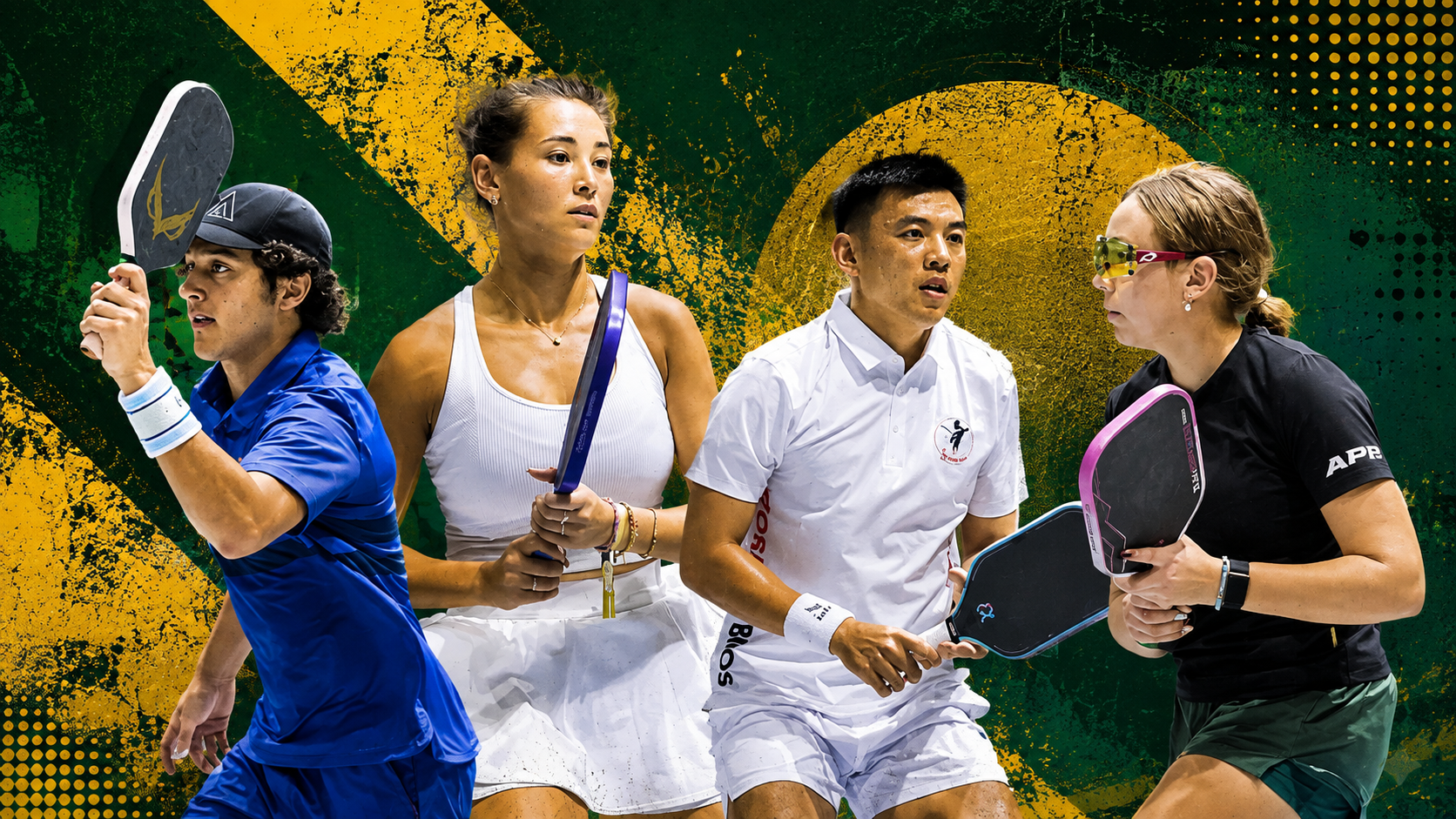
Lý Hoàng Nam and Roos Van Reek are through to the Pro Mixed Doubles final at the Pickleball World Cup in Da Nang. For Hoàng Nam, it completes an extraordinary set: men’s singles, men’s doubles and mixed doubles, with all three titles to be decided on Sunday.
Key Takeaways
- Lý Hoàng Nam has reached all three Pro Open finals at the 2026 Pickleball World Cup: men’s singles, men’s doubles and mixed doubles.
- Hoàng Nam and Roos Van Reek recovered from losing the opening game against Robert Stirling and Selina Turulja before eventually reaching the mixed final against Jack Munro and Nicola Schoeman.
- This is the third time in 2026 that Hoàng Nam has reached three finals at the same tournament, but he has yet to convert one of those opportunities into a triple crown.
Lý Hoàng Nam has spent the first four days of the Pickleball World Cup turning every professional draw he enters into the same destination.
Sunday.
First came men’s singles, where the Vietnamese No. 1 earned a final against Phúc Huỳnh. Then men’s doubles, where Hoàng Nam and Nguyễn Ảnh Gia Huy survived an increasingly difficult route to set up a championship match against Richard Livornese Jr and Jack Munro.
On Wednesday, he completed the set.
Playing alongside Roos Van Reek, Hoàng Nam recovered from losing the opening game of their Round of 16, survived another three-game examination against Livornese and Vivian Glozman, then beat Eungg Won Kim and Mihae Kwon 15-11, 15-10 in the semi-final.
The result puts Hoàng Nam and Van Reek into the Pro Mixed Doubles final against Munro and Nicola Schoeman.
More importantly, it means the Vietnamese player will contest all three Pro Open finals at his home World Cup.
That is no longer merely a good tournament.
It is three opportunities on the same Sunday to turn four days of progress through the draw into something permanent.
Van Reek and Hoàng Nam had to survive trouble
The mixed-doubles route was not clean enough to be dismissed as another home favourite moving comfortably through a draw.
Hoàng Nam and Van Reek reached Robert Stirling and Selina Turulja in the last 16 and immediately found themselves behind.
Stirling and Turulja took the opening game 15-9.
What followed is important precisely because the available results do not tell us enough to manufacture a neat tactical explanation for the turnaround. We know Hoàng Nam and Van Reek were one game down. We know they responded by winning the next two. And we know that, in a discipline where two players have to solve problems together rather than simply raise their own level, they found a way through a match that had started badly.
That was enough.
The 2-1 victory kept them alive and sent them into a quarter-final against Livornese and Glozman.
Their reward was another three-game match.
Livornese keeps appearing
If one opponent has repeatedly intersected with Vietnam’s Pro Open story this week, it is Richard Livornese Jr.
On Tuesday, Hoàng Nam and Gia Huy came through the men’s doubles draw to earn a Sunday final against Livornese and Munro.
Twenty-four hours later, Livornese was standing across the net from Hoàng Nam again, this time with Glozman beside him and Van Reek alongside the Vietnamese player.
The personnel changed.
So did the discipline.
Hoàng Nam and Van Reek still needed three games.
Their 2-1 victory put them into the semi-finals and added another demanding match to a week in which Hoàng Nam has repeatedly had to move between singles, men’s doubles and mixed without allowing the requirements of one discipline to dictate the next.
That may be the most impressive part of his World Cup so far.
Singles asks him to cover the entire court, construct points without a partner and repeatedly recover enough space to survive the next ball.
Men’s doubles changes the geometry. Gia Huy occupies half the partnership, roles have to be negotiated rather than assumed and every attempt to take extra court has consequences for the player alongside him.
Mixed changes it again. Van Reek is not simply somebody whose space Hoàng Nam can consume. She is a player good enough to have reached the women’s singles final herself, and their effectiveness depends upon two high-level players functioning as a pair rather than one trying to play the match for both.
Three disciplines.
Three different versions of the same player.
So far, all three have survived.
The semi-final finally brought separation
After consecutive three-game matches, the semi-final was different.
Eungg Won Kim and Mihae Kwon had reached the last four from another internationally varied section of the draw, but Hoàng Nam and Van Reek did not allow this match to become another recovery exercise.
They won the first game 15-11.
Then the second 15-10.
Straight games, a place in Sunday’s final and no deciding game required.
The margins are useful because neither game was a rout. Kim and Kwon remained close enough to demand another complete game after the first, but this time Hoàng Nam and Van Reek did not have to recover from falling behind or find an answer in a third.
They got in front.
They stayed there.
For a partnership that had needed six games to negotiate its previous two rounds, winning the semi-final in two was its cleanest result when the stakes were highest.
It also ensured Van Reek would join Hoàng Nam among the busiest players on Championship Sunday.
This is Van Reek’s Sunday too
Hoàng Nam’s three finals provide the obvious headline, but mixed doubles is not a solo achievement dressed up as a partnership.
Van Reek has constructed an exceptional World Cup of her own.
The Dutch player is already through to the women’s singles final against Turulja and will now return for the mixed final alongside Hoàng Nam. That means both players arrive at their partnership’s biggest match with another championship match elsewhere on Sunday’s programme.
That matters physically, but it matters tactically too.
A singles final demands movement across the full width of the court and leaves nowhere to hide a tired leg or a compromised movement pattern. Mixed then asks the same player to return to a smaller individual area but operate within a partnership, processing not only the opponent’s position but the movement and intentions of the player alongside them.
Van Reek has to make that transition.
So does Hoàng Nam.
The difference is that he has to make another one as well.
Munro and Schoeman are waiting
The final brings together four players whose World Cups are already connected to other parts of Sunday’s programme.
Munro has reached the men’s doubles final alongside Livornese, which means he will see Hoàng Nam twice.
First they will oppose each other in men’s doubles.
Then Munro changes partner, Hoàng Nam changes partner, and they do it again in mixed.
Schoeman arrives from a different route. She came to Vietnam almost immediately after completing a dominant NPL Australia season, where she was named Finals MVP after helping Gold Coast Glory win the championship.
WPM covered that performance earlier this week because Schoeman’s level had become impossible to separate from the Glory’s title run.
Da Nang asks something else.
The NPL Finals were team pickleball in Australia. The World Cup mixed final puts Schoeman alongside an American partner, against Vietnam’s leading player and a Dutchwoman who has already reached another final at the same event.
There is very little repetition in those demands.
That is what makes Sunday’s mixed match more interesting than simply putting four accomplished names together.
Three of them will already have another Pro final somewhere on their schedule.
Hoàng Nam will have two.
Hoàng Nam has created this chance before
There is one particularly good reason to resist calling this a triple crown before Sunday arrives.
Hoàng Nam has been here before.
This is the third time in 2026 that he has reached three finals at the same tournament. On the previous two occasions, he did not convert the opportunity into three titles.
At the Asia Open Pickleball Championship he won only the mixed doubles title, while at the AOPC 2026 he won men’s singles and mixed doubles but fell short of the sweep.
That distinction matters.
Reaching three finals demonstrates range.
Winning three on the same day requires range to survive fatigue, preparation and the emotional consequences of whatever happened in the match immediately before.
By Sunday, Hoàng Nam will also have given his opponents several days of material to study. His movement patterns have been exposed in singles. His court division with Gia Huy has been visible in men’s doubles. His partnership with Van Reek has already been pushed into consecutive deciding games.
Nothing about him is hidden now.
And several of Sunday’s opponents already know what facing him feels like.
Phúc Huỳnh awaits in singles.
Livornese and Munro await Hoàng Nam and Gia Huy in men’s doubles.
Then Munro returns alongside Schoeman for mixed.
The difficulty is not merely winning three finals.
It is repeatedly resetting after each one.
Tuesday looks different now
Wednesday also changes the way Hoàng Nam’s men’s doubles run should be viewed.
When Hoàng Nam and Gia Huy reached the final, the result already represented one of the strongest Vietnamese performances of the Pro Open.
They had beaten Jay Devilliers and Lucas Burnel in two games, survived Eungg Won Kim and Jack Wong in three, then recovered from losing the opening game against Quang Dương and Harsh Mehta to win 11-15, 15-11, 15-12.
That was a difficult route through players carrying experience from several different professional systems.
At the time, it looked like a significant Vietnamese doubles result.
Twenty-four hours later, it has become part of a larger test of Hoàng Nam’s adaptability.
His men’s singles run showed that he could control the whole court.
His men’s doubles run showed that he could produce alongside Gia Huy.
Now his mixed run has shown that another partnership, with another set of responsibilities and against another collection of opponents, can reach the same point.
The achievement is not that Hoàng Nam has played identically across all three disciplines.
It is almost the opposite.
He has repeatedly found enough of the version each one requires.
Three matches remain
There is no need to attach anything grander to what Hoàng Nam has done.
The results are sufficient.
He will play for the men’s singles title.
He will play for the men’s doubles title.
He will play for the mixed doubles title.
All three Pro Open finals are scheduled for Sunday, 6 September at Tien Son Sports Arena.
Before then, the World Cup itself has changed shape.
Thursday’s national-team competition is now under way, moving the event from the individual Pro Open brackets towards the country-versus-country format at its centre. Vietnam opened its group-stage programme against Chile, with Hoàng Nam part of a national squad that also includes Quang Dương, Phúc Huỳnh, Trịnh Linh Giang, Sophia Huỳnh Trần and Sĩ Bội Ngọc.
His workload, then, is not waiting politely for Sunday.
But his Pro Open tournament can now be reduced to three championship matches.
Phúc Huỳnh.
Livornese and Munro.
Munro and Schoeman.
Three different disciplines. Three different problems to solve. Three opportunities that Hoàng Nam has created without winning any of them yet.
That last distinction is the important one.
He has reached this position twice before this year and left without the sweep.
On Sunday, at a home World Cup, he gets another chance.
Further Reading
- Hoàng Nam & Gia Huy Reach Pickleball World Cup Doubles Final
- Latest tournament coverage
- Players and rankings
- Pickleball in Asia
- Latest world pickleball news

Chris Beaumont
Founder and Editor-in-ChiefChris Beaumont is the founder and Editor-in-Chief of World Pickleball Magazine. Chris follows the global game closely, reporting on the latest news, developments, stories and tournaments from all five continents. He also hosts the World Pickleball Podcast, interviewing people at…
View All Articles →