
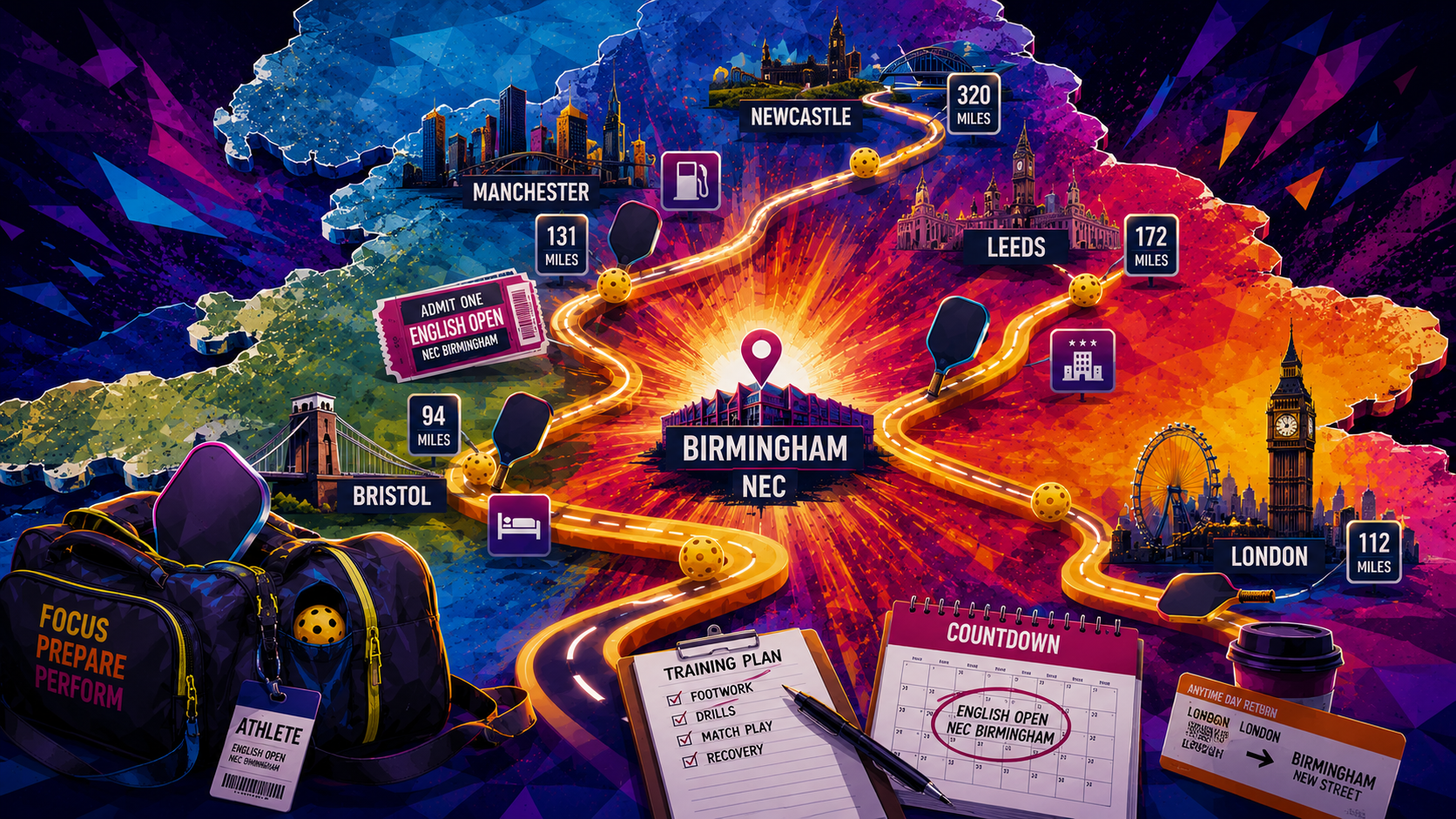
Twelve players. One summer. One road to the English Open. For the players World Pickleball Magazine has been following, the tournament itself still sits somewhere in the distance. August remains abstract, and the NEC remains imaginary. And yet, for almost everybody involved, the English Open has already started quietly reorganising ordinary life.
It appears in motorway drives and swollen knees, in alarm clocks and hotel bookings, and in compression boots beside the sofa. Nobody in this series is training full-time, but increasingly, pickleball is occupying full-time emotional space. Between early morning drills, motorway miles, injury rehab, and late-night match study, pickleball has quietly stopped being just a hobby. It has become structure, routine, friendship, identity, relief, and purpose.
The Pull of the Obsession
For some, the road to the English Open has started to consume almost every spare hour available. Stephen Hargreaves balances night shifts at Amazon involving up to 50,000 steps with finding the energy for training sessions. Coming from a squash background, his instincts relentlessly pull him towards the backhand side, fighting a technical battle where he just wants to “backhand everything”. Most of his evenings end the same way: watching PPA Tour matches deep into the night, studying patterns, and trying to close the gap between where he is and where he believes he can reach. Recently, after joining a new training group in Bridlington and Scarborough, he received a second invite to return, a tiny detail that provided massive validation. “It put a smile on my face knowing I was able to hold my own in every match at that level,” he admitted, finally sounding like somebody beginning to believe he belongs.
Zoe Ashbridge’s routine is similarly relentless. A year ago, she walked into the English Open unsure whether she even deserved to be there, and lost every match. Instead of retreating, she doubled down. Now, her weeks begin with 7am drills working on backhand dinks, and she completes five-hour round trips for tournaments. Even without a dramatic breakthrough moment or a medal, she recognizes the value of the journey, noting that success is sometimes simply about proving you belong in tougher environments. But there is an urgency to her preparation; she recently spoke movingly about feeling as though she is “on borrowed time” with pickleball before fostering children later this year changes the structure of her life completely.
Hari Bollineni started playing last year with no racket sports background, and what has struck him most is how quickly the game humbles players who think they have figured it out. After losing a final recently, he sat with a silver medal and frustration, not because he was overwhelmed, but because he could see the tactical flaws and couldn’t solve them quickly enough. For him, the frustration was motivating, proving that the tournament is no longer abstract, but living inside the details.
If you're following how the global game is shifting week by week, the World Pickleball Report breaks this down every day in our morning briefing.
The Physical Cost of Chasing It
As the tournament approaches, the road is beginning to cost something. It is testing bodies, confidence, relationships, time, and identity. The body has started entering negotiations, and improvement no longer depends entirely on effort.
At 8:17 on a Saturday morning, Dave “Thomo” Thompson was making beans on toast and wrapping his ankle, shaped by old football injuries, before driving to the Premier Pickleball League trials. He wasn’t expecting to get drafted, but simply wanted to test himself. But the physical toll is real; he quietly admitted recently that “a good week would be to not feel so tired,” a poignant recognition from someone who still thinks like an athlete while realising his body no longer negotiates on the same terms.
Kath Knowles, who has played a major role in the growth of Pickleball Wales, is temporarily off the court entirely. She was progressing well with her hamstring recovery until she stepped back onto the court and felt it “ping” almost immediately. Now, her road feels “full of potholes” consisting of physio appointments and water aerobics, and she privately questions every day whether retirement from the game is approaching. Karen Farnhill is managing tennis elbow, thyroid problems, IBS, and ongoing back pain while caring for her elderly mother, yet she is still “bursting to play” and picturing the courts set out at the NEC.
For Julie Vickerman, who helps oversee around 90 members at Richmond and Wellfield Pickleball Club, the physical toll arrived as plantar fasciitis. At first, it felt like a setback, but slowing down physically actually forced her to place the ball more intelligently, leading to more wins. Despite winning gold at last year’s English Nationals, Julie still honestly admits she suffers consistently with serve nerves, leading her to spend two hours drilling it through unglamorous repetition.
Sarah Reading experienced a different kind of health scare when blurred vision and floating shapes convinced her she might be losing her eyesight. The eventual diagnosis was dry eye syndrome, but the fear itself revealed the deep emotional weight of the sport: her biggest fear was simply not being able to play pickleball. Sarah now structures her days around training, occasionally completing 764 intense minutes of pickleball in a week, leaving her questioning whether she is “overstepping the mark” by entering the 4.0 category.
The Mental Battle and Second Chances
For some, the internal battle is even tougher than the physical one. Laura Yeomans has seen her pickleball life accelerate, but internally, her confidence wobbles. A year ago, she would have laughed at attending Premier Pickleball League tryouts, but recently left them realising she didn’t look out of place. However, after a recent trip to Canada and the disappointment of missing out on the PPL draft due to her DUPR rating, she found herself wrestling with imposter syndrome, wondering if she should even be competing at the 4.5 level.
And then there is Simon Heaps. At 70 years old, the former England and Great Britain table tennis international and bilateral amputee prepares for wheelchair competition with the cold honesty of someone who spent decades in elite sport. His training involves specific tournament balls, chair movement drills, and hitting 200 serves on Thursdays. Simon talks about the sport with an urgency that forces others to reassess their excuses. “There is no tomorrow. It has to be now,” he says, adding bluntly, “The clock is ticking”. This literal awareness changes the emotional gravity of everything around him.
Nobody Arrives at the NEC Alone
Underneath every update, a recurring truth emerges from this series: nobody arrives at the NEC alone. Emily Williams balances nursing placements, Welsh League competition, club responsibilities, and her son’s GCSE revision. Wives drive motorway journeys, partners absorb the time commitment, clubs organise practice groups, and communities quietly hold all of this together.
Three weeks ago, this project looked like twelve people preparing for the English Open. Now it looks more like twelve people trying to work out what they still want from themselves. It is about ordinary people discovering, sometimes uncomfortably, that they care far more than they ever expected to. Stephen Hargreaves perhaps explained it most honestly of all: “Since finding pickleball, I’m a happier person”.
The tournament itself has not started yet. But already, weeks before anybody walks into the NEC, something important has changed. For these twelve players, the journey already has.
Further Reading
- Latest pickleball news from around the world
- Tournament coverage and results
- Rankings and player profiles
- Regional pickleball coverage
Did you enjoy this June magazine article? You can download the whole issue to read at your own leisure here.

Chris Beaumont
Founder and Editor-in-ChiefChris Beaumont is the founder and Editor-in-Chief of World Pickleball Magazine. Chris follows the global game closely, reporting on the latest news, developments, stories and tournaments from all five continents. He also hosts the World Pickleball Podcast, interviewing people at…
View All Articles →