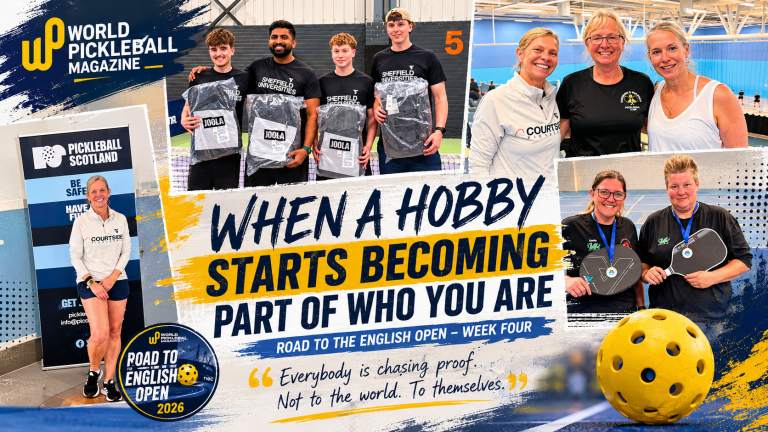

After spending a month documenting the journeys of twelve players on the Road to the English Open, I found myself confronting an uncomfortable truth. The questions they were wrestling with were the same ones I had spent years avoiding. Confidence. Fitness. Self-belief. Preparation. The tournament in Birmingham is getting closer, but this story is not really about the English Open. It is about the gap between the player I occasionally become and the player I am most of the time.
Key Takeaways
- The difference between confidence and doubt can be as little as a single week of tournament results.
- The biggest obstacles to improvement are often long-standing personal habits rather than technical weaknesses.
- The Road to the English Open has become a study of self-discovery as much as competitive pickleball.
Somewhere around the fourth match in Liverpool, I stopped recognising myself.
Not because I was losing.
I’ve lost plenty of matches and walked off court perfectly happy.
This felt different.
At one point, a fairly routine ball sat up in front of me. The sort of ball I normally put away without thinking. Instead, my feet stopped moving. I reached for it. The shot floated. The point disappeared.
Nothing unusual about that.
Except it kept happening.
Not the mistake itself.
The feeling.
The hesitation.
The heaviness.
The sense that everything was taking half a second longer than it should.
The ball would come back.
I would be late.
The shot would sit up.
Somebody would put it away.
Then the voice would start again.
Too slow.
Too passive.
Too many mistakes.
What are you doing?
Anybody who has spent enough time in competitive sport knows that voice.
Most of us pretend we don’t.
Most of us certainly pretend we have more control over it than we actually do.
The strange thing was that I knew exactly what was happening.
I could see it unfolding in real time.
Fitness was affecting my footwork.
Footwork was affecting my positioning.
Positioning was affecting my shot quality.
Shot quality was affecting my confidence.
Confidence was affecting my focus.
One problem became another.
Then another.
Then another.
By the end of the day I had convinced myself that I wasn’t ready for the English Open.
Seven days earlier I had been wondering whether I might be good enough to medal at 4.5 level.
That is amateur sport in a nutshell.
The emotional distance between those two thoughts is enormous.
The calendar distance is one week.
The Player From Telford
The frustrating thing is that I know there is another version of me.
I’ve seen him.
Last weekend, in Telford, he showed up.
My mixed doubles partner and I had already lost the first game.
In the second we were 9-3 down against a really strong pair.
We looked finished.
I don’t know exactly what happened.
I wish I did.
Because if I knew, I’d bottle it and use it every week.
Something clicked.
I stopped worrying about the score.
Stopped worrying about mistakes.
Stopped trying to force things.
Started competing.
Started trusting myself.
My partner later told me she had basically got out of the way and watched me take over the match.
We won the second game.
Then we won the third.
I walked off court thinking exactly what every inconsistent athlete thinks.
There he is.
That’s the player I’m looking for.
The problem is that he never seems to stay around very long.
A week later he was nowhere to be seen in Liverpool.
And that, more than anything else, is why I wanted to write this.
Not because I’ve got answers.
Because I’m still trying to understand the question.
If you’re following how the global game is shifting week by week, the World Pickleball Report breaks this down every day in our morning briefing.
Becoming One Of The Stories
When I launched Road to the English Open, I had absolutely no intention of becoming part of it.
The project was about other people.
Twelve players.
Twelve stories.
Twelve very different journeys towards Birmingham.
I was supposed to be the observer.
The editor.
The person joining the dots.
Then something unexpected happened.
The players started describing things I recognised in myself.
Sarah Reading talks about overthinking.
Laura Yeomans talks about confidence.
David “Thomo” Thompson talks about fatigue.
Simon Heaps talks about refusing to accept limitations.
Every week I found myself reading their submissions and quietly thinking:
Yep.
That one too.
The funny thing is that our circumstances couldn’t be more different.
Yet underneath all of it we seem to be wrestling with the same handful of questions.
How good could I be?
What is holding me back?
Why do I care so much?
Why does this matter so much?
And perhaps the biggest question of all.
Why is a game involving a plastic ball capable of occupying so much space inside our heads?
The Competitor And The Builder
A question somebody asked me while preparing this article has stayed with me.
Why have I taken so much on?
If my only goal was becoming the best pickleball player I could be, life would look very different.
I’d probably travel less.
Write less.
Work less.
Build less.
Instead, the reality looks something like this.
World Pickleball Magazine.
The daily newsletter.
The podcast.
The Academy.
Commercial partnerships.
Content creation.
Road to the English Open.
Tournament travel.
Commentary.
And somewhere in the middle of all that, trying to become a better pickleball player.
Then I turn up at tournaments and judge myself against players whose primary focus is improvement.
It’s a ridiculous comparison.
And yet I make it anyway.
The competitor inside me doesn’t care about context.
The competitor simply wants to know whether I performed.
Whether I competed.
Whether I brought my best version.
That is the tension I keep coming back to.
Because the truth is I don’t actually want to be a full-time pickleball player.
I want to build things.
I love building things.
The magazine.
The community.
The projects.
The stories.
The people.
Those things matter enormously to me.
The Sporting Weaknesses I’ve Been Carrying Around For Years
One question asked what pickleball has given me that has nothing to do with pickleball.
The answer arrived immediately.
It has given me the chance to confront every sporting weakness I’ve ever had.
Not some of them.
All of them.
Lack of belief.
Poor preparation.
Avoiding uncomfortable work.
Hiding in comfort zones.
Being too negative.
Giving up on myself too quickly.
The older I get, the more I realise these aren’t pickleball problems.
They’re Chris problems.
Pickleball simply exposes them.
That’s why the gym bothers me so much.
It’s not because I don’t have time.
I clearly do.
I can drive across Britain for a tournament.
I can spend hours writing.
I can build a magazine.
I can launch projects.
I can sit courtside all day.
Time isn’t the problem.
The truth is more uncomfortable.
I’ve always preferred doing things I’m already reasonably good at.
The gym strips that away.
The gym is repetitive.
The gym is boring.
The gym provides no immediate reward.
Nobody applauds because you did your mobility work.
Nobody congratulates you for strengthening your core.
The gym forces you to invest in a future version of yourself that doesn’t exist yet.
I’ve never been particularly good at that.
And if I’m honest, that weakness follows me well beyond sport.
The Fear I Don’t Really Talk About
One answer surprised me when I wrote it.
The question was simple.
What would failure look like at the English Open?
The answer arrived immediately.
Being the player who doesn’t belong.
Being the player the opposition targets.
Being the weak link.
The funny thing is that nobody else will care as much as I do.
Most players will be focused on their own games.
Their own nerves.
Their own matches.
Yet that’s the fear.
Not losing.
Looking like I shouldn’t be there.
Because entering 4.5 level means accepting a simple truth.
The standard is high.
Everybody can play.
Everybody can hurt you.
There is nowhere to hide.
And perhaps that’s why I keep coming back.
Because deep down, that’s exactly the environment I’ve always wanted.
The one that asks the question honestly.
Are you good enough?
Not compared to everybody else.
Compared to the standard you’ve set for yourself.
The Version Of Me I Keep Chasing
When I watch myself play, I see a footballer.
One we’ve all watched before.
Moments of brilliance.
Moments of frustration.
Capable of changing a match.
Capable of giving the ball away three times in thirty seconds.
Inconsistent.
Infuriating.
Promising.
The player from Telford.
The player from Liverpool.
The truth is that both are real.
One isn’t the imposter.
One isn’t the true version.
Both exist.
And maybe that’s what amateur sport really is.
Most of us spend years chasing a version of ourselves that only appears occasionally.
We catch glimpses.
A comeback.
A tournament.
A performance.
A weekend where everything clicks.
Then it disappears again.
And we spend the next few weeks trying to find it.
I know what the English Open version of me looks like.
He warms up properly.
He fuels himself properly.
He moves his feet.
He stays positive.
He accepts mistakes.
He competes hard.
Most importantly, he enjoys himself.
Because somewhere along the way I think that’s become the biggest lesson of all.
The people doing best in this sport usually aren’t the people carrying the most pressure.
They’re the people finding ways to keep it fun.
To smile.
To enjoy the ridiculousness of it.
To remember that none of this is life or death.
If I could send one message to myself on the morning of the English Open, it would be this:
Remember, you’re just hitting a wiffle ball over a net.
It’s silly.
It’s fun.
Have a laugh and enjoy it.
The truth is Birmingham probably won’t answer any of these questions.
If I play brilliantly, there will be another tournament.
If I play badly, there will be another tournament.
The search continues either way.
The player from Telford is coming to Birmingham.
The player from Liverpool is coming too.
The challenge is making sure only one of them gets out of the car.
Further Reading
- Latest pickleball news from around the world
- Tournament coverage and results
- Rankings and player profiles
- Regional pickleball coverage
For a clearer view of where the sport is heading each month, you can download the latest free issue of World Pickleball Magazine.

Chris Beaumont
Founder and Editor-in-ChiefChris Beaumont is the founder and Editor-in-Chief of World Pickleball Magazine. Chris follows the global game closely, reporting on the latest news, developments, stories and tournaments from all five continents. He also hosts the World Pickleball Podcast, interviewing people at…
View All Articles →