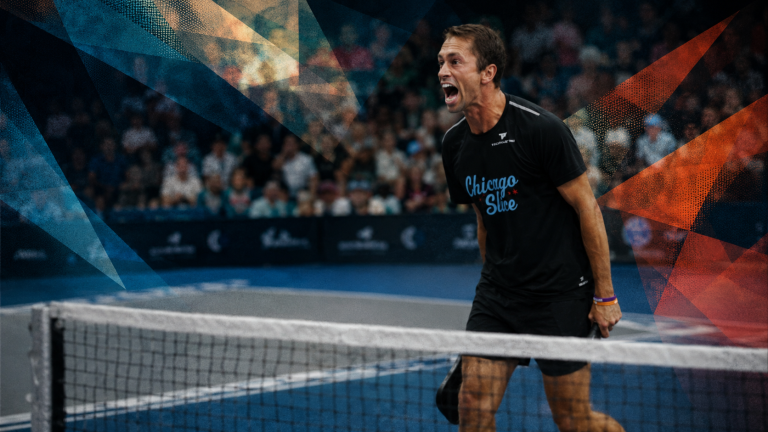

The 2026 Major League Pickleball season reaches its conclusion in Central Park this weekend. New Jersey and St Louis arrive with the strongest records, but Brooklyn and a rebuilt Dallas have already shown why three days of playoff pickleball can make an entire season’s evidence suddenly unreliable.
Key Takeaways
- New Jersey 5s enter the MLP Finals as the No. 1 seed after choosing Brooklyn as their semifinal opponent.
- St Louis Shock finished the regular season 29-3 but face a Dallas Flash side transformed by mid-season roster changes.
- Brooklyn and Dallas have already survived Dream Breakers during the playoffs, adding another tactical variable to a weekend decided by best-of-three series.
There is an obvious temptation, when four teams remain after an entire Major League Pickleball season, to decide that the standings have already told us which one is best.
The New Jersey 5s finished as the No. 1 seed. St Louis Shock went 29-3 in the regular season. Between them, they have accumulated enough evidence to make a convincing case that Sunday’s championship should belong to one of the top two.
Central Park is unlikely to be quite so accommodating.
Brooklyn Pickleball Team arrive after eliminating the defending champions. Dallas Flash have become almost unrecognisable from the side that went 1-4 in Austin and left without a single standings point. New Jersey’s only meeting with Brooklyn ended in a 3-0 victory in June, before both teams reached the versions of themselves they are now, while St Louis and Dallas have somehow made it through the entire 2026 season without meeting.
So the DoorDash MLP Finals, staged at CityPickle at Wollman Rink from August 28-30, begin with four contenders whose records tell only part of the story.
New Jersey had the right to choose between Brooklyn and Dallas for their semifinal opponent.
They chose Brooklyn.
That left St Louis with Dallas.
By Friday, the choices stop and the playing begins.
New Jersey 5s: When Being No. 1 Creates Its Own Problem
New Jersey’s reward for finishing first was the right to choose their semifinal opponent. There is logic behind taking Brooklyn. The 5s beat them 3-0 when the teams met in New York on June 28, while the alternative was a Dallas side transformed by its mid-season roster changes.
Opponent selection creates its own peculiar pressure, though. If Brooklyn win, New Jersey will not simply have lost a semifinal. They will have lost the semifinal they selected.
More interesting is what has happened inside the 5s themselves.
Anna Leigh Waters and Jorja Johnson have been almost untouchable together in women’s doubles, entering the Finals with a 33-1 record as a partnership. In mixed, New Jersey have generally divided their strength between Waters and Noe Khlif, and Johnson and Federico Staksrud.
Those combinations have hardly been weaknesses. Khlif and Waters are 29-5. Staksrud and Johnson are 7-1.
That leaves New Jersey with the sort of problem most teams would happily inherit: how much should you alter a lineup containing several combinations that already win most of the time?
Staksrud’s arrival from Orlando Squeeze, alongside Milan Rane, gave the 5s another elite option without forcing them to surrender Khlif or Will Howells. They could improve the men’s side while retaining the mixed partnerships that had helped carry them to the top of the standings.
There are still choices to make if a series begins moving against them. Staksrud can be deployed differently. Mixed partnerships can change. The men’s combination can be reconsidered. Yet every attempt to strengthen one part of an MLP lineup affects another.
That is the luxury and nuisance of having this many options.
The simplest case for New Jersey is also the strongest: there may be no reason to interfere.
Waters and Johnson have won 97 per cent of their matches together. Khlif and Waters are at 85 per cent. Staksrud and Johnson are at 87 per cent. Most teams would regard those numbers as evidence that tinkering would be an act of vandalism.
A best-of-three playoff series can make even overwhelming evidence feel less secure. Brooklyn get another look at the combinations, and potentially another after that. If something begins to fail, New Jersey must decide how long months of results should outweigh what is happening directly in front of them.
That may be the most important judgement the No. 1 seed makes all weekend.
Brooklyn: Finally the Team They Were Supposed to Be
The 3-0 defeat Brooklyn suffered against New Jersey in June is useful information. It is not necessarily a useful prediction.
Brooklyn’s season has been repeatedly interrupted by injuries, illness and availability problems, making the team difficult to assess because the intended lineup has not always been the lineup on court.
At the point when there is nowhere left to hide, it looks considerably healthier.
Christian Alshon and Riley Newman enter the semifinal with a 22-4 record together. Rachel Rohrabacher and Jackie Kawamoto are 12-5 in women’s doubles. Alshon and Rohrabacher have gone 20-5 in mixed.
Those are not the numbers of a fortunate semifinalist.
Nor did Brooklyn stumble into Central Park. It eliminated defending champion Columbus Sliders in Newport Beach by winning two Dream Breakers, precisely the sort of playoff experience that can become useful when a series stops resembling the tidy version imagined beforehand.
There are easier ways to prepare for the pressure of Finals weekend, but perhaps fewer more useful ones.
Brooklyn therefore present New Jersey with an awkward proposition. The 5s know they have beaten them, but they also know the team standing across the net now is healthier and has just eliminated the reigning champions.
Brooklyn, meanwhile, know something New Jersey have not yet been required to discover during these playoffs: what it feels like when the season has already been reduced to a handful of singles points.
St Louis Shock: How Much More Evidence Do They Need?
At some point, a team this good runs out of things to prove except the obvious one.
St Louis finished the regular season 29-3. Anna Bright and Kate Fahey are 30-4 together. Hayden Patriquin and Gabe Tardio have exactly the same record. The two principal mixed combinations, Patriquin with Bright and Tardio with Fahey, have won 78 and 84 per cent of their matches respectively.
In Newport Beach, Texas Ranchers never got close enough to force the Shock into mixed doubles.
And none of that quite settles the conversation around St Louis.
The Shock’s championship challenge ended in the semifinals in both 2024 and 2025. In 2024 it was Dallas who stopped them. Last year it was Columbus.
That history does not determine anything about Friday. The 2026 Shock deserve to be judged on what they have done this season, and what they have done is win with extraordinary regularity.
They also know better than most that being the strongest team across months of league play and surviving a playoff weekend are different achievements.
Bright, Fahey, Patriquin and Tardio have spent enough time together, and won often enough, that the usual questions about chemistry and ceiling have largely disappeared. At the Mid-Season Tournament in Grand Rapids, they swept New Jersey 3-0 in the final, another piece of evidence that their best is good enough against anybody left in the competition.
That performance also produced one of the season’s most revealing tactical stories, when St Louis found a repeatable way of directing pressure away from Waters and onto Johnson.
Twenty-nine regular-season wins establish quality. They cannot substitute for the championship everyone involved has spent the season trying to win.
That does not make St Louis fragile. If anything, the Shock arrive with the least obvious weakness of any remaining team.
It simply means their season will ultimately be judged somewhere different from where most of their excellence occurred.
Dallas Flash: The Season That Had to Be Rebuilt
Dallas left Austin with a 1-4 record, zero standings points and a season already beginning to look compromised.
The franchise did not wait for the problem to correct itself.
First came Danni-Elle Townsend, acquired from Columbus in the deal that sent Tyra Black the other way. A week later Dallas added Alix Truong from Phoenix. Those moves altered the women’s side of the roster and, in turn, gave the Flash different mixed-doubles possibilities around JW Johnson and Augie Ge.
The change was not immediate magic, but the direction of the season shifted dramatically. Dallas eventually put together a 13-match winning streak, won in San Diego and arrived in the postseason looking nothing like the team that had left Austin empty-handed.
The combinations explain some of it.
Townsend and Ge enter the semifinal 19-4 together. Johnson and Ge are 25-12 in men’s doubles, while Johnson and Brooke Buckner have gone 22-12 in mixed. Townsend and Truong, meanwhile, are 15-12 in women’s doubles.
None carries the near-absurd winning percentage of Waters and Johnson or the leading St Louis partnerships. Dallas’ case is different. It lies in how effectively the Flash changed the shape of their team once the original version had failed.
Los Angeles discovered how stubborn the new version could be in Newport Beach.
The Mad Drops won the opening match of their quarterfinal series, snapping Dallas’ 13-match streak. The Flash responded by taking the second in a Dream Breaker and then won the deciding match 3-1.
Even that description smooths out how close Dallas came to disappearing.
Townsend and Ge had to save match point against Connor Garnett and Catherine Parenteau to keep the Flash alive long enough to reach the Dream Breaker.
One point goes the other way and Dallas are not in New York.
Instead, they arrive having already confronted the moment when their season could have ended and escaped it.
There is no 2026 meeting with St Louis to provide a guide. The teams have reached the final four by almost opposite routes: the Shock through remarkable continuity and relentless winning, Dallas through recognising that its first version was not good enough and changing it.
Friday will be their first direct comparison.
The Strange Mathematics of a Dream Breaker
If either semifinal reaches 2-2, much of the analysis above suddenly becomes secondary.
Four doubles games disappear into the rear-view mirror and the season becomes singles.
Sort of.
The Dream Breaker has always made intuitive sense as a place to value singles specialists. If the deciding contest consists of singles points, surely the strongest singles players provide an advantage.
Recent MLP evidence has made that assumption less comfortable.
The format asks something quite different from a conventional singles match. There is little time to establish patterns, make adjustments or allow superiority to emerge over a larger sample of points. A player may have spent most of the previous hour playing doubles, or waiting to play at all, before being asked to solve an opponent immediately.
One bad return or one poor decision can represent a large percentage of that player’s entire contribution.
Brooklyn and Dallas know the sensation intimately. Both required Dream Breakers during their quarterfinal series to reach New York.
New Jersey and St Louis did not.
There is no guarantee that experience becomes an advantage. The preferable strategy remains avoiding the Dream Breaker altogether. But if Friday reaches 2-2, the two lower seeds will at least be entering territory they have already had to survive.
New Jersey Against Brooklyn
This is the semifinal in which the past may be most misleading.
New Jersey have the better season, the deeper collection of elite combinations and a 3-0 victory over Brooklyn already in the books.
They also chose this matchup.
Brooklyn have become healthier, reached the semifinals by eliminating the defending champions and possess an Alshon-Newman men’s partnership that has won 22 of 26 matches.
New Jersey should win.
The more interesting question is what happens if they do not win quickly.
A long series gives Brooklyn opportunities to expose a combination, forces New Jersey to consider using its depth differently and gradually makes that June result less relevant.
For the No. 1 seed, control matters.
Brooklyn need to make things uncomfortable enough for New Jersey to start asking questions it has rarely needed to ask.
St Louis Against Dallas
There is less history here and perhaps more uncertainty.
On the numbers, St Louis have the advantage almost everywhere. Bright and Fahey have been stronger than the Dallas women’s pairing. Patriquin and Tardio have been stronger in men’s doubles. The Shock’s mixed combinations have produced elite records over a substantial sample.
Dallas cannot win the semifinal by arguing with a spreadsheet.
It can win by making Friday look nothing like the regular season.
That has essentially been the Flash story already. They changed personnel, changed combinations, survived match point in Newport Beach and turned a season that appeared to be heading nowhere into one that will finish among the final four.
St Louis are trying to make the Finals confirm everything the previous months have told us.
Dallas have spent much of the summer demonstrating how quickly previous evidence can become obsolete.
Three Days to Settle It
There are convincing reasons to choose New Jersey.
There may be even more convincing ones to choose St Louis.
Waters and Johnson have lost once together all season. St Louis possess two gender-doubles partnerships sitting at 30-4. Brooklyn’s Alshon-Newman pairing is 22-4. Dallas have a mixed combination in Townsend and Ge that has won 19 of 23.
Those numbers have taken an entire season to accumulate.
The uncomfortable thing about the MLP Finals is how quickly they can cease to matter.
New Jersey’s 3-0 victory over Brooklyn happened two months ago. St Louis and Dallas have no previous meeting this season. Brooklyn and Dallas have already needed Dream Breakers simply to reach this point. One poor Friday match can turn a best-of-three series into an elimination match a few hours later.
That is what remains after all the trades, standings points, lineup experiments and regular-season arguments.
Four teams arrive in New York carrying months of evidence about what they are.
By Sunday evening, MLP will remember only which one survived.
Further Reading
- Latest pickleball news from around the world
- Tournament coverage and results
- Rankings and player profiles
- Regional pickleball coverage

Chris Beaumont
Founder and Editor-in-ChiefChris Beaumont is the founder and Editor-in-Chief of World Pickleball Magazine. Chris follows the global game closely, reporting on the latest news, developments, stories and tournaments from all five continents. He also hosts the World Pickleball Podcast, interviewing people at…
View All Articles →