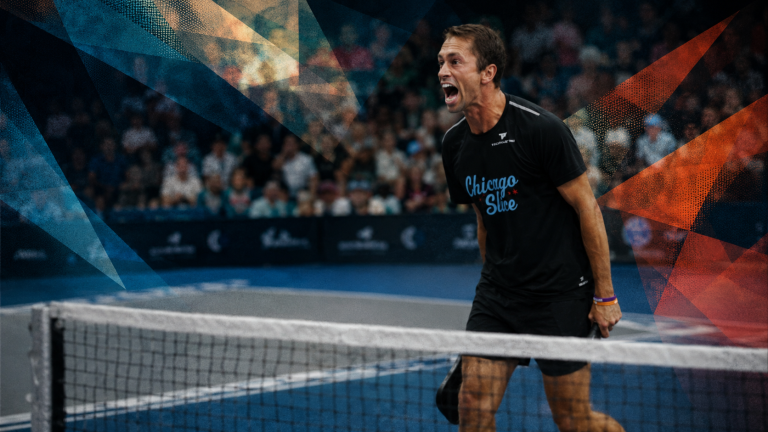

New Jersey acquired Federico Staksrud without surrendering either of its starting men. The 5s now have an answer to their weakest combination, but using him properly matters more than collecting another star.
Key Takeaways
- The New Jersey 5s acquired Federico Staksrud and Milan Rane from Orlando Squeeze for Martin Emmrich, Lina Padegimaite and an undisclosed cash payment.
- New Jersey retained Noe Khlif and Will Howells, allowing the franchise to strengthen men’s doubles without breaking up either of its successful mixed partnerships.
- The strongest first move is to preserve those mixed teams and pair Staksrud with whichever existing man best suits the opponent.
The New Jersey 5s did not need Federico Staksrud to rescue their season.
They were already tied for first when he arrived. Their problem was narrower and more important: the team most likely to stand between them and the Major League Pickleball title had just shown where they could be beaten.
Eight days after St. Louis Shock swept New Jersey in the MLP Mid-Season Tournament final, the 5s acquired Staksrud and Milan Rane from Orlando Squeeze. Martin Emmrich, Lina Padegimaite and an undisclosed cash payment went the other way.
New Jersey added one of the world’s leading men without surrendering Noe Khlif or Will Howells. Anna Leigh Waters and Jorja Johnson remained in place. General manager Ryan Harwood therefore strengthened the roster while preserving every partnership that had taken it to the top of the standings.
The trade gives New Jersey more talent. Its greater value is that it offers the 5s a different route through St. Louis.
New Jersey Paid Without Breaking Its Starting Four
Any conventional route to Staksrud appeared likely to cost New Jersey a starting man.
Khlif had compiled a 23-3 mixed doubles record alongside Waters. Howells and Johnson were 15-6. Trading either man would have strengthened one part of the line-up by dismantling another.
Instead, Orlando accepted Emmrich, Padegimaite and cash. The payment has not been disclosed. MLP rules allow cash consideration of up to $200,000 per player in a transaction, which led California Black Bears general manager Erik Tice to suggest that the total may have reached $400,000.
That is an informed estimate, not a confirmed price. What can be established is that New Jersey used its financial position and two players outside the established starting four to acquire Staksrud without sacrificing either winning mixed partnership.
Zane Navratil responded by declaring that the rest of MLP was now playing for third place. The line captured the scale of the deal, although it moved too quickly past the team that had supplied its competitive logic.
St. Louis still owns the recent sweep and a 2-1 lead in the season series.
The First Answer Should Be Men’s Doubles
New Jersey’s line-up had produced a clear imbalance.
Its two mixed doubles teams held a combined 38-9 record. Khlif and Howells, however, were 14-12 together in men’s doubles.
That record was respectable enough to support a leading team, but it left an opening against opponents capable of winning the gender doubles games and preventing New Jersey from taking control through its women and mixed combinations.
St. Louis exposed the consequence in the Mid-Season Tournament final. Its 3-0 victory did not prove that New Jersey could not beat the Shock in the play-offs. It showed that the 5s’ regular-season success had not solved this particular match-up.
Harwood’s strongest initial response is also the least disruptive. Keep Khlif with Waters. Keep Howells with Johnson. Use Staksrud in men’s doubles and select his partner according to the opponent.
Khlif or Howells would have to sit for that game, but New Jersey would retain the two combinations responsible for its outstanding mixed record. Staksrud could address the weak point without being asked to replace strength elsewhere.
Only if that arrangement fails, or a particular opponent creates a compelling tactical reason, should the 5s consider moving Staksrud into mixed doubles.
Staksrud Changes The St. Louis Match-Up
Before the trade, New Jersey’s path through St. Louis depended heavily upon Waters and Johnson establishing an advantage in women’s doubles, followed by two mixed teams converting records built across the season.
The Shock could pressure the point between those strengths. Their balance across the line-up, particularly in men’s doubles, gave them a way to reach the mixed games from a stronger position.
Staksrud changes that calculation. New Jersey can now field a more dangerous men’s pairing and should also possess formidable DreamBreaker options if the contest reaches singles. The 5s have gained another credible route to two regulation wins and, if required, the decider.
They have not yet proved that this prospective line-up functions better than St. Louis’s settled combinations.
That distinction matters. Championship teams are not assembled by ranking the names on a roster. Partnerships must withstand pressure, players must accept changing roles and tactical options must become clear decisions before the matches that matter.
New Jersey has acquired the pieces. The advantage will become real only when Harwood establishes how they fit.
Orlando Converts A Departing Star Into Future Options
The trade also reflects Orlando’s position outside the championship race. The Squeeze sat 11th on a points-per-event basis, while Staksrud had been linked with a move to a contender for weeks.
At MLP San Diego, Staksrud and Rane lost to Zoey Wang and Pablo Tellez. Staksrud received an orange card after striking a ball out of the playing area and was absent from Orlando’s Sunday line-up.
That sequence does not prove the trade had already been agreed or that one difficult weekend caused the separation. It did reinforce the sense that Orlando and Staksrud had reached the end of their useful time together.
The Squeeze turned a player unlikely to transform their remaining season into two roster pieces and an undisclosed payment. The longer-term value cannot be judged until the cash figure and Orlando’s plans become clearer.
Rane gives New Jersey additional women’s depth, although the existing Waters-Johnson partnership leaves no obvious reason to place her in the principal line-up. Her arrival improves cover. Staksrud is the part of the transaction designed to change the title race.
The Trade Has Created A Favourable Selection Problem
The temptation is to treat the deal as the moment New Jersey passed St. Louis.
The evidence does not support that conclusion yet. The Shock have the recent tournament title, the head-to-head advantage and combinations already tested together. New Jersey has the deeper collection of options, but its strongest new version has not played.
That leaves Harwood with a favourable selection problem rather than a guaranteed championship.
Preserve the mixed partnerships and Staksrud must transform men’s doubles while Khlif or Howells accepts a reduced role in that game. Move him into mixed and the 5s interfere with a combination that has already won at an exceptional rate. Rotate too freely and useful depth can become uncertainty.
The Mid-Season Tournament final showed New Jersey that its established line-up needed another answer against St. Louis. Staksrud supplies it without forcing the 5s to abandon what already works.
That is why this was the defining trade of the deadline.
Its success will not be measured by the number of stars New Jersey can place on one roster. It will be measured by whether one of pickleball’s best players can repair the 5s’ weakest game without disturbing the partnerships that made them contenders.
Further Reading
- Latest pickleball news from around the world
- Tournament coverage and results
- Rankings and player profiles
- Regional pickleball coverage

Chris Beaumont
Founder and Editor-in-ChiefChris Beaumont is the founder and Editor-in-Chief of World Pickleball Magazine. Chris follows the global game closely, reporting on the latest news, developments, stories and tournaments from all five continents. He also hosts the World Pickleball Podcast, interviewing people at…
View All Articles →