
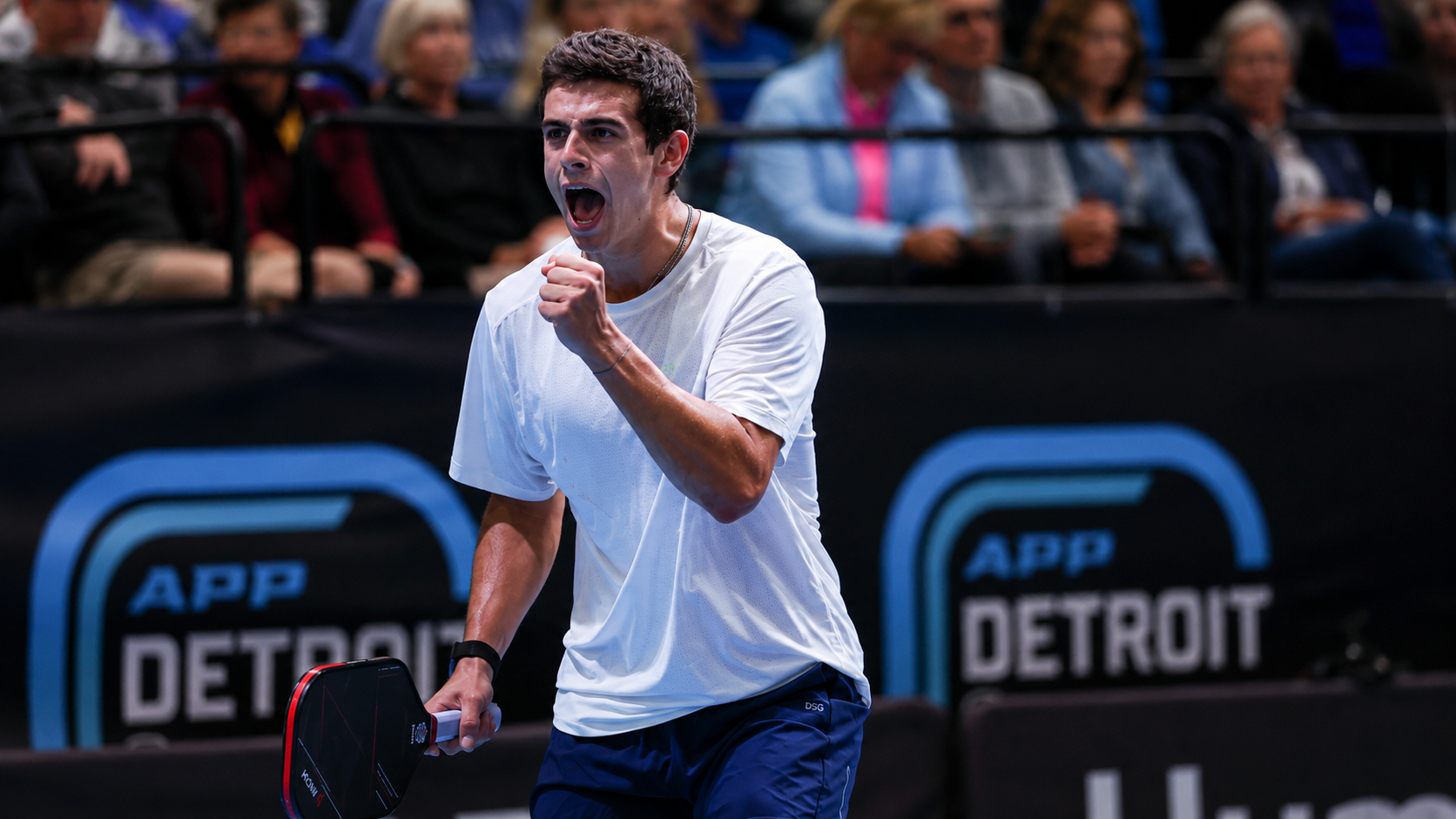
Ronan Camron reached Detroit as the APP’s No. 1 men’s singles player and its leading male medallist of 2026. One thing was still missing: a singles title. A rematch with Dusty Boyer finally changed that.
Key Takeaways
- Ronan Camron beat Dusty Boyer 11-7, 11-8 in Detroit to claim his first APP men’s singles gold of 2026.
- Camron had already built a season around repeated podium finishes, including silver in Cincinnati and bronze in Chicago and Kuala Lumpur.
- The Detroit result reverses his 11-5, 11-4 Cincinnati defeat to Boyer and finally brings his No. 1 APP ranking and medal record together.
Ronan Camron arrived in Detroit carrying one of the stranger records on the APP Tour.
At 21, he was the No. 1 men’s singles player in the APP U.S. rankings and led all APP men’s pros with five medals during 2026. He had reached the Cincinnati final, made another singles podium in Chicago and accumulated enough results across the season to establish himself at the top of the rankings.
He had not won a singles tournament.
That distinction mattered because Camron already knew what winning one felt like. His first career APP men’s singles gold had come at Mesa in November 2025. The problem was that his 2026 season had become a study in getting close without returning to the top step.
Detroit finally changed it.
Camron beat Dusty Boyer 11-7, 11-8 in Sunday’s final to claim his first singles gold of the year, reversing a Cincinnati championship match in which Boyer had beaten him comfortably and completing a tournament in which his run had already come within two points of ending in the quarter-finals.
It was not the biggest title Camron will hope to win in his career, nor was it some sudden arrival from nowhere. The significance came from everything that preceded it.
For much of 2026, Camron’s consistency had been good enough to make him No. 1.
In Detroit, it finally became a championship.
A Season Built Without a Singles Gold
Camron’s year makes more sense when the results are put beside one another.
In February, at the APP Kuala Lumpur Open, he lost 11-3, 11-8 to Wong Hong-kit in the semifinal before beating Ryler DeHeart 11-0, 11-2 for bronze. It was another useful result and another reminder that Camron was spending plenty of time around the closing stages of tournaments.
By Cincinnati in June, he had moved closer.
Camron entered as the No. 1 seed and reached the men’s singles final against Dusty Boyer, the No. 2. Both were chasing their first singles gold of the season.
It was not particularly close.
Boyer won 11-5, 11-4, using his placement well enough that Camron never managed to drag the match into the sort of uncomfortable territory where a final can change character. The player ranked first left with silver. Boyer left with his first career APP gold.
Then, in Chicago earlier this month, Camron reached the podium again. This time it was bronze as Ammar Wazir successfully defended his title and Jayden Broderick took silver.
None of those results was poor. Taken together, they explain how Camron could occupy the top of the APP rankings without winning a singles event during the year. He kept putting himself deep enough into tournaments to collect points and medals while the identity of the champion changed around him.
There was value in that consistency. There was also an increasingly obvious question attached to it.
When would he finish one?
Cincinnati Made Detroit Personal
Boyer’s presence across the net in Detroit gave Camron an unusually clean opportunity to answer it.
Only two months earlier, the same players had contested the Cincinnati final. Boyer had won 11-5, 11-4. The APP’s official Cincinnati recap described it as Boyer’s first career APP Tour gold and Camron’s latest near miss.
Detroit began differently.
Camron took the opening game 11-7 and carried that momentum into a 6-1 lead in the second. Boyer then began to recover, closing to 9-8 and putting the match in danger of becoming considerably more complicated than it had looked a few minutes earlier.
This was the point at which the Cincinnati result could have started to matter again.
Instead, Camron won the next two points and the title.
The contrast between the two finals is useful because it shows something more concrete than the language of revenge that naturally follows a rematch. Cincinnati had belonged to Boyer from the scoreboard down. Detroit required Camron to establish the lead, absorb the moment when Boyer threatened to take it away and close before a third game became necessary.
The same opponent presented a different match.
Camron produced a different result.
The Quarter-Final Nearly Ended the Story
The final was controlled enough to obscure how close Camron’s weekend had already come to ending.
Ninth seed Brandon Lane pushed him into a third game in the quarter-finals and then all the way to 12-10.
Two points separated Camron’s eventual gold medal from another tournament in which the central question of his season would have followed him home.
That is worth remembering when looking backwards at a championship weekend. Once the trophy has been lifted, the route towards it can acquire a false sense of inevitability. The winner was the top seed, reached the final and beat an opponent he was supposed to beat. Everything appears orderly.
A 12-10 deciding game is not orderly.
At that stage, there is barely enough separation to make grand claims about who is playing better. A loose return or one well-executed passing shot can redirect an entire tournament. Camron found the points he needed against Lane and eventually earned another meeting with the player who had denied him gold in Cincinnati.
Those matches asked different things of him. One demanded survival. The other required him to deal with an opponent carrying recent evidence that he could beat him.
Camron managed both.
What the No. 1 Ranking Actually Said
There is a temptation to treat rankings as verdicts. They are better understood as records of accumulation.
Camron’s position at No. 1 entering Detroit did not mean he had been the unbeatable men’s singles player of 2026. Clearly he had not. Boyer had beaten him in Cincinnati, Wazir had won Chicago and Kuala Lumpur had ended with Camron holding bronze rather than gold.
What the ranking captured was how regularly he had remained relevant.
That distinction is important in a men’s singles field that has refused to settle behind one dominant player. When championships are moving between players, repeated deep runs become particularly valuable. A silver here and a bronze there can build a season even when none carries the emotional weight of a gold medal.
Camron had become an unusually clear example.
He was consistently one of the players most likely to be around when a tournament became serious. What he lacked was the result that people remember more easily than ranking points.
Detroit supplies it without rewriting everything that came before.
The silver in Cincinnati still happened. So did the bronze medals. Boyer still showed in June that he could beat Camron convincingly, and Lane came within two points of removing him before Championship Sunday had taken shape.
The gold matters partly because those results existed.
The Men’s Singles Field Is Still Wide Open
Detroit should not be mistaken for the moment the APP men’s singles hierarchy suddenly became simple.
If anything, the season has argued against that conclusion.
Boyer’s Cincinnati title came at Camron’s expense. Wazir won Chicago. Camron had to survive Lane in Detroit before beating Boyer. International competition has added further opponents capable of interrupting the American hierarchy.
Detroit therefore does not establish Camron as the player everybody else is now chasing from a distance.
It does something more modest and, for his season, more important.
It removes the missing result.
Before Detroit, Camron could point to the ranking, medals and repeated appearances late in tournaments, but every APP singles event he had entered in 2026 had still ended with somebody else winning.
That is no longer true.
A Different Kind of Pressure From Here
The interesting question now changes.
Until Sunday, every deep Camron run carried the possibility of becoming another example of the same pattern. The further he went, the more obvious the absence of a 2026 singles gold became.
That pressure has gone. A different one replaces it.
Winning once confirms that Camron can convert the consistency that put him at No. 1 into a title. Remaining there requires him to do it again, particularly in a men’s field that has repeatedly produced different winners.
That makes the final weeks of the season more interesting than a simple breakthrough narrative.
Camron is not chasing validation anymore. Detroit supplied the result that was missing from his year. What comes next is a test of whether that result represents the beginning of a more decisive phase of his season or simply one successful weekend in a division where nobody has yet managed to stay in control for very long.
Detroit cannot answer that.
It did answer the question Camron carried into Michigan.
The APP’s No. 1 men’s singles player finally has his singles gold for 2026.
Now he has to defend the status that made its absence so noticeable in the first place.
Further Reading
- Tournament coverage and results
- Rankings and player profiles
- Latest pickleball news from around the world
- Regional pickleball coverage

Noah Burns-Green
Founder and Editor-in-ChiefNoah Burns-Green is an APP Correspondent for World Pickleball Magazine and a member of the WPM Academy. Aged 21, he has recently completed his first year studying at Solent University and is developing his skills in sports journalism through regular…
View All Articles →