
The forgotten tournament that transformed a backyard pastime into a sport
Prologue: Southcenter Athletic Club, The Forgotten Catalyst
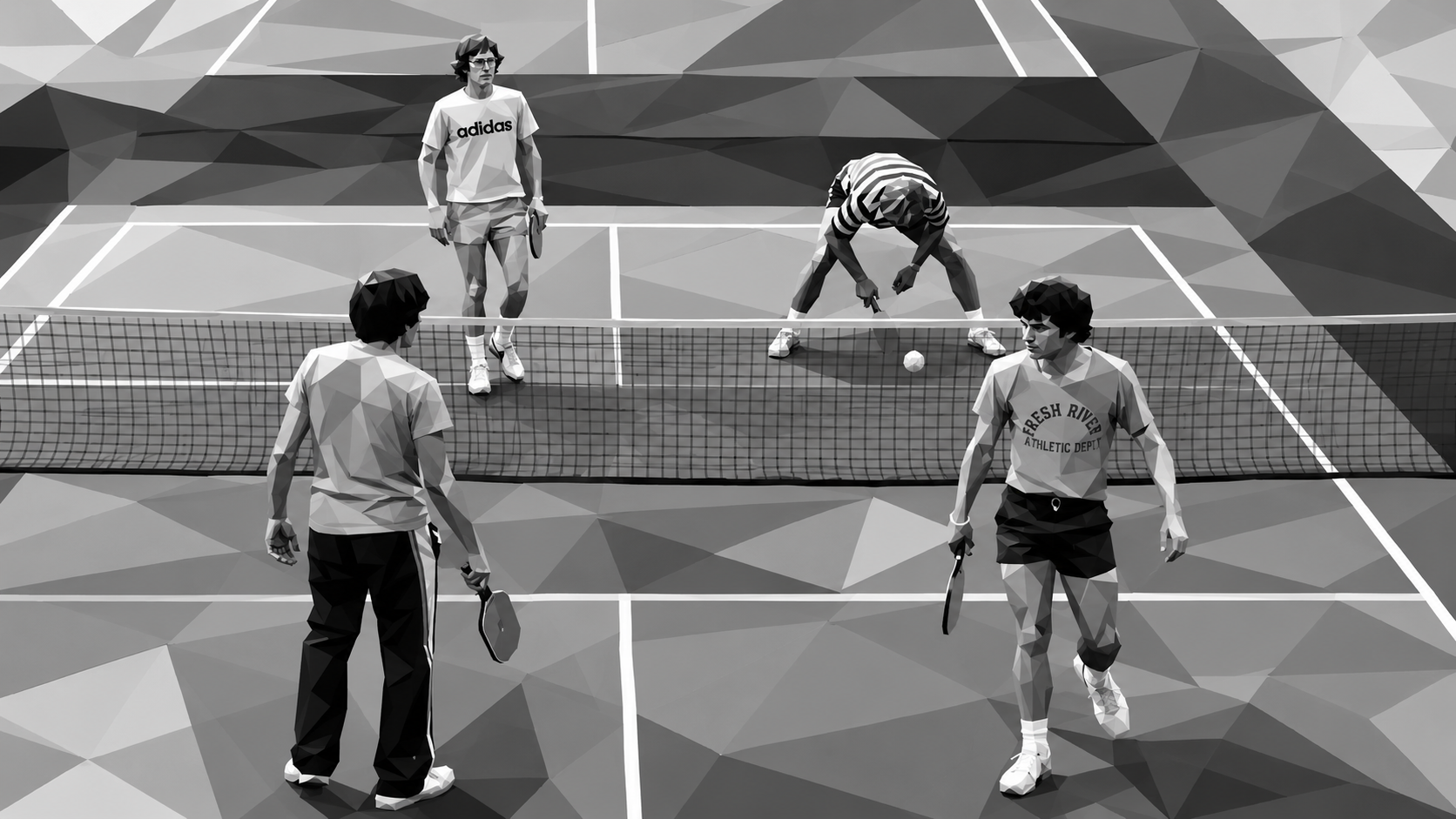
In 1975, entrepreneur Johannes F. Lisiecki leased a warehouse in Tukwila, Washington and transformed it into what was arguably the world’s first dedicated indoor pickleball facility.
At the time, pickleball remained largely confined to backyards, schoolyards and private courts around Bainbridge Island. Lisiecki believed the sport could become something bigger. Membership grew slowly. Finances remained precarious. The club came close to failure more than once.
Then came an idea.
America was celebrating its Bicentennial year.
Why not stage a tournament?
The result was the 1976 Bicentennial Pickleball Tournament, later promoted as the World’s First Pickleball Championship. Around eighty players attended, far more than organisers expected.
Looking back almost fifty years later, Lisiecki argued that the tournament’s true significance was not simply identifying champions. It took pickleball “out of the backyard and put it in the public.”
Without Southcenter Athletic Club, competitive pickleball might have taken far longer to emerge.
If you're following how the global game is shifting week by week, the World Pickleball Report breaks this down every day in our morning briefing.
Chapter One: The Sound of Something New
Nobody in the gymnasium could have known they were making history.
The Southcenter Athletic Club in Tukwila, Washington, was hardly a venue destined for sporting immortality. It was neither Wimbledon nor Augusta National. It sat a short drive south of Seattle, surrounded by the expanding suburban landscape of the Pacific Northwest.
Yet during the spring of 1976, inside a hall filled with improvised pickleball courts and folding chairs, a sport took its first genuine step into adulthood.
The sounds alone would have puzzled an outsider.
There was none of the crisp pop associated with lawn tennis. No rhythmic squeak of basketball shoes on polished hardwood. Instead, the building echoed with a sharp, hollow crack. Wooden paddles striking perforated plastic balls. Again and again. Hundreds of times each hour.
The United States was celebrating its Bicentennial year. Jimmy Carter was building momentum in the Democratic presidential race. The tennis boom was in full swing. Björn Borg and Jimmy Connors dominated headlines. Across America, racket sports had rarely been more popular.
Almost nobody outside Washington State had heard of pickleball.
The competitors gathered that weekend represented an unusual collection of athletes. Some were experienced pickleball players from the Seattle area who had spent years playing on backyard courts scattered across Bainbridge Island and the surrounding communities. Others arrived carrying far more impressive sporting credentials. College tennis players. Coaches. Talented young athletes convinced that whatever this curious pastime happened to be, their superior racket skills would quickly carry them to victory.
Many would discover otherwise.
The tournament’s title carried an almost laughable degree of ambition.
The World’s First Pickleball Championship.
Even in 1976, that description required a certain amount of optimism. The sport itself was barely eleven years old. Most Americans had never heard of it. There was no national governing body. No ranking system. No professional tour. No television coverage. No meaningful prize money.
Outside the Pacific Northwest, pickleball was little more than a rumour.
Yet the organisers were not entirely wrong.
If there had never been a championship before, then this one was, by definition, the first world championship. Small though the field may have been, every serious pickleball player who knew about the event suddenly had a destination.
For the first time, the sport would identify its champions.
Among those arriving in Tukwila was a nineteen-year-old college student named Steve Paranto.
Paranto looked exactly like the sort of athlete most observers expected to win. Young, quick and armed with a strong tennis background, he belonged to a generation raised on conventional racket sports. Like many others in the field, he approached pickleball with the confidence of someone who believed athletic talent could solve almost any sporting problem.
Standing elsewhere in the draw was David Lester, a high school tennis coach whose understanding of competition relied less upon physical gifts and more upon tactical calculation.
Elsewhere still were Rob Cahill and Scott Stover, players who possessed an advantage invisible to most of the field. Through countless matches on Bainbridge Island, they had spent years learning the peculiar geometry of pickleball directly from the people who had invented it.
The significance of that education would soon become apparent.
As matches unfolded across the courts of the Southcenter Athletic Club, something unexpected happened. The assumptions carried into the tournament by many of the strongest tennis players began to collapse.
Power alone was not enough.
Speed alone was not enough.
The instincts developed on full-sized tennis courts did not always survive the transition to a twenty-by-forty-four-foot rectangle guarded by an awkward seven-foot non-volley zone.
Again and again, players found themselves frustrated by a sport that refused to behave according to familiar rules.
The lightweight plastic ball slowed unexpectedly.
Aggressive drives flew long.
Net rushes ended in awkward defensive scrambles.
Points were won not through overwhelming force but through patience, placement and touch.
By the end of the championship, the winners would carry home little national fame.
What they would leave with was something far more important.
Proof.
Proof that pickleball could support organised competition.
Proof that it possessed its own tactical identity.
Proof that this strange backyard game was more than a family diversion.
Almost fifty years later, as professional players compete for substantial purses before packed crowds and television audiences, the Southcenter Athletic Club occupies only a footnote in most histories of the sport.
Yet everything that followed can be traced back to those few spring days in Tukwila.
Before the sponsorships.
Before the professional tours.
Before the investment money.
There was a gymnasium, a handful of wooden paddles, a plastic ball and a group of players attempting to discover what this new game could become.
Chapter Two: The Sport Before the Sport
Eleven years before the championship arrived in Tukwila, pickleball existed without ambition.
Nobody was talking about professional tours. Nobody was discussing television rights, franchise values or governing bodies. There were no rankings to chase, no sponsorship contracts to sign and no debates about paddle technology.
There was simply a game.
Its origin story has been repeated so often that it risks becoming mythology, but the broad outline remains remarkably straightforward. During the summer of 1965, on Bainbridge Island, Washington, Joel Pritchard, Bill Bell and Barney McCallum found themselves searching for a way to entertain their families. An old badminton court sat unused. A shuttlecock could not be found. Improvisation followed.
A perforated plastic ball replaced the shuttlecock.
Wooden table-tennis paddles became the striking instruments.
A game emerged.
What makes the story remarkable is not the invention itself. Sporting history is filled with games invented in gardens and schoolyards. What matters is that the founders kept refining what they had created.
Each adjustment solved a practical problem.
The net was lowered.
The court dimensions remained those of badminton.
The serve was restricted to an underhand motion.
The double-bounce rule was introduced.
Most importantly, the seven-foot non-volley zone appeared beside the net.
Today it is universally known as the Kitchen, perhaps the most distinctive piece of real estate in any racket sport. In 1965, however, it was simply a solution to an immediate problem.
The problem had a name.
Dick Brown.
Brown was tall, athletic and aggressive. Whenever he played, rallies ended quickly. He charged forward, smashed volleys into the court and rendered many opponents helpless. If pickleball was going to remain enjoyable for children, grandparents and casual players alike, the game needed protection against athletic domination.
The Kitchen provided it.
Players could no longer stand at the net and volley everything in sight. They were forced to let the ball bounce.
Without realising it, the founders had introduced the tactical concept that would eventually separate pickleball from every other major racket sport. The Kitchen rewarded patience. It rewarded touch. It rewarded players capable of controlling space rather than simply overwhelming opponents.
The sport’s DNA was already visible.
Throughout the late 1960s and early 1970s, that DNA spread slowly across the Pacific Northwest.
This was not a national movement.
It was a local one.
Friends introduced friends.
Families built courts in their backyards.
Physical education teachers carried the game into schools.
Community centres painted lines on gymnasium floors.
Most participants never imagined they were helping to establish a future global sport. They played because the game was enjoyable. Grandparents could compete against teenagers. Experienced athletes could challenge complete beginners. Entire families could participate together.
That accessibility became pickleball’s greatest strength.
The equipment helped.
Modern players, accustomed to carbon-fibre paddles and precision-engineered balls, would barely recognise the tools of the era.
Early paddles were often little more than shaped sheets of plywood. They were heavy, unforgiving and entirely lacking in sophistication. There were no textured faces designed to generate spin. No polymer cores. No aerodynamic shaping.
A player either struck the ball cleanly or paid the price.
The ball itself added further unpredictability.
Most games used a Cosom Fun Ball, a lightweight perforated plastic sphere that behaved nothing like a tennis ball. It slowed rapidly in flight. Wind could influence it dramatically outdoors. Powerful swings often produced disappointing results.
Tennis players frequently discovered this the hard way.
Years of muscle memory encouraged them to attack.
The ball stubbornly refused to cooperate.
The result was a game that rewarded intelligence more than force.
By the mid-1970s, pickleball had become an established feature of life in parts of Washington State. The founders had incorporated Pickle-Ball Inc. to manufacture equipment. Schools were introducing the sport to students. Recreation departments were beginning to include it in their programmes.
The game remained tiny by modern standards, but it was no longer confined to a handful of backyards.
Something else was happening too.
The first generation of dedicated players was emerging.
These were not casual participants who played once or twice each summer. They played constantly. They studied angles. They experimented with strategy. They developed partnerships and rivalries.
Most importantly, they began to realise that pickleball was not simply a smaller version of tennis.
It was its own sport.
On Bainbridge Island and throughout the Seattle area, a small group of players was quietly building a tactical vocabulary that did not yet have official names. They understood the value of patience at the Kitchen line. They learned how to neutralise power. They discovered that placement often defeated athleticism.
The broader sporting world remained completely unaware.
Outside the Pacific Northwest, few people had heard the word pickleball.
That anonymity would not last forever.
By 1976, a growing number of enthusiasts believed the game had reached an important threshold. It needed a stage. It needed competition. It needed a way to identify its best players.
Most of all, it needed a moment that would prove pickleball could be more than a backyard diversion.
The opportunity arrived in the form of an ambitious tournament organised at an athletic club in Tukwila.
The organisers gave it a grand title.
Whether anyone else believed it or not, they intended to crown world champions.
Chapter Three: The Championship That Should Not Have Existed
Looking back from the vantage point of modern pickleball, the most remarkable aspect of the 1976 championship is not who won it.
It is that it happened at all.
Every major sport follows a broadly recognisable path. Participation grows. Clubs form. Regional competitions emerge. Governing bodies establish rules. Rankings are created. National championships follow.
Pickleball ignored the script.
In the spring of 1976 there was no national federation. No recognised world authority. No accepted ranking system. No qualification pathway. No professional infrastructure.
Yet somebody decided the sport was ready for a championship.
That somebody was David Lester.
Lester occupied a fascinating position within the young sport. Unlike many participants who had discovered pickleball through family gatherings or neighbourhood games, he viewed competition through the eyes of a coach. As a high school tennis coach, he spent his days studying movement, strategy and performance. Where others saw a recreational activity, Lester saw something deeper.
He saw a sport.
That distinction mattered.
For much of its first decade, pickleball had been marketed and discussed as a family game. The founders themselves had emphasised accessibility. Stories focused on children playing alongside parents and grandparents.
Lester believed pickleball possessed competitive depth that few people had yet recognised.
The challenge was proving it.
A championship offered the perfect vehicle.
Together with local supporters, Lester helped organise a tournament unlike anything pickleball had previously attempted. The Southcenter Athletic Club in Tukwila agreed to host the event. Local networks spread the word. Invitations circulated through schools, colleges, athletic clubs and the growing pickleball community.
The organisers made a bold decision.
They refused to think small.
Instead, they branded it:
The World’s First Pickleball Championship.
The title carried a mixture of confidence, optimism and perhaps a touch of marketing bravado.
Yet it also revealed something important.
They were not simply staging a tournament.
They were making a statement.
Pickleball deserved champions.
The economics of the event reflected the sport’s humble reality. There was no television contract. No corporate sponsor. No appearance fees.
The rewards available to competitors were largely symbolic.
Recognition.
Prestige.
A place in history.
At the time, that was enough.
The field that assembled in Tukwila reflected the unique position pickleball occupied in American sporting culture.
Some competitors arrived from the sport’s original Pacific Northwest heartland.
Others came from more traditional sporting backgrounds.
College tennis players represented the most intriguing group.
On paper, they appeared overwhelming favourites.
They were younger.
Faster.
Stronger.
More experienced in formal competition.
Many arrived with the understandable assumption that pickleball was simply tennis condensed into a smaller space.
That assumption would become one of the defining themes of the championship.
For the first time, the sport’s two competing identities were about to collide.
One vision viewed pickleball as a simplified version of tennis.
The other viewed it as an entirely different game.
The tournament would reveal which interpretation was correct.
Chapter Four: The Players Arrive
If a modern professional pickleball player had walked into the Southcenter Athletic Club on the morning of the championship, the scene would have felt almost unrecognisable.
There were no sponsor backdrops.
No livestream cameras.
No commentators.
No player lounges.
No branded warm-up areas.
There were certainly no endorsement deals waiting for anybody at the end of the weekend.
Instead, there were athletes carrying wooden paddles that looked more like workshop projects than professional sporting equipment.
Most were crafted from thick plywood. The faces were smooth and featureless. There was no grit to generate spin. No honeycomb core hidden beneath a carbon-fibre shell. No carefully engineered sweet spot.
Every strike travelled directly into the player’s hand and forearm.
The ball looked equally primitive.
A lightweight plastic Cosom Fun Ball bounced unpredictably and travelled through the air with all the aerodynamic certainty of a paper aeroplane.
The equipment encouraged restraint.
The players had not yet learned that lesson.
Walking through the venue that morning, an observer could almost separate the competitors into distinct tribes.
There were the pickleball natives.
Players who had grown up around the sport. Men and women who understood its peculiar rhythms.
Then there were the converts.
Athletes arriving from tennis backgrounds who possessed superior credentials on paper. Their footwork was cleaner. Their conditioning was stronger. Their competitive experience was greater.
Most assumed those advantages would decide the tournament.
Among them was Steve Paranto.
At nineteen years old, Paranto represented exactly the sort of athlete many expected to dominate the emerging sport. He had already established himself as a standout competitor through intramural pickleball at Green River Community College. He possessed quick hands, explosive movement and the confidence of youth.
More importantly, he carried himself like a player who expected to win.
Across the venue stood David Lester.
Where Paranto embodied youthful athleticism, Lester represented something entirely different.
He was older.
More measured.
Less physically imposing.
But Lester possessed an attribute that often proves decisive in emerging sports.
He understood the game before most people realised there was a game to understand.
Elsewhere in the field, Rob Cahill and Scott Stover prepared for the doubles competition.
Unlike many entrants, they carried knowledge that could not be measured through rankings or résumés.
Through years of informal matches against the founders and early devotees of the sport, they had accumulated a practical understanding of pickleball’s hidden logic.
They understood how to use the Kitchen.
They knew when to slow the pace.
They recognised that forcing opponents to generate their own power often proved more effective than trying to overwhelm them.
What appeared passive to outsiders was, in reality, deeply aggressive.
Most of the field had not yet grasped that distinction.
The atmosphere inside the Southcenter Athletic Club reflected the sport’s transitional moment.
Players ranged dramatically in age.
Children shared court space with adults.
Parents watched from courtside seating.
Friends offered advice between matches.
The event felt part championship and part family gathering.
Yet beneath the friendly atmosphere sat a growing sense of anticipation.
For the first time, the sport’s best players were being assembled in one place.
For the first time, reputations would be tested beyond local courts and neighbourhood rivalries.
For the first time, pickleball would discover whether it possessed a genuine competitive hierarchy.
As warm-ups concluded and the first matches approached, most observers still believed athleticism would determine the outcome.
The flaw in that logic would soon become painfully apparent.
Because pickleball was preparing to teach its first great lesson.
The best tennis player was not necessarily the best pickleball player.
Chapter Five: The Tournament Begins
The first surprise arrived almost immediately.
It did not arrive in the form of a dramatic upset or an extraordinary shot. Instead, it emerged gradually, point by point, as some of the tournament’s most accomplished athletes discovered that pickleball stubbornly refused to behave as expected.
For years, many of the competitors had been conditioned by tennis.
The formula was familiar.
Generate power.
Control the centre of the court.
Force weak replies.
Finish points aggressively at the net.
On a tennis court, the approach was logical. On a pickleball court, it proved increasingly unreliable.
The problem began with the ball.
The lightweight Cosom ball simply would not cooperate.
Players who attempted to drive through it with full-blooded tennis swings often watched in frustration as shots sailed long. Others found their strokes dying unexpectedly into the net. The feedback they had relied upon for years was suddenly meaningless.
The smaller court created a second challenge.
There was less space to recover.
Less room for mistakes.
Less time to react.
Aggressive shots that might have produced winners on a tennis court frequently handed opportunities to opponents standing only a few feet away.
The geometry of pickleball punished excess.
That reality became increasingly apparent as the early rounds unfolded.
Some players adapted quickly.
Others stubbornly attempted to impose familiar patterns upon an unfamiliar sport.
The results were often brutal.
Observers began noticing a recurring pattern. The competitors with the strongest tennis résumés were not necessarily progressing most comfortably through the draw. In many cases, they appeared frustrated by situations they had never previously encountered.
A carefully constructed rally could be disrupted by a soft shot that landed harmlessly inside the non-volley zone.
An attacking position could suddenly become defensive.
Powerful strokes generated no meaningful advantage.
The game seemed to reward patience at precisely the moments when instinct demanded aggression.
It was here that pickleball began revealing its true character.
The Kitchen, originally created years earlier to prevent athletic domination, now became the tournament’s defining feature.
Many players still viewed the seven-foot zone as a restriction.
The more experienced competitors understood it as the strategic centre of the court.
The distinction proved crucial.
Those who approached the Kitchen as a problem often found themselves trapped by it. They hovered uncertainly near the line, reluctant to advance yet unwilling to retreat.
Those who understood the zone treated it as an opportunity.
They used it to dictate pace.
To create angles.
To force uncomfortable shots.
To control rallies without appearing to attack.
The championship was becoming an education.
No player embodied that lesson more effectively than David Lester.
Throughout the singles draw, Lester rarely appeared spectacular.
He did not overpower opponents.
He did not produce dazzling athletic displays.
He simply continued winning.
Contemporary descriptions and later recollections consistently portray Lester as a tactically minded competitor who understood the court better than many of his opponents. While younger athletes attempted to impose themselves physically upon matches, Lester relied on positioning, patience and shot selection.
The approach lacked glamour.
It produced victories.
Meanwhile, another storyline was developing elsewhere in the tournament.
Steve Paranto was doing exactly what many expected him to do.
He was winning.
The nineteen-year-old’s athletic gifts remained impossible to ignore. His speed allowed him to retrieve balls that seemed unreachable. His reflexes enabled him to survive exchanges that would have ended points against lesser opponents. When rallies became physical contests, Paranto usually held the advantage.
Spectators took notice.
There was an undeniable energy to his matches.
He represented the future that many expected pickleball to embrace. Younger. Faster. More explosive.
As the rounds progressed, an increasingly compelling final began to take shape.
Paranto, the gifted young athlete.
Lester, the cerebral strategist.
The matchup felt larger than the championship itself.
It represented two competing visions of the sport.
Was pickleball destined to become a faster, more athletic version of tennis?
Or would it develop its own identity, governed by entirely different principles?
The answer remained uncertain.
Yet while the singles competition moved steadily towards its conclusion, an even more significant development was taking place in the doubles bracket.
Most spectators barely noticed it at first.
The rallies did not appear dramatic.
The winners were not particularly powerful.
Nothing about the tactic seemed revolutionary.
And yet, hidden within those exchanges, Rob Cahill and Scott Stover were quietly demonstrating a style of play that would shape the sport for decades to come.
They were discovering that the fastest way to win a point was sometimes to slow it down.
Chapter Six: The Shot That Changed Everything
Sporting revolutions are rarely recognised when they happen.
They are usually obvious only in retrospect.
A tactical innovation emerges. Opponents dismiss it. A handful of practitioners embrace it. Victories follow. Eventually the innovation becomes orthodoxy, so deeply embedded within the sport that later generations struggle to imagine a time before it existed.
In Tukwila, during the spring of 1976, pickleball experienced its own tactical awakening.
The weapon responsible looked almost absurdly harmless.
It was not a smash.
Not a passing shot.
Not a spectacular display of athletic brilliance.
It was a soft shot played deliberately short.
A shot designed not to overpower an opponent but to disarm them.
Today it is known universally as the dink.
The important distinction is that the 1976 championship was not the birth of the dink. Players around Bainbridge Island had been using soft-touch tactics for years. What Tukwila provided was something different.
It was the first major public demonstration that this style of play could defeat superior athleticism.
The players most responsible for illustrating that lesson were Rob Cahill and Scott Stover.
Unlike many competitors in the championship, Cahill and Stover arrived with years of experience accumulated on Bainbridge Island, where pickleball had evolved in relative isolation from the rest of the sporting world. They had spent countless hours playing against the founders and early devotees of the game.
They understood that pickleball was not won by imposing power.
It was won by controlling space.
That distinction would prove decisive.
As the doubles tournament progressed, Cahill and Stover repeatedly found themselves facing opponents whose instincts had been shaped by tennis.
The pattern was predictable.
A hard serve.
A rapid advance towards the Kitchen line.
An attempt to dominate the point through aggression.
For decades, those habits had been rewarded on tennis courts across America.
In Tukwila, they became liabilities.
Whenever opponents attempted to accelerate the pace, Cahill and Stover responded with restraint.
Instead of driving the ball back, they absorbed its energy.
Instead of escalating the rally, they slowed it.
Instead of giving opponents the contest they wanted, they forced them into one they neither expected nor understood.
The effect was remarkable.
A hard-hit drive would arrive at shoulder height.
Moments later, the return would barely clear the net.
The plastic ball would descend softly into the Kitchen.
Suddenly, the attacking player faced a problem.
The ball was too low to strike aggressively.
The non-volley zone prevented an immediate attack.
The only available response was to lift the ball upwards.
And that was precisely what Cahill and Stover wanted.
Again and again, opponents were forced into uncomfortable positions. They bent awkwardly at the waist. They scooped upward. They generated defensive trajectories.
The initiative disappeared.
The moment the ball floated slightly too high, Cahill and Stover attacked.
Not with reckless force.
With precision.
The point ended.
To spectators unfamiliar with the tactical nuances involved, the sequence could appear almost mundane.
Yet the players experiencing it understood exactly how frustrating it was.
Every instinct told them to attack.
The geometry of the court refused to allow it.
Every athletic advantage they possessed seemed strangely diminished.
The harder they tried to impose themselves, the more vulnerable they became.
The championship was revealing something profound.
Pickleball rewarded patience in a way that few other racket sports did.
The best shot was not necessarily the most aggressive one.
Often, it was the one that forced an opponent into a decision they did not want to make.
Nearly half a century later, it is tempting to view the 1976 championship as the birth of modern pickleball.
The reality was more complicated.
The tournament revealed the power of touch, patience and court positioning, but the sophisticated Kitchen-line battles familiar to modern players were still years away.
Even Steve Paranto would later acknowledge how different the game looked in those pioneering years.
“Today strategy and shot selection has improved drastically. Today’s dinking is absolutely superior to the early days.”
The players in Tukwila were not demonstrating a finished tactical system.
They were discovering its foundations.
Perhaps the most fascinating aspect of the tournament is that many of the athletes being defeated by these tactics would eventually become believers themselves.
Steve Paranto serves as the perfect example.
In 1976, he arrived as a young competitor whose sporting instincts had been shaped primarily by tennis. Like many others, he learned difficult lessons about the limitations of power and the importance of touch.
Unlike many others, he adapted.
The future Hall of Famer who would later become renowned for his understanding of strategy, control and placement was, in many respects, forged by the experiences of Tukwila.
By the time the doubles competition reached its conclusion, Cahill and Stover had done more than win matches.
They had demonstrated a blueprint.
Champions are remembered.
Championship-winning ideas endure.
Nearly fifty years later, millions of pickleball players across the world routinely deploy the same tactical principles that Cahill and Stover helped showcase inside the Southcenter Athletic Club.
Most have never heard of the 1976 championship.
Many have never heard of Rob Cahill or Scott Stover.
Yet every time they engage in a patient Kitchen-line exchange, they are participating in a tradition that can be traced directly back to those courts in Tukwila.
Chapter Seven: David Lester and the First Crown
Every inaugural championship eventually arrives at the same question.
Who becomes the first name?
The first Wimbledon champion was Spencer Gore.
The first Masters winner was Horton Smith.
The first football World Cup final produced its own pioneers.
Long after the details fade, somebody remains attached to the beginning.
For pickleball, that distinction belonged to David Lester.
It was not necessarily the outcome many spectators would have predicted at the start of the tournament.
If one had been asked to identify the most naturally gifted athlete in the field, the answer may well have been Steve Paranto.
At nineteen years old, he represented the future.
He moved effortlessly around the court.
He retrieved seemingly impossible balls.
He possessed the competitive confidence that often accompanies young athletes discovering their own capabilities.
Throughout the championship, Paranto’s rise through the draw reinforced those impressions.
He looked like a champion.
Lester looked like something else entirely.
He looked like a man solving problems.
That distinction became increasingly important as the tournament progressed.
Where Paranto often imposed himself physically upon matches, Lester approached them intellectually. He treated each rally as a puzzle. Every opponent presented a set of tendencies to exploit. Every point offered information.
The approach lacked glamour.
It produced victories.
As the two men advanced towards the final, the contrast between them grew increasingly symbolic.
Whether anyone realised it at the time is another matter.
Paranto embodied many of the qualities that outside observers expected to dominate a racket sport.
Athleticism.
Speed.
Aggression.
Competitive intensity.
Lester embodied qualities that were becoming uniquely valuable within pickleball.
Patience.
Court awareness.
Tactical discipline.
The ability to resist attacking until the correct opportunity presented itself.
In many ways, the final became a referendum on the sport’s identity.
Not officially.
Not consciously.
But the contrast was impossible to ignore.
When the match began, Paranto immediately demonstrated why he had reached the championship match. His movement around the court was exceptional. Balls that appeared destined to become winners somehow returned over the net.
For a younger athlete, the temptation would have been to engage directly.
To increase the pace.
To turn the match into a physical contest.
Lester resisted.
That refusal became the defining characteristic of the final.
We do not possess a detailed point-by-point record of the championship match, and many specifics have been lost to time. What survives is a consistent picture of Lester as a player who relied on positioning, patience and intelligent shot selection rather than overwhelming force.
The longer the tournament progressed, the more apparent the difference became.
Paranto was frequently reacting.
Lester was dictating.
This is not to diminish the quality of the runner-up’s performance.
Far from it.
Paranto’s presence in the final validated his status as one of the most talented competitors of the emerging generation. The tournament established him as a major figure within the sport, a reputation he would build upon for decades. His future contributions to pickleball would ultimately extend far beyond a single championship result.
But on that day, inside the Southcenter Athletic Club, the title belonged to Lester.
The official score has disappeared into the gaps and imperfections that often plague early sporting archives.
What survives is the outcome.
David Lester won.
The significance of that victory extends beyond the simple fact of becoming champion.
Historically, inaugural champions often establish an identity for their sport.
Lester’s triumph offered a similar lesson.
The first champion of pickleball was not necessarily the strongest player.
Not the fastest.
Not the most explosive.
The first champion was the player who understood the game best.
That fact feels particularly important in retrospect.
As professional pickleball evolved, critics occasionally dismissed it as a simplified version of tennis.
The result in Tukwila quietly challenged those assumptions.
Talented athletes had entered.
The winner emerged not through superior physical gifts but through superior understanding.
That is the hallmark of every serious sport.
When the final point ended, Lester became something nobody else could ever be.
The first.
No subsequent champion could replace him.
Thousands would follow.
National champions.
US Open champions.
Professional champions.
World champions.
Yet every list must begin somewhere.
For pickleball, it begins with David Lester.
A high school tennis coach who recognised the sport’s competitive potential before most people believed it possessed any at all.
The outside world, however, had yet to receive the message.
That was about to change.
Chapter Eight: When Tennis Magazine Came Calling
For all its significance, the championship in Tukwila could easily have disappeared.
Sporting history is littered with important events that left barely a trace. Tournaments are staged. Champions are crowned. A few photographs are taken. Local newspapers publish a brief report. Time does the rest.
Had events unfolded slightly differently, the 1976 championship might have suffered precisely that fate.
The players would have remembered it.
The organisers would have remembered it.
A small circle of enthusiasts around Seattle would have remembered it.
Almost nobody else would.
Instead, something happened that altered the trajectory of the sport.
The wider racket-sports establishment noticed.
In July 1976, readers of Tennis Magazine opened an issue featuring John Newcombe on the cover and encountered something unexpected inside.
The headline was simple.
“America’s Newest Racquet Sport.”
For pickleball, it represented the equivalent of a small independent band suddenly finding itself played on national radio.
The significance is difficult to overstate.
In 1976, Tennis Magazine occupied a position of genuine authority within American racket sports. This was not a local newsletter or community publication. It spoke to serious players, coaches, club members and enthusiasts across the country.
For many readers, this article provided their first introduction to pickleball.
The timing was perfect.
The championship in Tukwila had supplied something the sport previously lacked.
Evidence.
Journalists could now point to organised competition.
Champions existed.
Results existed.
The game was no longer merely a backyard curiosity played by a handful of families in Washington State.
It had taken a step towards legitimacy.
Yet legitimacy did not necessarily mean acceptance.
For many readers, the sport must have appeared deeply strange.
The court dimensions looked unfamiliar.
The equipment looked primitive.
The ball resembled something stolen from a children’s toy box.
Then there was the name.
Even today, newcomers often pause when hearing the word pickleball for the first time.
In 1976, the reaction was even more pronounced.
To outsiders, the name sounded whimsical, faintly ridiculous and entirely incompatible with serious athletic competition.
The article therefore performed an important balancing act.
It treated the sport seriously without overstating its importance.
It explained the unusual court dimensions.
It described the hybrid nature of the game.
It highlighted the accessibility that allowed players of vastly different ages to compete together.
Most importantly, it acknowledged that there was something tactically distinctive about the sport.
This was not merely a simplified version of tennis.
Nor was it badminton played with a plastic ball.
It was something else.
For the first time, that message reached a national audience.
One can imagine the reactions.
Some readers were intrigued.
Others were sceptical.
Many probably laughed.
The history of emerging sports is full of similar moments.
When basketball first appeared, critics questioned whether spectators would ever take it seriously.
When snowboarding emerged, traditional skiers dismissed it as a passing fad.
When mixed martial arts first appeared on television, many viewed it as a novelty rather than a legitimate sport.
New ideas often look strange before they look inevitable.
Pickleball was no exception.
Across much of the United States, the sport remained largely unknown. The Pacific Northwest still represented its centre of gravity. Outside Washington State, finding a court or experienced players remained difficult.
Yet the article planted seeds.
Tennis players became curious.
Physical education teachers took notice.
Parks departments requested information.
Equipment orders increased.
Questions arrived.
What exactly was this game?
Where could people play it?
Could a tennis court be adapted?
How much did the equipment cost?
The founders and early promoters suddenly found themselves fielding enquiries from far beyond their traditional audience.
The sport’s footprint began to expand.
Not dramatically.
Not overnight.
But measurably.
The championship had provided the story.
Tennis Magazine provided the amplifier.
Together, they accomplished something neither could have achieved independently.
They transformed pickleball from a regional curiosity into a national conversation.
The irony is that many of the sport’s most important lessons emerged not from the article itself, but from what had happened inside the Southcenter Athletic Club.
Readers learned that a championship had been staged.
What they could not fully appreciate was what the players had already discovered.
The tactical battle between power and patience.
The growing importance of the Kitchen.
The emergence of the soft game.
The revelation that athleticism alone was insufficient.
Those lessons would take years to spread.
Yet they would spread.
Gradually, players across America would begin reaching the same conclusions that Cahill, Stover, Lester and Paranto had encountered in Tukwila.
The sport would evolve.
The equipment would improve.
The player base would grow.
New championships would emerge.
National governing bodies would eventually follow.
But none of those developments felt inevitable in 1976.
At that moment, pickleball remained balanced delicately between obscurity and opportunity.
Its future was uncertain.
Its growth was fragile.
Its champions were largely anonymous.
And its place in American sporting culture remained very much undecided.
The remarkable thing is not that pickleball eventually succeeded.
The remarkable thing is how easily it might have failed.
Chapter Nine: The Forgotten Championship
History has a habit of simplifying itself.
Complex stories become simple ones. Messy realities are replaced by neat narratives. Entire generations of contributors disappear, leaving behind only a handful of names and moments deemed important enough to survive.
Pickleball has not escaped this process.
Ask most players about the history of the sport and they can usually tell you where it began.
They know about Bainbridge Island.
They know about Joel Pritchard, Bill Bell and Barney McCallum.
They know the stories about the improvised court, the plastic ball and the debate surrounding the sport’s unusual name.
What far fewer people know is what happened next.
The invention story survived.
The first championship largely vanished.
That imbalance is striking.
After all, invention and competition are not the same thing.
A game becomes a sport only when people decide that winning matters.
That was the significance of Tukwila.
The championship represented the moment pickleball crossed an invisible line.
Before it, there were players.
After it, there were champions.
Yet despite its importance, the tournament occupies surprisingly little space within the modern narrative of the sport.
Part of the reason lies in geography.
For much of its early life, pickleball remained heavily concentrated within the Pacific Northwest. Seattle and its surrounding communities formed the centre of the game’s universe.
The major media organisations of the era were concentrated elsewhere.
New York.
Los Angeles.
Chicago.
Tukwila sat a long way from those centres of influence.
Important events can disappear surprisingly quickly when nobody is present to document them properly.
Another challenge was institutional.
Most major sports developed governing bodies relatively early in their histories. Those organisations became custodians of records, results and archives.
Pickleball possessed no such structure in 1976.
There was no national federation maintaining rankings.
No official archive preserving tournament draws.
No dedicated historians recording every result.
Consequently, details slipped away.
Official scores disappeared.
Tournament records became fragmented.
Stories survived largely through personal recollections, local publications and the memories of those who had been there.
The sport’s image also played a role.
For decades, pickleball was promoted primarily as a recreational activity.
That strategy made sense.
Accessibility fuelled participation.
Families embraced the game.
Schools adopted it.
Retirement communities discovered its appeal.
But there was a trade-off.
When a sport defines itself primarily through participation, its competitive history often receives less attention.
The championship became another casualty of that emphasis.
There is also a deeper reason.
Modern pickleball grew so quickly that it effectively overwhelmed its own past.
Within a few decades, the sport experienced a level of expansion that few could have imagined in 1976. Dedicated facilities appeared across North America. Professional tours emerged. Television coverage followed. Equipment technology advanced at astonishing speed.
As new stars emerged, attention naturally shifted towards the present.
Players knew the names winning major tournaments today.
They knew the faces appearing on broadcasts.
The achievements of earlier generations faded further into the background.
David Lester became a historical footnote.
Rob Cahill and Scott Stover became obscure names.
Even Steve Paranto, whose influence extended far beyond competition and into equipment innovation, remained unfamiliar to many modern players.
The irony is that the issues confronted in Tukwila remain central to the sport today.
How important should power be?
How much should equipment influence performance?
Can touch overcome athleticism?
What role should patience play?
The players of 1976 wrestled with precisely the same questions.
They simply did so with wooden paddles and plastic balls inside a suburban athletic club.
In many respects, the modern game still lives within the framework they established.
That is what makes the championship worthy of remembrance.
Not because it was large.
Not because it was glamorous.
Not because it attracted huge crowds or media attention.
It possessed none of those qualities.
It matters because it revealed the sport’s identity before the world was watching.
Long before television cameras arrived.
Long before sponsorships transformed the landscape.
Long before professional players made careers from the game.
The participants in Tukwila discovered what pickleball wanted to be.
That achievement deserves a place in the historical record.
Yet perhaps there is something fitting about the championship’s relative obscurity.
The event itself reflected the character of the sport it helped shape.
Unpretentious.
Accessible.
Community-driven.
More interested in participation than prestige.
The tournament did not announce itself as the beginning of a sporting empire.
It simply happened.
Only later did its importance become visible.
The passage of time often works that way.
Moments that feel ordinary become extraordinary.
Events that seem small become foundational.
A handful of players gathering in a gymnasium can eventually alter the trajectory of a sport played by millions.
Nearly fifty years later, that is exactly what happened in Tukwila.
Chapter Ten: Before the Millions
If the competitors of 1976 could step into a modern professional pickleball tournament, they would recognise the court.
Everything else would feel astonishing.
The dimensions would be familiar.
The Kitchen would remain exactly where they left it.
The net would stand at the same height.
The scoring system would still contain traces of the game they knew.
Beyond that, the sport would appear almost unrecognisable.
The wooden paddles would be gone.
In their place would be sleek carbon-fibre instruments developed through years of experimentation and engineering.
The casual gathering inside a suburban athletic club would have become a professional production.
Grandstands.
Livestreams.
Commentators.
Sponsors.
Merchandise.
Prize money.
Athletes training full-time to compete at the highest level.
The numbers alone would seem impossible.
Millions of players.
Professional leagues.
International tournaments.
Investment from major corporations.
Valuations stretching into territory that nobody inside the Southcenter Athletic Club could plausibly have imagined.
And yet, beneath all that growth, something remarkably familiar remains.
Watch a professional match long enough and eventually the rally slows.
The players arrive at the Kitchen line.
The pace disappears.
The crowd settles.
Then begins a sequence that would have felt entirely familiar to Rob Cahill and Scott Stover.
A soft exchange.
A patient battle for position.
A search for the smallest possible advantage.
The dink.
Nearly fifty years after it helped define the first championship, the shot remains at the heart of elite pickleball.
The sport has grown beyond recognition.
Its central idea has not.
That continuity is perhaps the most striking legacy of Tukwila.
Many inaugural championships become historical curiosities. The sports they launch evolve so dramatically that early competitions feel disconnected from the modern version.
The 1976 pickleball championship is different.
The equipment has changed.
The scale has changed.
The visibility has changed.
The tactical lessons remain remarkably intact.
Players still learn that power alone is insufficient.
They still discover the value of patience.
They still struggle to control space around the Kitchen.
They still realise that a smaller court often demands greater discipline.
The participants in Tukwila were confronting problems that continue to define the sport.
They simply did so first.
That, ultimately, is why the championship matters.
Not because it attracted large crowds.
Not because it generated national headlines.
Not because the winners became household names.
None of those things happened.
The tournament matters because it established a foundation.
Every championship that followed rests upon it.
Every ranking system.
Every national title.
Every professional tour.
Every world championship.
Every televised final.
Each traces a line back to a handful of courts inside the Southcenter Athletic Club.
The connection is not symbolic.
It is direct.
The sport discovered itself there.
History often remembers beginnings through grand moments.
A dramatic goal.
A famous speech.
A record-breaking performance.
The beginning of competitive pickleball was quieter.
It sounded like wood striking plastic.
A sharp, hollow crack echoing through a gymnasium in Washington State.
Most of the people present believed they were attending a tournament.
In reality, they were witnessing an origin story.
Not the origin of the game itself.
That had happened eleven years earlier on Bainbridge Island.
This was something different.
This was the origin of competition.
The moment pickleball stopped being merely a pastime and became a sport.
Nearly half a century later, the first championship remains hidden in the shadow of everything that followed.
The founders are better known.
The modern stars are more recognisable.
The billion-dollar headlines attract greater attention.
Yet none of those stories exist without Tukwila.
Without David Lester lifting the first singles title.
Without Steve Paranto learning lessons that would shape the next chapter of the sport.
Without Cahill and Stover demonstrating a tactical future that few others could yet see.
Without organisers bold enough to call a small local tournament the World’s First Pickleball Championship.
History has largely forgotten that weekend.
Pickleball has not escaped its influence.
Every tournament played today carries a small piece of it.
Every championship trophy owes a debt to it.
Every player who walks onto a court inherits something from it.
And somewhere beneath the noise of modern pickleball, beneath the broadcasts and sponsorships and professional tours, the faint echo remains.
Wood.
Plastic.
A gymnasium.
And the moment everything began.
Further Reading
- Latest pickleball news from around the world
- Tournament coverage and results
- Rankings and player profiles
- Regional pickleball coverage
Did you enjoy this June magazine article? You can download the whole issue to read at your own leisure here.

Chris Beaumont
Founder and Editor-in-ChiefChris Beaumont is the founder and Editor-in-Chief of World Pickleball Magazine. Chris follows the global game closely, reporting on the latest news, developments, stories and tournaments from all five continents. He also hosts the World Pickleball Podcast, interviewing people at…
View All Articles →