
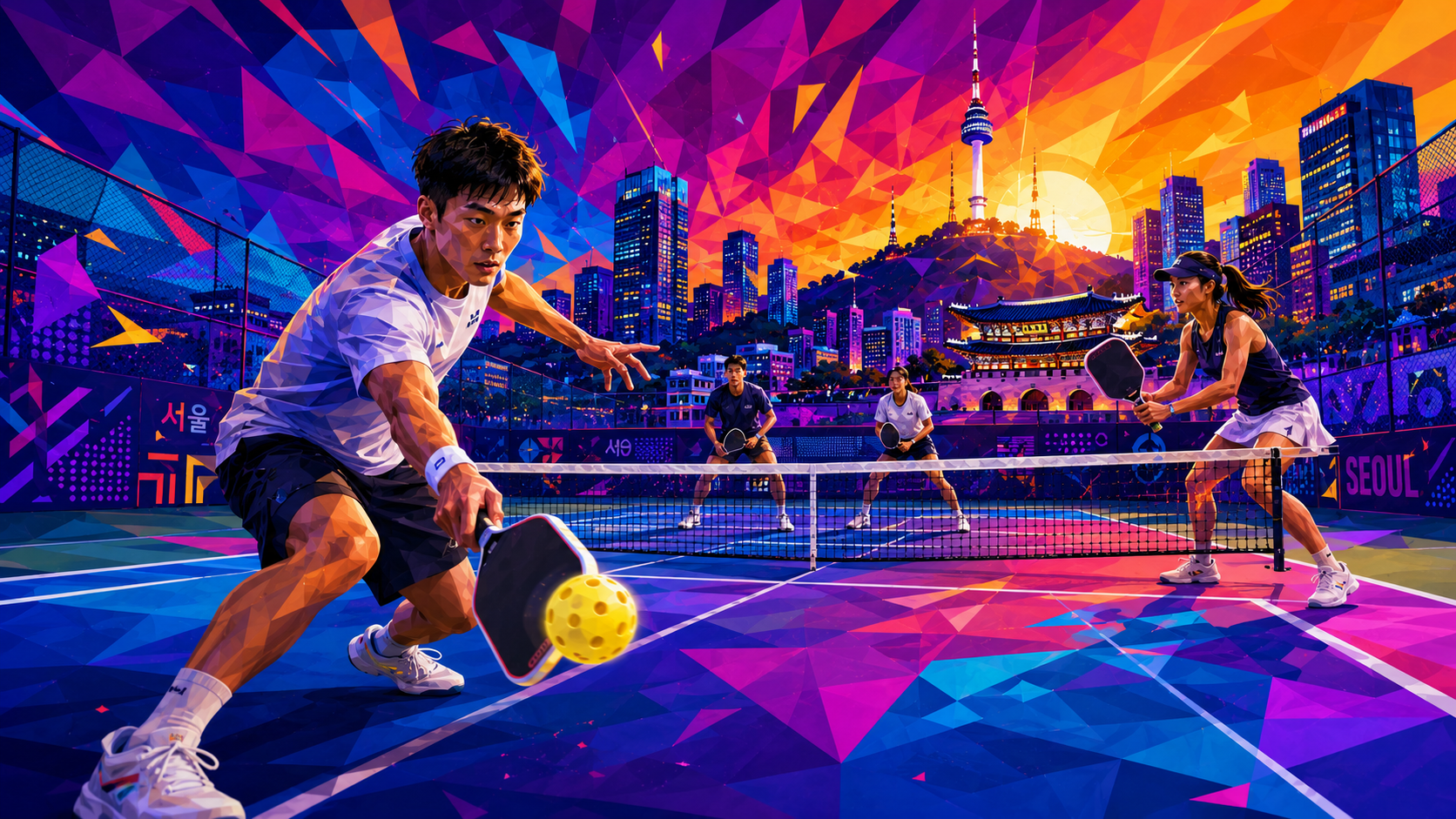
How a city built on pressure discovered a sport built on belonging
The spreadsheet is already half full by the time Kim Min-jae opens it.
It is 7:18am.
Outside, Seoul is waking up.
Subway trains are filling.
Coffee shops are serving the first commuters of the day.
Office workers are checking overnight emails before they have even left home.
On his phone, Kim scrolls through a shared Google Sheet.
Court 3.
8pm.
Intermediate.
One space remaining.
He enters his name.
By lunchtime the session will be full.
By evening he will spend two hours playing pickleball with people he has never met before.
In modern Seoul, this has become entirely normal.
A few kilometres away, beside the Han River at Gwangnaru Hangang Park, the city’s new 14-court pickleball complex sits quietly in the morning sunshine.
By nightfall it will be one of the busiest social spaces in the capital.
Not a nightclub.
Not a bar.
Not a workplace networking event.
A pickleball court.
That, perhaps more than anything else, explains why pickleball has become one of the most fascinating cultural stories in Asia during 2026.
The sport’s growth in South Korea is not simply a sporting boom.
It is a window into a society searching for something many modern cities struggle to provide.
A place to belong.
The City That Never Stops
Seoul is often described through its achievements.
Its technology.
Its infrastructure.
Its education system.
Its global brands.
Its entertainment industry.
The city operates with extraordinary efficiency.
Yet anyone who spends time here quickly notices another side.
The pace.
The expectation.
The pressure.
South Korea’s economic transformation remains one of the great success stories of the modern era, but success always extracts a price.
Students compete intensely for university places.
Employees navigate long working hours and demanding corporate cultures.
Young professionals face rising housing costs and fierce competition.
Many Koreans speak openly about burnout, exhaustion and loneliness.
Not loneliness in the traditional sense.
The city is never empty.
The trains are packed.
The restaurants are busy.
The streets are alive.
Yet many people still struggle to find meaningful social connection beyond family and work.
Urban planners have a phrase for places that help solve this problem.
Third places.
Home is the first place.
Work is the second.
The third place is where community happens.
Increasingly, Seoul’s pickleball courts are becoming exactly that.
If you're following how the global game is shifting week by week, the World Pickleball Report breaks this down every day in our morning briefing.
From Jokgu to Pickleball
The emergence of pickleball becomes more interesting when viewed against Korea’s sporting traditions.
Unlike many countries where pickleball arrived into a relatively empty recreational space, South Korea already possessed its own established culture of accessible community sport.
Badminton courts are everywhere.
Cycling clubs attract huge participation.
Hiking is almost a national obsession.
And then there is jokgu.
Part football.
Part volleyball.
Entirely Korean.
For decades jokgu courts have served as informal gathering places where friendships are maintained and communities strengthened.
In many ways pickleball feels less like a revolution and more like a cousin arriving from overseas.
The atmosphere is familiar.
The social dynamic is familiar.
The emphasis on participation rather than elite performance is familiar.
What differs is who the sport attracts.
Pickleball appears uniquely capable of bringing together people who might otherwise never meet.
The retiree.
The university student.
The software engineer.
The expatriate teacher.
The returning Korean professional.
Everyone begins at roughly the same level.
Everyone spends their first few sessions laughing at mistakes.
That equality matters.
Particularly in a society where status often remains highly visible.
The BTS Effect
Every major cultural shift requires a spark.
For pickleball in South Korea, celebrity visibility helped provide one.
When members of BTS began discussing and playing the sport publicly, something changed.
The numbers tell part of the story.
Search traffic increased.
Media coverage expanded.
Participation accelerated.
Yet statistics miss the deeper significance.
The impact of BTS was not that they taught people how to play.
The impact was that they made the sport look socially acceptable.
For years pickleball carried a reputation throughout much of Asia as a niche pastime associated primarily with older players.
Suddenly some of the most recognisable cultural figures in the country were holding paddles.
The image changed overnight.
What had looked niche began to look current.
What had looked unfamiliar began to look accessible.
And perhaps most importantly, what had looked old started looking young.
The Expat Spreadsheet
If the celebrity story helped open the door, the spreadsheets built the house.
Among Seoul’s growing pickleball community, open-access spreadsheets have become an unlikely organising principle.
The system sounds almost absurdly simple.
Someone creates a session.
People add their names.
Players arrive.
Games happen.
Friendships form.
Yet simplicity is exactly the point.
Traditional sporting clubs often require introductions, memberships or established social networks.
The spreadsheets remove those barriers.
A newcomer can join within seconds.
For expatriates arriving in Seoul, this has proved transformative.
Moving to a new country often means starting again socially.
Finding friends can be difficult.
Finding community can be harder.
The spreadsheets offer something unusual.
Immediate access.
No interview.
No invitation.
No gatekeeper.
Just a name on a screen and a court reservation later that evening.
One player described it perfectly in an interview with local organisers.
“The spreadsheet is like a handshake before you’ve met.”
That may be the most important sentence in Korean pickleball.
Because the spreadsheet is not really organising sport.
It is organising trust.
The Han River Clubhouse
Visit Gwangnaru on a busy evening and a pattern emerges.
Players arrive alone.
Few leave that way.
A young office worker carrying a laptop bag changes into sports clothes beside the court.
A university student arrives on a bicycle.
Two expatriates speak English.
A retired couple discuss line calls in Korean.
Within minutes they are all sharing the same space.
The sport itself almost becomes secondary.
Between games conversations begin.
Recommendations are exchanged.
Restaurants are discussed.
Travel plans appear.
Career advice is offered.
Phone numbers are swapped.
The court functions as a social accelerator.
Relationships that might take months to develop elsewhere form naturally through repeated games.
One organiser described the phenomenon as “friendship through scheduling.”
It sounds simplistic.
Yet the evidence sits on every court.
The players keep returning.
Not necessarily because they are obsessed with pickleball.
Because they know the people.
Four Lives, One Court
Consider four players.
The first is a 24-year-old graduate entering her first corporate job.
Most of her university friends now live elsewhere.
She initially joined because she wanted exercise.
She stayed because she built a social circle.
The second is a middle-aged office worker recovering from burnout.
Tennis felt too demanding.
Golf felt too expensive.
The smaller court and relaxed atmosphere appealed immediately.
The third is an American teacher who arrived in Seoul knowing nobody outside work.
The spreadsheet community became his introduction to the city.
The fourth is a former jokgu player in his sixties who initially viewed pickleball with suspicion before becoming one of its most enthusiastic advocates.
Their stories differ.
Their reasons differ.
Yet they all arrive at the same conclusion.
The court provides something modern life often struggles to offer.
Regular, low-pressure human interaction.
The Problem With Success
Success brings complications.
Today the biggest challenge facing Seoul’s pickleball community may be its own popularity.
Demand is growing faster than infrastructure.
Popular sessions fill almost immediately.
Gymnasium rentals are increasingly required to accommodate players.
Public facilities face mounting pressure.
The irony is obvious.
A sport celebrated for accessibility is beginning to experience shortages.
Yet these challenges reveal something encouraging.
Nobody worries about overcrowding when nobody cares.
The queues themselves represent evidence of cultural momentum.
The question facing organisers is no longer how to attract players.
It is how to find enough courts.
Learning How to Play
The most interesting aspect of Seoul’s pickleball boom has little to do with paddles or scoreboards.
It concerns permission.
Permission to participate.
Permission to meet strangers.
Permission to spend time on something that serves no professional purpose.
Permission to be imperfect.
South Korea has spent decades becoming one of the world’s most productive societies.
Productivity built prosperity.
It also built pressure.
Pickleball offers a temporary escape from that equation.
Nobody asks where you studied.
Nobody asks your job title.
Nobody asks your salary.
The game reduces everyone to the same level.
Can you return the ball?
Can you keep the rally going?
Can you enjoy yourself?
Those questions feel surprisingly radical in a culture often defined by achievement.
Under the Lights
At 10pm the courts remain busy.
The Han River reflects the city lights.
A train crosses a bridge in the distance.
The final games of the evening are still underway.
A rally ends.
Paddles tap together.
Players laugh.
Someone suggests food.
Someone else starts organising next week’s session.
Before leaving, several players pull out their phones.
Not to check work.
Not to answer emails.
To update the spreadsheet.
Names begin appearing in empty cells.
Tomorrow’s games are already forming.
The process repeats.
Strangers become partners.
Partners become friends.
Friends become communities.
For all the discussion surrounding celebrity endorsements, facility construction and participation statistics, that remains the real story of pickleball in Seoul.
The city has not merely embraced a new sport.
It has discovered a new way of gathering.
And in a world where genuine connection often feels harder to find than ever, that may prove far more important than any tournament result.
The spreadsheet fills.
The courts fill.
And, little by little, so do the spaces in people’s lives that modern cities too often leave empty.
Further Reading
- Latest pickleball news from around the world
- Tournament coverage and results
- Rankings and player profiles
- Regional pickleball coverage
Did you enjoy this June magazine article? You can download the whole issue to read at your own leisure here.

Chris Beaumont
Founder and Editor-in-ChiefChris Beaumont is the founder and Editor-in-Chief of World Pickleball Magazine. Chris follows the global game closely, reporting on the latest news, developments, stories and tournaments from all five continents. He also hosts the World Pickleball Podcast, interviewing people at…
View All Articles →