

There is an old saying that a rising tide lifts all boats.
It is a simple philosophy, but one that captures the thinking behind one of Australian pickleball’s most ambitious player-development projects.
Participation is growing. New courts are opening, tournament fields are filling and Australian players are beginning to test themselves internationally. Yet expansion creates another question.
What happens next?
How does a promising player become a professional? How does a young athlete navigate a sport whose tours, organisations and opportunities are still taking shape? Who supports them before the medals, contracts and sponsorships arrive?
Those questions sit behind APEX Pickleball, formally the Australian Pickleball Excellence Growth Academy.
Speak with its founder, John Myer, and it soon becomes clear that the project is about more than producing technically accomplished players. Medals matter. Rankings and professional contracts matter. But John believes they should come from a broader environment that helps athletes manage the demands surrounding the game.
The curious part is that he never intended to establish an academy.
A home away from home
Before APEX, John was chief executive of a technology company. His working life was dominated by airports, boardrooms and international travel.
For almost three years, he spent two weeks out of every six in San Francisco. Work also took him regularly to London and Istanbul. The travel was exciting, but extended periods away from family could be lonely.
Then somebody invited him to play pickleball.
“It completely changed my experience of travelling,” John recalls.
Instead of returning to an anonymous hotel room at the end of the working day, he found a local community ready to welcome him. Strangers became doubles partners. Opponents became friends. San Francisco began to feel less like somewhere he worked and more like somewhere he belonged.
The experience repeated itself elsewhere.
Different cities, countries and cultures offered remarkably similar welcomes when John searched for a pickleball court.
“I realised that wherever I travelled in the world, pickleball gave me a sense of belonging,” he says. “It normalised life when I was away from home.”
Many players will recognise that quality in the sport. Arrive at a court with a paddle and there is a reasonable chance somebody will make room for you.
John experienced that hospitality across several continents. He did not forget it when he returned home.
Coming home
After selling his business and moving with his family to Queensland’s Gold Coast, John expected life to become quieter.
Retirement was meant to bring more time with his family and an opportunity to decompress after a demanding corporate career. Instead, pickleball gave him another outlet for his energy.
Friendly games became a regular part of his week. The local pickleball community offered competition, friendship and a renewed sense of purpose.
“I realised pickleball was giving me so much,” he says. “It gave me a sport I could still be competitive in, continue improving at and immerse myself in, but it also became something I wanted to give back to.”
John had competed at a high level in futsal and believed he recognised something familiar in pickleball’s development.
Futsal had attracted substantial participation without always possessing the structures, pathways and funding available in football. Pickleball appeared to be encountering some of the same problems.
Talent was emerging, but the route ahead was unclear. Players could train and compete domestically, yet discovering how their level compared with leading international professionals was far more difficult.

John wondered whether he could help.
Then he met Sahra Dennehy.
The first test
Introduced by RebeKah Green, John encountered a young athlete with ability, determination and a belief that she could compete internationally.
The obstacle was not simply coaching. It was access.
Like other ambitious Australian players, Sahra was trying to navigate limited financial support, expensive international travel and several possible competitive pathways. Whatever her potential, she needed opportunities to test it.
John had learned the importance of that test through futsal. His team once travelled to Portugal believing it could compete with the best, only to discover the size of the gap when it faced clubs such as Benfica and Sporting Lisbon.
The lesson stayed with him.
You cannot properly measure your progress until you encounter the standard you are trying to reach.
Working with RebeKah and Nathanael Green, John helped arrange an overseas trip for Sahra and another promising player, Liam Jesperson. The immediate aim was not to return with medals. It was to discover how they compared.
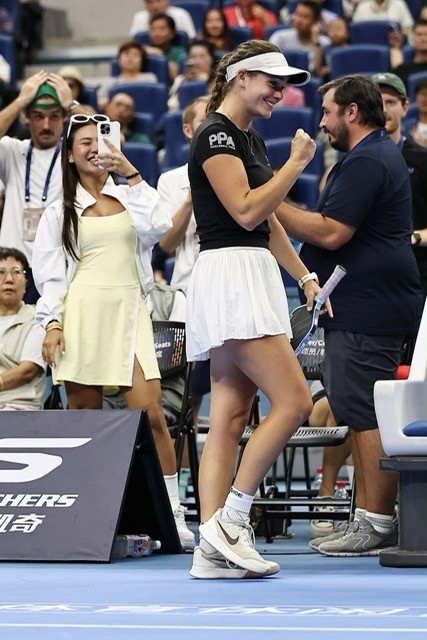
Sahra qualified for the main draw at the Masters and earned a match against Anna Leigh Waters. She later collected medals while competing in Vietnam, Malaysia and China.
Those results did not establish that the distance between Australia and the leading pickleball nations had disappeared. They did, however, suggest that Australian players could be more competitive than many assumed when given the chance to travel, prepare and play.
Other athletes began asking similar questions. Could they gain access to coaching? Could somebody help them understand the route towards professional competition? How could they afford the travelling and training necessary to find their level?
The beginnings of APEX emerged from those conversations.
Building an environment
The first official APEX group contained eight athletes training together each week.
Australia already had capable pickleball coaches. John wanted the academy to offer something broader: an environment in which athletes could learn about the less visible demands of pursuing the sport seriously.
“The goal was never simply to produce better pickleball players,” he says. “We wanted to provide young athletes with the tools, disciplines and support systems that would help them become the very best versions of themselves, both on and off the court.”
Players at different stages of development were deliberately brought together. The more experienced athletes could offer guidance. Younger players could bring their energy and questions. Everybody would have regular access to others who understood the peculiar commitment involved in chasing a career in a young sport.
The members became more than convenient training partners.
Professional pickleball can be isolating. Rankings belong to individuals. Players spend long hours drilling, travelling and managing the disappointments of competition. Even doubles partnerships may change regularly.
John wanted APEX to provide some stability within that uncertainty.
“We felt being a professional could be a lonely vocation,” he says. “So we wanted our athletes to have travelling companions, drilling partners, sparring partners and, most importantly, friends who understood their ‘crazy’.”
The academy celebrates individual results, but its members also share defeats, travel and the ordinary frustrations behind tournament performance.
“We win or we learn” has become an unofficial motto.
It could sound like another piece of sporting optimism. Within APEX, John intends it as a reminder that progress in a developing sport will rarely follow a clean line.
The work around the game
Technical coaching remains central to APEX.
Ben Costin, Joey Farias, Wes Vine and Tom Evans bring different forms of playing and coaching experience to the programme. The intention is for athletes to encounter several perspectives rather than depend upon one voice.
The academy’s larger purpose, however, lies in the support surrounding that coaching.
APEX helps with tournament registration, travel and accommodation. Its athletes can also receive strength and conditioning guidance, mental-performance coaching, nutritional support and advice around contracts, finance, taxation, media and commercial development.
If you're following how the global game is shifting week by week, the World Pickleball Report breaks this down every day in our morning briefing.
These are ordinary parts of established professional sports. In pickleball, especially for athletes trying to build careers far from the game’s wealthiest market, access can be inconsistent and expensive.
The support also exposes an uncomfortable truth. Talent alone does not create an international player.
Somebody must pay for flights, hotels, tournament entries and coaching. Somebody must absorb the cost before results produce meaningful prize money or sponsorship. In APEX’s case, much of that initial commitment has depended upon John’s personal investment, time and willingness to use experience gained through his previous business career.
He describes APEX as a labour of love rather than a commercial venture. That gives the academy room to support athletes who might otherwise struggle to travel. It also means its present model is closely tied to the commitment of one benefactor and the group he has assembled around him.
John is the public face, but he is keen to credit the people carrying much of the daily load.
Nathanael Green oversees coaching, player development and the use of technology and match analysis. RebeKah Green works across player welfare and logistics, becoming what John affectionately calls the academy’s “camp mum”. Corey Krimuldens contributes strategic management and brand development, while Grant Lyons provides international input.
John also credits his wife, Natice, whose support allows him to commit so much time to the project.
The academy’s growth, he argues, has also been helped by a wider community willing to collaborate. Governing bodies, tour operators, coaches, volunteers and other organisations have all played roles in creating opportunities for Australian players.
No academy can manufacture an entire pathway on its own.
A growing group
Sahra’s international progress remains an important part of the APEX story, but the academy has expanded beyond the player who helped inspire it.
Danielle Townsend, Harry Brown, Katy Hart, Josh Barber, Josh Niperess, Liam Jesperson, Tayah Cross and Lachy Donnelly are among the athletes who have trained or competed under the APEX banner. Joey Wild, Lucas Pascoe and Conor Robertshaw have since joined the group. Talia Saunders became an ambassador, while young Aria Henare received an encouragement scholarship.
Results inevitably provide the most visible measure of progress. John insists they are only one measure.
He takes similar pride in seeing athletes become more confident, communicate better and support teammates through difficult periods. The academy is attempting to produce players capable of handling a sporting life, not merely winning individual matches.
“They’re amazing human beings,” he says.
That warmth runs throughout my conversations with John. It is also inseparable from APEX’s central challenge.
Family feeling can carry a small group through its early development. A long-term pathway requires stable funding, clear opportunities and a structure that can endure as its athletes and ambitions multiply.
Beyond the first generation
APEX is still young, but its plans extend beyond the original training group.
Junior pathways, school partnerships, holiday clinics, residential programmes, international exchanges and further opportunities to compete in Asia and the United States are all being considered.
John is particularly interested in junior development. He has worked with Pickleball Australia, PPA Australia, NPL and UPA-supported initiatives, believing that cooperation will be necessary if young players are to find clearer routes into the game.
Those plans will take money, people and patience. Australian pickleball is still deciding what its professional future should look like, and no private academy can make those decisions alone.
For now, APEX represents one answer to a problem that exists across emerging pickleball countries.
What happens when ability grows faster than the structures required to support it?
John’s answer has been to invest in a group of players and surround them with as much of a professional environment as he can assemble. The model is personal, ambitious and still developing. Its full effect will only become clear over time.
Before finishing our conversation, I ask him one final question.
Why?
After selling a successful business, why devote so much time and personal investment to a sport still finding its feet?
His answer arrives without hesitation.
“I feel incredibly grateful for what pickleball has given me,” he says. “We get to work with talented, hardworking athletes and hopefully help them achieve dreams they couldn’t achieve on their own. There’s something incredibly satisfying about paying it forward.”
Perhaps that is the real story behind APEX.
Pickleball gave John a community when he was far from home. Now he is attempting to create a home for Australian athletes travelling in the opposite direction, out into a sporting world where talent is necessary, opportunity is expensive and nobody reaches the highest level alone.
A rising tide may lift every boat.
First, somebody has to help get them into the water.
For a clearer view of where the sport is heading each week, you can join the World Pickleball Report here.