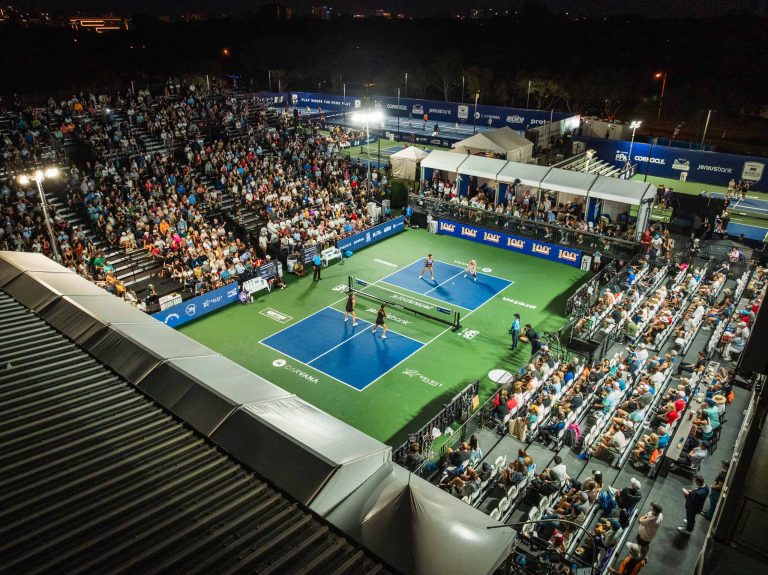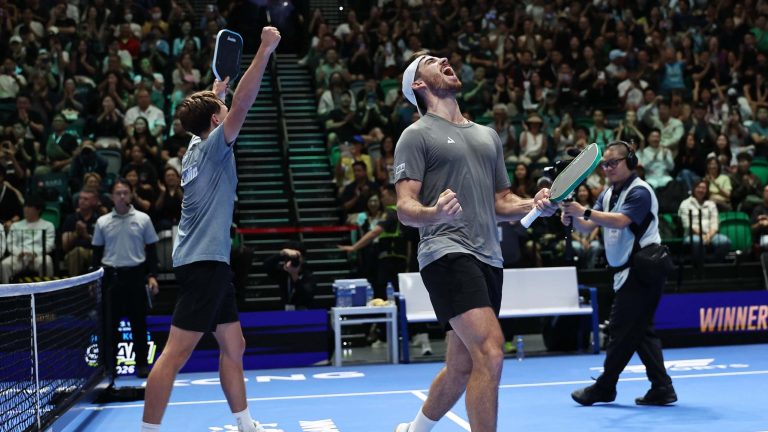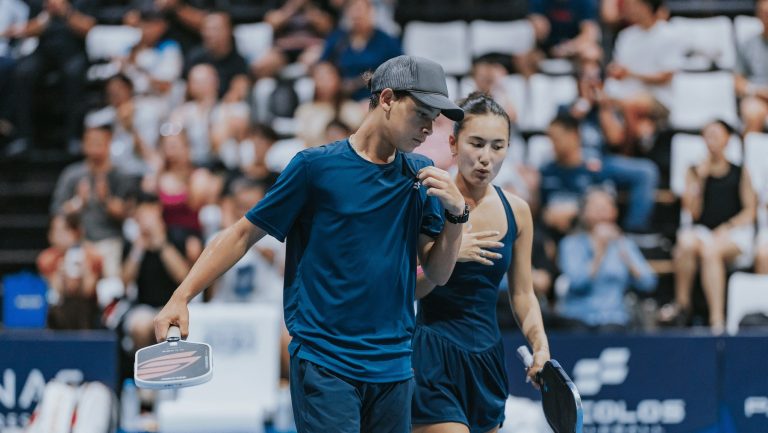
The short answer: Andie Dikosavljevic won the women’s singles at both of the PPA’s new 1500-level events, the Australian Pickleball Cup in Brisbane and the Hang Seng Bank Hong Kong Slam, and lost one game in ten completed matches: 20 games won, one lost. Anna Leigh Waters played neither singles draw, and Waters has won her last 55 singles finals. Dikosavljevic goes to the World Championships in Dallas (2–8 November) as a genuine contender. She does not go as the favourite.
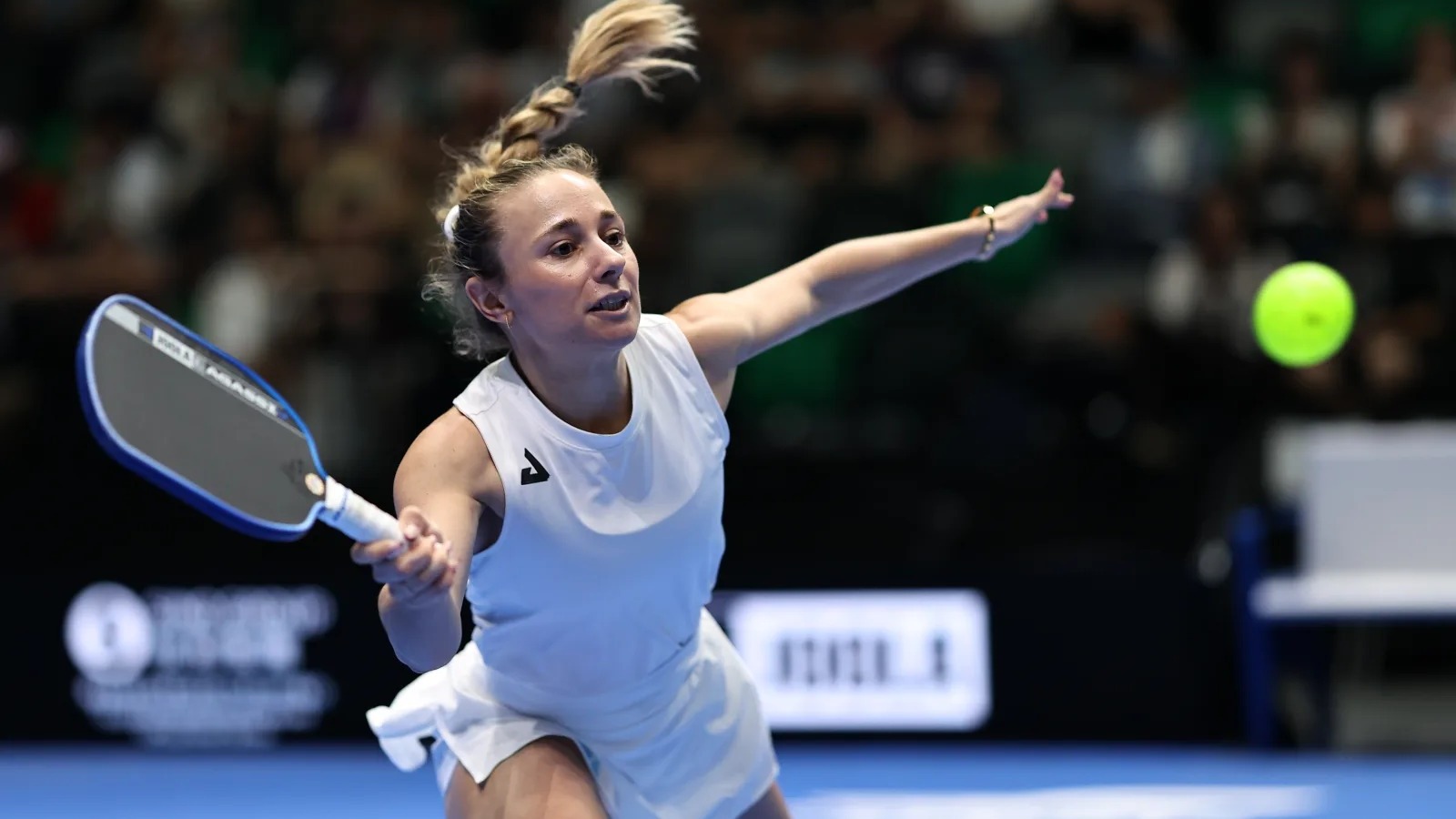
Castillo won six points. At Kai Tak Arena on Sunday, Dikosavljevic beat Judit Castillo 11-1, 11-5 in the Hong Kong final, and the first game was over almost before it had begun. PPA Tour Asia’s match report said she “was a class above” and “overpowered Judit Castillo 11-1, 11-5 from the baseline”. Castillo, it added kindly, “brought plenty of entertainment, but Dikosavljevic was playing on a different level.”
A week earlier in Brisbane the same final had finished 11-6, 11-6. Todd Boss, writing for Forbes, called it “a baselining clinic”, with Castillo “continually going on a tour of the court every rally”. Two finals against the same opponent, and Castillo got 18 points in four games. That is not a rivalry. It is a pattern.
Let me begin with an argument that will make me unpopular in at least one Brisbane postcode. The conventional view this week is easy to write and nice to read: “Dikosavljevic is the in-form player, so she is the Worlds favourite.” The first half is true. The second half doesn’t survive contact with the other number in this piece.
A quick word on the method
The scores are from the official PPA results feeds for both events, results to 25 October 2026. The game and points counts are mine. Ten completed matches and one walkover across two tournaments is a small sample, so treat what follows as a weather forecast rather than a verdict.
How good was the fortnight, really?
Very good, and better than the headline. In Hong Kong, seeded eighth, she played six matches and won all 12 games, conceding 40 points: about three and a third a game. In the quarter-final she beat the second seed, Chao Yi Wang, 11-8, 11-6. In the semi-final she beat Sahra Dennehy, whom PPA Tour Asia lists as world singles No. 10, 11-1, 11-3. Only Wang reached eight points in a game against her all week.
Brisbane was harder, and more revealing. The No. 3 seed, Kiora Kunimoto, gave her a walkover in the quarter-final, which is the least strenuous way to beat a top-three seed yet devised. The semi-final against Dennehy was the only real contest of her fortnight. The official scores show two lopsided games, 11-5 and 11-1, one each, then a decider she won 12-10. Published reports disagree about which of the first two went which way, so I’ll stick to the bit nobody disputes. When it came down to two points, she won them.
That match is the key. Set the two Dennehy meetings side by side. In Brisbane, a top-ten player took her to 12-10 in a third game. In Hong Kong six days later, the same player got four points in two games. You would expect results against one opponent to fluctuate a bit. They don’t usually fluctuate like that. The simplest explanation is that her level went up during the fortnight, not that the draws went down.
Where did she come from?
Not from nowhere. From somewhere the American tour rarely looks.
She played college tennis at Auburn before she took up pickleball, and she is a director at FTI Consulting in Brisbane. So one of the best singles players in the world has been combining the tour with a senior consulting job, which says something about the economics of the sport outside the United States, and possibly something about her diary. When she won the Australian Pickleball Open in March, FTI posted her reaction on LinkedIn: “Having competed at the Junior Australian Open over 10 years ago and now competing in the fastest-growing sport globally on the world stage felt like such a special moment… Getting the win was the cherry on top, especially as days of play all came down to one point in the end.”
One point in the end. Remember that line. In July 2025 at the Brisbane Cup in Redcliffe she beat Dennehy 11-7, 9-11, 11-7. Her 2026 results are wins by distance rather than survival: the Australian Open, then Sydney and Moreton Bay, where she beat Kaitlynn Hart 11-5, 11-2 in the April final, and then a triple crown at the PPA250 event in Melbourne. By mid-August, Forbes had counted nine PPA Australia singles titles for her since March 2025.
Her first title outside Australia came in Ho Chi Minh City on 9 August. She beat Trang Huynh 11-2, 9-11, 11-7 for her first PPA Tour Asia title, and won the women’s doubles there with Yufei Long. By October, Boss was calling her “very under-seeded” for Brisbane. He was right.
The structure explains the seeding. PPA Tour Australia has given players like her a ladder of regular events and ranking points. In 2026 it added the top rung: Forbes called Brisbane the first event at that level held in Australia, and noted that several leading players chose it over the PPA’s Virginia Beach event the same week. PPA Tour Asia then staged its own first 1500 in Hong Kong, the last of ten stops in its 2026 season. The Dink called it “the biggest pickleball tournament ever held in Asia”, with a prize pool of up to $1.1 million.
For most of the professional era the road to the top of women’s pickleball has run through American events. This was the first time 1500-level points were up for grabs in the Asia-Pacific in consecutive weeks. A local took the most from it. Hunter Johnson also won the men’s singles at both events, but he already had a Las Vegas title this month. Dikosavljevic’s double is the one that changes what a draw looks like.
Is the field thin without Waters?
No. But it’s a different field without her, and that’s the whole argument.
Waters was in Hong Kong. She won the women’s doubles with Anna Bright, 11-6, 11-4 over Tyra Hurricane Black and Jorja Johnson, and the mixed with Ben Johns. She didn’t enter singles, and she didn’t play singles in Brisbane either. In both events the top seed was Kaitlyn Christian, and Castillo knocked her out both times: 14-12, 10-12, 11-8 in the Brisbane semi-final, then 11-9, 5-11, 12-10 in the Hong Kong quarter-final.
So the field had depth. Dikosavljevic beat Hong Kong’s second seed, beat a top-ten player twice, and beat twice a finalist who had just knocked out the top seed twice. A thin field doesn’t produce that list.
Now the other number. At the Chicago Cup on 11 October, a fortnight before Hong Kong, Waters beat Kate Fahey 11-1, 11-7. The PPA’s statistics page put her at 66-3 in singles finals, and 55-0 in finals since June 2022. She is also the defending world champion: she beat Fahey 11-4, 12-10 in the 2025 final.
Fifty-five finals without a defeat isn’t a purple patch. It’s the weather. Twenty games to one is a superb fortnight, but it was earned in two events the favourite didn’t enter. That doesn’t make it worthless. It means it doesn’t answer the question being asked.
What would she need in Dallas?
Three things, roughly in order of difficulty.
First, the game has to travel. Boss and PPA Tour Asia both used the same word for it: baseline. Against Castillo that meant long rallies that kept Castillo running until they ended on Dikosavljevic’s terms. That style works on any court. It is also the style Waters has been beating in finals for four years, and her record suggests she has seen most of what can be thrown at her from the back.
Second, she has to cope with depth. Most of her titles have come in Australia and Asia, and the Dallas field will be deeper than either draw she has just won. The week before Worlds is busy too, with the MLP Nations Cup at the same venue, Brookhaven Country Club, from 30 October to 1 November.
Third, the event itself. Worlds is a seven-day PPA major worth 3,000 ranking points per title, with a total payout of $1,648,641. Main-draw rounds run daily from 3 November, the semi-finals are on 7 November and the finals on the 8th. Winning it almost certainly means beating two top-ten players on consecutive days, and then the woman who doesn’t lose finals.
Here is the counter-argument, and I take it seriously. The best evidence against a player in form is usually a close defeat to the elite, and she doesn’t have one in this run, because the leading players she met, Wang and Dennehy, didn’t get close. Form like that is rare enough that it shouldn’t be dismissed as a kind draw. If she meets Waters and it goes to a third game, nobody should be surprised. Including, I suspect, Waters.
So, favourite or not?
Not. Waters is the favourite, by a margin two weeks in the Asia-Pacific can’t close. But Dikosavljevic is the most credible semi-final threat from outside the established American core, and she’s the player nobody in the other half of the draw from Waters will want to meet.
As of 26 October the PPA’s event page had not published the Worlds women’s singles draw, so her seeding and path are unknown. The seeding matters. Boss’s “very under-seeded” was about Brisbane, but it may well apply again, because the rankings reward a season of points and many of hers came at lower-tier events.
What the run hasn’t offered is the one match that would settle it: Dikosavljevic against Waters. Until then, the short answer stands. Twenty games to one is a statement of form. Fifty-five finals to none is a statement of fact. In Dallas we’ll find out whether her fortnight comes down to one point in the end.

Chris Beaumont
Founder and Editor-in-ChiefChris Beaumont is the founder and Editor-in-Chief of World Pickleball Magazine, published by World Pickleball Media Ltd. He follows the global game closely, reporting on news, developments, stories and tournaments from all five continents. He also hosts the World Pickleball…
View All Articles →