
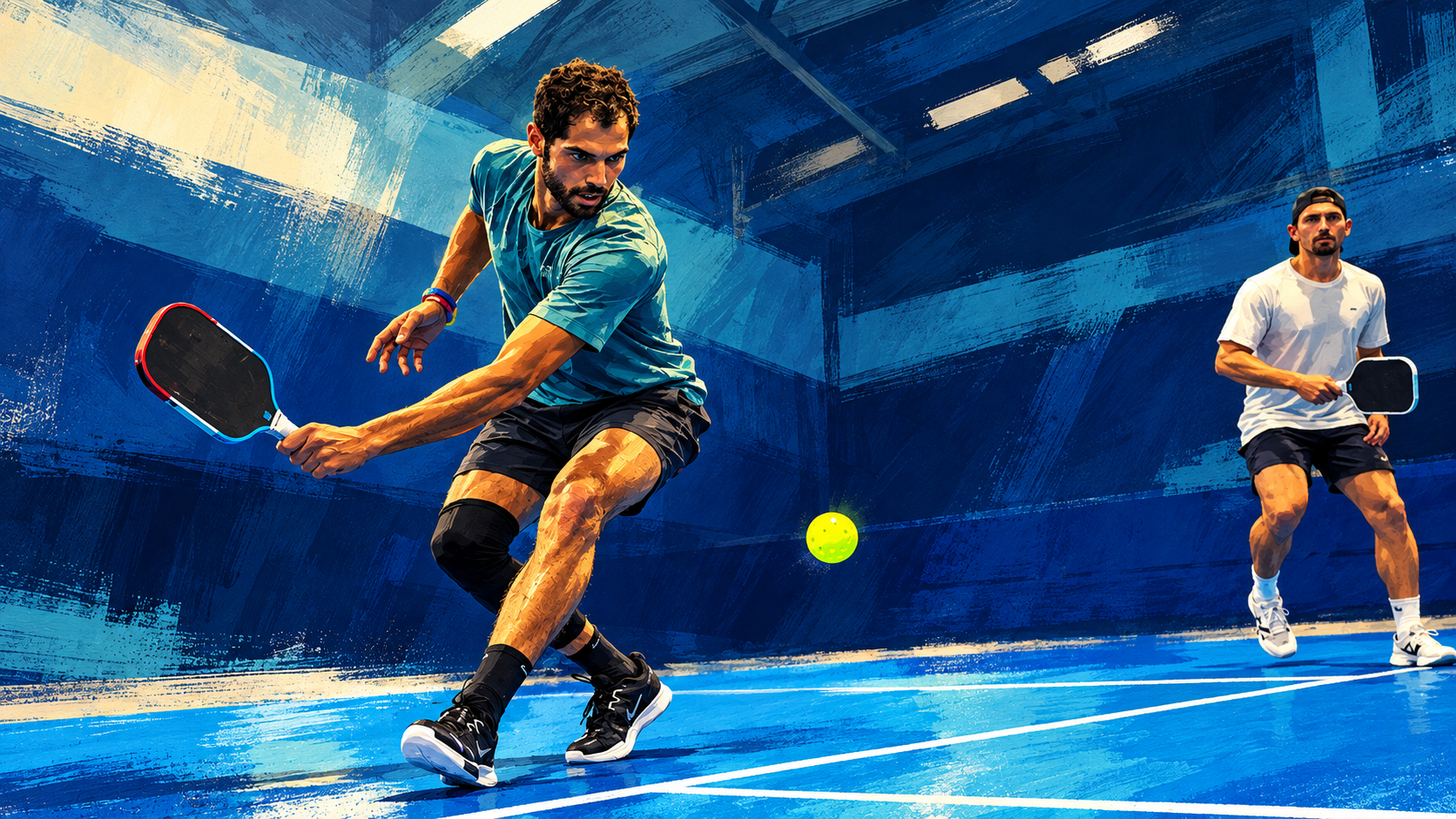
Lauren Cole missed a women’s doubles medal, then won mixed gold. Anderson Scarpa followed a men’s doubles title with a second final, while Kelsey Laurente came within two points of winning on successive days. Charlotte’s five champions emerged from a weekend in which each new draw could change a player’s story.
Key Takeaways
- Jarryd Woog and Lauren Cole won mixed doubles after Cole had finished fourth in women’s doubles the previous day.
- James Delgado and Anderson Scarpa took men’s doubles gold 11–5, 12–10 over Collin Shick and Eric Roddy; Scarpa then reached the mixed final with Alex Walker.
- Kelsey Laurente reached the women’s singles and doubles finals, losing both in deciding games that ended 11–9.
- William Hsieh, Samantha Buyckx, Madalina Grigoriu and Jaeda Minniefield completed the weekend’s other title-winning performances.
Lauren Cole’s Saturday ended one place outside the women’s doubles medals. She and Samantha Buyckx had lost a semi-final to Marisa Ruiz and Kelsey Laurente 13–11 in the deciding game, then fell 11–9, 11–1 to Mya Bui and Paula Rives in the bronze match. On Sunday, Cole stood on the winning side of the Charlotte PPA Challenger’s last professional final. Partnering Jarryd Woog, she beat Anderson Scarpa and Alex Walker 11–9, 11–2 for mixed doubles gold.
That change of fortune gives the tournament its strongest thread. The event moved through singles on Friday, same-gender doubles on Saturday and mixed doubles on Sunday. Players beaten in one discipline returned with different partners and another opportunity, while those who had won were asked to produce a result again. Cole’s fourth-place finish did not prevent a title. Scarpa’s men’s doubles gold did not secure another in mixed. Kelsey Laurente reached two finals and found that getting there twice did not make either deciding game easier.
The 25–27 September event at Peak Time Pickleball was a 125-point Challenger stop. William Hsieh and Buyckx won singles, James Delgado and Scarpa took men’s doubles, Madalina Grigoriu and Jaeda Minniefield won women’s doubles, and Woog and Cole finished the programme with mixed gold. Five title results tell us who completed each draw; the players who repeatedly reached the late rounds show what the weekend may mean beyond Charlotte.
A difficult Saturday gives Cole another task on Sunday
Cole and Buyckx reached the women’s doubles semi-finals, where Ruiz and Laurente forced a match that changed hands. Buyckx and Cole won the opening game 11–8. Ruiz and Laurente answered by the same score, then took the decider 13–11. The last two-point margin left Cole and Buyckx close to playing for gold, yet their next match was for bronze instead.
They had another opportunity against Bui and Rives, but lost a close first game 11–9 before the bronze medallists won the second 11–1. Buyckx therefore finished Saturday with fourth place to go beside the singles title she had won on Friday. For Cole, it was the only placing she had secured before mixed doubles began. The scores establish how narrow the semi-final was and how clearly the bronze match ended, without telling us how either player responded away from the court.
On Sunday, Woog and Cole encountered another of Saturday’s champions. Minniefield, who had won women’s doubles with Grigoriu, partnered Parth Mody in mixed. They took the first game against Woog and Cole 11–5. Woog and Cole replied 11–8, 11–5, turning a match that could have ended their title attempt into a significant recovery on their route to gold.
They followed it with an 11–5, 11–5 semi-final win over Ross Whittaker and Andrea Koop, then took the final against Scarpa and Walker in straight games. The 11–9 opening game gave the finalists a close start; the 11–2 second game settled the title emphatically. Across those three matches, Woog and Cole had to respond to a game deficit, then won their semi-final and final without conceding another game. Their Sunday success rested on a complete run rather than one result in isolation.
Cole’s Saturday and Sunday belong together, while the two partnerships remain distinct. With Buyckx, she came within two points of reaching a final but did not take a medal. With Woog, she came through a three-game test and won the last match of the event. Charlotte gave her another chance because its schedule brought another discipline, and she made the most of it.
Scarpa comes closest to two different doubles titles
Scarpa had a different kind of weekend. Alongside Delgado, he won men’s doubles, beating Collin Shick and Eric Roddy 11–5, 12–10 in the final. Jace Morris and Kyle Koszuta finished third. The second game of the gold match gives the title more texture than the standings alone: Delgado and Scarpa had taken the opener clearly, but still had to win two extra points to finish the contest in straight games.
Sunday asked Scarpa to work with Alex Walker instead. They beat Mya Bui and Eduardo Santini Ayon 11–5, 11–7 in the mixed semi-final, earning Scarpa a second gold-medal appearance in as many days. The final gave him a route to another title with a different partner, but Woog and Cole held on to the opening game 11–9 and won the next 11–2.
A gold and a silver is a substantial return from Charlotte. More revealingly, the results came in different doubles disciplines, with partnerships facing different opponents and demands. Scarpa and Delgado finished the men’s draw as champions; Scarpa and Walker got past a team that would take mixed bronze before losing the last match. His performance across the weekend warrants attention without treating either pair as an extension of the other.
Walker’s place in the result matters too. Scarpa did not reach Sunday’s final alone, and Walker’s contribution to their run should not disappear behind the story of a player pursuing two gold medals. Doubles titles and finals belong to pairs: Delgado shares Scarpa’s gold, while Walker shares his silver. That distinction keeps the account of a productive individual weekend faithful to how the matches were won and lost.
Bui and Santini Ayon beat Wade Heerboth and Allie Reichert 11–7, 11–9 for mixed bronze. It was Bui’s second medal after women’s doubles bronze with Rives. She did not reach a final, yet medalled in both Saturday’s and Sunday’s disciplines with different partners. Her record provides another measure of consistency across Charlotte, even though Scarpa’s repeated appearances took him one round further each time.
Laurente was two points away twice
Friday’s women’s singles final began decisively for Kelsey Laurente. She had beaten Helen To 11–1, 11–1 in the semi-final, then opened the title match against Samantha Buyckx with an 11–4 game. Buyckx recovered 11–8, 11–9 to win gold. For Laurente, the final moved from a commanding start to a third game decided by two points.
The same margin ended her Saturday. Laurente and Marisa Ruiz came through their women’s doubles semi-final against Buyckx and Cole 8–11, 11–8, 13–11, then faced Madalina Grigoriu and Jaeda Minniefield for the title. Grigoriu and Minniefield took the first game 11–6. Ruiz and Laurente responded 11–3, sending a second gold-medal match involving Laurente to a decider. The champions won it 11–9.
Two silver medals tell us that Laurente reached consecutive finals. The games within them give those results their proper proportions. She won the opening game of the singles final and was still within two points at the end. With Ruiz, she recovered strongly from losing the opening doubles game and was again within two points when the title was decided. No medal-table summary conveys how consistently she placed herself in contention, or how narrowly both chances ended.
Her semi-final scores offer a fuller view. She dominated her singles semi-final and, with Ruiz, came through a deciding game that extended to 13–11 against the eventual singles champion and Cole. Those were distinct performances in distinct disciplines. The finals left her without gold, but reaching them required work that cannot be treated as incidental. For Ruiz, Saturday’s silver likewise followed a demanding semi-final and a final in which their partnership answered a lost opening game.
The next question for Laurente and Ruiz is whether that pairing can reproduce its late-round level and close a title match. Charlotte establishes that it can get there and contest one closely. It leaves the final step unresolved, a useful player-trajectory story within a Challenger circuit whose ability to prepare competitors for the main tour WPM has examined throughout the season.
Grigoriu and Minniefield win the hardest closing stretch
The women’s doubles champions had little room to spare themselves. In the semi-final, Grigoriu and Minniefield beat Rosie Johanson and Jessica Haywood 11–9, 7–11, 14–12. They lost the middle game and needed a deciding game that ran beyond the usual finish. Ruiz and Laurente’s own 13–11 decider meant that both finalists reached the title match after demanding semi-finals.
Grigoriu and Minniefield won the opening game of that final 11–6, then lost the second 3–11. The third went to them 11–9. Their last two matches thus required a 14–12 decider to reach the final and an 11–9 decider to win it. That is the competitive substance of their title: they held their place through two extended deciding games against different opponents, including one after a heavy loss in the middle game of the final.
Minniefield’s mixed result the following day adds another connection across Charlotte without altering Saturday’s achievement. She and Mody took the first game against the eventual champions Woog and Cole, but lost the next two. Once again, winning one title did not give a player protection in the next draw. The same weekend that brought Minniefield gold beside Grigoriu brought Cole the chance to reverse her own Saturday finish.
Buyckx’s part in the women’s doubles semi-final connects another champion to this section of the tournament. Her singles gold had been secured through two recoveries from a game down, first against Helena Jansen in the semi-final and then against Laurente for the title. With Cole she won the opening doubles semi-final game but lost the decider, before missing bronze. Friday demonstrated Buyckx’s ability to complete a comeback; Saturday showed how a new discipline and partnership could produce a different ending.
Hsieh’s singles title had its own tests before the final
William Hsieh’s men’s singles gold came in straight games against Braylon Ohrel, 11–6, 11–7. His route to the final was less uniform than that score suggests. Garrison Eaby pushed him to an 18–16 opening game before Hsieh won the second 11–7. Daniel Miron then kept their match close through a 12–10 first game and an 11–8 second. Hsieh beat Edward Perez 11–3, 11–2 in the semi-final and finished by taking both games against Ohrel.
Those results make Hsieh’s title more than a comfortable final. He had dealt with extended and narrow games earlier, then produced decisive scores as the draw reached its end. The sequence itself shows that his route required different responses: remaining in an opening game that reached 18–16, closing a tight match against Miron, and handling the last two rounds without dropping a game.
Ohrel earned silver after an 11–3, 11–6 semi-final victory over Shay Hugo. Hsieh’s final score establishes who finished the men’s draw more strongly; it does not erase Ohrel’s route to the title match. Friday’s men’s singles result stands somewhat apart from the changing doubles partnerships that came to define Saturday and Sunday, but it deserves its full place within a five-discipline account.
What the Challenger results measure
Charlotte’s five golds went to Hsieh, Buyckx, Delgado and Scarpa, Grigoriu and Minniefield, and Woog and Cole. Beyond the champions, Laurente reached two finals and lost both deciding games 11–9; Scarpa paired a men’s doubles title with mixed silver; Bui won bronze in two partnerships; Cole moved from fourth on Saturday to first on Sunday. Each record says something different about performing repeatedly across a three-day event.
One weekend cannot establish that a new competitive order has formed. It can identify who reached the title matches, who responded when a match moved against them and who returned after a difficult result to compete again. WPM’s examination of Miles Hoover’s Challenger pathway and its Arizona finals analysis show why those records are worth following when players move between this circuit and the main PPA Tour.
Cole supplied Charlotte’s final answer, completing her mixed title with Woog after Saturday’s missed medal. Scarpa came closer than anyone to winning twice with two partners. Laurente reached two finals that could each have ended differently with a handful of points. Their results explain why the weekend’s strongest story sits between its five gold-medal entries: each new draw gave players another way to define what Charlotte would mean for them.
Charlotte professional results
| Discipline | Gold | Silver | Final score |
|---|---|---|---|
| Men’s singles | William Hsieh | Braylon Ohrel | 11–6, 11–7 |
| Women’s singles | Samantha Buyckx | Kelsey Laurente | 4–11, 11–8, 11–9 |
| Men’s doubles | James Delgado and Anderson Scarpa | Collin Shick and Eric Roddy | 11–5, 12–10 |
| Women’s doubles | Madalina Grigoriu and Jaeda Minniefield | Marisa Ruiz and Kelsey Laurente | 11–6, 3–11, 11–9 |
| Mixed doubles | Jarryd Woog and Lauren Cole | Anderson Scarpa and Alex Walker | 11–9, 11–2 |
Further Reading
- Why the PPA Challenger Tour Is Getting Harder to Win
- Miles Hoover Faces Pickleball’s New Ranking Reality
- Arizona Opened the Door. Haworth, Alshon and the Tour’s Disruptors Walked Through It
- Charlotte PPA Challenger event information
- Anderson Scarpa’s official PPA results, including the men’s doubles final

Chris Beaumont
Founder and Editor-in-ChiefChris Beaumont is the founder and Editor-in-Chief of World Pickleball Magazine. Chris follows the global game closely, reporting on the latest news, developments, stories and tournaments from all five continents. He also hosts the World Pickleball Podcast, interviewing people at…
View All Articles →