
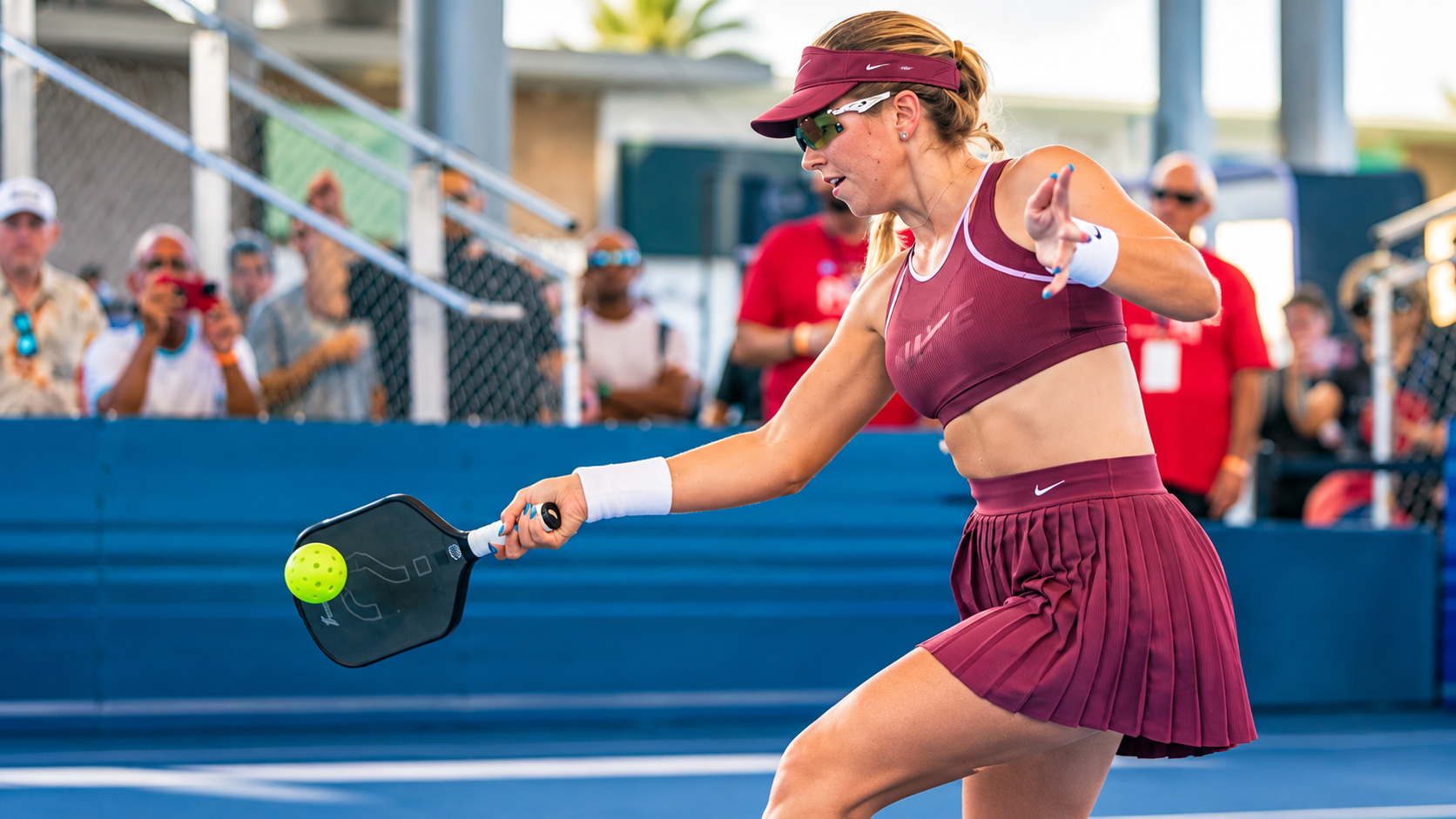
The Veolia Arizona Open began with unusual partnerships, significant absences and opportunities across several draws. By Championship Sunday, Christopher Haworth and Christian Alshon had converted theirs into gold, Anna Leigh Waters had restored the familiar order in two disciplines, and Yuta Funemizu and Nicolas Acevedo had transformed one extraordinary upset into a run all the way to the men’s doubles final.
Key Takeaways
- Christopher Haworth won men’s singles, beating Federico Staksrud after responding immediately to his defeat at the National Championships.
- Christian Alshon and Andrei Daescu won men’s doubles 11-7, 7-11, 15-13 against Yuta Funemizu and Nicolas Acevedo.
- Funemizu and Acevedo proved their upset of Ben Johns and Staksrud was no one-match anomaly, surviving consecutive 12-10 deciding games to reach Championship Sunday.
- Anna Leigh Waters won both disciplines she entered, taking women’s singles and mixed doubles alongside Ben Johns.
- Parris Todd and Rachel Rohrabacher won women’s doubles 11-4, 10-12, 11-6 against Meghan Dizon and Tyra Hurricane Black.
Arizona’s biggest upset happened on Thursday.
Its meaning changed over the next two days.
When Yuta Funemizu and Nicolas Acevedo dismantled top seeds Ben Johns and Federico Staksrud 11-4, 11-5, it immediately became one of the results of the young PPA season. The No. 15 seeds were a new partnership facing two of the most established men’s players in the sport, yet they removed them without requiring a deciding game.
That alone was newsworthy.
What followed was better.
Funemizu and Acevedo did not disappear once the shock had landed. They survived Casey Diamond and Tyson McGuffin in three games, then came from behind against CJ Klinger and Camden Chaffin in another match decided at 12-10. By Championship Sunday, the partnership that had entered Arizona outside the obvious title conversation was playing for gold.
They ultimately finished with silver, beaten 11-7, 7-11, 15-13 by Christian Alshon and Andrei Daescu, but their week supplied the clearest answer to the question World Pickleball Magazine asked before the tournament.
The draw had opened.
Who could actually do something with it?
Across five disciplines, the answers varied. Haworth responded to defeat at the National Championships by returning to the top of the men’s singles podium. Alshon turned a three-discipline weekend into men’s doubles gold and mixed silver. Rachel Rohrabacher and Parris Todd converted the No. 1 women’s doubles seed created by several high-profile absences into a title. Waters entered only two disciplines and won both.
Around them, several of Arizona’s supposed disruptors survived long enough to become something more substantial than early-round curiosities.
That is what made Mesa different.
Funemizu and Acevedo refuse to become a one-match story
The score against Johns and Staksrud remains startling.
11-4, 11-5.
There was no deciding-game lottery, no match point survived and no narrow escape against a partnership still learning how to play together. Funemizu and Acevedo controlled the encounter sufficiently to concede only nine points.
The more revealing evidence, however, arrived after the upset.
Their next match against Diamond and McGuffin was entirely different. Funemizu and Acevedo won the opener 11-6, lost the second 12-10 and then survived the decider 12-10.
The semi-final required them to recover rather than protect a lead.
Klinger and Chaffin took the opening game 11-6. Funemizu and Acevedo responded 13-11, then won another pressure game 12-10 to reach Championship Sunday.
That sequence changes how their Arizona performance should be understood.
Against Johns and Staksrud they were front-runners, playing aggressively enough to prevent the favourites from ever establishing control. Against Diamond and McGuffin they had to survive a third game. Against Klinger and Chaffin they had to recover from behind.
Three rounds demanded three different things.
They answered all three.
It also changed the meaning of the result WPM had identified as the tournament’s defining disruption before the quarter-finals. Beating Johns and Staksrud was no longer an isolated upset; it had become the beginning of a Championship Sunday run.
Alshon and Daescu finally convert the run
Standing between Funemizu and Acevedo and the title were the partnership most obviously positioned to benefit once Johns and Staksrud disappeared.
Christian Alshon and Andrei Daescu were the No. 2 seeds.
More importantly, they arrived in Mesa already knowing they could reach Championship Sunday together.
They had done exactly that at the National Championships, where their run ended with silver. Arizona therefore presented a straightforward progression test: could another deep run become a championship?
It did.
The final demanded all three games. Alshon and Daescu took the first 11-7, Funemizu and Acevedo answered 11-7 in the second, and the deciding game stretched beyond regulation before the No. 2 seeds finally closed it 15-13.
That matters more than simply adding another gold medal to either player’s record.
New partnerships frequently produce encouraging tournaments. Sustaining them is harder. Alshon and Daescu have now taken consecutive PPA final appearances and converted the second into victory, creating at least the beginnings of evidence that this combination can remain relevant when more familiar men’s partnerships return.
Arizona opened the route.
They still had to take it.
Alshon becomes Arizona’s three-discipline constant
The title also completed perhaps the broadest weekend of any male player in Mesa.
Alshon reached the semi-finals in men’s singles, the final in mixed doubles and won men’s doubles.
His singles run ended emphatically against Haworth, who beat him 11-3, 11-1 in the semi-final. Alongside Rohrabacher, however, Alshon was considerably harder to remove in mixed.
The pair reached the semi-finals without dropping a game before recovering from a game down against Daescu and Todd, winning 8-11, 11-6, 11-7.
The final brought Waters and Johns.
That proved one match too far.
Waters and Johns won 11-3, 11-6, leaving Alshon with silver before his men’s doubles title completed the weekend.
The broader point is increasingly difficult to ignore. Alshon’s value is no longer confined to the possibility that he can make a run in any one discipline; he is increasingly capable of remaining relevant across all three simultaneously.
Arizona offered a particularly clear version of that.
Haworth answers the National Championships
Christopher Haworth’s Arizona title should be understood partly through what happened at the previous PPA stop.
At the National Championships, Hunter Johnson beat Haworth and Staksrud on his way to men’s singles gold.
Haworth arrived in Mesa as the No. 1 men’s singles seed. His response was unusually clean.
He opened against Acevedo with an 11-4, 11-3 victory and then beat Connor Mogle 11-8, 11-7. Rafael Lenhard pushed him harder in the Round of 16, but Haworth survived 11-7, 13-11 before beating Yates Johnson 11-1, 11-8 in the quarter-finals.
Alshon then managed only four points in their semi-final.
That put Haworth opposite Staksrud for gold.
The final finally gave him the sustained resistance the previous rounds had not, but Haworth recovered after losing the opening game to claim the Arizona title.
For men’s singles, the result is more useful than a simplistic change-of-the-guard narrative.
Johnson won the National Championships after beating both men. Haworth won Mesa. Staksrud reached another final. Alshon made another semi-final.
The names are increasingly familiar.
The order is not settled.
Waters provides the counterargument
Almost everything interesting about Arizona involved uncertainty somewhere.
Women’s singles did not.
Anna Leigh Waters beat Kiora Kunimoto 11-3, 11-4 in the quarter-finals before producing one of the weekend’s most emphatic performances against Jalina Ingram, winning 11-0, 11-0 in the semi-final.
Kate Fahey was similarly decisive on the other side, beating Cailyn Campbell 11-4, 11-5 before reaching another Championship Sunday against Waters.
That is significant in itself.
Fahey is not simply appearing intermittently near Waters in the draw. She is repeatedly putting herself in position to ask the question.
The answer in Mesa remained the same.
Waters won the final in straight games and took another women’s singles title.
That gave her the first half of a two-title weekend.
In mixed doubles, she and Johns had to work considerably harder before reaching the final. Their semi-final against Staksrud and Fahey went three games, with Waters and Johns eventually winning 11-6, 6-11, 11-7.
Once on Championship Sunday, Rohrabacher and Alshon could not repeat that resistance.
Waters and Johns won 11-3, 11-6.
Waters entered two disciplines.
She left with two gold medals.
Arizona spent much of the week demonstrating how quickly the hierarchy underneath her can move.
Waters remains the part that does not.
Rohrabacher and Todd convert the women’s doubles opening
Women’s doubles presented almost the opposite structural problem.
Waters did not enter. Anna Bright and Jorja Johnson were also absent.
The result was a draw in which Rohrabacher and Todd became No. 1 seeds and Meghan Dizon and Tyra Hurricane Black No. 2, exactly the kind of opening highlighted in WPM’s tournament preview.
Calling that an opportunity is fair.
Calling the eventual result inevitable would not be.
Rohrabacher and Todd had to recover from losing the opening game against Judit Castillo and Mari Humberg, winning 9-11, 11-8, 11-8, before beating Catherine Parenteau and Sofia Sewing 11-5, 11-5 to reach the final.
Dizon and Black came through the other side without dropping a game, including an 11-5, 11-8 victory over Jessie Irvine and Etta Tuionetoa and an 11-8, 11-6 win over Tina Pisnik and Lacy Schneemann.
The top two seeds therefore reached the match their positions suggested they should.
The final was considerably less orderly.
Rohrabacher and Todd took the opener 11-4. Dizon and Black responded by taking the second 12-10, before the No. 1 seeds reasserted themselves to win the decider 11-6.
For Todd, that meant gold after the temporary reshaping of the women’s doubles hierarchy.
For Rohrabacher, it completed a Sunday containing women’s doubles gold and mixed doubles silver.
And for the draw itself, it offered an important distinction.
Arizona created an opening.
The players nearest the top still had to prove they belonged there.
The Challenger pathway leaves fingerprints on the main draw
Not every Arizona story ended on Championship Sunday.
Kiora Kunimoto and Elliott Schupp’s mixed doubles run is the one worth carrying forward.
The teenagers arrived with evidence behind them rather than simply promise, having built a strong record together on the PPA Challenger circuit before testing that form against main-tour opposition in Mesa.
They responded by reaching the mixed doubles quarter-finals, with their run including a 12-9, 12-10 victory over John Lucian Goins and Meghan Dizon before Waters and Johns eventually stopped them 11-6, 11-3.
The significance is not that a quarter-final represents some kind of breakthrough by itself.
It is where the result came from.
One of the PPA’s central structural questions is whether the Challenger level can become a genuine development route rather than a parallel circuit whose results tell us little about readiness for the main tour.
Kunimoto and Schupp have supplied a useful case study.
That deserves its own deeper WPM treatment rather than being forced into the Arizona results narrative, but their week belongs in the tournament verdict because it represents another form of disruption: not an established professional exploiting absences, but younger players carrying success upward through the system.
Arizona’s real winners were the players who made opportunity stick
The Arizona Open was always going to be judged partly through its absences and unusual combinations.
Gabe Tardio, Hayden Patriquin and JW Johnson were among those missing from men’s doubles. Bright and Jorja Johnson were absent from women’s doubles. Waters skipped that discipline. Johns partnered Staksrud.
Those circumstances loosened the tournament.
They did not decide it.
That distinction matters.
Alshon and Daescu were given a clearer route when Johns and Staksrud disappeared, but they still had to convert a second consecutive final into a title.
Rohrabacher and Todd inherited the No. 1 women’s doubles seed, then survived a three-game test before another three-game battle for the championship.
Haworth had just been beaten at the National Championships and answered by winning the next tournament.
Waters was offered no such opening because she remains the player everyone else is trying to create one against. She entered twice and won twice.
And then there were Funemizu and Acevedo.
Their Arizona story is the one that best captures the tournament because nothing was handed to them.
They removed Johns and Staksrud themselves.
Then they survived 12-10 in a third game against Diamond and McGuffin.
Then they lost the opening game of their semi-final and survived another 12-10 decider against Klinger and Chaffin.
Only Championship Sunday stopped them, and even then it required 15-13 in the third.
The 11-4, 11-5 victory over Johns and Staksrud will remain the result most likely to be remembered from Mesa.
What happened afterwards is what gave it weight.
Arizona opened several doors.
Funemizu and Acevedo kicked theirs down — and kept walking.
Further Reading
- The Door Is Open in Arizona: New Partnerships, Missing Champions and a Rare Chance to Break Through
- Arizona Starts to Bite as McGuffin Survives and Sewing-Diamond Land the First Blow
- Arizona Starts to Bite: The Seeds Are Still Standing, but the Draw Is No Longer Behaving
- PPA Arizona Open: Johns-Staksrud Arrives Early as Arizona’s Disruptors Refuse to Leave
- Veolia Arizona Open Features Wide Open Draws — Pickleball.com

Chris Beaumont
Founder and Editor-in-ChiefChris Beaumont is the founder and Editor-in-Chief of World Pickleball Magazine. Chris follows the global game closely, reporting on the latest news, developments, stories and tournaments from all five continents. He also hosts the World Pickleball Podcast, interviewing people at…
View All Articles →

