The professional game has tours, contracts and sponsors, yet many recreational players could not name five people who earn their living from it. Peak Pickleball founder Shane Dunn believes the missing connection runs through the coaches, clubs and familiar faces who already hold influence inside the sport.
The temperature in Kansas City had climbed to something close to unbearable. Shane Dunn remembers it at around 105 degrees Fahrenheit, with the court feeling hotter still.
He was standing inside a professional sport that had suddenly decided to rearrange itself.
The battle between pickleball’s competing tours had erupted. Players were being offered contracts. Decisions that could determine careers were being made at speed. Dunn was talking to people on both sides while attempting to secure a deal for Aanik Lohani, the first player he represented.
Months earlier, Lohani had told him that playing professional pickleball was costing him money. Now Dunn was negotiating contracts worth, by his account, a little more than $250,000.
“I remember thinking, ‘What is happening?’” Dunn says.
Peak Pickleball had begun as an almost casual suggestion over coffee. In Kansas City, it became something else.
A Joke That Lasted Until Dark
Dunn’s own relationship with pickleball started during the pandemic.
He had played college tennis and was accustomed to the culture surrounding conventional racquet sports. Pickleball entered his life through a group of friends who began playing together, often arriving at 10 in the morning and staying until darkness made it impossible to continue.
They brought a grill. They made a day of it. The court became less a sporting venue than a place around which an entire social life could form.
The game itself was only part of the attraction.
That experience led Dunn to Lucky Shots, an indoor club in Minneapolis. He describes his first sight of the facility with the enthusiasm of someone recalling a minor religious conversion.
“It was like the golden gates opened and the harps were playing,” he says.
Then he entered his first PPA event at the 4.0 level.
He was destroyed.
The result was humbling, but it placed him inside the competitive side of a sport he had previously experienced mainly as a player and community member. It was there that he met Lohani.
Dunn asked him a blunt question: how much money do you make as a professional pickleball player?
Lohani’s answer was that he was spending approximately $15,000 a year to travel and compete.
Dunn joked that he needed an agent. They met for coffee. The joke survived the meeting.
Peak Pickleball was born.
Its timing could hardly have been more fortunate. Dunn readily acknowledges that. The tour conflict created a brief, frantic market for players, and Lohani was good enough to attract attention.
The relationship subsequently produced the moment Dunn still identifies as Peak’s real beginning.
At the 2023 PPA Championships in Las Vegas, Lohani arrived as the 23rd seed and advanced through a succession of established opponents to reach his first Championship Sunday. Ben Johns was waiting in the final.
Dunn was courtside, watching his player prepare to face the dominant figure in men’s pickleball while simultaneously working on Lohani’s first shoe deal.
“It was straight-up Jerry Maguire for me,” he says. “I was on centre court. There was Ben, and there was Aanik, the player I had signed, and I was on the phone cutting deals.”
Lohani lost the final, but the week altered Dunn’s understanding of what Peak could become.
It was no longer simply about helping one player negotiate a contract. It was about the commercial structure forming around a sport whose participation had grown more quickly than its professional identity.
If you're following how the global game is shifting week by week, the World Pickleball Report breaks this down every day in our morning briefing.
How Many Professionals Are Actually Professional?
Professional pickleball presents a curious contradiction.
It has tours, team competitions, broadcasts, sponsorship agreements and athletes who train full-time. It also has players travelling from event to event without the financial security normally implied by the word “professional”.
Dunn estimates that the leading 10 to 15 players in the United States can make a comfortable living from the sport. Below them sits a broader group earning perhaps $60,000 to $100,000 a year through some combination of contracts, prize money, coaching and sponsorship.
Those figures are Dunn’s assessment rather than a published salary scale, and individual circumstances vary considerably. His larger point is that the distance between appearing professional and being financially secure remains substantial.
For most players, the first significant commercial relationship is with a paddle company. From there, the familiar categories follow: apparel, footwear, eyewear, grips and accessories.
Those deals can keep a career moving. They do not necessarily build one.
The more interesting opportunity, Dunn believes, lies outside the industry. Insurance providers, jewellery companies, luggage brands, travel businesses and other companies already spend heavily to reach active consumers. Pickleball can offer them an audience, but it has not yet built a reliable way to move those brands from general awareness to meaningful participation.
Mike Strommen has seen that difficulty from both sides. As co-founder of paddle company PIKKL and an executive with experience building campaigns for major brands, he invested in Peak because he believed Dunn was constructing something more systematic.
“I’ve built brand programs for some of the largest companies in the world and my partner and I built a paddle company that was recently acquired by Paddletek. Both taught me that awareness is cheap and activation is hard. Peak is the first group in this sport building a real framework to solve it, and building it accountable from day one. I wrote a check, but the relationships I can bring them are worth more than the money.”
Mike Strommen, Strategic Investor and Advisor, CEO of PD Instore and Co-founder of PIKKL
Peak publicly represents 20 players, according to Dunn, with further conversations under way. He expects the roster to reach approximately 30 athletes during 2027.
Yet he says athlete management accounts for only a small part of the company’s day-to-day activity.
Peak has a nine-person team and, according to Dunn, handles between 40 and 50 brand conversations in an average week. Most concern the same underlying problem.
How does a company enter pickleball in a way that reaches the people who actually play it?
The Participation Paradox
Pickleball has an enormous playing public. What it does not yet possess is a professional audience of comparable size.
Ask recreational players to name five touring professionals and many will struggle. That does not mean they lack commitment to the sport. They may play four times a week, own several paddles, organise their holidays around access to courts and spend hours discussing ratings, footwear and the behaviour of their local open-play group.
They simply do not follow professional pickleball in the same way football supporters follow clubs or tennis fans follow Grand Slam champions.
“This is not a spectator sport yet,” Dunn says.
The word “yet” matters.
Pickleball’s professional ecosystem has often behaved as if mass participation would automatically produce mass spectatorship. Dunn does not believe that connection can be assumed. Playing a sport and caring about its professional personalities are different behaviours.
The professional game therefore faces two linked challenges.
It must turn elite players into people whose stories matter beyond a tournament result. At the same time, brands need routes into the recreational communities where influence already exists.
A logo on a professional’s shirt may create visibility. It does not guarantee that anybody will buy the product.
Suzy Changed Her Paddle
Dunn’s favourite example of influence is not a champion.
It is Suzy, the hypothetical 3.5 player who appears at the same club every Tuesday, Thursday, Friday and Saturday. She knows everybody. Everybody knows her.
If Suzy changes her paddle, people notice. If she arrives wearing a different shoe or using a new grip, someone asks why. Her recommendation carries weight because it comes from inside an existing relationship.
The same is true of teaching professionals, head pros and club organisers. These people may have far smaller online followings than touring athletes, but they possess something that cannot be measured by follower count alone: trust in context.
A professional athlete can validate a product. A familiar local figure can explain why it might be right for the player standing beside them.
Lightning Loop has worked with Peak as that idea has developed from athlete endorsements into education delivered through local professionals.
“We’ve been with Peak for a few years and watched it evolve. It started with pros repping our product. Now we’re building training programs inside Summit so head pros and teaching pros actually understand what we make. Those are the people rec players listen to, and Peak puts us in front of them at scale.”
Kane Fitzgerald, CEO and Co-Founder, Lightning Loop
This is the distinction at the centre of Dunn’s argument.
Professional players matter, but not always because they can produce an immediate sale. They provide credibility, aspiration and visibility. Local communities provide conversation, repetition and purchasing influence.
The opportunity is to connect the two.
The Club Cannot Become a Billboard
Facilities are crucial to that connection because they hold the relationships that many outside brands want.
A busy pickleball club sees players several times a week. It knows which programmes they attend, which coaches they trust and how they behave once they walk through the door.
That access creates commercial value. It also creates risk.
Clubs already receive frequent approaches from businesses looking for exposure. If every proposal results in another banner, sample table or demand on staff time, the facility can quickly feel less like a community and more like a showroom.
Chris Sears, founder and CEO of Indianapolis Pickleball Club, says Peak’s approach was different because it began with the club’s existing strengths.
“Everybody who comes through our door wants to sell us something. Peak was the first group that showed up asking what we already do well and then paid us for it. The activations fit into things we were running anyway, and the platform keeps it organized so it isn’t one more thing my staff has to chase.”
Chris Sears, CEO and Founder, Indianapolis Pickleball Club
That principle is important.
An effective activation should belong naturally within the life of the facility. It might appear through a clinic, a league, a coach education programme, a product trial or something players already have a reason to attend.
The club should not have to manufacture an audience for the brand. The brand should add something useful to the audience the club has already built.
What Summit Is Supposed to Connect
Peak’s attempt to organise that process is a platform called Summit.
Dunn describes it as the technology connecting the company’s three principal groups: professional athletes, pickleball facilities and commercial brands.
The platform has been in development for approximately two years and is being formally introduced in September. Its purpose is to turn a collection of individual relationships into a repeatable structure.
A brand entering pickleball might begin with an athlete partnership, giving the product credibility and a recognisable face. It could then reach clubs through training material, coach education or facility activations. The results can be tracked within the same system.
SaltStick’s involvement offers an example of the intended path.
“We [SaltStick] noticed a few pickleball players finding our products, but we had no idea how to get in the game. Peak has entirely changed that for us. From pro athlete deals, to getting us into a PPA event, to building a sales pipeline in with SaltStick products in dozens of pickleball facilities. Nobody else in this space could hand us that entire path in one campaign.”
Noah McDermott, SaltStick
The wider ambition is clear. Peak does not want to operate solely as an agency negotiating sponsorship agreements for individual players. It wants to build the route through which brands move across the sport.
Whether Summit can achieve that at scale will depend on execution. Facilities must see enough value to participate. Brands will require evidence that campaigns produce something more meaningful than impressions. Athletes must benefit without becoming interchangeable advertising inventory.
The concept is persuasive because it reflects how pickleball communities actually function. The challenge is proving that those relationships can be organised without losing the personal qualities that make them influential.
David Johnson, the founder and CEO of the International Association of Pickleball Facilities and co-founder of Pickleball Central, believes Peak’s arrival could alter a commercial system that is still finding its shape.
“This is one of the two or three things I’ve seen this year that tells me there’s a major player coming in who’s going to shift some of the market dynamics in an ecosystem that is very immature to this point in time.”
David Johnson, Founder and CEO, IAPPF, and Co-founder of Pickleball Central
It is a significant judgement, though Peak still has to justify it. The company is presenting Summit as connective infrastructure for a sport in which many commercial relationships have developed separately and informally.
Its next stage will be measured by whether those parts genuinely work better together.
Rankings Measure One Kind of Value
Athlete representation introduces another tension.
The best player is not always the most commercially valuable player.
Rankings measure competitive performance. Brands also consider personality, communication, reliability, audience and the ability to make a partnership feel credible.
Dunn believes players ranked 30th, 80th or even 100th can sometimes earn as much as somebody ranked 15th if they understand how to build value away from the court.
That does not make results irrelevant. Winning creates attention and leverage. It simply means a player’s career cannot depend entirely on how far they advance through the draw each week.
Adam Harvey credits Peak with looking beyond the next available contract.
“Peak got me into a paddle deal that took my brand international and gave me something to build on. They were thinking about where my career is going, not just the deal in front of them.”
Adam Harvey, PPA Signed Pro Athlete
Dunn describes athlete representation as a partnership rather than a service performed on demand.
There is no “magic agency dust”, as he puts it. Signing with Peak does not cause sponsorship agreements to appear. Players must compete, communicate, meet obligations and participate in building their own commercial identity.
Peak’s role is to recognise potential, position it and create opportunities around it.
Sometimes that begins before the athlete sees the possibility themselves.
Seeing a Career Before the Player Does
Dunn met Zoey Weil while playing open pickleball at Lucky Shots.
She had a tennis background and an obvious level of ability, but had not yet decided that pickleball should become a professional pursuit. Dunn told her she ought to turn pro.
Weil says that intervention changed the direction of her career.
“Shane told me I should turn pro before I believed it myself. We were playing open play at Lucky Shots in Minneapolis and he saw something I hadn’t decided to take seriously yet. Peak did the work to get the right people to see it too. Everything since then, the Tour, MLP, the magazine covers, the broadcast work, all of it traces back to somebody being willing to bet on me first.”
Zoey Weil, PPA Signed Athlete
Peak now scouts by being physically present within the sport. Dunn and his colleagues attend events, watch players and speak to them away from the compressed pressure of a result.
Performance opens the conversation. Personality often determines whether it continues.
Dunn looks for what he calls reciprocity. He wants to feel that the energy Peak invests in a player will be met by that player’s willingness to do the work.
That assessment is necessarily subjective. It is also how many sporting careers begin. Someone sees not only what an athlete is now, but what they might become with the right support.
A Sport Looking for Its Public
Pickleball’s professional players are unusually accessible.
Supporters can stand close to the court. They can see athletes warming up, speak to them after matches and follow careers without the physical distance imposed by large stadiums.
Yet accessibility alone does not create attachment.
People become supporters when they know enough to care. They need rivalries, personalities, setbacks, recoveries and reasons to choose one player over another.
Dunn points to a striking imbalance. Some of the world’s leading players have social audiences that appear remarkably small beside the size of pickleball’s recreational population.
For him, this is the clearest sign that participation and professional fandom remain disconnected.
The solution cannot be found entirely in better highlights or more tournament coverage. Results tell people what happened. Stories explain why it matters.
Pickleball has players building careers from uncertain beginnings, changing countries, managing the cost of travel, recovering from injury and attempting to establish themselves inside a sport that is still constructing its own rules of employment.
Those are not side stories. They are the material from which a spectator culture can be built.
The Work After the Medal
Dunn saw that combination of performance and personality recently with Bruno Faletti.
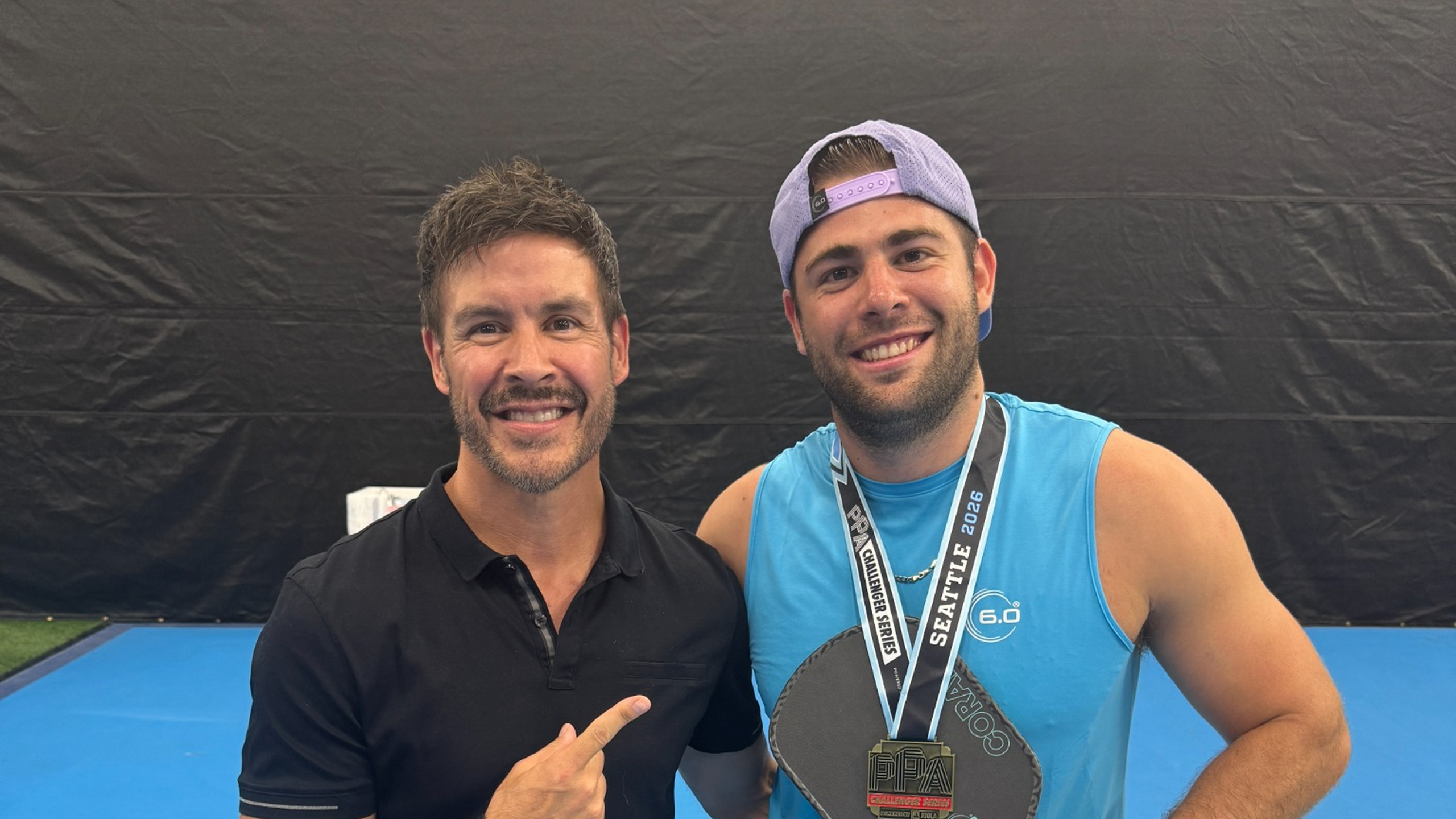
After meeting him, Dunn was struck by his energy and decided he wanted Peak to work with him. The agency signed Faletti and helped him secure a UPA contract.
At the PPA Challenger event in Seattle, Faletti won mixed doubles gold and took silver in men’s doubles.
Dunn’s message afterwards captured how he views the division of responsibility between player and agency.
“You did the work on the court,” he told him. “Now it’s my turn to go do the work off the court.”
That is the business Peak is attempting to build.
The player performs. The agency converts performance into opportunity. The brand receives more than a logo placement. The club gains something useful for its members. The recreational player encounters the product through a person or place they already trust.
Each element is straightforward when viewed alone. Connecting them is harder.
Peak’s growth has benefited from good timing, particularly the sudden contract market created by the tour conflict. Dunn does not disguise that. The larger test begins now, when the company must demonstrate that its model can work beyond those exceptional circumstances.
Pickleball does not lack players. It does not lack products, clubs or companies interested in reaching its audience.
What it lacks is a mature relationship between them.
Most established professional sports built their stars first, then sold supporters a way to feel closer to them. Pickleball has developed in the opposite direction. It created an enormous playing community before most of that community knew who its leading professionals were.
The people are already here.
The sport is still working out who they listen to.

For a clearer view of where the sport is heading each week, you can join the World Pickleball Report here.

Chris Beaumont
Founder and Editor-in-ChiefChris Beaumont is the founder and Editor-in-Chief of World Pickleball Magazine. Chris follows the global game closely, reporting on the latest news, developments, stories and tournaments from all five continents. He also hosts the World Pickleball Podcast, interviewing people at…
View All Articles →