
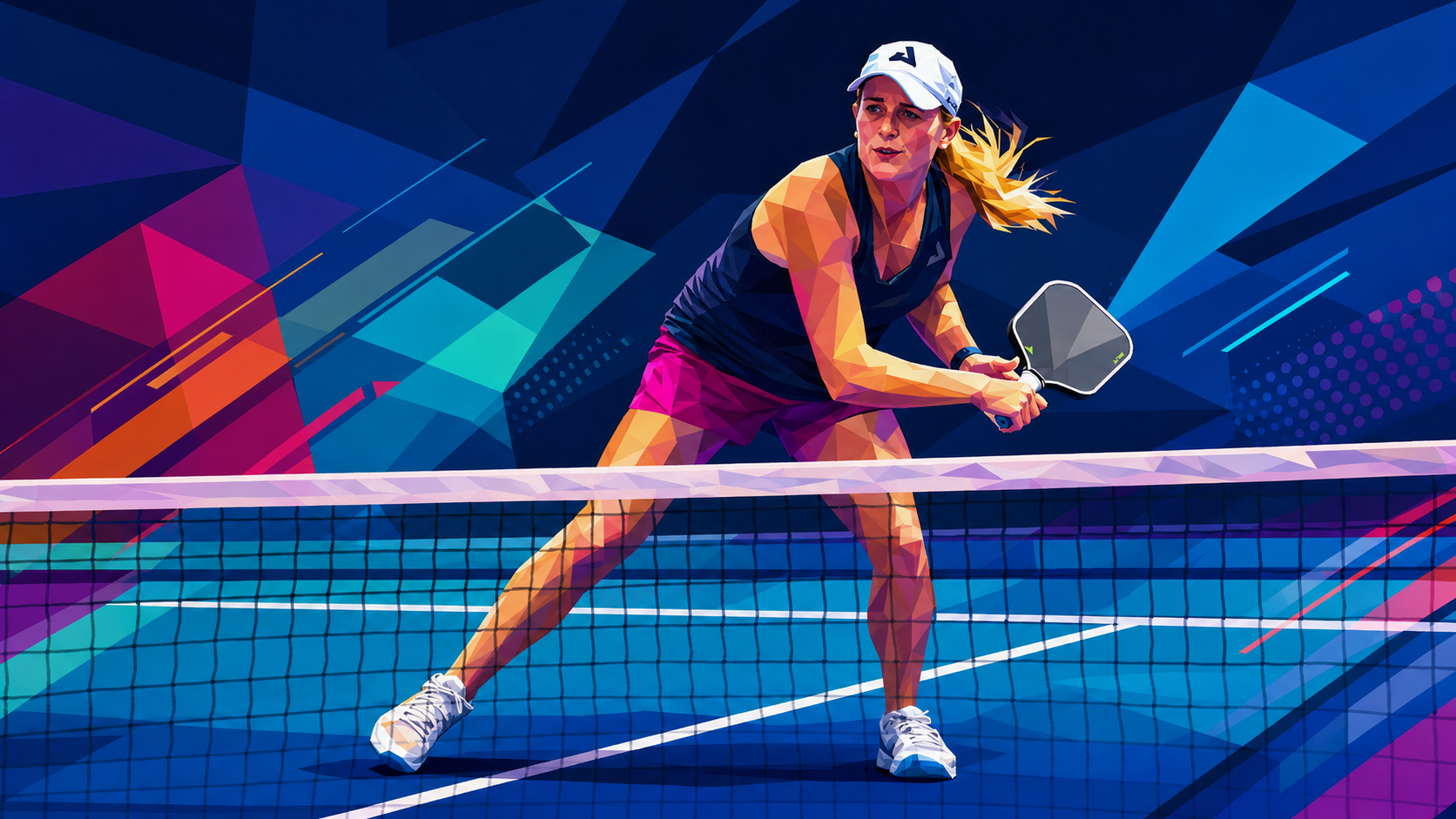
At 34, with three children at home and a training schedule constructed across two cities, Brooke Buckner cannot solve professional pickleball by adding more hours. Her rise to world No. 4 has depended on making better use of the ones she has.
Key Takeaways
- Brooke Buckner entered July 2026 ranked world No. 4 in women’s singles.
- She and coach Mike Wolf have rebuilt her game around net coverage, lateral movement and the first volley.
- Buckner came within two points of beating Anna Leigh Waters in 2025 before returning to the PPA Finals gold-medal match in 2026.
At 9-4 in the second game of the 2025 Mesa final, Brooke Buckner stood two points from doing what nobody managed across Anna Leigh Waters’ entire singles season.
Buckner had already won the first game 11-4. Her groundstrokes were reaching Waters early and deep, taking time away from a player accustomed to controlling it. When the ball came shorter, Buckner moved forward rather than waiting for another baseline exchange.
Waters was being pushed backwards.
Then the match changed.
The world No. 1 began taking the ball earlier, entering the court before Buckner’s weight of shot could force her behind the baseline. Waters won seven consecutive points to take the second game 11-9, then completed the recovery 11-5 in the third.
From 9-4 onwards, Waters outscored Buckner 18-5.
Buckner had come closer than anyone else would that year. Waters finished 2025 unbeaten in singles, winning all 12 tournaments she entered and dropping only two games across 12 gold-medal matches.
One of them belonged to Buckner.
The result added another escape to Waters’ record. For Buckner, it provided evidence that the game she and coach Mike Wolf had spent rebuilding could place the best player in the world under sustained pressure.
Buckner had not reached that position by trying to become younger, faster or available for unlimited training. At 34, with three children and a home in Charlotte, she could not organise her life like a player entering the professional game at 20.
She had to become more efficient, then make that efficiency a competitive advantage.
The baseline game had taken her far enough
Buckner’s first version as a professional pickleball singles player made sense.
She grew up in Cleveland, played three of the four junior tennis Grand Slams and once appeared to be heading towards a professional tennis career. She chose the University of Michigan instead, then moved into coaching roles at Western Michigan, Yale and UNC Charlotte.
Her tennis background supplied many of the qualities that carried early converts through professional pickleball: heavy groundstrokes, a deep serve, sound movement patterns and the confidence to strike repeatedly from the baseline.
For a while, that was enough.
Buckner could drive through weaker balls, pass opponents who approached behind poor shots and make the court feel smaller through pace. She had little need for an elaborate transition game when opponents struggled to establish a position at the kitchen line.
Women’s singles changed around her.
Former tennis players arrived with comparable weight of shot. Younger athletes covered the baseline more comfortably. Passing lanes closed. A deep return no longer guaranteed control of the next exchange because opponents were learning to take the ball early and move forward themselves.
Buckner understood what that meant.
“I knew that I wasn’t going to get by just passing people from the baseline.”
Coming forward required greater trust in skills that had not originally carried her into the professional game: the first volley, lateral movement at the kitchen, reading passing angles and choosing when to abandon the relative safety of the baseline.
Buckner could preserve the game that had made her successful and gradually lose ground as the field improved. She chose to change it while she was still winning.
Mike Wolf was rebuilding movement, not strokes
Buckner’s work with Wolf retained the power that made her dangerous. Her serve and groundstrokes remained among the reasons opponents struggled to establish themselves in rallies.
The aim was to make those shots lead somewhere.
A heavy drive becomes more valuable when it creates the next movement. If an opponent is forced deep or wide, Buckner can enter the court, take away space and finish from a stronger position. Remaining behind the baseline after producing the opening simply gives the opponent time to recover.
Wolf’s work therefore concentrated on net coverage, lateral footwork and the quality of Buckner’s first volley. They rehearsed the steps following a forceful groundstroke: how far to advance, where to split-step, which passing lane to protect and how to prevent a defensive reply from becoming a clean winner.
The change was tactical and practical.
Buckner lives with her family in Charlotte and trains in Kansas City. Travel, tournament weeks and parental responsibilities mean she cannot respond to every weakness by adding another long session. Each block of work must identify something capable of surviving contact with a match.
That gives her preparation a particular character. She trains to solve the next repeatable problem.
Can she move forward without offering the pass? Can she cover the line and still recover towards the middle? Can she volley aggressively enough to retain the advantage created by her groundstroke? Can she make a younger opponent hit one more difficult ball without asking her own body to defend the full court again?
These are small questions. Together, they have changed the geography of her singles game.
Mesa showed the progress and the remaining distance
The first game against Waters demonstrated how disruptive Buckner’s combination had become.
She drove with enough depth to hold Waters behind the baseline, then advanced when the reply allowed it. Waters later said Buckner’s pace and consistency had left her on her heels from the opening point.
The 11-4 score did not come from reckless hitting. Buckner was taking control early and carrying it further into each rally than she had during the first phase of her pickleball career.
Her 9-4 lead in the second game brought her within two points of the title.
Then Waters solved the problem.
By entering the court earlier, Waters stopped giving Buckner repeated opportunities to dictate from the baseline. She pushed her own shots deep, reached the kitchen and shifted the match towards the quick exchanges in which her speed and hand skills carried greater weight.
That sequence exposed the difficulty of Buckner’s project. Improving her own transition game was only one part of the problem. She also had to manage opponents who recognised the same value and raced her towards the net.
Elite singles never remains finished. Each improvement forces a response.
Mesa nevertheless established that Buckner’s reconstructed game could take Waters somewhere few opponents managed during 2025. Across an undefeated year, Waters lost only one other game in a gold-medal match.
Buckner had made the match depend on Waters finding an answer.
Motherhood shapes the schedule, not the strokes
Buckner did not begin pickleball with a carefully mapped professional plan.
She had stepped away from college coaching in June 2020 and was at home after the birth of her son. Her mother pushed her to play during a period when the isolation of early motherhood had been compounded by the restrictions of the pandemic.
Pickleball restored something familiar. Buckner could compete again.
She entered professional doubles in January 2022, then played singles at the US Open later that year. Within a relatively short period, the former college coach was building a second competitive career in a sport she had initially approached as a route back onto a court.
Her third pregnancy interrupted that development without ending it.
Buckner continued competing into 2023 while seven months pregnant. She acknowledged that her movement had changed and planned to return to a regular schedule after the birth.
The physical effect was real. Buckner refused to treat the interruption as a judgement on what could follow it.
In 2024, she won consecutive PPA singles titles in Kansas City and Bristol. At Bristol, her husband Adam arrived unexpectedly with their three children, Lucas, Ellie and Margo, in time to watch her recover from losing the first game to Kaitlyn Christian and win the final 3-11, 11-3, 11-7.
By then, motherhood had become the most obvious public feature of her story.
It is also easy to misunderstand.
Buckner’s results do not prove that sufficiently determined mothers can overcome any obstacle. Her career depends on support at home, careful scheduling, professional coaching and a body capable of handling elite competition. Those conditions are not available to everyone.
Having three children does not explain why she wins.
It explains why her preparation must be selective. The winning comes from what she and Wolf choose to do within it.
The player other professionals are watching
At the PPA Finals in May 2026, Buckner returned to a singles gold-medal match for the first time since October.
The final fell on Mother’s Day. Kate Fahey beat her 11-0, 11-9, avenging an earlier defeat in Hanoi, but used the post-match interview to speak about more than the result.
Fahey had followed Buckner from their shared connection to the University of Michigan into the professional pickleball tour. She called Buckner an important role model and admitted that she did not know how her opponent managed the demands of competing while raising three children.
The admiration is revealing because Fahey represents part of the pressure Buckner has had to answer.
She is younger, quick across the court and central to the increasingly athletic generation reshaping women’s singles. Buckner is trying to remain near the top while the physical standard rises around her.
Her response has been to reduce the number of situations in which pure court coverage decides the rally.
A deeper serve can produce a shorter return. A forceful groundstroke can create an approach. An earlier position at the kitchen can shrink the passing angles. A controlled first volley can prevent a rally from reopening.
The intelligence lies in how those pieces connect.
Buckner’s tennis pedigree gave her the capacity to hit hard. Her second career has depended on learning when power has completed its purpose.
A different kind of longevity
Professional pickleball is still young enough that nobody knows what a normal career should look like.
Some leading players entered as teenagers. Others arrived after college tennis, coaching careers or years spent in different professions. The sport contains established champions in their twenties alongside athletes who did not begin competing seriously until their thirties.
That variety will narrow as junior pathways improve and more players grow up inside pickleball. Future professionals will arrive with better movement, more specialised technique and thousands of competitive repetitions already behind them.
Buckner is competing against the beginning of that change.
She cannot recreate the development years she never had. The years spent coaching tennis, the pregnancies that interrupted competition and the limits imposed by family life are part of her career.
She can decide what her game requires now.
That has meant preserving the groundstrokes that first made her dangerous, adding the net coverage necessary to keep them relevant and treating every training session as a problem-solving exercise rather than proof of commitment.
The approach took her to world No. 4 entering July 2026. It brought consecutive PPA titles, a return to the 2026 Finals gold-medal match and a two-point lead over Waters that nearly became the defining upset of the previous season.
Waters eventually found a way past her in Mesa. Fahey did the same at the PPA Finals. The younger field will continue to become faster and deeper.
Buckner’s achievement is that she has continued to change before the game can make the decision for her.
She could not train like a 24-year-old, so she stopped measuring progress by volume.
Then she built a singles game in which almost everything has a purpose.
Further Reading
- PPA Season Finale: Champions, Challengers and a Tour Evolving
- MLP Finals Shockers and Hong Kong Open Champions
- Nike Makes Pickleball History as Anna Leigh Waters Headlines the 2026 PPA Masters

Chris Beaumont
Founder and Editor-in-ChiefChris Beaumont is the founder and Editor-in-Chief of World Pickleball Magazine. Chris follows the global game closely, reporting on the latest news, developments, stories and tournaments from all five continents. He also hosts the World Pickleball Podcast, interviewing people at…
View All Articles →