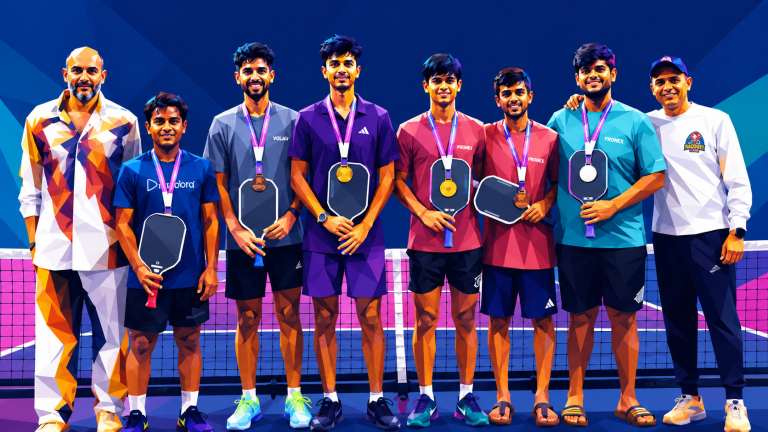

The second Pickleball Now Grand Prix will carry up to ₹50 lakh in prize money, but its greater consequence is a formal route from city-level competition into the Indian Pickleball League’s player market.
- The Pickleball Now Grand Prix 2026 will begin in Mumbai on 23 July and expand across 13 Indian cities.
- Winners at each stop will earn entry into the Indian Pickleball League player auction, although an auction place does not guarantee a contract.
- The circuit could give franchises a national scouting system, provided they follow and recruit from it beyond the opening event.
Winning a domestic pickleball tournament usually brings a medal, prize money and perhaps enough ranking points to reach the next event.
India’s Pickleball Now Grand Prix is adding something more consequential.
Winners at each stop on the 2026 circuit will earn entry into the Indian Pickleball League player auction, placing them in front of the franchises assembling squads for future editions of the professional competition.
An auction place is not a contract. Players must still persuade a franchise to select them. Even so, the Grand Prix establishes a route that has often been missing from pickleball’s new professional leagues: win at city level, enter a defined recruitment process and give professional teams a reason to watch.
The second edition begins in Mumbai on 23 July. According to the competition announcement reported by Indian Television, Times Network has planned a 13-city programme carrying up to ₹50 lakh in prize money and Pickleball World Rankings points.
Bengaluru, Hyderabad and Gurugram have been named among the subsequent stops. The announcement also describes a Lucknow leg to be staged in Noida. Further locations and dates are expected to be confirmed as the circuit progresses.
Winning now leads somewhere
The partnership with the Indian Pickleball League changes the purpose of the Grand Prix.
The circuit remains a national tournament series offering prize money and ranking points. Its winners, however, will leave with a possible effect on their professional future rather than rewards limited to the weekend they have just completed.
That distinction matters because the route into many new professional pickleball competitions remains unclear. Players may depend on rankings, invitations, combines, personal contacts or selectors already familiar with the leading names.
The Grand Prix offers a simpler proposition: win a city event and enter the IPL auction.
What happens there will be decided by the franchises. Auction eligibility does not promise a bid, a roster position or playing time. The pathway will only carry real weight if teams use the circuit to find players they would not otherwise have considered.
The defending IPL champions, Mumbai Smashers, are expected to attend the opening leg. That gives the first tournament an immediate scouting presence. The larger test will be whether franchise attention follows the competition beyond Mumbai and across the full schedule.
The first stop combines competition levels
The Mumbai tournament will use a round-robin format and is open to players aged 19 and above.
Competition will be divided across advanced and intermediate levels. Men’s doubles, women’s doubles, mixed doubles, gender-neutral doubles and men’s singles are included in the programme.
That structure broadens the entry point, but important details remain to be clarified. The announcement does not explain whether every category winner receives auction entry, how franchises will compare results across standards or whether the qualification terms will remain identical at every stop.
Those are significant questions when the reward reaches beyond the tournament itself. A place in a professional auction carries greater value when players understand precisely how it can be earned.
The 13-city scale still creates an opportunity that a single national event cannot. It can expose players who might never travel to one established pickleball centre and give franchises a season of competitive results rather than one selection weekend.
One title can identify a winner. Repeated performances across a national schedule can begin to identify a professional player.
A national scouting circuit for the IPL
The ₹50 lakh prize offering gives the Grand Prix immediate weight, while its ranking status connects domestic results to a wider competitive system.
The auction pathway is the part that could give the circuit lasting importance.
India does not lack ambitious tournaments or league announcements. The harder task is connecting participation, domestic competition and professional teams so that players can see how progress at one level opens the next.
The Grand Prix is attempting to occupy that middle ground. It sits below the IPL, reaches beyond one host city and gives league franchises a common scouting platform.
For Times Network, that creates a competition with a story extending beyond individual weekends. Each stop will produce champions, but it may also produce players whose names return when the auction begins.
For franchises, it offers a wider body of competitive evidence. For players, it offers access to the professional market without pretending that access is the same as admission.
The partnership should therefore be judged by more than entries, prize money or the number of cities eventually confirmed. Its meaningful figures will come later: how many Grand Prix winners enter the auction, how many attract bids and how many reach an IPL court.
The pathway now exists on paper. The 13-city circuit will determine whether it works in practice.
Further Reading
- Latest pickleball news from around the world
- Tournament coverage and results
- Rankings and player profiles
- Regional pickleball coverage

Chris Beaumont
Founder and Editor-in-ChiefChris Beaumont is the founder and Editor-in-Chief of World Pickleball Magazine. Chris follows the global game closely, reporting on the latest news, developments, stories and tournaments from all five continents. He also hosts the World Pickleball Podcast, interviewing people at…
View All Articles →