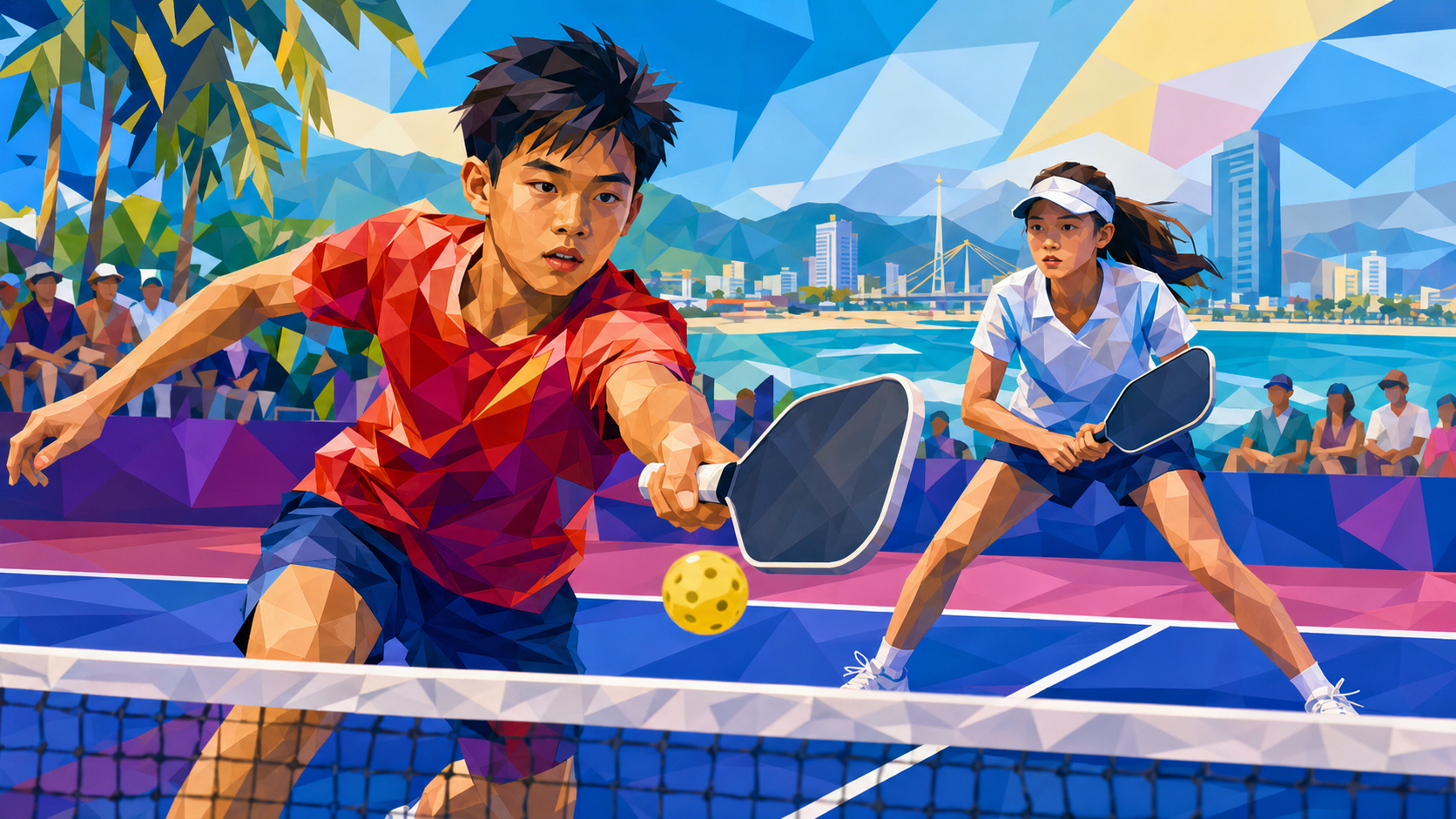
Players competed from under-10 to under-18 in Da Nang, but the more important result was the appearance of a national pathway built through provincial teams, public institutions and age-group competition.
- The first qualifier of Vietnam’s 2026 National Youth Pickleball Championship was held at Nam Hoa Xuan Sports Center in Da Nang from 18 to 20 July.
- Hải Phòng brought 36 athletes and entered players throughout the programme from under-10 to under-18.
- Provincial delegations, the People’s Public Security team and national sports administration involvement reveal a system developing behind the individual results.
Vietnam’s first qualifier of the 2026 National Youth Pickleball Championship produced winners from under-10 to under-18.
It also revealed the system forming behind them.
Held at Nam Hoa Xuan Sports Center in Da Nang from 18 to 20 July, the tournament was sanctioned by the Vietnam Sports Administration. Organised delegations arrived from Bắc Ninh, Hải Phòng, Phú Thọ, Thái Nguyên and the People’s Public Security team, known as CAND.
Hải Phòng alone brought 36 athletes. Its players entered age groups throughout the programme from under-10 to under-18, providing a clearer measure of the country’s youth development than any single final could offer.
A junior tournament can identify talented children. A national structure asks whether those players have somewhere to go next.
Vietnam is beginning to supply an answer.
Thirty-six players from one delegation
The size of Hải Phòng’s squad was the weekend’s most revealing number.
Led by Nguyễn Việt Hòa, General Secretary of the Hải Phòng Pickleball Federation, the delegation did not arrive with one promising teenager or a small group concentrated in the oldest divisions. It entered players throughout the age structure.
That breadth matters because youth pathways are built from the bottom rather than assembled when players are already close to senior competition.
An under-18 winner may be ready for higher-level events. An under-10 entry shows that a province is attempting to identify and retain players years before that transition.
Hải Phòng also produced one of the event’s leading results. Nguyễn Thị Phương Thảo beat Tống Xuân Mai 15-9 to win the under-14 girls’ singles division.
Phương Thảo later reached the under-14 mixed doubles final alongside Trọng Việt. They were beaten 15-7 by Phú Thọ’s Phát Lộc and Thanh Trúc, leaving her with a singles victory and a second final across two disciplines.
Her weekend offered an individual example of what the delegation numbers suggested collectively. Vietnamese juniors are gaining competitive experience across singles and doubles while representing identifiable provincial programmes.
A final changed by the semi-final before it
The under-18 mixed doubles winners provided the tournament’s clearest tactical story.
Minh Ngọc and Đình Mạnh of Bắc Ninh reached the final only after surviving a semi-final that nearly escaped them. They had led 8-3 before their opponents recovered, eventually facing match point before winning 15-14.
The scare changed their approach.
Their group-stage game had been built around aggressive baseline attacks. In the final against Anh Minh and Bình An, they played with greater patience, using the soft game to limit counter-attacking opportunities before choosing when to accelerate.
They won 15-2.
The scoreline looked comfortable. The route towards it was not. Minh Ngọc and Đình Mạnh had to recognise why a five-point lead disappeared, adjust within the same tournament and trust a different pattern when the event was at stake.
That is a more useful sign of development than junior power alone.
Young players often arrive from tennis or table tennis with speed, spin and confidence in the first attack. Pickleball asks whether they can also control pace, reset points and remain patient near the kitchen.
The under-18 final suggested that at least some of Vietnam’s leading juniors are already being asked those questions.
Hoàng brings another sporting education with him
The under-16 boys’ singles division was won by Anh Hoàng, widely known as Hoàng “Samurai”.
Hoàng used heavy spin on serve, controlled changes of rhythm and looked to dictate from the baseline. Before the qualifier, he and doubles partner Đạt “Trố” had also attracted attention by defeating former national table tennis players who had won SEA Games gold medals.
The young pair used deep, high-looping lobs to disturb the table-tennis players’ flatter hitting rhythm. The result was not a formal comparison between the sports, but it showed juniors learning to identify an opponent’s strength and move the match somewhere less comfortable.
Vietnam’s developing pathway will contain athletes with different technical inheritances. The coaching challenge is turning those strengths into complete pickleball games rather than leaving players dependent upon them.
Hoàng’s use of spin, pace changes and height suggests that process has begun.
The youngest divisions make the pathway real
Other winners came from institutions and provinces spread across the age structure.
Nguyễn Quỳnh Ngân of CAND won the under-12 girls’ singles division. She was leading Nguyễn Thị Phương Thảo 10-3 when the final ended through withdrawal.
Nguyễn Anh Tuấn of Thái Nguyên won the under-10 boys’ singles division.
Those categories may carry less immediate international importance than under-18 competition, but they are central to the meaning of the event. A country cannot claim a youth pathway if its organisation begins only when players are old enough to approach the senior game.
The presence of CAND adds another institutional layer. The People’s Public Security delegation shows that youth pickleball activity is not restricted to private academies or independent clubs. Provincial federations and public-sector sporting structures are entering the same national competition.
The available evidence does not yet tell us how regularly these players train, what coaching resources each delegation receives or where the best juniors progress after the qualifier. Those questions will decide whether the pathway produces lasting development.
What Da Nang established was the outline.
There are defined age groups. There are provincial teams. There is national sports administration involvement. There are children entering multiple disciplines, and there are older juniors making tactical changes under pressure.
Vietnam’s next test is continuity: further qualifiers, regular competition between provinces and a clear route from the under-18 divisions into senior national and international events.
The first 2026 qualifier did not prove where Vietnam’s young players will eventually stand in world pickleball.
It showed that the country is no longer waiting until they become adults to find out.
Further Reading
- Latest pickleball news from around the world
- Tournament coverage and results
- Rankings and player profiles
- Regional pickleball coverage

Chris Beaumont
Founder and Editor-in-ChiefChris Beaumont is the founder and Editor-in-Chief of World Pickleball Magazine. Chris follows the global game closely, reporting on the latest news, developments, stories and tournaments from all five continents. He also hosts the World Pickleball Podcast, interviewing people at…
View All Articles →