
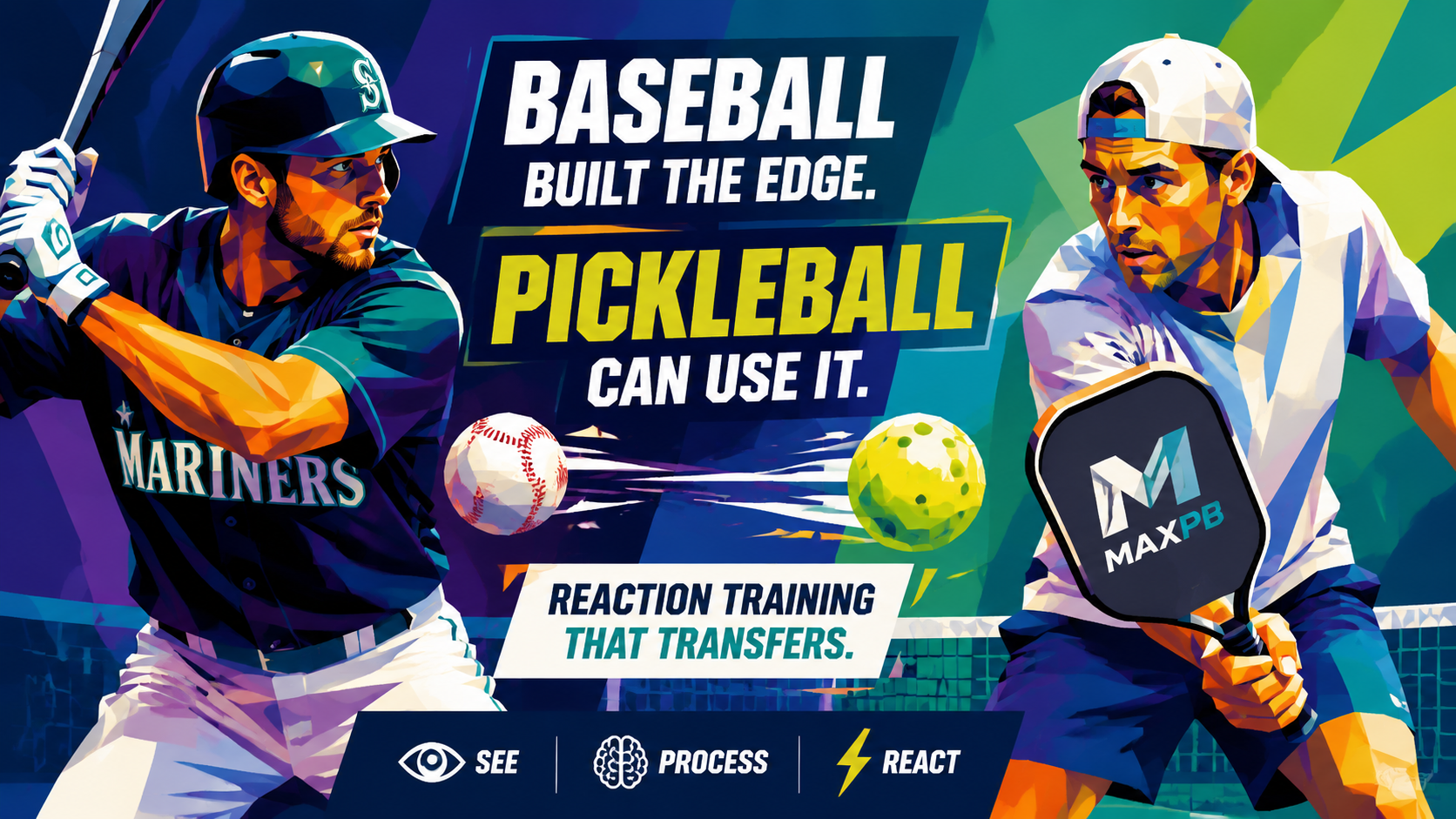
Former Seattle Mariners draft pick Billy Cooke joins the World Pickleball Podcast to explain why baseball’s small-ball reaction training may help pickleball players win more hands battles at the kitchen line.
Key Takeaways
- Billy Cooke explains how baseball reaction training transfers into pickleball
- Small-ball drills can make normal pickleballs feel easier to track and hit
- The discussion explores Max PB, visual processing, and kitchen-line speed
There is a question almost every improving pickleball player eventually asks.
How do you get more time?
More time to recognise a speed-up. More time to counter a drive. More time to move from merely surviving a firefight at the kitchen line to actually taking control of it.
Billy Cooke thinks baseball may already have the answer.
Cooke, a former NCAA National Champion at Coastal Carolina, a Seattle Mariners draft pick and now a 5.0-plus pickleball player in Florida, joined the World Pickleball Podcast this week to discuss his journey from professional baseball to competitive pickleball.
What emerged was a fascinating conversation about reaction training, visual processing and why practising with smaller targets might fundamentally change the way players perceive the game.
The Small-Ball Theory
“We want the ball to look like a beach ball,” Cooke explained.
It sounds simple. In reality, it is built upon years of training methods used throughout elite baseball.
Baseball players have long used golf-ball-sized wiffle balls and thin training bats to challenge hand-eye coordination. By deliberately making practice harder, the theory suggests that normal competition becomes easier. The brain learns to process information faster, track smaller moving objects more efficiently and make cleaner decisions under pressure.
Cooke believes the same principles transfer naturally into pickleball.
Having moved into the sport after an elbow injury ended his baseball career, he quickly realised that many of the attributes developed over years of facing 95 mph fastballs carried across.
“Being able to see a 95 mph fastball at the highest level is equivalent to a very quick hands battle in pickleball,” he said.
Why Practice Has To Feel Harder Than The Match
That background also shapes how Cooke views training.
Rather than simply hitting more balls, he believes players should ask whether they are creating genuinely challenging practice environments.
One example discussed during the podcast was the difficulty recreational and advanced players face when trying to simulate realistic speed-ups. Traditional pickleball ball machines can struggle to recreate the height, trajectory and pace of attacks struck from the non-volley zone, making it difficult to practise the rapid counters increasingly required at higher levels.
For Cooke, reaction training is less about volume and more about specificity.
The goal is not simply to hit hundreds of balls. It is to train the eyes and brain to become comfortable operating at speeds beyond those encountered during normal competition.
The Baseball Mindset
The conversation also touched on an aspect of baseball that may resonate with pickleball players: failure.
Baseball players are conditioned to understand that success often comes surprisingly infrequently. A batter who succeeds three times out of ten can become an All-Star. In pickleball, Cooke argues, players can use a similar mindset.
“You only have to win about 60 per cent of the points,” he said. “Even if you lose a point or lose two points, you can still have that advantage throughout the match.”
That perspective has helped his own transition into pickleball, where he now competes in PPA qualifying events while helping to build Max PB, a training business adapting proven baseball concepts for the pickleball court.
Why This Matters
Whether small-ball training becomes a staple of elite pickleball preparation remains to be seen.
But if baseball has spent decades searching for fractions of a second in reaction time, there is a reasonable chance pickleball players may eventually arrive at the same conclusion.
At the very least, Cooke thinks it is worth asking the question.
And for anyone looking to win one or two more hands battles each game, it might be a question worth listening to.
The full conversation with Billy Cooke is available now on the World Pickleball Podcast.
You can find the MaxPB ball machine here – get the benefit of the small ball theory.
Further Reading
- Latest pickleball news from around the world
- Tournament coverage and results
- Rankings and player profiles
- Regional pickleball coverage

Chris Beaumont
Founder and Editor-in-ChiefChris Beaumont is the founder and Editor-in-Chief of World Pickleball Magazine. Chris follows the global game closely, reporting on the latest news, developments, stories and tournaments from all five continents. He also hosts the World Pickleball Podcast, interviewing people at…
View All Articles →