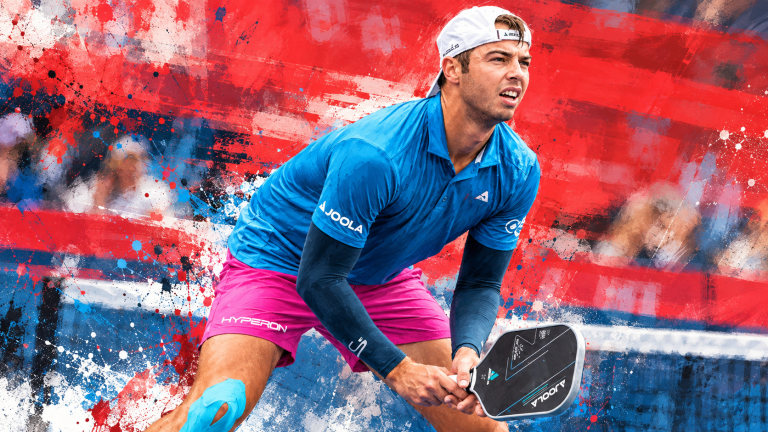

The New Jersey 5s are not winning because they dominate every part of Major League Pickleball. They are winning because they have solved the parts that matter most.
- New Jersey defeated Columbus 3-1 to win the MLP Austin Super Sunday Belt and extend their winning streak to 12 matches.
- The 5s split gender doubles with Columbus before winning both mixed doubles games to close the final.
- Their success points to a bigger MLP lesson: mixed doubles chemistry may matter more than simply collecting the highest-ranked players.
The Puzzle Behind New Jersey’s Dominance
The New Jersey 5s are the clearest standard in Major League Pickleball right now.
They left Austin with the Super Sunday Belt after a 3-1 win over the Columbus Sliders, extending their winning streak to 12 matches and adding a second event title of the season after their earlier success in Columbus. Pickleball.com’s report from MLP Austin confirmed the final score, the 12-match streak and the fact Columbus were playing without Parris Todd.
The easy explanation is star power. New Jersey have Anna Leigh Waters, which will always be a useful starting point in any team competition. They also have Jorja Johnson, one of the most valuable doubles players in the sport.
But that explanation is too simple.
New Jersey are not overwhelming in every category. Their men’s doubles pairing of Will Howells and Noe Khlif has been good rather than dominant. The 5s are not built like a team that has removed every possible weakness.
They are built like a team that understands which strengths matter most.
The Point Before The Match Starts
Waters and Johnson have become the most reliable women’s doubles pairing in MLP. The Kitchen’s latest MLP power rankings listed them at 17-0 this season, a record that changes the shape of almost every tie New Jersey play.
On paper, every game inside an MLP match carries the same value. In reality, an almost automatic point changes how the rest of the contest feels.
Opponents know they are unlikely to beat Waters and Johnson. That does not end a match by itself, but it does mean the other three games arrive with greater pressure attached. A team facing New Jersey is often forced to win men’s doubles and then find at least one mixed doubles answer. That narrows the path quickly.
The best teams in any sport create pressure before the decisive moment arrives. New Jersey do that through women’s doubles. The scoreboard may show only one game, but the tactical effect is larger than that.
Mixed Doubles Is Where New Jersey Pull Away
The Austin final told the story clearly.
Columbus and New Jersey split the two gender doubles games. At 1-1, the match was alive. Columbus had done enough to make the final competitive, even without Todd.
Then New Jersey won both mixed doubles games.
Waters and Khlif defeated Judit Castillo and Andrei Daescu 11-5. Johnson and Howells then beat Danni-Elle Townsend and CJ Klinger by the same scoreline, closing the tie before a DreamBreaker could enter the conversation.
That is not a side note. It is the heart of the New Jersey model.
MLP is often discussed through its stars, but the format rewards combinations. A brilliant individual can lift one game. A balanced mixed doubles structure can control the entire back half of a match.
New Jersey’s mixed pairings give them two different ways to win. Waters and Khlif bring obvious top-end firepower. Johnson and Howells offer a second pairing strong enough to prevent opponents from loading all their planning into one matchup.
That is why the 5s are difficult to solve. Beating one part of their lineup is not enough.
The League May Have Been Solving The Wrong Problem
Early MLP roster construction often looked like a race to collect names. That was understandable. In a young league, player rankings and reputation are easy shorthand.
New Jersey’s run suggests the next phase will be more subtle.
The best roster may not be the one with the strongest player at every spot. It may be the one with the best internal fit. In MLP, fit means more than personality or locker-room energy. It means pairings, handedness, shot tolerance, court coverage, mixed doubles balance and the ability to win specific games in a specific order.
This is where the 5s have separated themselves.
They are not asking their men’s doubles team to carry the franchise. They are asking it to keep them close enough for women’s doubles and mixed doubles to tilt the match. That sounds modest, but in MLP’s format it is a powerful design.
The Next MLP Arms Race
Every league eventually discovers what matters most.
Baseball found new ways to value getting on base. Basketball learned to reprice the three-point shot. Football clubs built entire recruitment departments around pressing, transition and repeatable chance creation.
MLP may now be reaching its own version of that moment.
If New Jersey turn this run into a championship, the rest of the league will not simply try to find another Waters. There is only one. The more realistic copycat move will be to search for mixed doubles compatibility with far greater seriousness.
Future drafts may place more value on players who raise two or three partners rather than those who dominate one narrow lane. Mid-season trades may become less about reputation and more about solving specific pairing problems. Teams may begin to ask not only who the best player is, but where that player wins inside the format.
That is what New Jersey have exposed.
They have not just won 12 matches in a row. They have given the rest of the league a roster-building question it now has to answer.
What This Means
The 5s are not unbeatable. No MLP team is. A hot men’s doubles game, a missed mixed doubles adjustment or a DreamBreaker swing can still change a match quickly.
But New Jersey have made the league look at itself differently.
They are showing that the strongest team is not always the one with the fewest weaknesses. Sometimes it is the team that understands which weaknesses can be carried, and which strengths decide matches.
Right now, nobody in MLP is making that calculation better than New Jersey.
Further Reading
- Latest pickleball news from around the world
- Tournament coverage and results
- Rankings and player profiles
- Regional pickleball coverage

Chris Beaumont
Founder and Editor-in-ChiefChris Beaumont is the founder and Editor-in-Chief of World Pickleball Magazine. Chris follows the global game closely, reporting on the latest news, developments, stories and tournaments from all five continents. He also hosts the World Pickleball Podcast, interviewing people at…
View All Articles →