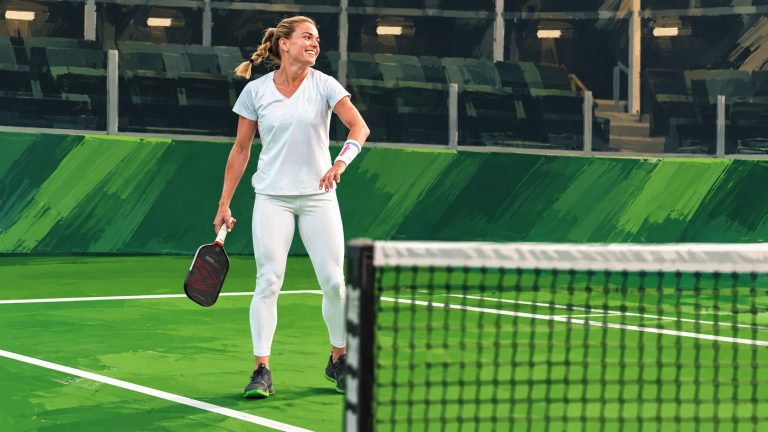

Rankings reward activity, activity rewards geography, and geography still overwhelmingly rewards the United States. Lee Whitwell argues that if pickleball wants to grow internationally, host nations must stop treating their own players as supporting acts.
- International pickleball seedings still lean heavily on rankings shaped by American tournament volume.
- Host-nation players risk being pushed into difficult early-round draws despite building the sport locally.
- Lee Whitwell argues that protected seeding should support local players until a genuinely global ranking system exists.
The Volume Problem
Pickleball wants to be a global sport. Its seedings still largely behave as though it is an American one.
As professional pickleball lands in new countries, fills new courts and discovers new talent, one question keeps getting quietly avoided: when the draw goes up at an international event, whose rankings actually matter?
Right now? Mostly America’s.
And too many people running international events seem perfectly comfortable with that.
Here is the uncomfortable truth about how pickleball seedings currently work: they are, to a significant degree, a reflection of who has had the most opportunity to accumulate points, not necessarily who is the best player in the room.
Rankings reward volume. Volume rewards access. Access rewards geography. And geography, overwhelmingly, rewards the United States.
The player who has competed in twenty domestic events in a calendar year carries a very different ranking profile from the Finnish, Spanish or Australian player who has competed in five, not because they are better, but because they had more courts available, more financially viable flights and more tournaments on their doorstep.
This is not a conspiracy. It is a structural problem. And it has real consequences at the international level.
Until there is a unified global ranking system that can genuinely demonstrate it measures quality over quantity, one that accounts for the geographic and financial inequalities baked into the current model, any seeding derived from existing rankings is not a measure of ability. It is a measure of postcode.
Show me that ranking system and I will back it completely.
We are not there yet.
The Attraction Trap
There is still a significant imbalance embedded in how some international pickleball organisations approach their own events.
American professionals cross the Atlantic and are treated as the attraction. The drawcard. The credibility. The reason people will show up.
Local professionals, some of whom have dedicated years to building the sport in their own countries, are too often treated as supporting acts. In some cases, they are not even afforded the same courtesies extended to visiting players.
I say this not to point fingers.
I have deep respect for the people working to grow this sport internationally, and I understand the commercial reality. Early-stage events need names that help sell tickets. American pros, for now, move the needle in ways that home-nation players sometimes cannot yet match.
But here is the problem with that logic.
It becomes self-perpetuating.
If your own local talent is consistently under-promoted, under-seeded and under-valued at home events, they will never become the names that sell tickets.
You cannot grow a sport in a country by repeatedly treating that country’s best players as an afterthought in their own backyard.
The era of looking abroad for validation needs to end.
Not because American players do not deserve their flowers. They absolutely do.
But because every year it continues is another year a genuinely talented international player misses out on the platform they have already earned.
The Bracket Lottery
When an event is held in England, Australia, Finland or elsewhere, and the draw is seeded by an American-activity-weighted ranking, here is what often happens.
The local talent gets fed into the teeth of the draw.
Players who have built the sport in that country, who fill the stands, who inspire the next generation picking up a paddle for the first time, face higher seeds in the opening rounds.
They exit early.
The home crowd watches their players disappear before lunch on day two and spends the rest of the week watching visitors.
Some people will say: if the overseas talent is truly that good, the bracket will sort itself out.
Prove it on court.
I would invite those people to apply that logic to Wimbledon. To Roland Garros. To any sport that has seriously invested in growing its international footprint.
You do not build a sport in a country by flying in players and having them eliminate the locals before the crowds have finished their coffee.
You build it by creating compelling local narratives, by giving home players meaningful exposure at the right stage of a draw and by helping people in the stands believe that someone who looks like them, trains where they train and lives where they live belongs on that court.
The “brackets sort themselves out” crowd are not entirely wrong.
Quality usually does emerge.
But grassroots sport does not run on eventually.
It runs on moments.
It runs on the player in Tuscany or Birmingham or Helsinki watching someone from their city push a seeded opponent to three games and thinking:
I could do that.
A Simple Principle Worth Defending
The argument is not complicated.
When professional pickleball travels internationally, host-nation players should receive protected seeding in their own events.
Not charity seeding.
Protected seeding.
The same principle tennis has long applied through wildcards and home-nation opportunities. It exists precisely because ranking systems are imperfect instruments, and they are most imperfect when the data underpinning them is geographically skewed.
This principle applies universally or it applies to no one.
American players travelling internationally should receive no such protection.
They carry their ranking and take their place in the draw like everyone else.
The protection belongs to the host nation.
Full stop.
Because the host nation is where the sport needs to grow, where the next generation is watching and where the sport’s future is being decided one match at a time.
The Bottom Line
Professional pickleball’s international expansion is real, accelerating and genuinely exciting.
New markets are opening.
New talent is emerging.
New audiences are discovering what this sport can be at its highest level.
But opportunity and outcome are not the same thing.
If we want pickleball to truly belong to the world, not simply to be exported by one country into it, we need to treat local talent as an asset worth protecting, not a seeding inconvenience to be resolved by whoever happened to play the most tournaments this calendar year.
Fix the ranking system first.
Build one that actually measures what it claims to measure across every country where this sport is played.
Make it transparent.
Make it equitable.
Make it genuinely global.
Until that day, back your locals.
Because right now, the ranking is not necessarily telling you who the best player is.
More often than not, it is simply telling you who had the money, time and opportunity to keep showing up.
Further Reading
- Latest pickleball news from around the world
- Tournament coverage and results
- Rankings and player profiles
- Regional pickleball coverage

Lee Whitwell
OpinionsLee Whitwell is the current world #1 ranked senior female professional pickleball player, a two-time MLP MVP, coach, author, and entrepreneur. A former professional tennis player, Lee has built a reputation as one of the sport's most respected educators and…
View All Articles →