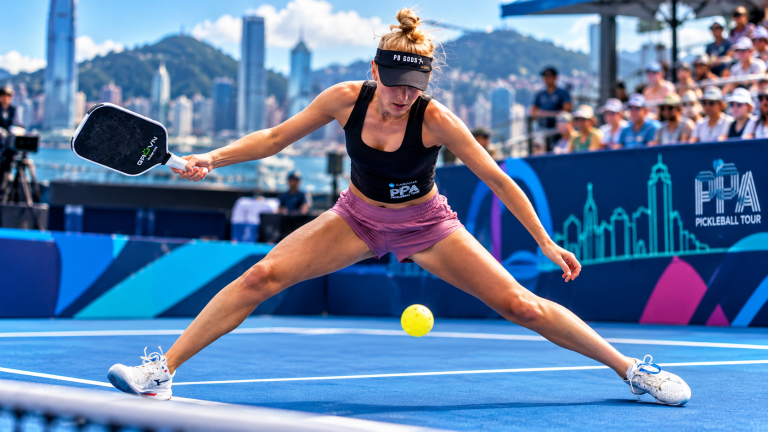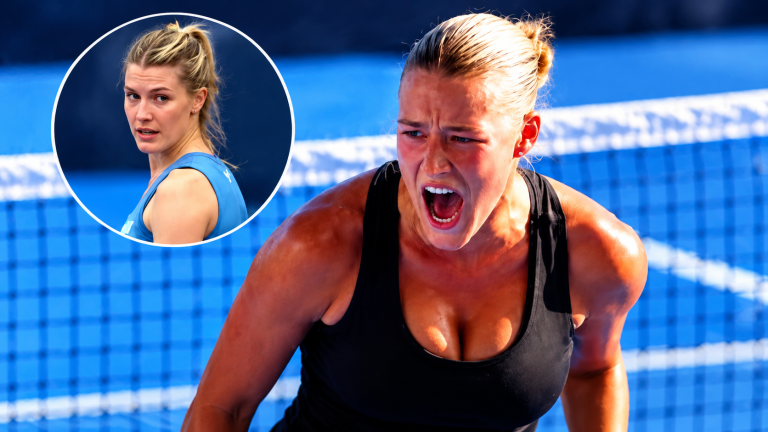
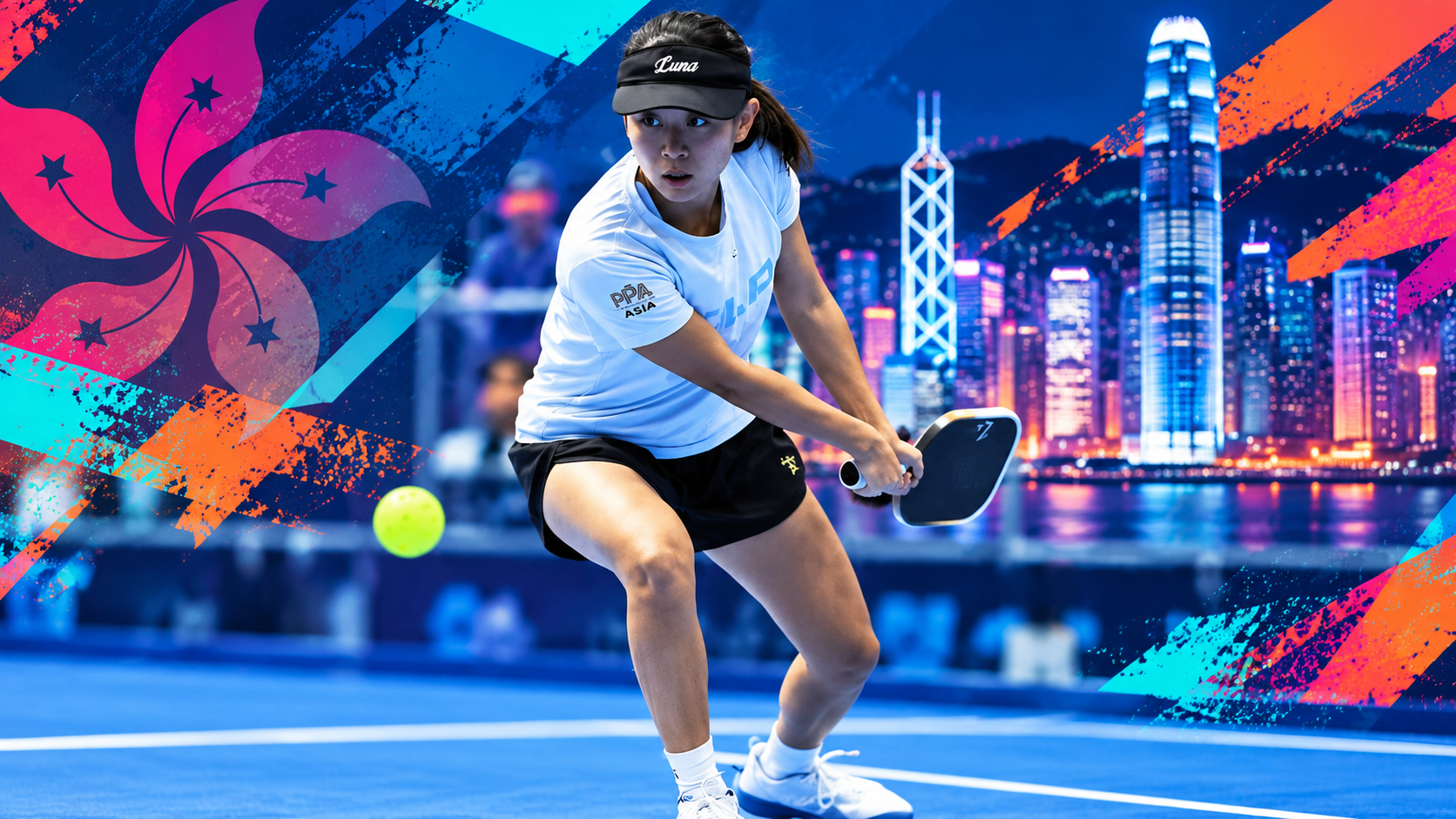
Christopher Haworth and Federico Staksrud advanced at the Hong Kong Slam, but Zane Navratil and JW Johnson were eliminated from men’s singles. Meanwhile, home contenders Hong Kit Wong and Nok Yiu Tang reached the Round of 16 as the first PPA Asia 1500 began to produce its own competitive story.
Key Takeaways
- Christopher Haworth defeated Zane Navratil 11-3, 12-10, while Eric Oncins eliminated JW Johnson 11-5, 11-7 in Wednesday’s men’s singles Round of 32.
- Hong Kong’s Hong Kit Wong and Nok Yiu Tang both progressed to the Round of 16, where they will face Francis Chi and Chao Yi Wang respectively.
- The singles draws now bring several established international professionals into direct competition with leading Asian circuit players, while the strongest doubles partnerships are beginning their campaigns.
The Hong Kong Slam is beginning to produce something more valuable than a collection of famous names: matches that give the tournament a competitive identity of its own.
Christopher Haworth ended Zane Navratil’s men’s singles campaign on Wednesday, Eric Oncins eliminated JW Johnson, and Hong Kong’s Hong Kit Wong and Nok Yiu Tang both reached the Round of 16.
For Wong and Tang, the victories extended opening-day performances that had already established them as the principal local contenders. For Navratil and Johnson, they brought an early end to their singles ambitions at the first PPA Asia 1500 event.
The results do not amount to a wholesale disruption of the established order. Haworth, Federico Staksrud and Christian Alshon all advanced, while many of the strongest doubles partnerships were only beginning their campaigns.
But they have altered the shape of the draw.
Wednesday’s completed singles matches produced emphatic victories, deciding-game escapes and two notable departures. They also confirmed that Hong Kong’s strongest players intend to contribute more than local interest to a tournament built around international competition.
Staged at Kai Tak Arena from 19 to 25 October, the Hang Seng Bank Hong Kong Slam is the finale of the 2026 PPA Tour Asia season. Organisers have advertised up to US$1.1 million in professional prize money and payouts, with 1,500 ranking points available to champions.
That scale attracted a powerful international field, but the tournament’s sporting significance will increasingly depend on the matches between established professionals and competitors developed through the Asian circuit.
Wednesday brought the first meaningful evidence.
Haworth Beats Navratil to Continue Impressive Start
Christopher Haworth’s path through the men’s singles draw has so far been emphatic.
The top seed opened with an 11-0, 11-3 victory over Xirui Liu on Tuesday before overcoming Zane Navratil 11-3, 12-10 in the Round of 32.
Navratil had negotiated a competitive opening game against Loh Shi Sheng in his first match, eventually winning 12-10, 11-2.
Against Haworth, he struggled to establish himself in the opening game before producing considerably more resistance in the second.
Haworth nevertheless closed out the contest without being taken to a decider.
The result removes an experienced professional from the competition, although it should not be presented as an upset. Haworth was the leading seed and entered the match as the player expected to progress.
What matters now is the opponent awaiting him.
Vietnam’s Hien Truong reached the Round of 16 after recovering from a game down against Muhammad Aiman, winning 7-11, 11-7, 11-6.
It was a different route through Wednesday’s competition. Haworth advanced without dropping a game, while Truong had to recover his position and finish strongly against an opponent who had taken the initiative.
Truong’s performances across PPA Tour Asia have already established him as a credible singles competitor. He reached the Shenzhen Open final earlier this season, further strengthening a regional record that has brought him increasingly demanding opportunities.
He now faces the tournament’s top seed.
Haworth has conceded relatively few points across his opening two matches. Truong has demonstrated an ability to recover when a contest begins badly.
Neither record guarantees what happens next.
For Haworth, this is another match he will be expected to win. For Truong, it is an opportunity to measure his established regional credentials against one of the strongest singles specialists in the field.
Oncins Eliminates JW Johnson and Earns Staksrud Meeting
If Haworth’s victory followed the seedings, Eric Oncins produced one of Wednesday’s more notable results.
Oncins defeated JW Johnson 11-5, 11-7, ending the American’s men’s singles campaign in the Round of 32.
Johnson’s reputation is considerable, particularly in doubles, where he has established himself among the leading professionals.
His elimination attracts attention because of that standing, although doubles achievements should not automatically be treated as evidence of superiority in singles.
Oncins was capable of competing with Johnson in this discipline and proved it by taking both games without requiring a decider.
His reward is a Round of 16 meeting with second seed Federico Staksrud.
Staksrud’s opening performance was comprehensive. He defeated Hsieh Chen-An 11-3, 11-3, conceding just six points across two games.
Those results create one of the strongest encounters of the next round.
Staksrud arrives having dominated his opening opponent. Oncins arrives having eliminated a recognised international professional.
The question is whether Oncins can reproduce that standard against a player whose credentials in singles are more firmly established.
That distinction matters when assessing the significance of a tournament result.
Defeating a famous player is noteworthy. Defeating one of the strongest specialists in the discipline offers a more direct measure of competitive standing.
For Oncins, Wednesday earned the opportunity to attempt both.
Hong Kit Wong Wins the Battle Between Doubles Partners
Hong Kit Wong arrived at the Hong Kong Slam with considerably more behind him than the advantage of playing at home.
The seventh seed is an established competitor on PPA Tour Asia, having won the 2025 Hong Kong Open men’s singles title and built a record that places him among the region’s leading players.
His opening day at Kai Tak demonstrated that experience.
Wong won his first singles match against Zida Li and advanced in both men’s and mixed doubles, partnering Eunggwon Kim and Lingwei Kong respectively.
That created an unusual situation on Wednesday.
Kim, his men’s doubles partner, was also his Round of 32 opponent in singles.
The two players had to compete against one another individually while remaining partners in another discipline.
Wong won their singles encounter 11-5, 11-5.
It was a convincing performance against a familiar opponent and secured his place in the Round of 16 without requiring a deciding game.
More importantly, it extended a home campaign that is beginning to justify the attention surrounding him.
Wong is an established regional contender rather than a local player enjoying an unexpected run. His previous results give him legitimate ambitions of reaching the later rounds.
His next opponent, Francis Chi, progressed when Dylan Frazier withdrew from their scheduled singles match.
Chi’s advancement should therefore not be confused with a competitive victory over Frazier.
Wong enters the next encounter having completed two singles victories, while Chi’s progression was affected by a withdrawal.
That difference cannot establish who will win their meeting, but it is relevant context when comparing their tournament routes.
For Wong, the larger challenge remains unchanged.
Success on the Asian circuit has established his credentials. The Hong Kong Slam provides an opportunity to demonstrate how those credentials hold up within a deeper international field.
Reaching the last 16 is another step. Advancing beyond it would make the home story considerably more substantial.
Nok Yiu Tang Builds on Her Opening-Day Statement
Nok Yiu Tang’s Tuesday performances demanded attention.
She defeated Kwan Wun Man 11-5, 11-0 in women’s singles and then partnered Eunggwon Kim to an 11-3, 11-0 mixed doubles victory over Miyu Hazawa and Syed Uzair Sufi.
In both matches, Tang won a game without conceding a point.
PPA Tour Asia placed her alongside Wong at the centre of its opening-day report, highlighting their contributions to an encouraging start for Hong Kong players.
Wednesday provided a more demanding examination.
Tang faced Mihae Kwon and won 11-9, 11-3 to secure her place in the Round of 16.
The difference between those two game scores is important.
Tuesday had demonstrated Tang’s ability to dominate. Wednesday required her to win a close opening game before establishing a more comfortable margin in the second.
It would be premature to attribute that change to a particular tactical adjustment without match evidence. The scores do not establish precisely how Tang gained control.
They do confirm that she negotiated a different type of challenge and advanced in straight games.
Her reward is a meeting with Chao Yi Wang, one of the Asian circuit’s most accomplished women’s singles competitors.
Wang reached the Round of 16 by defeating Allyce Jones 11-2, 14-12.
The extended second game made Wang’s victory considerably more demanding than the opening score suggested.
That creates one of the most compelling fixtures of the next round.
Wang has demonstrated her ability to win singles titles in Asia, including at the Shenzhen Open earlier this season. Tang has begun her home tournament with consecutive victories.
They are also women’s doubles partners in Hong Kong, giving their singles meeting an additional dimension.
For Tang, victory would represent a significant step beyond the opening rounds. For Wang, the challenge is to maintain her established competitive position against an opponent enjoying the momentum of home competition.
Either way, one of two prominent regional players will reach the quarter-finals.
Christian Dominates as Women’s Singles Draw Develops
While Tang provides the strongest local story, Wednesday’s women’s singles results offered further evidence of how the draw is developing.
Top seed Kaitlyn Christian defeated Tayah Cross 11-0, 11-1, conceding just one point across two games.
Christian will face Ho Tam, who survived a considerably closer encounter against Anni Xie.
Tam won 11-8, 3-11, 11-8, recovering from a difficult second game to claim the decider.
The contrast between their routes is striking.
Christian’s opening victory was emphatic. Tam has already experienced the pressure of a deciding game.
Neither result determines the outcome of their next match, but they demonstrate how differently players can arrive at the same stage.
Judit Castillo advanced by defeating Kei Sawaki 11-7, 11-5.
Her next opponent, Hannah Blatt, required three games against Cailyn Campbell, eventually winning 11-9, 7-11, 11-9.
Elsewhere, Yufei Long defeated Yu-chieh Hsieh 11-3, 11-8 and will face Sophia Nhi Huynh, who beat Marcela Aguila Ampon 11-0, 11-3.
Kiora Kunimoto and Aiko Yoshitomi will meet after both progressed in straight games.
Lacy Schneemann faces Andie Dikosavljevic, whose 11-1, 11-7 victory over Kaitlynn Hart was among Wednesday’s more convincing results.
Sahra Dennehy meets Sophia Phuong Anh Tran, while Rika Fujiwara and Mari Humberg complete the confirmed last-16 pairings.
The principal observation is that the women’s draw has retained considerable strength.
Christian remains in contention. Wang, Castillo, Schneemann and Dikosavljevic have advanced. Several established Asian competitors are also through.
The next round should therefore provide a more revealing measure of relative strength than the opening matches alone.
Tama Shimabukuro Continues His Rise
Another player worth following is Tama Shimabukuro.
The Japanese teenager has already become an important name in the developing international structure of professional pickleball, with success on the Asian circuit bringing opportunities in higher-profile competition.
His previous singles titles, including at the Macao Open and Kuala Lumpur Cup, demonstrate that his presence in the later rounds is supported by an established record.
At the Hong Kong Slam, Shimabukuro advanced to the men’s singles Round of 16 after defeating Timothy Foo 11-1, 11-1.
He next faces Luc Pham, who beat Wil Shaffer 11-3, 11-5.
Shimabukuro’s margin of victory was emphatic, but the significance of his participation extends beyond one scoreline.
The wider question is whether younger players developing through Asian competition can translate their regional success into sustained performances against increasingly strong international fields.
He is among the clearest examples of why that question deserves attention.
The tournament’s strongest singles specialists remain formidable opponents, but Shimabukuro has already demonstrated that his development deserves to be followed beyond his age and nationality.
Leading Doubles Partnerships Enter the Competition
While singles has already produced notable eliminations, doubles is where much of the tournament’s strongest international talent is concentrated.
Ben Johns and Gabriel Tardio entered the men’s doubles competition among the headline partnerships.
Other leading combinations include Federico Staksrud and Hayden Patriquin, Collin Johns and Len Yang, Connor Garnett and Dylan Frazier, and JW Johnson alongside Tama Shimabukuro.
The women’s doubles field is equally strong.
Anna Leigh Waters and Anna Bright, Tyra Hurricane Black and Jorja Johnson, Rachel Rohrabacher and Parris Todd, and Catherine Parenteau and Sofia Sewing are among the combinations expected to contend for the title.
Mixed doubles adds further established partnerships, including Ben Johns and Waters, Anna Bright and Hayden Patriquin, and Jorja and JW Johnson.
Their records explain much of the attention surrounding the Slam.
These partnerships have established themselves through sustained competition at the highest level. Their presence creates a demanding benchmark for regional opponents.
Some completed men’s doubles results already demonstrate the strength of the leading combinations.
Collin Johns and Len Yang defeated Jimmy Liong and Loh Shi Sheng 11-4, 11-7, while Staksrud and Patriquin beat Robert Stirling and Joey Wild 11-2, 11-5.
Other matches remained live or incomplete in the available bracket snapshot, making it premature to present a full doubles roundup.
The more important question will emerge as the draws progress.
Can established Asian partnerships and cross-regional combinations produce sustained competition against teams whose achievements have largely been established on the main professional circuit?
Hong Kit Wong and Eunggwon Kim provide one example in men’s doubles. Nok Yiu Tang and Chao Yi Wang provide another in women’s doubles.
Attracting recognised international names demonstrates the tournament’s organisational and commercial reach. Producing competitive matches between those players and regional opponents offers a separate sporting measure.
That second question will become more revealing as the competition moves towards its quarter-finals.
Hong Kong Slam Round of 16: Confirmed Singles Matches
The completed Round of 32 singles results establish the following matchups:
Men’s Singles
- Christopher Haworth v Hien Truong
- Noe Khlif v Harrison Brown
- Christian Alshon v Grayson Goldin
- Tama Shimabukuro v Luc Pham
- Federico Staksrud v Eric Oncins
- Hong Kit Wong v Francis Chi
- Connor Garnett v Mitchell Hargreaves
- Tyson McGuffin v Hunter Johnson
Women’s Singles
- Kaitlyn Christian v Ho Tam
- Judit Castillo v Hannah Blatt
- Yufei Long v Sophia Nhi Huynh
- Kiora Kunimoto v Aiko Yoshitomi
- Chao Yi Wang v Nok Yiu Tang
- Lacy Schneemann v Andie Dikosavljevic
- Sahra Dennehy v Sophia Phuong Anh Tran
- Rika Fujiwara v Mari Humberg
Four encounters stand out in particular.
Haworth against Truong will test a proven Asian circuit competitor against the leading men’s seed.
Staksrud against Oncins will determine whether Wednesday’s elimination of JW Johnson develops into a deeper tournament run.
Wong against Chi carries the strongest local interest in men’s singles, with Wong attempting to reach the quarter-finals on home soil.
Wang against Tang brings together women’s doubles partners competing for a place in the singles last eight.
Elsewhere, Shimabukuro will attempt to sustain his progress against Luc Pham, while Connor Garnett faces Mitchell Hargreaves.
Tyson McGuffin and Hunter Johnson meet in another significant men’s contest after both progressed from Wednesday’s Round of 32.
These matches should provide a clearer picture of which players are capable of challenging for the singles titles.
Hong Kong’s Real Competitive Test Is Still Ahead
The Hong Kong Slam began with ambitious promises.
Its advertised professional prize package, 1,500 ranking points and presence of leading international professionals established it as the flagship event of PPA Tour Asia’s season.
Those achievements mattered before the opening ball was struck.
The more interesting sporting questions are emerging now.
Wong and Tang have both progressed beyond their first matches, giving Hong Kong two credible home contenders in the singles Round of 16.
Haworth and Staksrud have advanced as expected, but Navratil and JW Johnson have departed from the men’s singles draw.
Oncins has earned the opportunity to face one of the strongest specialists in the field, while Shimabukuro continues to demonstrate why his development is attracting attention beyond Asia.
None of those results guarantees that the final stages will look dramatically different from the established professional hierarchy.
The international doubles partnerships remain particularly formidable, and several leading teams are only beginning their campaigns.
But that is precisely why the next round matters.
For Wong and Tang, reaching the last 16 confirms that they belong in the competitive conversation. Their next matches will show whether they can extend their success against increasingly demanding opposition.
For established international professionals, the challenge is to justify their reputations in contests that will not always follow expectations created by rankings or previous titles.
And for PPA Tour Asia, the larger question is whether its leading regional competitors can turn opportunities against world-class opposition into performances that narrow the distance between the sport’s established centres and developing circuits.
Those questions cannot be answered through prize announcements, the size of an entry list or the names appearing in a tournament draw.
They have to be answered on court.
Hong Kong has already demonstrated that it can attract the world’s leading players. The next few days will begin to show how many of Asia’s best can compete with them.
Follow the Hong Kong Slam: World Pickleball Magazine continues its independent coverage as the tournament progresses towards the quarter-finals and championship matches. Read our opening-day report for the first results from Kai Tak.
Stay with WPM: Visit World Pickleball Magazine for international tournament reporting, player analysis and the latest developments across professional pickleball.
Further Reading
- Hong Kong Slam 2026: Day One Results
- Hong Kong Slam: World Stars Set the Standard as Asia’s Challengers Prepare
- Hong Kong Slam Brings the World’s Elite and Asia’s Next Wave Under One Roof
- PPA Tour Asia: Tang and Wong Sweep Through to the Round of 32
- Official Hong Kong Slam Tournament Information

Chris Beaumont
Founder and Editor-in-ChiefChris Beaumont is the founder and Editor-in-Chief of World Pickleball Magazine. Chris follows the global game closely, reporting on the latest news, developments, stories and tournaments from all five continents. He also hosts the World Pickleball Podcast, interviewing people at…
View All Articles →