
The PPA Tour arrives in Arizona with several established combinations broken up, an unusually open women’s doubles field and a men’s singles champion trying to go back-to-back. In triple-digit heat, Mesa may reward the players best equipped to recognise an opportunity before the familiar order returns.
Key takeaways
- Ben Johns and Federico Staksrud are the top men’s doubles seeds after Gabe Tardio’s absence forces one of the week’s most intriguing new partnerships.
- Women’s doubles is unusually open with Anna Leigh Waters, Anna Bright and Jorja Johnson all absent from the draw.
- Hunter Johnson arrives after winning men’s singles in Cary, while Sofia Sewing again carries seedings that appear to underestimate her current level.
- The new World Pickleball Ranking system will send the top four WPR players or teams in each event directly into the Round of 16.
There are weeks on the PPA Tour when the draw changes considerably but the destination does not.
Partnerships move around, somebody dangerous lands much lower in the bracket than their ability suggests and an upset briefly alters the route, yet by Championship Sunday the same handful of players have usually found their way through. The depth at the top of professional pickleball has made opportunity increasingly difficult to manufacture.
Mesa feels different.
The Veolia Arizona Open begins on 14 September at Arizona Athletic Grounds with 1,000 ranking points available and enough significant absences to alter several draws before a ball has been struck.
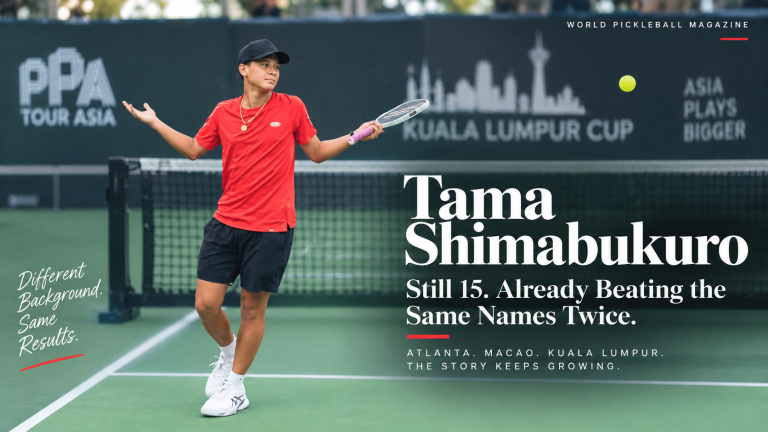
Gabe Tardio, Hayden Patriquin, JW Johnson and Tama Shimabukuro are missing from men’s doubles. Anna Bright and Jorja Johnson will not play women’s doubles, while Anna Leigh Waters is also sitting out that discipline.
Those absences do more than remove contenders. They separate established partnerships, elevate unfamiliar combinations and create sections of the draw that suddenly look navigable to players accustomed to encountering one of the tour’s dominant teams before Championship Sunday.
Ben Johns will play men’s doubles with Federico Staksrud. Rachel Rohrabacher and Parris Todd become the top seeds in women’s doubles, with Tyra Black and Meghan Dizon at No. 2. Jack Sock appears alongside Augie Ge. Hunter Johnson partners Collin Johns.
Some of those combinations may disappear again as quickly as they have appeared.
That is precisely why Arizona is interesting.
For one week, the established hierarchy has loosened.
The question is who can exploit it.
Johns and Staksrud begin at the top
The partnership attracting most attention is also the one seeded to win men’s doubles.
With Tardio out of the country, Johns turns to Staksrud for the first time. It is a combination that makes obvious sense on paper while still requiring considerably more than two elite names to make it work.
Staksrud has the versatility and hand speed to operate on the right, which should allow Johns to take more court through the middle and impose himself with his forehand, but the balance between them will be worth watching. Elite men’s doubles partnerships depend on dozens of small understandings: who accelerates first, who takes a ball both players could reach, how aggressively the right-side player protects the middle and how quickly responsibility shifts once a rally becomes chaotic.
Johns and Staksrud have to establish those patterns while playing matches that matter.
Their position at No. 1 helps.
Andrei Daescu and Christian Alshon are the second seeds after reaching the final at the PPA National Championships in Cary, while CJ Klinger and 15-year-old Cam Chaffin form another new partnership at No. 3.
Chaffin’s quarter-final run alongside Chris Haworth in North Carolina provided another indication that his age is becoming less interesting than the standard of pickleball he can already produce against established professionals.
The more difficult traffic appears towards the bottom of the bracket.
Eric Oncins and Noe Khlif are fourth seeds, followed by Dekel Bar and Dylan Frazier at No. 5 and Connor Garnett and Roscoe Bellamy at No. 6. Hunter Johnson and Collin Johns start seventh.
The upper half offers greater scope for somebody to travel.
Will Howells and Pablo Tellez, seeded 13th, could reach Klinger and Chaffin in the Round of 16, while No. 8 seeds Sock and Ge occupy another section from which a significant run would hardly qualify as a surprise.
For Johns and Staksrud, Arizona provides an unusual test. They are the top seeds because of what they have achieved separately, but Mesa will begin discovering how quickly that individual quality can become a functioning partnership.
A women’s doubles title without Waters, Bright or Johnson
Nowhere has the landscape changed more dramatically than women’s doubles.
Waters, Bright and Jorja Johnson are all absent.
That leaves Rohrabacher and Todd as top seeds and Black and Dizon at No. 2, two formidable partnerships entering a draw in which considerably more teams can begin the week with a realistic Championship Sunday argument.
Rohrabacher and Todd’s half includes fourth seeds Sofia Sewing and Catherine Parenteau, Kate Fahey and Jamie Wei at No. 5, and Brooke Buckner and Kaitlyn Christian at No. 7.
Sewing and Parenteau are particularly interesting.
The partnership reached the quarter-finals in Cary before losing to Rohrabacher and Todd and is still developing, but Sewing’s trajectory has reached the point where her presence changes the expectation around a team. Her speed, athleticism and increasing comfort against the established elite have been visible for some time, while Parenteau provides the experience and stability of somebody who has spent years navigating the final stages of PPA draws.
The bottom half is hardly empty.
Lacy Schneemann and Tina Pisnik are seeded third, with Etta Tuionetoa and Jessie Irvine at No. 8 and Black/Dizon heading that side.
There is no overwhelming favourite.
That may be the most unusual feature of the draw.
Women’s doubles has frequently been defined by the problem waiting at the end of the tournament. In Arizona, several teams can reasonably believe the end of the tournament belongs to them.
Sofia Sewing may be the player to watch all week
Sewing’s presence in women’s doubles is only the beginning.
She may be the most interesting player to track across Arizona because Mesa repeatedly places her in positions where the number beside her name does not appear to describe the player on court.
That is not new.
Before Cary, WPM examined why Sewing’s No. 46 singles seed lagged behind her current competitive level. She responded by beating No. 9 seed Liz Truluck and No. 8 Kiora Kunimoto before Kate Fahey stopped her in the quarter-finals.
Arizona provides another test.
Mixed doubles supplies the first example.
Waters and Johns restore some familiarity as the No. 1 seeds, with Rohrabacher and Alshon at No. 2. Todd and Daescu are third and Black and Khlif fourth, while Fahey/Staksrud and the first-time pairing of Parenteau/Jonathan Truong are among the combinations attempting to break through.
Yet one of the most compelling matches could arrive in the Round of 64.
Schneemann and Sock are seeded 14th.
Sewing and Casey Diamond are No. 46.
The gap between those numbers is enormous. The likely gap between the teams is not.
Sewing and Diamond are exactly the kind of early-round opponents a seeded partnership would prefer somebody else to encounter, and their position creates the possibility that one significant team disappears before the tournament has properly settled.
Tuionetoa and Howells, seeded 21st, are another partnership capable of travelling further than their ranking suggests.
There remains, however, an important distinction between mixed and the other doubles draws.
Waters and Johns are here.
The absences of Bright/Patriquin and JW/Jorja Johnson remove two combinations capable of disrupting the very top of the bracket, but they do not remove its benchmark. Anybody wanting mixed gold will probably still have to solve the most decorated partnership in the discipline.
The door is open.
Just not quite as wide.
Hunter Johnson arrives as something different
Men’s singles provides another example of how quickly the context around a player can change.
A week ago, Hunter Johnson entered Cary as one of several players capable of winning.
He arrives in Arizona as the man who just did.
Johnson beat both Haworth and Staksrud on his way to the title, finishing the week by handing Staksrud an 11-0 game in the final. It was one of the defining results of a Cary tournament that repeatedly disturbed the expected hierarchy before many of the familiar champions re-emerged on Sunday.
That changes what Arizona asks of Johnson.
Consecutive tournaments create their own test because the physical and emotional cost of going deep one week follows a player directly into the next, while opponents arrive with recent evidence of precisely what is working.
Arizona may have given him a route through that problem.
Haworth is the No. 1 men’s singles seed and Staksrud No. 2, with Johnson at No. 3 and Christian Alshon fourth.
Johnson’s side appears less congested than Haworth’s, giving the Cary champion a realistic chance to conserve some of the physical expenditure that usually accumulates before the decisive rounds.
That does not make another title straightforward. Men’s singles remains too volatile and too physically demanding for that, especially in a tournament expected to be played through temperatures above 100°F.
It does make Johnson one of the central figures of the week.
The new WPR changes the route
The World Pickleball Ranking system adds another layer.
Arizona is the first Open at which the new WPR determines the byes, with the top four players or teams in each event according to their World Pickleball Ranking moving directly into the Round of 16.
That can produce brackets that initially look unusual when compared with the event’s singles seeds.
Ben Johns provides the clearest example.
He is seeded No. 22 in men’s singles but advances directly into the last 16 because of his WPR position. A deep run could even produce a quarter-final against Staksrud, the man standing beside him in men’s doubles.
The important consequence this week may be less philosophical than physical.
Every match avoided is time not spent on court.
In Arizona, that could matter.
Sewing’s No. 43 may be the most misleading number in Mesa
Women’s singles begins with a much simpler proposition.
Anna Leigh Waters is playing.
Her unbeaten singles streak stretches back more than two years, and until somebody provides compelling evidence otherwise she remains the overwhelming favourite.
Kaitlyn Christian, seeded third, sits in Waters’ half. No. 2 Kate Fahey occupies the opposite side with Brooke Buckner among the players capable of challenging her route back towards another final.
Then there is Sewing.
She is seeded No. 43.
That number tells us considerably more about accumulated ranking position than it does about the player Mary Brascia will encounter in the Round of 64.
Cary has already given us fresh evidence. Sewing entered there as No. 46, removed two seeded opponents and reached the quarter-finals before losing to Fahey.
Mesa now asks whether she can turn that run into something repeatable.
The path is difficult. Brascia comes first, with established names waiting deeper in the bracket.
But that is also how an unrepresentative seed eventually changes.
Players escape it by repeatedly beating the opponents the number places in front of them.
Sewing no longer needs to prove that she is dangerous.
Arizona is about proving how consistently that danger travels.
The heat becomes part of the tournament
Then there is Mesa itself.
The PPA is forecasting triple-digit Fahrenheit highs during the Arizona Open, putting physical management alongside tactics and draw position as another variable across the week.
The professional tournament uses a progressive draw, with one round of each bracket played per day and no bronze-medal matches. That spreads the competitive load differently from a compressed event, but it does not remove the cumulative demands on players entering two or three disciplines.
Recovery becomes part of the calculation.
So does efficiency.
A player who avoids an unnecessary third game, receives a bye or finishes a match before it becomes an hour-long fight carries something into the next day that cannot be measured only by the score.
That gives extra weight to some of Arizona’s apparently favourable routes.
Johnson’s singles position looks more attractive through that lens. So does any early breathing room available to a new doubles combination still learning how to function together.
Arizona will reward quality, as every PPA tournament does.
It may also reward the players who spend the least unnecessary energy proving they have it.
A week to take something
The temptation with a depleted field is to define the tournament by who is missing.
By Sunday, Arizona will be about who recognised what their absence created.
Johns and Staksrud have an opportunity to discover whether an elite partnership can be assembled almost immediately. Rohrabacher/Todd and Black/Dizon enter a women’s doubles draw without Waters, Bright or Jorja Johnson blocking the horizon. Hunter Johnson has a chance to turn Cary from one title into the beginning of a run.
And Sewing enters Mesa almost everywhere as something more dangerous than the number next to her name.
None of this means the established order has disappeared.
Waters remains the overwhelming women’s singles favourite and, alongside Johns, the standard in mixed. Johns remains at the top of men’s doubles, albeit with somebody different standing beside him. The players chasing them are still trying to solve many of the same problems that confront them every week.
Professional tours, though, are shaped as much by the weeks when the hierarchy briefly loosens as by those when it holds.
Arizona looks like one of those weeks.
Somebody who normally finds the road blocked will reach a round they do not normally reach. A new partnership may discover something worth preserving. An underseeded player may leave with a ranking beginning to resemble their actual level. A contender may turn one good tournament into two and suddenly have something that looks much more like momentum.
The opening is there.
In Mesa, through the heat and the unfamiliar draws, somebody has to take it.
Further reading
- Cary Spent a Week Breaking the Script. On Sunday, the Champions Took It Back
- Cary’s Draw Has a Ranking-Lag Problem. Sofia Sewing Is the Clearest Example
- Cary Has Already Broken the Draw: What Matters Before the PPA Round of 16

Chris Beaumont
Founder and Editor-in-ChiefChris Beaumont is the founder and Editor-in-Chief of World Pickleball Magazine. Chris follows the global game closely, reporting on the latest news, developments, stories and tournaments from all five continents. He also hosts the World Pickleball Podcast, interviewing people at…
View All Articles →