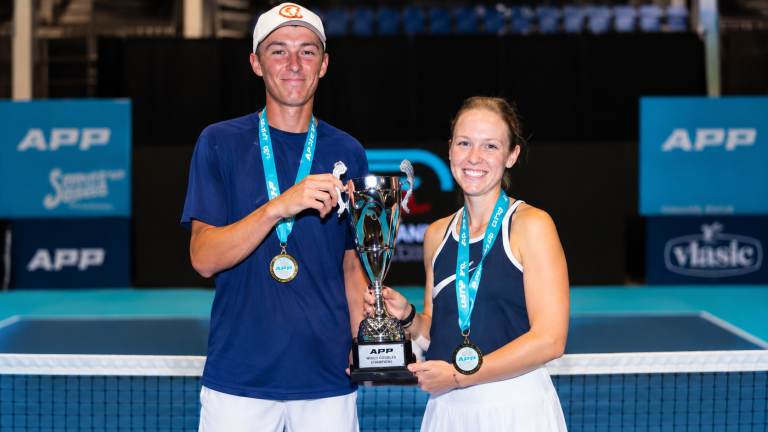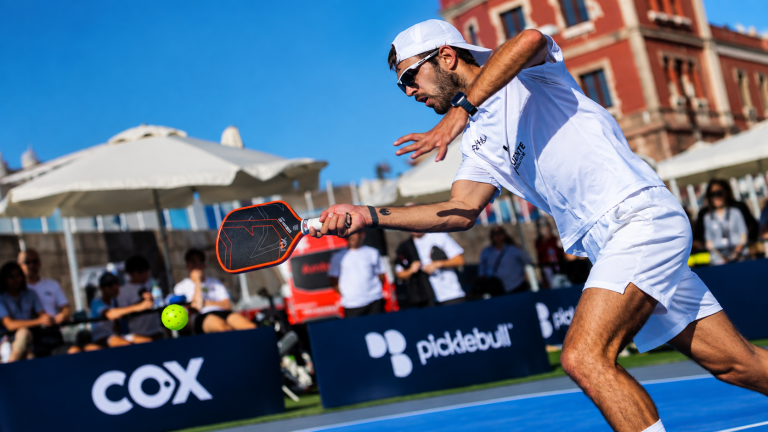

New Premier franchise The Coasters have won the opening event of the 2026 MLP Australia season, with Danni-Elle Townsend, Roman Esteraja, Ryan Henry and Tayah Cross surviving a semi-final DreamBreaker before completing their first weekend together as champions in Melbourne.
Key Takeaways
- The Coasters won the opening MLP Australia Premier event of 2026, defeating Northern Crocs in Sunday’s championship match.
- Townsend’s team had to survive a 3-2 DreamBreaker victory over Brisbane Breakers in the semi-finals, while Northern Crocs eliminated defending champions Bondi Pickleball Club 3-1.
- The result gives one of MLP Australia’s new franchises an immediate title after the Premier competition was reduced from 12 teams to eight for 2026.
- Melbourne is only the first of four events, with Brisbane, Gold Coast and the championship weekend in Sydney still to come.
MLP Australia reduced its Premier competition from 12 franchises to eight for 2026 in the belief that concentrating its leading players across fewer four-person teams would produce a deeper competition.
The first weekend of the new structure ended with one of those new franchises taking immediate advantage.
The Coasters, captained by Danni-Elle Townsend and featuring Roman Esteraja, Ryan Henry and Tayah Cross, defeated the Northern Crocs in Sunday’s Premier Championship match in Melbourne to take the opening title of a four-event season.
It was a significant first weekend for a team that did not exist in last year’s Premier competition, but the route to the trophy also provided an early indication of why this particular roster could prove difficult to dislodge.
The Coasters had to survive the most unforgiving part of the MLP format before they even reached the final.
Their semi-final against Brisbane Breakers finished 2-2 across the four regulation doubles matches, forcing a DreamBreaker. The Coasters won the singles decider to complete a 3-2 victory, while Northern Crocs defeated defending champions Bondi Pickleball Club 3-1 in the other semi-final.
Then came the final, and by the end of Sunday Townsend, Esteraja, Henry and Cross were holding the Melbourne trophy.
For a league that spent the off-season rebuilding the architecture of its top division, it was an intriguing way for the new era to begin.
Four players and nowhere to hide
The significance of Melbourne begins with what changed before anybody stepped on court.
As WPM examined in May in MLP Australia 2026: A Leaner League, A Bigger Stage, the Premier competition has contracted from 12 teams to eight this season, concentrating the available talent rather than continuing to add franchises.
The league’s official 2026 roster announcement underlines why the composition of each team matters. Every Premier roster contains four athletes, two men and two women, with match days moving through women’s doubles, men’s doubles and mixed doubles before a DreamBreaker singles decider is used when required. There is no deeper squad capable of absorbing a difficult match or changing the line-up.
The Coasters are one of the clearest examples of how the new competition has been assembled.
Townsend was appointed captain, Esteraja occupies the marquee position, and Henry and Cross complete the four-player roster. Pre-season analysis from the Australian Around the Pod podcast characterised the Coasters as a high-octane offensive group while identifying DreamBreaker capability as one of the wider questions hanging over the newly assembled Premier teams.
Melbourne provided an answer far earlier than the Coasters might have expected.
Brisbane push the champions all the way
If the championship photograph represents the clean ending, the semi-final tells us considerably more about the Coasters’ weekend.
Brisbane had secured the first selection in MLP Australia’s inaugural draft, with the league using a hybrid snake format to distribute the available players across its eight franchises. The league explained the draft order and format before selections were made.
Four regulation matches could not separate Brisbane and the Coasters.
At 2-2, everything moved to the DreamBreaker.
That changes the nature of an MLP contest because the doubles combinations that have carried a team through the previous four matches no longer settle the result. Players instead rotate through singles rallies, testing movement, passing ability, return quality and one-on-one court coverage in a format capable of exposing a weakness that conventional doubles can sometimes protect.
Pre-event analysis had specifically identified DreamBreaker strength as one of the variables worth watching across the new rosters.
The first Premier semi-final of the season supplied the test. The Coasters passed it.
Their 3-2 victory sent them into the championship match and denied Brisbane despite the Breakers taking the eventual champions to the final possible stage of the tie.
That matters more than an uncomplicated passage to the final might have done. MLP championships are not built purely around possessing the strongest conventional doubles partnership. The format deliberately asks four players to solve different problems, and Melbourne has already shown that the Coasters possess another route when four doubles matches are not enough.
Northern Crocs remove the defending champions
Northern Crocs reached the championship match through a different route.
Captain Andie Dikosavljevic leads a roster completed by marquee player Prycen Haas, Talia Saunders and Dan Fogl-Kulich. Pre-season analysis highlighted the Crocs’ depth as one of the more compelling elements of their construction.
Their semi-final gave that assessment some immediate substance.
Bondi Pickleball Club entered Melbourne as defending Premier champions, but the Crocs beat them 3-1, ending any possibility that the opening event of 2026 would simply reproduce the hierarchy established last season.
It left Sunday’s championship match with an appealing contrast. One side was a new franchise that had survived the narrowest possible semi-final. The other had just eliminated the defending champions without requiring a DreamBreaker.
The Coasters ultimately emerged with the trophy.
The precise championship-match score has not been published through MLP Australia’s currently available results material, but the league’s post-event imagery confirms the Coasters as Melbourne Premier champions.
Townsend’s Australian return ends with a title
There is a wider player-trajectory story attached to Townsend’s weekend as well.
Her season has increasingly demonstrated how porous the boundaries between pickleball’s regional professional circuits are becoming.
WPM explored that trajectory in August in Danni-Elle Townsend Was Good Enough for World-Level Table Tennis. Pickleball Made Her Start Again., tracing her journey from international-level table tennis through the uncomfortable process of rebuilding herself as a pickleball player and ultimately into Major League Pickleball in the United States.
Only a week before Melbourne, she was competing in another professional ecosystem entirely.
Townsend reached two Championship Sunday finals at the PPA Tour Asia Kuala Lumpur Cup, partnering Sahra Dennehy in women’s doubles and Joey Wild in mixed. She and Wild took the opening game of the mixed final against Jessie Irvine and Gabriel Tardio before eventually losing 5-11, 11-3, 12-10, while Dennehy and Townsend were also beaten in three games by Irvine and Alix Truong in women’s doubles.
WPM followed that run throughout the weekend, including Dennehy’s Triple-Crown Bid Ends, but Kuala Lumpur Leaves Her One Final.
Seven days later, Townsend had changed countries, partners and competitive formats, assumed the captaincy of a newly constructed MLP Australia roster and reached another championship match.
This time she finished with the trophy.
That does not make Melbourne a one-player story. MLP’s structure makes that interpretation difficult, particularly when the Coasters’ defining semi-final required all four members of the roster to negotiate a DreamBreaker.
It does, however, make Townsend’s September a useful illustration of the professional ecosystem developing around the Asia-Pacific region.
PPA Tour Asia, MLP Australia and the US professional game are no longer entirely separate competitive worlds. The same players are increasingly moving between them, taking partnerships, tactical experiences and reputations from one into another.
WPM has seen the same trend developing elsewhere. The inaugural MLP Asia rosters, examined in MLP Asia Has Its Teams. Now We Can See What Kind of League It Wants to Be, were constructed around a deliberate combination of domestic and international talent.
Townsend’s last two weekends sit directly inside that movement.
Melbourne offers the first evidence for MLP Australia’s gamble
There is a temptation after any opening event to treat the first champion as the team everybody else must now chase.
With three tournaments remaining, Melbourne does not tell us nearly enough for that.
What it does provide is the first competitive evidence against the structural decisions MLP Australia made during the off-season.
The central question behind the reduction from 12 Premier franchises to eight was whether concentrating the available talent would create stronger rosters and more consequential contests.
The Melbourne knockout stage supplied several encouraging indicators.
The defending champions did not automatically return to the final. A new franchise won the event. One semi-final went all the way to a DreamBreaker. Northern Crocs justified some of the pre-season confidence around their roster depth by reaching the championship match.
Most importantly, the eventual champions had to demonstrate more than one route to winning.
The Coasters were assembled around an increasingly internationally experienced captain, a designated marquee player and two further pieces of a completely new four-player roster. When Brisbane pushed them to the edge of elimination, they still found enough across those four positions to survive.
By Sunday evening, the new franchise had its first trophy.
Melbourne is only the beginning
The significance of that trophy still needs to be kept in proportion.
Melbourne was the first of four MLP Australia events scheduled between September and November. According to the official MLP Australia calendar, Brisbane follows from 9-11 October, before the league heads to the Gold Coast from 20-22 November and finishes in Sydney from 27-29 November.
That leaves plenty of time for the competitive picture to change.
Brisbane came within a DreamBreaker of removing the eventual Melbourne champions. Northern Crocs reached the final immediately. Bondi have already discovered how difficult defending last year’s title could become in a league with four fewer Premier franchises.
The Coasters, meanwhile, could hardly have asked for a better introduction.
Before Melbourne they were a new name, a newly assembled collection of four players and one of the first tests of MLP Australia’s decision to make its Premier division smaller and deeper.
After Melbourne, they are the first event champions of 2026.
More revealingly, they already have evidence that their roster can withstand precisely the kind of pressure the MLP format was designed to create.
Further Reading
- MLP Australia 2026: A Leaner League, A Bigger Stage
- Danni-Elle Townsend Was Good Enough for World-Level Table Tennis. Pickleball Made Her Start Again.
- Dennehy’s Triple-Crown Bid Ends, but Kuala Lumpur Leaves Her One Final
- MLP Asia Has Its Teams. Now We Can See What Kind of League It Wants to Be

Chris Beaumont
Founder and Editor-in-ChiefChris Beaumont is the founder and Editor-in-Chief of World Pickleball Magazine. Chris follows the global game closely, reporting on the latest news, developments, stories and tournaments from all five continents. He also hosts the World Pickleball Podcast, interviewing people at…
View All Articles →