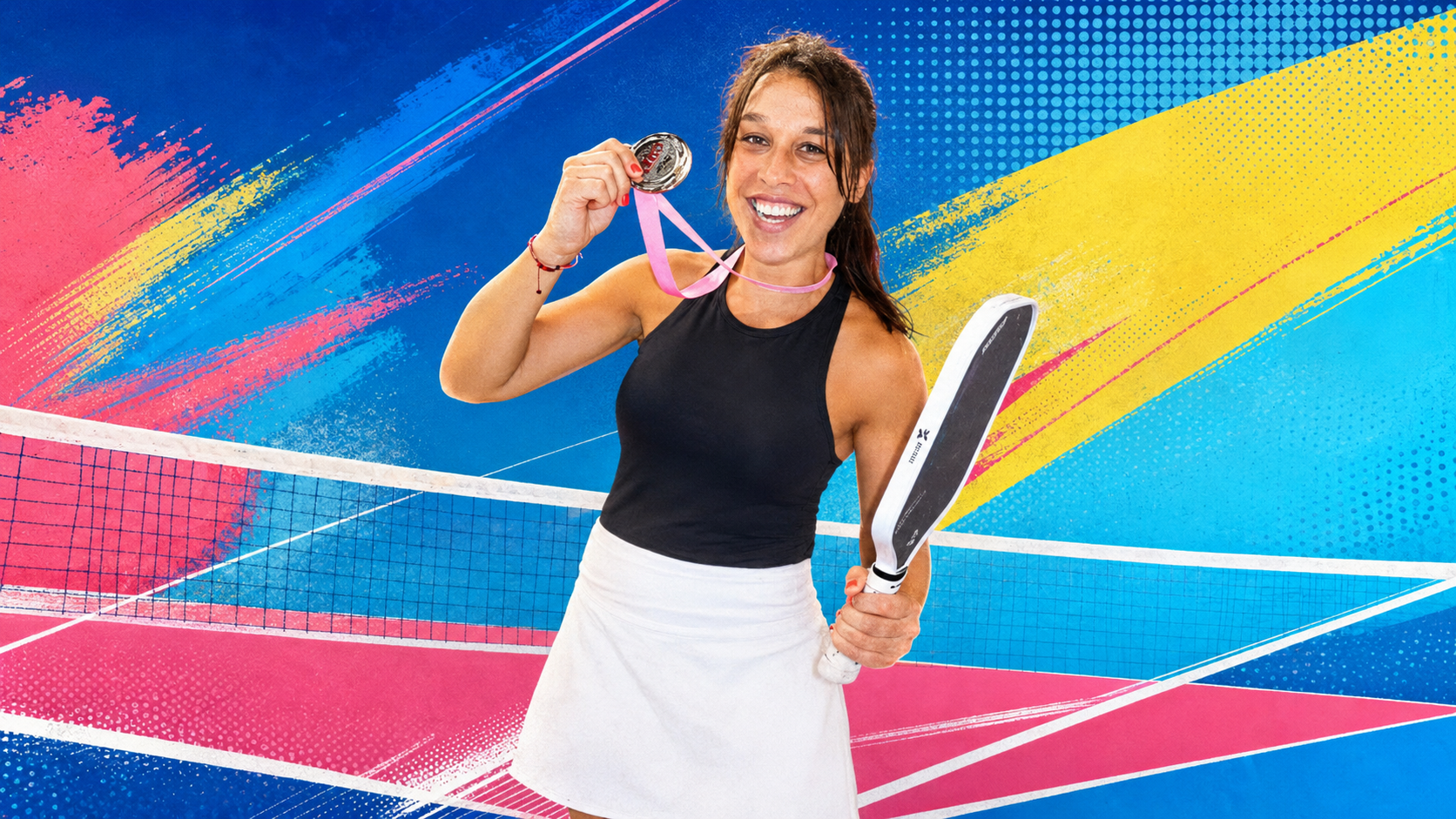
Former UFC champion Joanna Jędrzejczyk will bring a new audience to Warsaw, but Poland’s established pickleball players carry the serious medal expectations as competitors from 18 countries arrive for the WPC Polish Cup.
Key Takeaways
- Former UFC women’s strawweight champion Joanna Jędrzejczyk will compete at the Pickleball Polish Cup as she works towards a 5.0 DUPR rating.
- Karolina Owczarek, Mikołaj Biedermann and Bartosz Karbownik lead Poland’s medal challenge in Warsaw.
- The 2026 event brings together players from 18 countries, building on an inaugural WPC edition that attracted almost 100 competitors.
By Will Russell, WPM Academy WPC Correspondent
Joanna Jędrzejczyk spent years learning how to control distance inside an octagon. This weekend in Warsaw, the former UFC women’s strawweight champion will attempt to solve a different geometry.
Jędrzejczyk is among the entrants for the 2026 Pickleball Polish Cup, which takes place at Legia Tenis from 17–19 July. Her presence supplies the crossover attraction at Poland’s largest international pickleball tournament, but this is not being presented simply as a celebrity appearance.
She plays regularly, has already finished second at a local tournament and has set herself the personal target of reaching a 5.0 DUPR rating.
The transferable qualities are obvious. Jędrzejczyk built her fighting career on footwork, reactions, balance and an ability to recognise patterns at speed. Pickleball asks different questions of those attributes, particularly when touch, patience and shot selection become more important than physical intimidation, but her decision to compete gives the opening day an unusual point of interest.
Once the novelty recedes, however, the strongest Polish medal prospects lie elsewhere. Karolina Owczarek, Mikołaj Biedermann and Bartosz Karbownik arrive with established WPC records and the pressure that accompanies competing at home.
Around them sit family partnerships, returning names from recent WPC events and an international entry drawn from 18 countries.
Jędrzejczyk will attract attention. Poland’s leading pickleball players must decide what to do with it.
Owczarek Carries The Home Expectation
Karolina Owczarek enters the weekend with perhaps the clearest expectations of any Polish competitor.
She sits eighth in the WPC women’s 19+ 5.0 singles standings, carries a 5.518 doubles DUPR and has compiled 37 wins from 42 matches across the WPC European Open and WPC Masters in China. More importantly for the Warsaw audience, she has already demonstrated that she can win at this venue.
At the 2025 Polish Cup, Owczarek collected two gold medals: the mixed doubles title alongside Paweł Jankowiak and women’s doubles with Marta Zając.
Returning as a proven home champion changes the nature of the assignment. She is no longer arriving as somebody capable of making a run. She is one of the players others will measure themselves against.
Owczarek is entered across singles, doubles and mixed doubles, creating a possible route to a triple crown. That possibility brings opportunity and strain in equal measure. A deep run in three draws means repeated switches of partner, rhythm and tactical responsibility, with the physical demands accumulating across the weekend.
Home advantage can also be an unstable gift. Familiar courts and local support may help at important moments, but they remove the freedom of entering unnoticed. Owczarek will be expected to contend every time she steps on court.
Biedermann And Karbownik Lead The Men’s Challenge
Poland’s men’s field contains two players arriving from different positions.
Mikołaj Biedermann is ranked 12th in the WPC 19+ 5.0 singles standings and came close to a home title last year, finishing runner-up to Hungary’s Bálint Bakó. He did leave Warsaw with gold, partnering Jankowiak to win the men’s doubles, and returns with evidence that his game holds up under the conditions and expectations of the event.
For Biedermann, improvement can be measured simply. He was one victory short in singles in 2025; the challenge is to take the final step this time.
A strong weekend could also move him into the WPC top 10, but the greater prize would be establishing himself as the leading Polish performer in the men’s draw.
Bartosz Karbownik arrives with more immediate momentum. At the recent WPC Italian Open, he won gold in both men’s 19+ 5.0 singles and doubles. Tournament form does not transfer automatically across countries, surfaces and draws, but two titles at his most recent WPC appearance make him difficult to dismiss in Warsaw.
The contrast should sharpen the home challenge. Biedermann has unfinished business from last year’s Polish Cup; Karbownik arrives with the confidence of a player who has just completed a double elsewhere on the circuit.
Both will be expected to challenge, and each has a credible reason to believe this could be his weekend.
When Family Becomes A Competitive Advantage
The Polish Cup will also feature several partnerships built on something deeper than tournament convenience.
Michal Cicvak Sr and his 16-year-old son, Michal Cicvak Jr, are entered together in the men’s 19+ 5.0 doubles. Cicvak Sr, 43, organised WPC England in Leeds last month and reached the quarter-finals of its 19+ 5.0 singles competition. His son was born in Leeds and provides the Warsaw field with its British connection.
Their 27-year age difference makes the pairing one of the weekend’s most unusual. The intriguing part is not simply that a father and son will share the court, but how their different stages of development might complement one another.
The elder Cicvak brings experience and a detailed understanding of WPC competition; the younger player brings the speed and possibility of a game still changing quickly.
Both are also entered separately in singles, ensuring that the family story will contain an element of comparison as well as cooperation.
Polish sisters Klaudia and Agata Suchoka offer another established partnership in the women’s 19+ 5.0 doubles. Klaudia, ranked 80th in the WPC standings, is also entered in singles and has an opportunity to improve her position across the weekend.
In doubles, the sisters’ familiarity should reduce one of the format’s recurring problems: the need to establish communication and court ownership under tournament pressure.
Estonia’s Alar and Rasmus Ink add a second father-and-son combination to the men’s doubles. This will be their first WPC event, placing them at the opposite end of the experience scale from the Cicvaks.
Family familiarity guarantees neither clean tactics nor calm decision-making. It does, however, give these teams a shared language that newly assembled partnerships must develop in real time.
A Polish Event With A Wider Reach
Players from Italy, Spain, Hungary, Lithuania, Estonia, the United States and elsewhere will join the Polish contingent, with 18 countries represented across the entry list.
Several competitors have appeared at WPC England or the Italian Open during the past month, giving Warsaw a place within a busy run of European events rather than leaving it as an isolated national tournament.
The scale matters. Last year’s inaugural WPC Polish Cup attracted almost 100 players from 10 countries and staged close to 400 matches. Organisers reported nearly 3,000 spectators across the three days.
The 2026 edition returns with a €5,000 cash purse inside a wider prize pool valued at €12,000, as well as a field that reaches further beyond Poland.
Those figures do not, by themselves, prove that the WPC circuit has secured a permanent place in European pickleball. They do show that Warsaw is capable of attracting players, spectators and partners to an event that mixes high-level brackets with amateur competition.
That combination will be visible throughout the weekend. Jędrzejczyk represents the accessibility of a sport that can pull an elite athlete into a fresh competitive pursuit. Owczarek, Biedermann and Karbownik represent the other end of the proposition: players for whom WPC standings, medals and repeatable results already matter.
The former UFC champion may generate the largest burst of attention when play begins. By Sunday evening, the more revealing story will be whether Poland’s established contenders were able to convert home expectation into gold.
Further Reading
- Latest pickleball news from around the world
- Tournament coverage and results
- Rankings and player profiles
- Regional pickleball coverage

Will Russell
EditorWill Russell is a journalism student at the University of Central Lancashire (UCLan) and a contributor to the World Pickleball Magazine Academy. He is particularly interested in player development, emerging talent and the stories shaping pickleball's growth around the world.
View All Articles →