
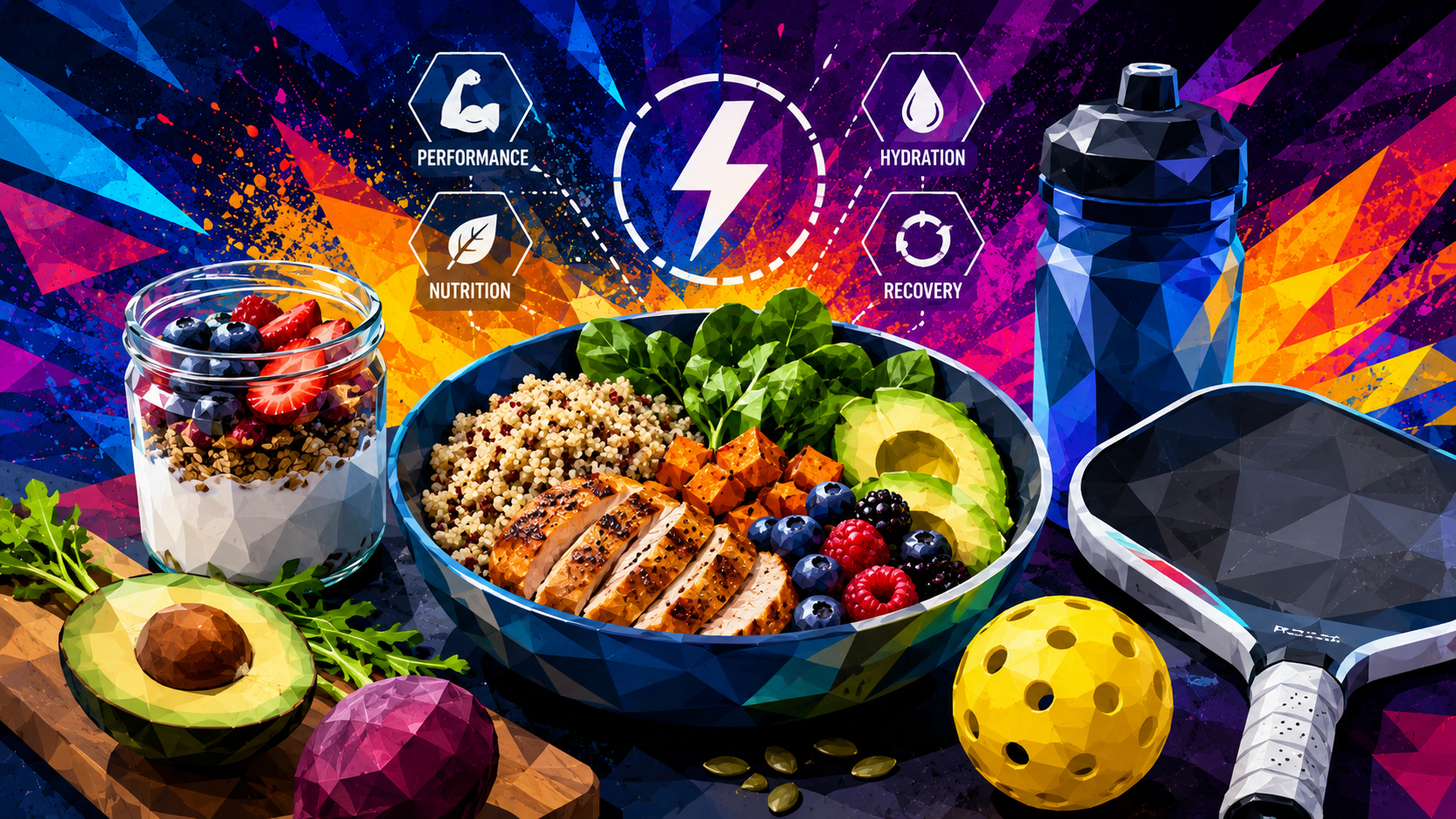
Walk around any pickleball tournament and you will see every approach to nutrition imaginable.
One player is surviving on coffee and determination. Another is carrying a cooler packed with carefully measured snacks. Someone else is grabbing a burger between matches and hoping for the best.
Yet the longer you spend around the sport, the more obvious something becomes.
The players who consistently perform well late in the day are rarely the players who make dramatic nutritional decisions on tournament morning.
More often, they are the players whose kitchens have been quietly doing the work all week.
That matters because pickleball places unique demands on the body.
A singles player may spend large periods operating at moderate-to-vigorous intensity while covering every inch of the court. A doubles specialist may not run as far, but they repeatedly perform explosive lateral movements, rapid accelerations, sudden decelerations and lightning-fast hand exchanges at the kitchen line.
Tournament days can stretch across six or more hours. Recovery windows can be unpredictable. Hydration can become a challenge. Glycogen stores gradually diminish. Mental sharpness begins to fade.
Then there is the reality that makes pickleball different from many other sports.
A huge proportion of the player base is over 50.
That means nutritional strategies must support not only performance, but also recovery, muscle preservation, bone health, cognitive function and long-term athletic longevity.
The good news is that none of this requires a complicated diet.
It starts with a kitchen built around four simple jobs.
The Four Jobs of the Performance Kitchen
Every meal a pickleball player eats should contribute to at least one of these goals.
Fuel
Carbohydrates remain the body’s preferred fuel source during high-intensity activity.
Whether you are chasing down a passing shot in singles or exchanging rapid volleys at the kitchen line, your body relies heavily on stored glycogen.
When glycogen levels fall, performance falls with them.
The first job of the performance kitchen is ensuring those fuel tanks remain topped up.
Hydrate
A surprisingly small amount of dehydration can affect reaction speed, concentration and decision-making.
In a sport measured in fractions of a second, that matters.
Hydration is not simply about drinking more water. It is about maintaining fluid balance and replacing electrolytes lost through sweat.
Repair
Every training session and every tournament creates microscopic muscle damage.
That is not a problem. It is how adaptation occurs.
The challenge is providing the body with the raw materials needed to rebuild stronger.
Protein plays the leading role here.
Protect
For many players, the objective is not simply to play well next weekend.
It is to keep playing well for the next twenty years.
That means supporting muscle mass, bone density, joint health, immune function and cognitive performance.
The performance kitchen is not just about winning medals. It is about extending athletic life.
If you're following how the global game is shifting week by week, the World Pickleball Report breaks this down every day in our morning briefing.
The Pickleball Plate
Before discussing individual meals, it helps to understand what an ideal plate looks like.
For most recreational and competitive players, every main meal should contain four components:
- A quality protein source
- A carbohydrate source
- Fruit or vegetables
- Healthy fats
The exact proportions change according to training load.
A player preparing for a major tournament may increase carbohydrate intake significantly. A player on a recovery day may reduce carbohydrates and focus more heavily on protein and vegetables.
The principle remains the same.
Build meals around real food.
Keep protein consistent.
Adjust carbohydrates according to activity.
Make hydration a daily habit rather than a tournament emergency.
Breakfasts That Set Up Better Pickleball
Breakfast is often the most neglected meal in the sport.
Many players either skip it entirely or rely on little more than caffeine.
That approach usually works until the third game.
Then the wheels come off.
High-Protein Overnight Oats
Rolled oats, whey protein, blueberries, almond milk and hemp seeds.
This is close to an ideal tournament breakfast.
The oats provide slow-releasing carbohydrates. The protein helps preserve muscle tissue. The berries contribute antioxidants.
Most importantly, the meal delivers steady energy rather than a rapid spike followed by an equally rapid crash.
Breakfast Burrito
Scrambled eggs, spinach, cheese and a flour tortilla.
Simple.
Portable.
Effective.
The combination of carbohydrates and protein provides a reliable source of fuel without sitting heavily in the stomach.
For players facing morning matches, it is one of the most practical options available.
Ben Johns’ Smoothie Approach
Professional pickleball’s most successful player is known for favouring nutrient-dense smoothies featuring protein powder, blueberries, peanut butter and oat milk.
It is easy to understand why.
The drink is calorie-dense, packed with nutrients and easy to consume even when nerves make solid food less appealing.
Avocado and Egg Sourdough Toast
A strong recovery breakfast.
Eggs provide complete protein. Avocado contributes healthy fats. Sourdough delivers carbohydrates to begin replenishing depleted glycogen stores.
After a demanding tournament weekend, few breakfasts offer a better combination of recovery nutrients.
Lunches Built for Long Days
Lunch often becomes the forgotten meal at tournaments.
Players either overeat and feel sluggish or undereat and run out of energy.
The solution lies somewhere in the middle.
Turkey Wrap and Pretzels
This might be the most practical tournament lunch in pickleball.
Turkey provides lean protein.
The wrap delivers carbohydrates.
The pretzels contribute sodium and rapidly digested fuel.
Nothing fancy.
Just effective.
Grilled Chicken and Sweet Potato Bowl
The classic athlete’s lunch.
Chicken provides protein.
Sweet potatoes provide sustained energy.
Broccoli and olive oil round out the nutritional profile.
This is an excellent choice three hours before a training session.
Quinoa and Black Bean Salad
For players looking for a plant-based option, this combination offers sustained energy and a substantial nutrient load.
It is especially useful during training blocks when overall dietary quality matters as much as immediate performance.
Tuna and Arugula Bowl
Ideal on lighter training days.
High in protein.
Rich in omega-3 fats.
Lower in carbohydrates.
A meal designed more for recovery than fuel.
Recovery Dinners That Earn Tomorrow’s Performance
One of the biggest nutritional mistakes in pickleball is believing recovery begins the following morning.
Recovery begins at dinner.
Salmon and Rice
Few meals tick more boxes.
Protein.
Omega-3 fats.
Carbohydrates.
Micronutrients.
Easy digestion.
This should appear regularly in the rotation of any serious player.
Turkey Meatballs and Lentil Pasta
An outstanding option for older athletes.
Turkey provides high-quality protein.
Lentil pasta contributes both carbohydrates and additional protein.
The result is a meal that supports recovery while helping maintain lean muscle mass.
Chicken, Rice and Beans
Simple.
Affordable.
Highly effective.
This combination has fuelled athletes across countless sports because it works.
Teriyaki Tofu and Rice Bowl
For plant-based players, this provides an excellent balance of protein and carbohydrates while remaining relatively easy to digest.
It is particularly useful the evening before competition.
The Twenty Meals Every Pickleball Player Should Know
Every player does not need all twenty.
Most players only need six or seven reliable options.
Still, these meals deserve a place in every pickleball kitchen.
Breakfasts
- Ben Johns Breakfast Smoothie
- High-Protein Overnight Oats
- Sourdough Avocado and Egg Toast
- Five-Minute Breakfast Burrito
- Cottage Cheese and Tomato Toast
Lunches
- Turkey Wrap with Pretzels
- Tuna Arugula Bowl
- Chicken and Sweet Potato Bowl
- Quinoa and Black Bean Salad
- Chicken Rice Bowl
Dinners
- Teriyaki Salmon and Rice
- Turkey Meatballs with Lentil Pasta
- Salsa Shredded Chicken and Rice
- Teriyaki Tofu Rice Bowl
- Turkey Burger and Salad
Snacks and Recovery Options
- Berry Greek Yogurt Parfait
- Mediterranean Snack Plate
- Turkey Jerky, Grapes and Almonds
- Berry Beet Recovery Smoothie
- Whole-Grain Crackers with Smoked Salmon
Collectively, these meals provide solutions for almost every nutritional challenge a pickleball player will face.
Training.
Tournament preparation.
Recovery.
Travel.
Longevity.
The Tournament Nutrition Timeline
Most tournament mistakes happen because players think about food too late.
The process should begin the evening before.
The Night Before
Focus on carbohydrates.
Rice.
Pasta.
Potatoes.
Lean protein.
Adequate sodium.
Good hydration.
The goal is simple.
Arrive at the venue with full glycogen stores and a well-hydrated body.
Three Hours Before Play
This is the main pre-match meal.
Oatmeal with banana.
Eggs and toast.
A breakfast burrito.
A bowl of overnight oats.
Keep it familiar.
Avoid experimentation.
Sixty Minutes Before Play
Think top-up rather than feast.
A banana.
A few dates.
An applesauce pouch.
A small sports chew.
The objective is simply to provide a final carbohydrate boost.
Between Matches
This is where many tournaments are won and lost.
For short breaks, focus on quick carbohydrates.
For longer breaks, add some protein.
The key is consistency.
Do not wait until fatigue arrives.
After Play
The body is primed for recovery.
Protein and carbohydrates should arrive quickly.
A recovery smoothie.
Chocolate milk.
Greek yogurt and fruit.
Then follow that with a balanced meal within a couple of hours.
The Rules for Players Over 50
The older athlete cannot eat exactly like a twenty-year-old and expect identical results.
The physiology changes.
Muscle protein synthesis becomes less responsive.
Recovery takes longer.
Bone density becomes more important.
Hydration becomes more critical.
The solution is not complicated.
Prioritise Protein
Most active pickleball players over 50 should pay far more attention to protein than they currently do.
Rather than consuming most protein at dinner, spread intake throughout the day.
Aim for meaningful servings at breakfast, lunch and dinner.
Respect Recovery
You can no longer ignore nutrition after a hard session and expect the body to bounce back effortlessly.
The players who recover best often continue improving longest.
Embrace Strength-Friendly Nutrition
Meals rich in protein, omega-3 fats, calcium and vitamin D help support long-term athletic function.
Do Not Train Empty
Many older players still believe fasted exercise is beneficial.
For high-intensity pickleball, the evidence increasingly points in another direction.
A small amount of protein and carbohydrate before play is usually a far better option.
Five Things to Stop Doing Immediately
Stop Relying on Coffee as Breakfast
Caffeine is not fuel.
Stop Waiting Until You Feel Thirsty
By then, performance may already be declining.
Stop Treating Tournament Nutrition as an Afterthought
Tournament nutrition starts the day before.
Stop Skipping Recovery Meals
Recovery delayed is often recovery reduced.
Stop Looking for Magic Supplements
Most players will see bigger gains from improving breakfast than from buying another supplement.
The Real Edge
Pickleball players often search for the latest paddle, the newest training drill or the next tactical breakthrough.
Those things matter.
But there is a quieter advantage available to everyone.
It sits in the fridge.
It waits in the pantry.
It appears on the dinner table every evening.
The players who consistently arrive at tournaments well fuelled, properly hydrated and fully recovered give themselves a head start before a ball has even been struck.
That does not require perfection.
It does not require weighing every gram of food.
It simply requires building a kitchen that supports the sport you love.
Because the truth is surprisingly simple.
The best pickleball performance programme in the world starts long before you step onto the court.
It starts with what is on your plate.
Further Reading
- Latest pickleball news from around the world
- Tournament coverage and results
- Rankings and player profiles
- Regional pickleball coverage
Did you enjoy this June magazine article? You can download the whole issue to read at your own leisure here.

Chris Beaumont
Founder and Editor-in-ChiefChris Beaumont is the founder and Editor-in-Chief of World Pickleball Magazine. Chris follows the global game closely, reporting on the latest news, developments, stories and tournaments from all five continents. He also hosts the World Pickleball Podcast, interviewing people at…
View All Articles →