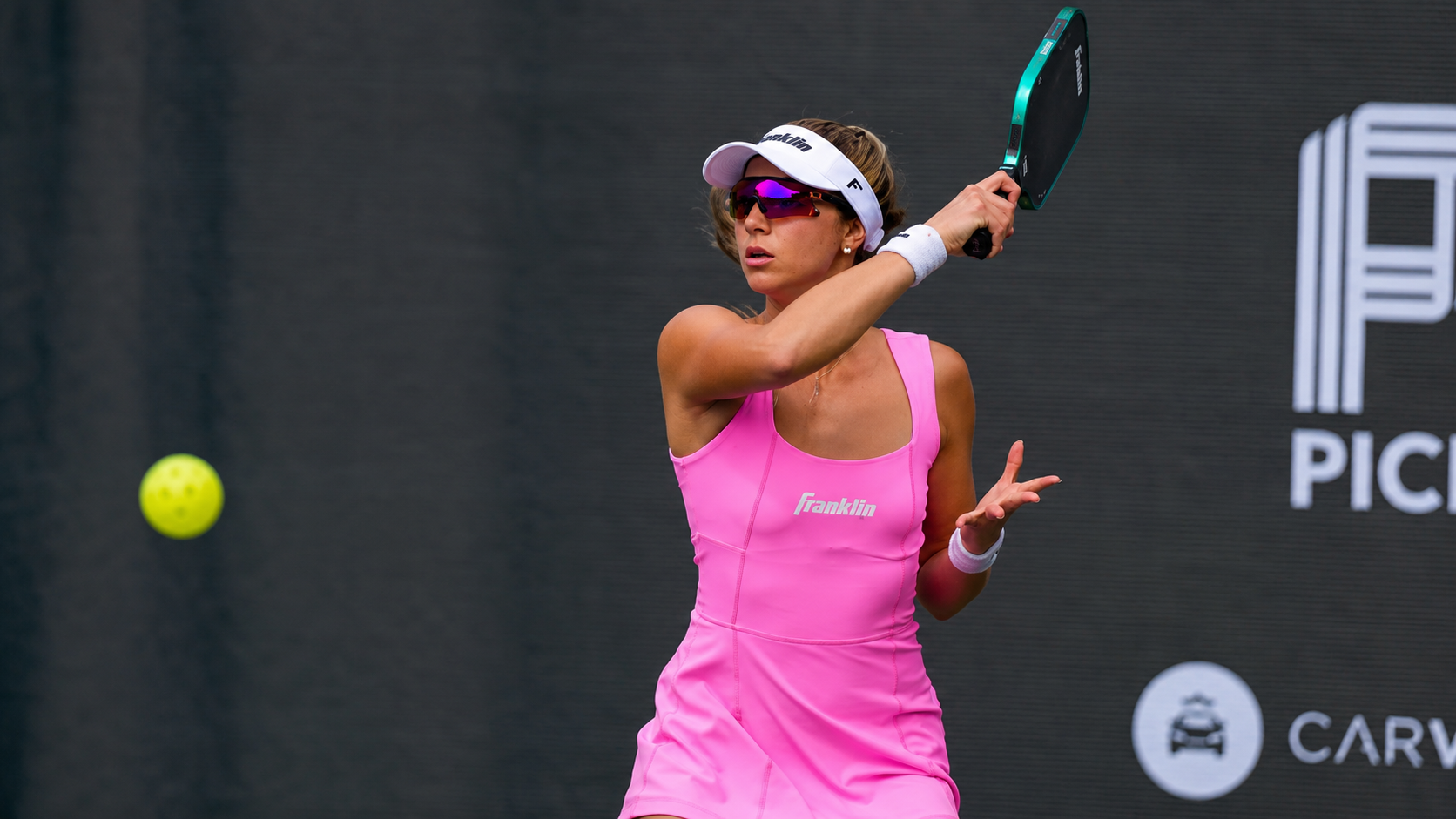
Sofia Sewing arrives at the PPA National Championships as the No. 46 seed in women’s singles after a season spent winning elsewhere. Ben Johns sits at No. 24 in the men’s draw and opens against Tyson McGuffin. Both numbers are defensible. Neither necessarily tells Cary how dangerous the player attached to it will be.
Key Takeaways
- Sofia Sewing starts the PPA National Championships as the No. 46 women’s singles seed despite winning major APP titles and spending the summer competing at Premier-level MLP.
- Ben Johns is seeded No. 24 in men’s singles and faces No. 39 Tyson McGuffin in the Round of 64, a match-up that once belonged much deeper in major draws.
- Cary exposes the difference between a tour ranking and current competitive strength, particularly when elite players move between PPA, APP and MLP.
Sofia Sewing is the No. 46 seed in women’s singles at the Veolia Pickleball National Championships in Cary.
The number makes sense if the question is how much recent PPA singles Sewing has played. She has spent most of her competitive time elsewhere and arrives without the PPA points accumulated by the players above her.
Ask a different question, though, and 46 becomes considerably harder to reconcile.
How good is Sofia Sewing right now?
Her 2026 season has provided plenty of evidence.
Sewing won all three professional divisions at the APP Kuala Lumpur Open in February. She followed that with women’s doubles and mixed doubles gold in Japan while reaching another singles final, then completed another triple crown at the APP Sacramento Open.
The APP’s own results list Sewing as the Sacramento women’s singles champion, alongside her women’s doubles and mixed doubles victories.
She has also spent the summer playing Major League Pickleball for the Palm Beach Royals, the expansion franchise that made Sewing one of the first pieces of its 2026 roster.
Her PPA seed accurately describes one thing.
Her recent PPA history.
Cary is about to discover how accurately it describes the player.
Sewing Has Spent The Year Proving Her Level
There is no need to turn Sewing into an unknown quantity simply because much of her evidence has been gathered outside the PPA Tour.
Her singles game is established.
The tennis background remains visible in the way she covers the court. Sewing can accelerate through the forehand without needing a perfect ball, takes time away when an opponent leaves the return short and has enough speed behind the baseline to turn defence back into a neutral exchange.
Her 2025 APP season had already established the foundation. She led all APP Tour women with 13 gold medals, eight of them in singles, before carrying that form into 2026.
Kuala Lumpur showed how difficult she can be to remove once a match changes shape.
Against Katerina Stewart in the women’s singles final, Sewing lost the opening game 11-1.
She adjusted.
The second went 11-6. Sewing then took the decider 11-9, completing the comeback and one part of a three-title weekend.
Sacramento produced another singles title in April, alongside women’s doubles and mixed doubles gold.
The results do not convert into PPA ranking points.
They remain evidence of competitive level.
MLP Added Another Measuring Stick
Sewing’s move into Major League Pickleball made the picture more complicated.
The Palm Beach Royals acquired her ahead of their expansion season, giving Sewing regular access to Premier-level opposition after much of her recent résumé had been constructed on the APP circuit.
That does not turn MLP into a substitute for PPA singles.
DreamBreakers are different. Players rotate after four rallies, coaches can influence match-ups and nobody has to solve the same opponent over an entire game. Rhythm, endurance and tactical adaptation work differently.
But the format still exposes certain qualities quickly.
There is nowhere to hide movement. Returns have to hold up. Passing lanes open. A player must defend the entire width of the court and create enough pressure from the baseline to stop an opponent walking forwards through the point.
Sewing’s broader MLP season reinforced what her APP results had already suggested. Her level had moved far beyond what a player starting in the 40s might normally imply.
That assessment is not ours alone. In its own Cary preview, the PPA singled Sewing out as a dangerous No. 46 seed expected to climb rapidly.
The ranking is therefore not being exposed as incorrect.
It is being exposed as backward-looking.
Cary Is Catching Sewing Between Systems
That distinction matters.
A tour cannot simply seed somebody fifth because recent performances elsewhere suggest she might be the fifth-best player in the field. Once subjective assessment starts overriding published ranking rules, the draw loses consistency.
So Sewing starts at 46.
The consequence belongs to everybody around her.
A seed is supposed to separate the strongest competitors through the early rounds, reward accumulated performance and increase the likelihood that the best players meet later.
When current level and accumulated points drift apart, that protection becomes less reliable.
Sewing is the clearest example in Cary.
She is not the only one.
Ben Johns Arrives From The Other Direction
Ben Johns is the No. 24 seed in men’s singles.
Unlike Sewing, nobody needs an introduction to his PPA history.
For years Johns set the standard in men’s singles. His ability to control the kitchen line mattered in doubles, but the singles court exposed the broader game that made him so difficult to dislodge: return depth, anticipation, disciplined movement and a willingness to attack short balls without forcing the point too early.
The division around him has changed.
Chris Haworth enters Cary as the No. 1 seed. Federico Staksrud is No. 2, Hunter Johnson No. 3 and Christian Alshon No. 4. A deeper generation of singles specialists has accumulated points while Johns has reduced his singles schedule.
Rankings respond to participation.
Reputation does not disappear at the same speed.
So the player who once spent tournament after tournament at the very top of the bracket begins Cary at No. 24.
His reward is Tyson McGuffin.
Johns v McGuffin In The Round Of 64
McGuffin is seeded No. 39.
The pair meet immediately in the Round of 64.
Not long ago, Johns against McGuffin belonged on a Championship Sunday rather than the opening day of a major draw.
That is what ranking lag looks like when it stops being abstract.
The numbers have perfectly understandable explanations. Johns has played less singles. McGuffin is no longer positioned where he once was in the hierarchy. Neither receives protection based on reputation.
Once the match starts, those explanations cease to matter.
The PPA itself described the contest as a Round-of-64 match-up that had once been a regular final.
Johns has also supplied recent proof that his singles threat has not disappeared. His three-game Atlanta final against Connor Garnett showed a player still capable of making elite singles opponents solve difficult physical and tactical problems deep into a match.
No. 24 may describe his current place in the points structure.
It does not make him a normal No. 24 seed.
Cary Makes The Distortion More Important
At an ordinary tournament, an awkward seed can produce an entertaining early match.
The Veolia Pickleball National Championships carries considerably more consequence.
The event is the first Major of the PPA’s new 2026-27 season and carries 2,000 ranking points for each divisional champion. More than 1,400 players are entered, every No. 1 seed is present and the PPA lists a total payout of $1,648,641 across the five professional divisions, including appearance fees.
The professional draw is progressive, with one round played each day through Championship Sunday.
Lose once and the run is over.
That makes an unexpectedly dangerous early opponent more than an inconvenience.
It can change an entire section of the draw.
If Sewing performs like a conventional No. 46 seed, there is no story.
If she starts removing established players, every round provides another measure of the distance between her ranking and her current level.
Johns offers the same test from another point in a career.
The Rankings Are Not Broken
That distinction deserves protecting.
Nothing about Sewing or Johns proves that the PPA ranking system is broken.
Rankings have rules. Players earn points through the competitions those rules recognise. Results age, participation changes and positions move accordingly.
The alternative would be worse.
A committee deciding that Johns still feels like a top-eight player, or that Sewing’s APP results make her deserving of a particular PPA seed, would replace a transparent system with judgement calls.
What Cary exposes is the difference between ranking and current competitive strength.
Usually they track one another closely.
They do not have to.
Pickleball makes the gap unusually visible because leading players now operate across PPA, APP, MLP and increasingly significant international competition. Results are produced in different formats and recognised by different ranking systems.
Players can move faster than one table records them.
A Smaller Experiment In Doubles
Cary also contains one partnership worth watching for a different reason.
Pablo Tellez and Max Freeman are both left-handed.
A conventional right-left partnership can put two forehands through the middle, allowing either player to attack a ball entering the seam. With two left-handers, that geometry changes.
The middle naturally becomes a backhand space unless one player crosses further than usual.
That does not make the partnership unworkable. It does mean the responsibilities need to be unusually clear.
Opponents will test the seam, ask who owns balls through the middle and try to establish whether either player can create enough pressure from the outside to stop that pattern becoming predictable.
The useful evidence begins once they play.
Cary Will Tell Us What The Numbers Missed
Tournament seeds are backward-looking by design.
Cary is interesting because several players have changed faster than the numbers beside their names.
Johns remains capable of making No. 24 deeply uncomfortable for anybody above him. His reduced singles schedule explains why he starts there.
Sewing is the more extreme case.
She has spent 2026 winning singles matches, collecting titles across disciplines and testing herself against Premier-level competition in Major League Pickleball.
The PPA draw has her 46th.
That number is legitimate because it answers a specific question: what has Sofia Sewing accumulated within the ranking system that produced this draw?
Cary is about to answer a different one.
How good is she now?
Further Reading
- Latest pickleball news from around the world
- Tournament coverage and results
- Rankings and player profiles
- Regional pickleball coverage

Chris Beaumont
Founder and Editor-in-ChiefChris Beaumont is the founder and Editor-in-Chief of World Pickleball Magazine. Chris follows the global game closely, reporting on the latest news, developments, stories and tournaments from all five continents. He also hosts the World Pickleball Podcast, interviewing people at…
View All Articles →